Cézanne's Auvers: A Study of Planes
Walking through Paul Cézanne's panoramic village, 1873–75
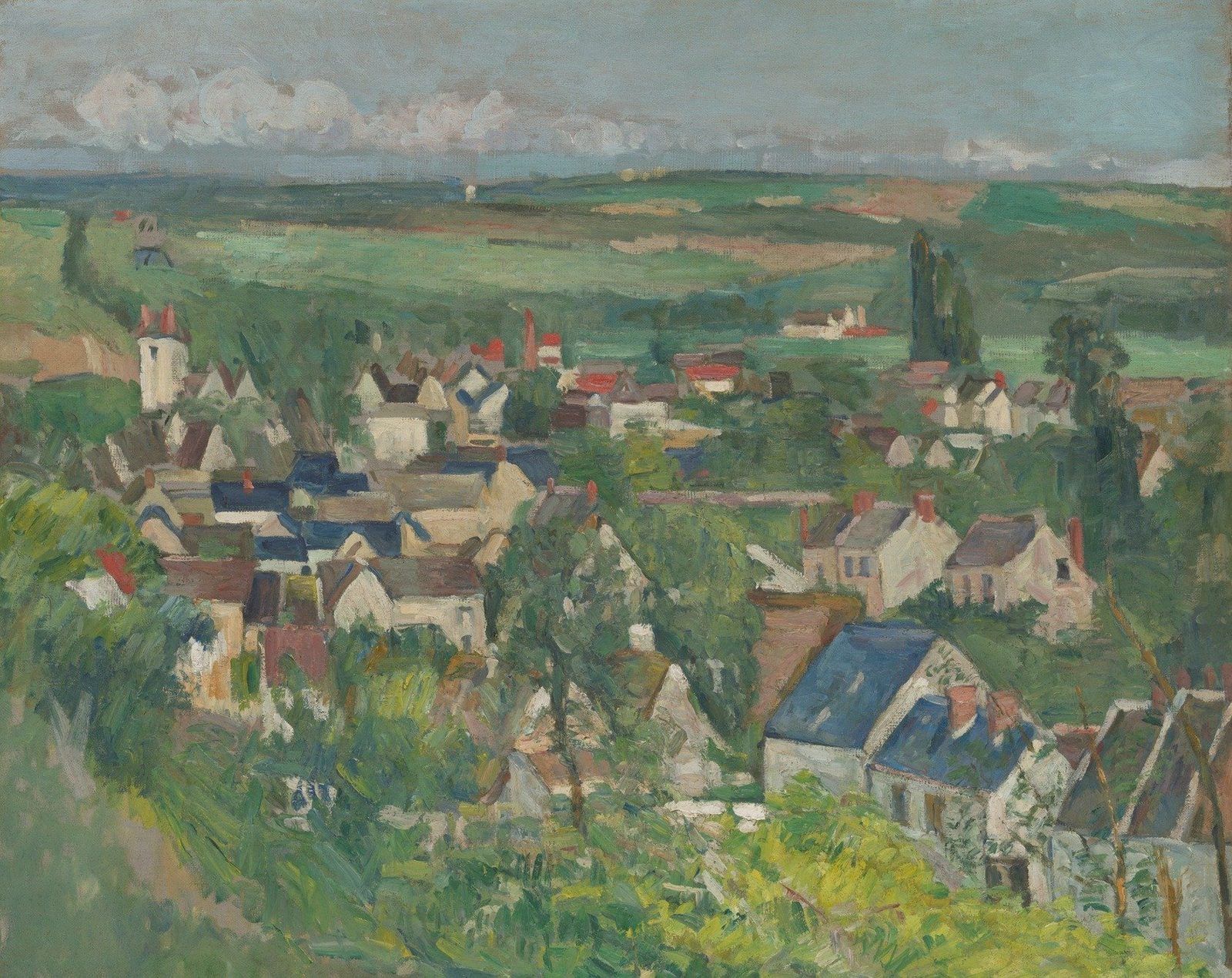
- Artist
- Paul Cezanne
- Title
- Auvers, Panoramic View
- Date
- 1873–75
- Medium
- Oil on canvas
- Museum
- Art Institute of Chicago
- Image
- Public domain (CC0)
Open in Simple Art
Watch this story on iPhone and iPad, with offline downloads and a painting every day.
About 6 minutes of looking, in 11 parts.
A panoramic view from above
Above a small French village, the world drops away into soft green and grey. We're looking at Auvers, Panoramic View — Cézanne painted this looking down from a hill, and he turned the whole valley into a study of stacked planes. Stay with me as the camera moves across the canvas.
Cézanne, 1873–75
Paul Cézanne made this between 1873 and 1875 in oil on canvas, the years when he was pushing past Impressionism toward something more structured. The brushwork you see here is constructive — he built the landscape in patches, not in blended washes. That's the frame for everything we'll look at next.
Layered horizontal bands
Before we zoom in, take in the whole composition. Cézanne organizes the canvas as a series of horizontal bands — sky across the top, then distant fields, the cluster of houses in the middle, and darker vegetation in the foreground. The horizon sits low in the frame, around one-fifth of the way down, giving most of the picture to land.
Soft overcast daylight
The light is soft and diffuse — an overcast midday, with no strong cast shadows. Because the illumination is even, Cézanne has to use temperature and value shifts to describe form rather than relying on raking shadows. Notice how the brightest values are reserved for the cream walls of the houses and the cumulus clouds, while the deepest notes sit in the dark tree masses at the right edge.
Warm red accents
Now let the camera settle into the village. Watch how the saturated red-orange roofs act as warm accents against the cool green surroundings. That complementary tension pushes the mid-ground forward in space. Cézanne laid the reds in as fairly flat planes — no modelling — so they read almost like flags signaling the eye across an otherwise horizontal composition.
Central village cluster
Now we're on the central village cluster, the focal point of the whole painting. Look closely: cream and ivory walls sit directly next to deep blue and terracotta rooftops, and the edges between buildings are defined by shifts in value, not by drawn lines. Each plane is a discrete patch of paint — vertical strokes on the walls, more horizontal across the roofs — and where two cream walls meet, a thin slip of darker roof or shadow does the separating work.
Constructive foliage strokes
Down here in the foreground foliage, the brushwork gets dense and physical. Cézanne worked in two crossing diagonals — short, loaded marks running upper-left to lower-right crossed by lower-left to upper-right — and let adjacent strokes of contrasting green sit side by side rather than blending them. The volume of the bushes emerges optically in your eye, not on the brush; lighter yellow-greens ride on the upper planes, cooler darker greens tuck into the pockets.
Horizontal plane construction
Now lift your gaze to the distant plain. Look how Cézanne stacks the land into horizontal strata of green — deep teal-green near the horizon, mid yellow-greens in the middle, lighter sage tones closer. A few warm ochre and rust accents interrupt the green like punctuation marks. The edges between bands are softly blurred wet-into-wet; there are no outlines anywhere, and form is carried by the meeting edge itself.
Softened architectural edges
Back to the houses — notice how their silhouettes dissolve into the trees. The right edge of a cream wall isn't a hard line; it's a series of alternating short strokes of wall color and foliage color meeting shoulder-to-shoulder, with a transitional half-tone — a muted pink or ochre — bridging the two. The chimney reds are laid in with thick, roughly parallel strokes that stand forward, while everything around them softens into the leaves.
Stroke direction follows plane
On this blue roof, look at the brushstroke direction — long diagonal sweeps that follow the slope of the plane. That's deliberate: when the direction of the brush matches the geometry of what you're painting, a flat area of color gains volume and structure without changing hue. The muted steel-blue also echoes the sky above, creating a quiet color harmony between architecture and atmosphere.
The brightest wall
And here is the brightest value in the entire composition — this cream wall of the central house. Even on an overcast day, Cézanne doesn't paint it as a single flat value. The lit side is warm cream and ivory, while the turning edge on the right shifts to noticeably cooler pink and lavender. That small temperature change does the work a hard cast shadow would do in raking light; below it, the red roof and dark blue-green foliage press up against the wall in a sharp pasted-on boundary.
Look closer
8 details, each checked against a close-up of the picture.
-
Central Village Cluster
The cluster consists of cream-colored walls contrasted against a mix of blue and red roofs.
The crop shows a tightly packed cluster of village houses with cream and ivory walls, accented by rooftops in deep blue, terracotta red, and slate gray-green. Edges between buildings are defined primarily by shifts in value and hue rather than hard contour lines, so adjacent cream walls often meet through a thin slip of darker roof or shadow. Brushstrokes are short, blocky, and directional—vertical and diagonal on the walls, more horizontal across the roof planes—creating a mosaic-like surface. Two small red chimneys rise from a roof in the middle of the cluster, providing warm accents amid the neutral architecture. Foliage at the lower right is rendered in layered greens with broken, dappled marks that contrast with the flatter wall planes.
-
Foreground Foliage
Short, diagonal, multi-tonal green and yellow strokes build the volume of the bushes.
The crop is filled with dense, impasto-loaded brushstrokes layered across the surface, most clearly seen as short, diagonal marks running roughly from upper-left to lower-right and lower-left to upper-right. The palette is dominated by a range of greens — deep blue-green shadows (roughly 0.15–0.35 luma), saturated mid-greens for body, and pale yellow-greens for highlights — with small accents of warm ochre and pale cream catching the diffuse upper-left light. Edges between strokes are left soft and broken rather than blended, so adjacent strokes of contrasting value and hue sit side by side and create optical volume. Lighter strokes are placed on the upper faces of the foliage masses while darker greens recede into the lower and recessed pockets, producing a faceted, almost sculptural form. In the upper portion, looser, longer strokes lean toward warmer cream tones where the bushes meet the lighter background, while the lower half is built from tighter, more parallel marks that tighten the silhouette.
-
Distant Plain Planes
The landscape is divided into horizontal bands of varying shades of green and ochre.
The crop isolates a middle-to-lower section of the landscape where horizontal bands of green dominate, stacked in roughly parallel strata from a deeper teal-green at top through mid yellow-greens to lighter sage tones below. Soft ochre and pale yellow passages sit as warm interruptions in the green, while a rust-pink shape intrudes from the upper right and pale near-white touches appear upper left. Edges between bands are wet-into-wet and softly blurred rather than sharply delineated, with individual brushstrokes reading as broad, slightly diagonal sweeps that tilt gently from upper left to lower right. Canvas weave is visible through thinner passages, and the paint sits in low to moderate relief.
-
Red Roof Accents
The red roofs are applied as flat, saturated blocks of color against green surroundings.
The crop is a narrow vertical slice dominated by dense, vertically brushed green foliage that fills the upper two-thirds and recedes behind a cluster of red-orange roof planes. The red shapes are read as roofs: a tall slim wedge on the left, a broader slanted trapezoid in the center, and a wider red block at the lower right, all painted with relatively uniform saturation rather than modelled gradations. Where red meets green, the edges are soft and slightly broken, with thin transitional strokes of warmer brown-cream along the lower rooflines suggesting wall faces catching diffuse light. Cream and pale ochre strokes below the roofs read as sunlit walls, while a small dark green vertical near the lower center acts as a tree trunk that overlaps the architecture.
-
House Silhouettes
The edges of the houses are softened and bleed into the surrounding greenery.
The crop centers on two peaked-roof houses flanked by dense green foliage, with two terracotta-red chimneys rising from the central cream-pink structure. Where the pale walls meet the surrounding trees, the contour is not a single crisp line but a series of short, broken strokes: cream tints sit directly beside green strokes, and a few pink and ochre notes are dragged into the leaves. The roof slopes are built from angled patches of grey, blue-grey, and muted green that echo the sky and foliage rather than reading as a hard silhouette. The lower edge dissolves into dark navy and blue-green strokes that suggest either a foreground roof or shadowed terrain rather than a drawn boundary.
-
Brightest Wall
The white wall of the central building uses a pale cream highlight with minimal shadow.
The central wall is a roughly triangular mass of pale cream and ivory (#E8DCC0 / #EDE0C8) interrupted by visible cool-pink and lavender shadow notes along its right edge and lower slope (#D2B8B0, #B8A4A0). A small red-orange roof or chimney sits at the top of the wall (#B84A3C), and a darker blue-green plane presses against its right side (#2A3848), forming a hard meeting edge. Below, scumbled olive and forest-green strokes (#5A6B3A, #3E4A28) suggest foliage. The wall is not a single flat value: a soft cool-warm gradient runs diagonally from upper-left bright to lower-right cooler pink-grey, and individual strokes are clearly visible at the edges where the cream meets the blue-green roof.
-
Blue Roofs
The roofs use a muted steel-blue tone that echoes the color of the sky.
The crop centers on a large, angled roof plane rendered in a muted steel-blue, with a secondary smaller blue roof in the lower right. Brushstrokes are clearly constructive, laid in long diagonal sweeps that follow the roof's slope, with lighter cream-yellow passages breaking up the blue mass and suggesting reflective breaks or paper/ground showing through. A warm terracotta-pink wall rises on the left and a pale cream wall on the right carries a small red-orange flowerpot, while olive-green foliage masses sit at the upper edges. Edges between the blue roofs and adjacent walls are defined by abrupt value and temperature shifts rather than drawn outlines, giving each plane a distinct, faceted read.
-
Right-side Cluster
Houses on the right are painted with darker tones and more vertical strokes.
The crop reveals a dense cluster of building forms on the right, rendered with deep teal, muted violet, and reddish-brown passages outlined by pale, near-white faceted edges. A bright ochre-orange diagonal stroke runs from upper-center down through the cluster, reading as either a roof ridge or a tree branch crossing the plane. The surrounding fields are built from layered green planes—olive, sap, and grey-green—laid in short, blocky strokes that butt against the darker architectural mass. Edges between house and landscape are softened where the white dabs of the rooftops sit against the greens, while the right margin shows a near-vertical strip of dark pigment cut by a single bright vertical highlight.
Auvers, Panoramic View in context
Three kilometres from Pissarro
Cezanne arrived in Auvers-sur-Oise, a village near Pontoise about thirty kilometres from Paris, in September 1872, stayed until early 1874 and returned for shorter visits until 1881 [2]. Camille Pissarro, who had settled in Pontoise in April 1872, wrote on 3 September that, if he stayed, Cezanne would astonish the artists who had been too quick to condemn him [2]. Pissarro's son Lucien later recalled Cezanne walking the three kilometres to work beside his father every day, and the two experimenting together, at one point with palette knives sent from Paris [2].
The doctor's attic
The painting's first owner was Dr Paul-Ferdinand Gachet, who bought a property in Auvers in April 1872 [2]. A physician and amateur painter, he's best remembered today for treating Vincent van Gogh in Auvers in 1890 [3]. He was already Pissarro's doctor and let both painters use the etching press in his attic studio, and Cezanne, living on the same street with Hortense Fiquet and their infant son, painted there too [2]. Gachet's son, Paul-Louis, later made a watercolour copy of this picture and described its view in detail in a typescript catalogue of his father's collection in 1928 [2].
A motif, not a view
The title isn't Cezanne's. Paul-Louis Gachet listed the picture as Panorama (Auvers), and it was first shown under something close to its present name in Paris in 1912 [2]. Paul Smith argues that Cezanne avoided the guidebook sights visible from this hillside, including the church later painted by Van Gogh, and chose a spot above a path used by farm workers [2]. Comparing a pencil sketch of the scene in Basel, Smith suggests that Cezanne moved closer and gave up a conventional panorama for a more intimate view [2]. The House of the Hanged Man, the subject of a painting Cezanne showed at the first Impressionist exhibition in 1874, appears among the houses at the front left [2].
Seeing in patches
Smith links the lack of sharp detail to a habit Cezanne seems to have taken up at this time, looking at a scene through half-closed eyes, which Lucien Pissarro described in a letter of 1912 [2]. Late in life Cezanne told the poet Joachim Gasquet that he saw in patches [2]. A peasant from Auvers, quoted by the critic Gustave Coquiot, is said to have mimed the difference between the two painters: Pissarro pricked at the canvas, Cezanne dabbed [2]. Lucien also recalled that the knives were soon given up for divided strokes, which the catalogue uses to place this picture after the knife-painted House of the Hanged Man [2].
From Gachet to the Coburn bequest
Gachet's son sold the painting before 1912, and it passed to Ambroise Vollard, who lent it to an exhibition in Paris that year [1]. It then belonged to Alfred Strölin, at whose sale at the Hôtel Drouot on 7 July 1921 it was lot 7 and, according to sale reports cited by the museum, fetched 65,500 francs [1]. After the dealers Hector Brame and Durand-Ruel, it entered the collection of Annie S. Coburn of Chicago, who bequeathed it to the Art Institute in 1932 [1][2].
- Paul Cezanne, Auvers, Panoramic View, 1933.422: object record, provenance and exhibition history . Art Institute of Chicago (public API)
- Cat. 1, Auvers, Panoramic View, 1873-75: entry by Paul Smith, technical report by Kim Muir with Giovanni Verri, in Cezanne Paintings and Watercolors at the Art Institute of Chicago (2026) . Art Institute of Chicago
- Paul Gachet . Wikipedia