Ballet Dancers by Henri de Toulouse-Lautrec: A Walkthrough in Strokes
1885–86, oil on plaster transferred to canvas — a study in economy
- Artist
- Henri de Toulouse-Lautrec
- Title
- Ballet Dancers
- Date
- 1885–86
- Medium
- Oil on plaster, transferred to canvas
- Museum
- Art Institute of Chicago
- Image
- Public domain (CC0)
Open in Simple Art
Watch this story on iPhone and iPad, with offline downloads and a painting every day.
About 5 minutes of looking, in 11 parts.
Barely declared, immediately alive
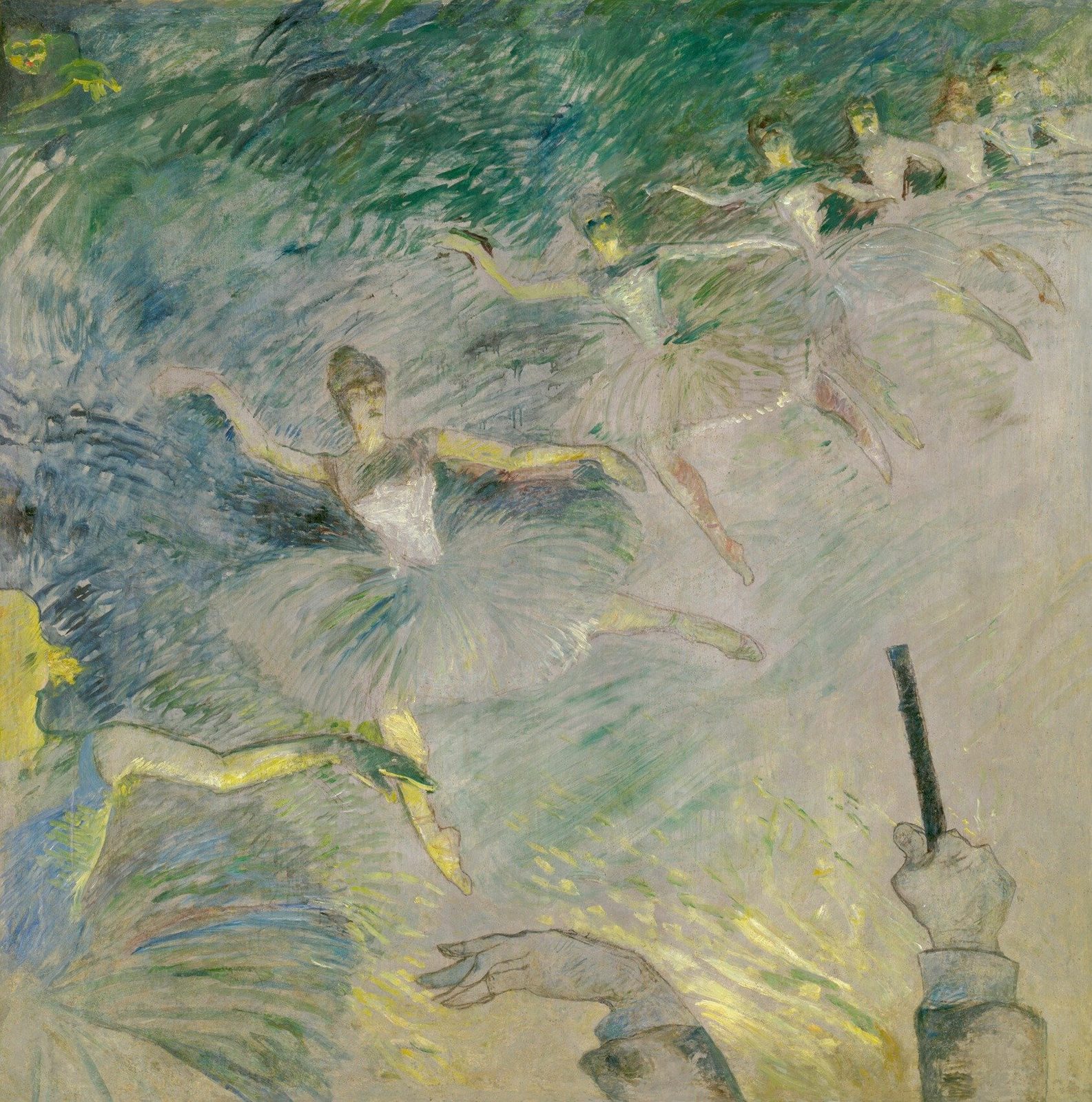
Stop. Before you is a painting that barely declares itself. Pale tutus dissolve into olive green, a few yellow flashes, and a dark vertical that interrupts the field at the lower right. This is Toulouse-Lautrec's Ballet Dancers from 1885 to 1886, and what looks unfinished is, in fact, the point.
Why the surface matters
By the mid-1880s, Toulouse-Lautrec was obsessed with Parisian dance halls and the bodies in motion on their stages. Here he works in oil on plaster, later transferred to canvas — a technique that gives the surface its chalky, absorbent feel and makes the ground itself an active player in the picture.
A frieze with a diagonal pull
Look at the overall structure. A frieze of overlapping dancers stacks top to bottom, with a faint diagonal pull from upper right to lower left. The thirds grid lands roughly across the brightest band of tutus; the central cream dancer sits just above the lower third line, anchoring the eye.
Light without a lamp
Notice there is no single source. Light is diffuse, almost ambient — the brightness of the canvas itself does the work, with shadows kept only as cool teal accents. It reads less like a stage and more like a memory of one.
Where the eye lands first
Follow the eye's opening move up to the upper right, where cadmium yellow dabs punch through the cool palette. These are small, thick strokes, applied after the lighter skirt passages, sitting crisply on top rather than blended in. Saturation, not lightness, is what makes them pop.
One-direction hatching
Drift left along the top band. The entire field is built from single-pass hatching, mostly diagonal, running upper-right to lower-left. Each stroke ends in a dry, tapered tip. No contour line encloses any figure — shape is implied by where strokes stop or change direction.
The central dancer
Now drop down to the focal point — the pale, central dancer. Her tutu is just a fan of cream and off-white strokes laid in diagonal passes from a darker waistline. The bodice is warm pinkish-cream with no hard contour underneath; it melts straight into the skirt. Her limbs are blocked in with thin yellow-green strokes that share color with the field, unifying figure and ground.
Lost edges, in motion
Lean into the boundary. The tutus have no outlines — they blend directly into the green background. What you read as an edge is really a temperature shift: a slightly warmer pinkish tone against cooler green, with both colors intermixing in the transition. That interpenetration is what gives the dancers their sense of motion.
A leg in one stroke
Follow the green skirt down to the lower left. That leg is one long, tapered sweep of yellow-green paint ending in a point. It is committed in a single loaded stroke, with thin dark contour lines reinforcing just the two long edges. No internal modeling — the silhouette and one accent color do almost all the descriptive work.
The dark interruption
Jump to the lower right, where a dark, nearly black vertical interrupts the frieze. We don't know exactly what it is — a guitar neck, a stage post, a painted column — but look at how it's painted. One decisive vertical pull, bristle tracks visible inside, cool blue-grey along the left edge, warmer brown at the base. The painter did not overwork it.
The ground as mid-tone
Now take in the open passages. Large areas of the warm ground are left completely bare, reading as both mid-tone and negative space. The figure is only suggested by a few broken strokes whose color temperature shifts the local hue of that ground. The lesson here: count the strokes you actually need, then stop.
Look closer
7 details, each checked against a close-up of the picture.
-
Central Dancer
The tutu is formed by broad, diagonal white and cream strokes over a pale ground.
The crop centres on a ballerina in mid-gesture, her arms extended horizontally and her head turned to the right. The tutu occupies the lower half of the image as a fan of pale strokes - cream, off-white, and pale yellow-green - laid in diagonal passes that sweep outward from a darker waistline. The bodice is a warm pinkish-cream with no hard contour on its lower edge, melting directly into the tutu. Behind her, broad vertical and diagonal strokes of blue-green and teal read as an unmodelled stage backdrop, while the dancer's limbs are blocked in with thin yellow-green strokes that share colour with the surrounding field, unifying figure and ground.
-
Rapid Hatching
The dancer's arm and shoulder are suggested by a few quick, dark teal-green lines.
The crop shows a flurry of diagonal, mostly parallel brushstrokes running from upper-right to lower-left across most of the field. A curved band of bright yellow-green pigment, roughly horizontal but arcing slightly downward on the right, sits in the middle band and reads against darker teal-green strokes above and pale gray-green passages below. The marks are single-pass, with no blending at their edges; each stroke ends in a dry, tapered tip or a ragged brush-lift. No continuous contour line encloses any figure—shape is implied by where strokes stop or change direction. The support texture is visible through thin paint in many areas, producing a mottled, broken surface.
-
Lost Edges
The edges of the tutus blend directly into the green background with no hard outlines.
The crop shows the lower portion of a tutu-like form in pale cream, soft pink, and a touch of coral, dissolving downward into a cool greenish ground. The upper area has a fan-shaped cluster of green-grey strokes that read as either foliage or a tutu's frill, with the strokes visibly continuing across the boundary where figure and ground meet. There is no drawn contour line around the pale shapes; instead, the edges are formed by a meeting of slightly warmer pinkish tone against cooler green, with both colours intermixing in the transition zone. A thin pinkish-peach stroke extends downward in the lower centre, reading as a limb or ribbon, also terminating softly into the surrounding field. The marks are dry, scratchy, and translucent in places, allowing the pale ground or support to show through.
-
Yellow Accents
Bright cadmium yellow highlights are applied as small, thick dabs on the dancers' skirts.
The crop shows loosely brushed figures with pale, creamy tutus occupying the lower two-thirds, set against a streaky blue-green background in the upper third. Bright cadmium-yellow dabs sit on top of the lighter skirt areas, particularly a small thick mark near the lower right and another warmer yellow patch in the upper left figure. Edges are soft and broken, with the yellow applied as isolated accents rather than blended into the surrounding cream. The tutus read as sweeping arcs of pale value, with the greenish underlayer showing through in places to cool the highlights.
-
Ground Exposure
Areas of the raw canvas or pale ground are left completely unpainted between figures.
The crop centers on a dancer's lower leg and the trailing edge of a tutu, set against a broad field of pale peach-pink ground that remains almost entirely unpainted. Loose, hatched strokes of sage and yellow-green describe the skirt's volume with broken, calligraphic marks that never fully close the silhouette, allowing the warm ground to read as both mid-tone and negative space. The leg is modeled with a few economical strokes of deeper green, ochre, and a lavender-grey shadow along the calf, ending in a small ochre-yellow foot whose edges are tentative and almost dissolving into the ground. The exposed ground is not uniformly bare: thin scumbled whites and pinks in the upper half soften what would otherwise be hard transitions, and short green flecks scatter like ground-cover, integrating figure and field.
-
Lower-Left Leg
The leg is indicated by a single, long sweep of yellow-green paint ending in a point.
A long, tapered yellow-green stroke dominates the upper-center, reading clearly as a leg extending from a darker green hip/thigh mass on the right and ending in a pointed foot shape near the right edge. The stroke is bounded by thin dark contour lines on both edges, with brighter yellow accents sitting on top of a slightly more muted yellow-green underlayer. Below the leg, loose gestural marks in pale blue, muted green, and ochre sweep diagonally, reading as the ground or surrounding fabric rather than anatomical form. The leg's outline is firm but slightly broken where the dark line skips along the top edge, and the foot terminates in a sharp downward-angled point against a mottled grey-blue ground.
-
Dark Vertical Object
The object consists of a dark, nearly black vertical stroke with visible brush hair texture.
A single dark vertical stroke dominates the center of the crop, leaning slightly to the right at its top end. The stroke is a near-black mass with cool blue-grey tints along its left edge and warmer brownish notes near the base. Its surface shows longitudinal streaking consistent with bristle drag, and its edges are mostly crisp but soften where the background was dragged into the wet paint. The surrounding field is a pale, scumbled cream with loose diagonal green-grey hatch marks and small ochre flecks at lower left, while the bottom edge hints at a paler, rounded form (a hand) gripping the object's base.
Ballet Dancers in context
A wall in a country inn
Ballet Dancers was not made as an easel painting [2]. According to an earlier Art Institute collection text, it is one of four related mural decorations that Toulouse-Lautrec painted for an inn at Villiers-sur-Morin, where he visited his friends the Greniers from the autumn of 1885 [2]. The museum dates it 1885 to 1886 and describes the medium as oil on plaster, transferred to canvas [1].
The French Wikipedia entry on Villiers-sur-Morin lists a hotel, restaurant and café-concert there run by Eugène Ancelin, leader of the village brass band and a dance-hall musician, known as the Maison Ancelin [4]. But the Art Institute text consulted here just names an inn at Villiers-sur-Morin, so these sources don't confirm if the murals were actually painted for the Maison Ancelin [2] [4].
The Grenier circle
The Greniers were the painter Albert Grenier and his companion Lili Grenier, a model in the Montmartre circle of the 1880s [3] [4]. French Wikipedia says Toulouse-Lautrec stayed with them at 19 bis rue Fontaine from the summer of 1884 and shared Albert's studio for a time before moving to rue Caulaincourt in 1885 [3]. The couple later bought property in Villiers-sur-Morin, and Lili died there in 1936 [3].
The painter François Gauzi remembered costume games and photographs at the Greniers' gatherings, with Toulouse-Lautrec dressed as a Japanese figure, a choirboy or a Spanish dancer with a fan [3]. Toulouse-Lautrec also painted the couple: a portrait of Albert Grenier from 1887 is in the Metropolitan Museum of Art, and one of Lili in a kimono from 1888 is in the Museum of Modern Art [3].
An early experiment
The Art Institute text calls the work early and experimental, and one of the first of his paintings to use the daring compositional devices that became a hallmark of his style a few years later [2]. It points to silhouetted dancers plunging forward along a diagonal, their limbs simplified almost to caricature [2]. The cropped hands of the orchestra leader at the lower right are read there as a nod to the intruding heads, instruments and fans at the edges of works by Edgar Degas and by artists influenced by Japanese prints [2]. Wikipedia likewise notes his debt to Degas's backstage ballet scenes and to ukiyo-e [5].
Off the wall and into Chicago
The museum's earlier text says the painting was removed from the plaster and transferred to canvas some time between 1913 and 1920, when Toulouse-Lautrec's work was especially popular [2]. The resulting canvas measures 153.5 by 152.5 centimetres and is listed as P. 241 in M. G. Dortu's catalogue raisonné [1].
Frederic Clay Bartlett bought it in 1931 from Étienne Bignou, a Paris dealer in Impressionist and Post-Impressionist art, and it was the last work he added to the Helen Birch Bartlett Memorial Collection [2]. That collection, assembled by Frederic and Helen Bartlett in the early 1920s and placed on view at the museum in 1926, also holds Seurat's A Sunday on La Grande Jatte and Toulouse-Lautrec's At the Moulin Rouge [2]. The museum's online record currently gives no provenance or exhibition history for the painting, so the story of its removal from the wall rests on that earlier text [1] [2].
- Henri de Toulouse-Lautrec, Ballet Dancers (1931.571): object record . Art Institute of Chicago (public API)
- Helen Birch Bartlett Memorial Collection: collection page with entry on Ballet Dancers (archived 24 January 2012) . Art Institute of Chicago, via Internet Archive
- Lili Grenier . Wikipédia (French)
- Villiers-sur-Morin . Wikipédia (French)
- Henri de Toulouse-Lautrec . Wikipedia