A river behind the flowers
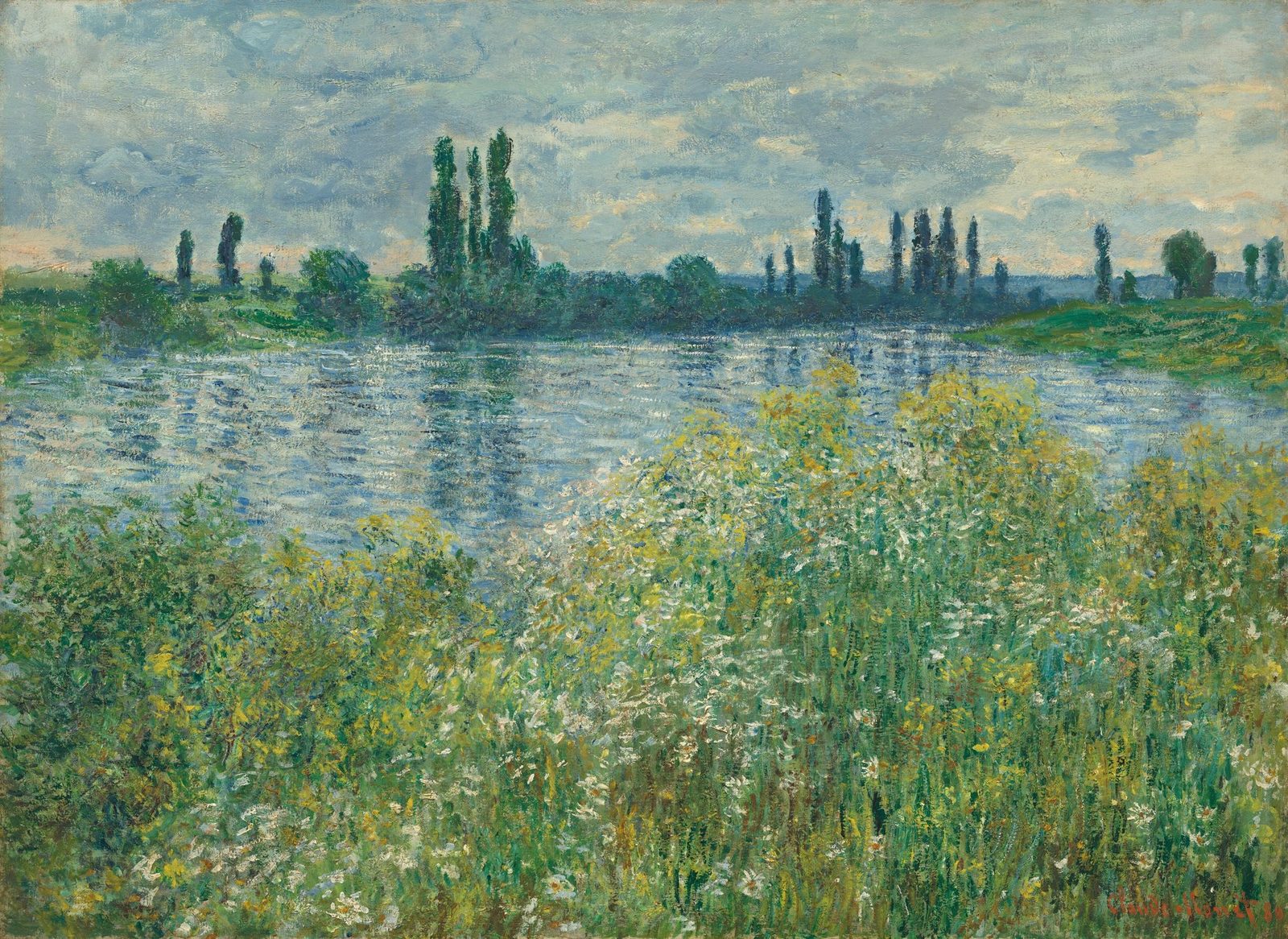
How Monet pushes the Seine into the middle distance and gives the front of the picture to a bank of grass and flowers
- Artist
- Claude Monet
- Title
- Banks of the Seine, Vétheuil
- Date
- 1880
- Medium
- oil on canvas
- Image
- Public domain (CC0)
Open in Simple Art
Watch this story on iPhone and iPad, with offline downloads and a painting every day.
About 4 minutes of looking, in 9 parts.
Banks of the Seine, Vétheuil
A river runs across this picture, but it isn't really the subject. Almost half the canvas is a bank of tall grass, yellow flowers and small white blooms, and the water is a silver band behind it. Start by noticing how much room Monet gives to the weeds.
Vétheuil, 1880, oil on canvas
This is Claude Monet's Banks of the Seine, Vétheuil, painted in oil on canvas and dated 1880. You can find the date in his own hand at the lower right, in red: Claude Monet 80. The picture is now in the National Gallery of Art in Washington.
Three bands, two groups of trees
The design is simple. Three horizontal bands, sky, river and flowering bank, are crossed by two groups of tall poplars, one just left of centre and one further right. The far bank sits high, about a third of the way down, so the meadow becomes the biggest shape in the picture.
Where yellow meets blue
Look at the yellow shrubs on the right. Thick, rounded dabs of buttery yellow sit right up against cool blue and violet strokes of water, with no mixed colour in between. The light everywhere is soft and grey, so these warm notes are what pull your eye across the bank.
Water made of separate marks
Now cross to the river. The water is built from short horizontal strokes of pale blue, lavender and cream, each one kept separate. A darker blue shows in the gaps, like the troughs between ripples. Close to, it's a mosaic. From a few steps back, it shimmers like reflected sky.
A tree made of dabs
Climb up to the tall poplars left of centre. They're made of short, upright dabs of deep green and blue-green, stacked into columns, with a few near-black touches in the deepest parts. Now drift to the edge where tree meets sky. There's no outline. The shape simply stops where the green strokes end and the pale sky strokes begin.
Even the sky is brushwork
The sky is worked just as hard. Curved, comma-shaped touches of cream, pale blue and grey overlap without being smoothed together. The creamy strokes read as the lit tops of the clouds, and the cooler blues tuck in underneath like their shadows.
Near trees, far trees
Compare the poplars on the left with the group across to the right. The right-hand trees are slimmer, made with narrower upright strokes, and below them the marks turn into short horizontal dabs, as if their reflections were dissolving into the water. The size and direction of each stroke quietly tells you how far away things are.
Signed in red
Down in the lower right is that signature. The thin, flowing red letters ride over the broken greens of the grass, and in places the paint underneath shows through them. It's a small warm note against all the cool green.
Look closer
8 details, each checked against a close-up of the picture.
-
Left poplar group
The left poplar group is formed from jagged vertical dabs of deep green and blue-black paint set directly against the pale sky without any continuous outline.
The left poplar mass is built from short, vertical, dagger-like dabs of paint stacked into a tall column. The marks themselves carry the silhouette: there is no drawn contour line, and the boundary with the pale blue-cream sky is created purely by alternating vertical strokes of deep teal-green against the lighter ground. Within the tree, cooler shadow tones (blue-greens) sit beside warmer dark greens, and a few near-black accents mark the deepest recesses. Behind the poplar the sky shows horizontal scumbling in cream, peach and pale blue, so the green dabs read as crisp vertical rhythms against a soft horizontal field.
-
Yellow flowering shrubs
Thick yellow-orange strokes in the flowering shrubs sit adjacent to cool blue-violet water strokes, demonstrating a deliberate warm-cool temperature juxtaposition.
The crop shows dense, broken impasto marks grouped into two horizontal registers: an upper band of cool blue, blue-violet and white horizontal strokes (the river/reflected sky) and a lower two-thirds of green, yellow-green and white dabs representing grass and foliage, punctuated by thick buttery yellow-orange dabs clustered across the upper-middle that read as flowering shrubs. The yellow marks are short, rounded, and slightly heavier than the surrounding foliage strokes, sitting on top of the green rather than blending into it. Edges between the warm flower dabs and the cool blue strokes above are left unblended — the two temperatures meet as adjacent patches of distinct color, never as a mixed mid-tone. White and pale-blue flecks are scattered throughout the green register, keeping the whole surface optically vibrating rather than resolving into a single mass.
-
Silvery river ripples
River ripples are built from discrete horizontal strokes of pale blue, lavender, and cream that remain separate up close and suggest reflected skylight.
The crop is dominated by short, horizontal-ish dabs of pale blue, lavender, and cream that read as rippled water across roughly 80% of the frame. Strokes remain distinct rather than blended, with little gaps of cooler mid-blue and occasional deeper teal sitting between the lighter marks to suggest pooled shadow in the troughs. Along the right edge and bottom, denser, more broken flecks of yellow-green, ochre, and pink-white crowd against the water, acting as a loose edge where the meadow meets the river. Edges throughout are unblended: every dab keeps its own contour, and the surface reads as a mosaic of separate marks rather than a smoothed wash.
-
Poplar-sky edge
The silhouette of the poplar foliage against the sky is created solely by the meeting of dark green and pale blue-grey strokes, with no drawn contour line.
The crop isolates the upper poplar masses against a broken overcast sky. Foliage is built from short vertical and slightly diagonal dashes in dark teal, deep emerald, and blue-green, with scattered lighter passages that read as leaf-clusters or sky glimpsed through branches. The sky is a mosaic of pale cerulean, cool grey, and warm cream strokes laid in directional sweeps. Along the boundary between tree and sky, the silhouette is entirely irregular, produced where a green stroke simply ends and an adjacent sky-coloured stroke begins; no continuous dark outline travels around the foliage mass. At certain points a green stroke runs a little way into the sky zone, fragmenting the edge rather than reinforcing it.
-
Cloud-laden sky
Cloud masses are rendered by overlapping, curved touches of cream, pale blue, and grey that are individually visible and never blended into a smooth wash.
The crop is dominated by a sky built from short, arcing, comma-shaped strokes that overlap rather than blend. Pale cream and ivory touches form the luminous centres of cloud masses, while cool pale-blue and mid-blue strokes define the shadowed undersides and the sky gaps between them. Greyer, slightly desaturated blue strokes tuck beneath the warmer cream passages, producing a soft volumetric read without any hard contour line. Every individual touch remains legible as a discrete dab of pigment; edges between colours are crisp at stroke boundaries yet lose themselves in the overall shimmer. Along the bottom margin, the jagged dark silhouettes of poplar tops (deep blue-green) and a few emerald meadow touches sit sharply against the lighter cloud band just behind them.
-
Right bank poplars
The right-hand poplars are painted with narrower vertical dark strokes whose reflections dissolve into shorter horizontal dabs directly below them.
The right-hand poplars read as a series of slender, upright dark columns set against a pale cream-blue sky; their edges are ragged, built from short vertical and slightly diagonal strokes in deep teal-green and near-black, with touches of the sky color dragged down into the silhouettes. Directly beneath this tree line the surface shifts to a denser field of small, mostly horizontal dabs in cool blues, violets, and muted greens, where the vertical strokes are replaced by short lateral marks that suggest reflections dissolving into the surface. The brushwork across this transition is loaded and broken, leaving visible ridges of paint rather than blended edges. A patch of brighter green-yellow sits to the right mid-ground, separating the trees from the horizontal dab field.
-
Distant left bank
The distant left bank is painted with small, muted green-grey strokes of lower contrast and reduced texture compared to the foreground.
The crop shows a band of distant bank beneath a pale peach-and-grey sky, with dark vertical poplar trunks punctuating the upper third. The bank itself is built from small, short, mostly horizontal strokes in muted olive, sage, and blue-greens, with occasional warmer flecks that echo the sky above. Compared to the foreground meadow at the bottom, the marks here are tighter, thinner, and less impastoed, producing softer edges that visually merge with the sky. A few stray brighter strokes of cobalt and white in the mid-ground act as little atmospheric accents, while the lower foreground shows thicker, more loaded dabs of pigment.
-
Monet's signature
The red signature in the lower right consists of a thin, continuous cursive stroke laid over the textured paint of the foreground grasses.
The crop isolates a horizontal band where a cursive red-orange signature reading 'Claude Monet 80' traverses a field of broken green and olive brushwork. The signature strokes are thin, continuous, and laid over the textured underlayer; underlying green, ochre and dark dab marks remain partly visible through the thinner sections of the red paint, especially in the descenders. The red of the signature is a warm vermillion that reads strongly against the cool and neutral greens beneath. Edges of the letters are soft, indicating the paint was applied to an already-dry, irregular surface rather than a smooth one.
Banks of the Seine, Vétheuil in context
Three years in a river village
From 1878 to 1881 Claude Monet, his wife Camille and their two children shared a small house in Vétheuil with the family of Ernest Hoschedé [2]. The Frick Collection describes Vétheuil as a village of about 600 people on the Seine, some 70 kilometres west of Paris [2]. The MuMa in Le Havre says money troubles forced Monet out of Paris in the summer of 1878, while the National Gallery of Art dates his arrival to September of that year [3][4].
The museum calls the Vétheuil years a time of personal loss and financial hardship but also of intense work, with nearly three hundred paintings in three years [4]. In that period, it says, his art moved away from scenes of modern life towards landscape and atmospheric effects [4]. He often painted the village from a small studio boat anchored in the river [2].
After Camille
Camille Monet died on 5 September 1879 and was buried two days later in the cemetery beside the village church [2]. This canvas is signed and dated 'Claude Monet 80' in red at the lower right, so it belongs to the first summer after her death [1].
In 1880 Monet sent two paintings to the Salon, and one was accepted [5]. He stayed at Vétheuil until December 1881, when the landlady refused to extend his lease because of unpaid rent and he moved with Alice Hoschedé and her children to Poissy [5].
Reading the date
The museum records the picture as oil on canvas, 73.4 by 100.5 centimetres, and its bibliography cites it as number 597 in Daniel Wildenstein's catalogue raisonné of Monet's paintings [1]. It also lists a discussion in Grace Seiberling's 1976 Yale dissertation on Monet's series [1].
A date painted on the canvas is strong evidence, but the same museum has shown that Monet's dates can mislead. Its own Artist's Garden at Vétheuil carries the date 1880, yet the museum now dates it to 1881 and says Monet added the wrong date when he repainted the foreground later [4]. Nothing published by the museum suggests a similar problem with this canvas, which it dates to 1880 [1].
From Vétheuil to New York
According to the museum, the painting went from the artist to James F. Sutton of New York, who died in 1915, and then to his widow [1]. Sutton was a co-founder and president of the American Art Association, the New York gallery and auction house set up in 1883 [6]. The picture was sold at the Sutton sale held by the American Art Association on 26 October 1933, lot 48, where Chester Dale bought it [1].
Dale left it to the National Gallery of Art with his collection in 1963 [1]. It was shown in the Chester Dale bequest display in 1965 and in the exhibition of his collection in Washington from 2010 to 2012, and it hangs in Gallery 80 of the West Building [1].
- Claude Monet, Banks of the Seine, Vétheuil (1963.10.177): object record, inscription, provenance, exhibition history and bibliography (Internet Archive copy, 14 April 2025) . National Gallery of Art, Washington
- Claude Monet's Vétheuil in Summer (1998 exhibition): introduction . The Frick Collection, New York
- Monet, The Seine at Vétheuil: artworks in context . MuMa, Musée d'art moderne André Malraux, Le Havre
- Monet's The Artist's Garden at Vétheuil: exhibition page (Internet Archive copy, 22 September 2026) . National Gallery of Art, Washington
- Claude Monet . Wikipedia
- American Art Association . Wikipedia