Goya's Bartolomé Sureda y Miserol: A Walk Through Light, Color, and Economy
One portrait, eleven beats — chasing the eye from the red hat lining to the hand on the hip.
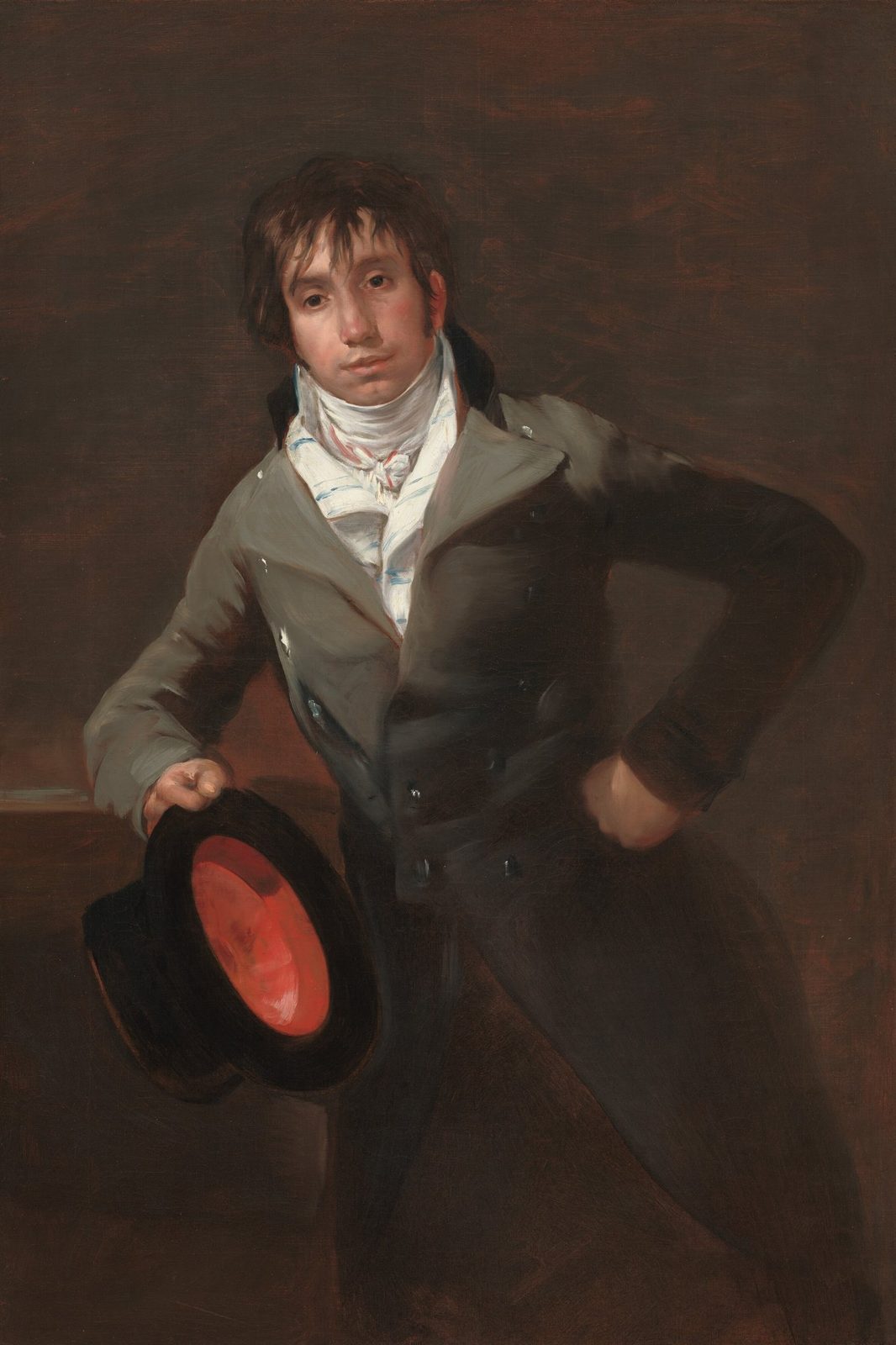
- Artist
- Francisco Goya
- Title
- Bartolomé Sureda y Miserol
- Date
- c. 1803/1804
- Medium
- oil on canvas
- Image
- Public domain (CC0)
Open in Simple Art
Watch this story on iPhone and iPad, with offline downloads and a painting every day. This one is free in the app.
About 4 minutes of looking, in 10 parts.
A single slash of red
Stop here. A young man against a deep brown ground — and then, suddenly, this slash of red where his top hat flips open. That single saturated note is the emotional engine. Let it pull your eye as we move in.
Goya, c. 1803/1804
This is Bartolomé Sureda y Miserol, painted by Francisco Goya around 1803 to 1804, oil on canvas. A half-length portrait, unpretentious modern dress, no insignia — just a working professional rendered with extraordinary economy.
A pyramid with one surprise
Pull back to the whole shape. The composition is a quiet pyramid: head at the apex, shoulders widening, with the hand on the hip forming one lobe and the hat a counterweight lobe at the lower left. That red balances the hand across the center.
Light from the upper left
Now the light. It rakes in from the upper left, soft and diffused. A broad pale peach highlight sits on the forehead and bridge of the nose, broken by a few diagonal hair strokes. The eye sockets fall into warm reddish-brown half-shadows, modeled without any drawn outline.
Two catchlights, one brow
Closer on the eyes. Tiny white catchlights sit at the upper-left edge of each iris, matching that single light. The left eyebrow is essentially one dark defining stroke with a few thin flicks above — not a built-up mass. Two catchlights, one brow, a living gaze.
Hair in two passes
Up to the hairline. A warm mid-brown ground first, then darker slanted slashes dragged down from the crown. At the boundary, short ochre ticks break the silhouette into fine wiry strands — never outlining the whole shape. The brown ground still glows through between strokes.
White that isn't white
Down to the cravat. The white stock isn't pure white — it carries discrete horizontal streaks of pale cerulean in the fold ridges and shell pink under the chin. A cool note beside a warm one, with one saturated red accent in the central rosette.
Summary, not finish
Now the coat, and notice the handling changes. The gray is built from broad diagonal strokes running upper-left to lower-right, with the warm reddish-brown imprimatura deliberately reading through between them. The ground does the mid-tone work, so you don't have to mix every shadow.
The painting's spark
And the red. The hat interior is built from unblended strokes of vermilion and a cooler scarlet, sitting on a darker crimson underlayer. The deep red shows through in two spots as shadow; a near-white pink stroke is dragged across the lower interior as highlight. Two reds, one ground, one highlight.
Three strokes for a hand
Finally, the hand on the hip. It's described in maybe three broad strokes of warm pinkish umber, with one diagonal cream highlight where the light rakes across. No knuckles, no fingernails — the lower edge dissolves softly into the dark ground. Gesture over detail, every time.
Look closer
8 details, each checked against a close-up of the picture.
-
Face and eyes
The sitter's eyes contain small white catchlights at their upper-left edges, and the left eyebrow is drawn with a single dark defining stroke.
The crop isolates a soft, three-quarter-lit face framed by dark hair and a brilliant white cravat. Both irises carry small white catchlights; the sitter's left eye shows one clearly at the upper-left edge of the iris, while the right eye's catchlight sits closer to the upper-center and is fainter. The left eyebrow is essentially a single confident dark stroke along its lower edge with only a few thinner hairs flicks above it, not a built-up mass. Skin transitions from cool pinkish-grey near the eyes to warmer rose on the cheeks and nose tip, and the background reads as a dark reddish-brown rather than black.
-
Red hat lining
The hat interior is painted with separate, unblended strokes of vermilion and scarlet that sit on a darker underlayer.
The crop centers on the elliptical red lining of an upturned black top hat, with a pale hand visible at the upper edge gripping the brim. Inside the red oval, separate brushstrokes of bright vermilion and a slightly cooler scarlet sit over a darker crimson underlayer that shows through in the upper-left and lower-right shadow zones. A near-white pink stroke is dragged across the lower interior, reading as a specular highlight on the concave surface. The boundary between the red lining and the black hat body is a soft, wet-into-wet edge, not a hard line, while the inner highlight stroke is laid on top with a drier, more loaded brush. The black hat shows a network of fine age cracks but no obvious secondary detail; tonal contrast carries the form rather than drawn edges.
-
Forehead light
A concentrated patch of pale peach highlights occupies the forehead and bridge of the nose, bounded by softer shadows in the eye sockets.
The crop isolates the upper face, showing a broad, pale peach highlight that runs across the forehead and continues down the bridge of the nose. The light patch is broken by wispy, dark hair strokes that cut diagonally across the brow. The eye sockets recede into warm, reddish-brown half-shadows that sit just below the highlight, with soft transitions rather than crisp edges. Loose, broken brushwork is visible throughout, with thin paint dragged over a slightly warmer underlying tone, especially along the temples and outer forehead where strokes feather into the hair.
-
Cravat color streaks
The white cravat carries discrete horizontal streaks of pale cerulean and shell pink between its folds.
The crop is dominated by a voluminous white stock wrapping the sitter's neck, with a partial chin visible at the top edge and the lapels of a tan-gray coat flanking it. Discrete horizontal dashes of pale cerulean blue mark the left fold ridge and the lower right wedge of fabric, while soft shell-pink strokes read as warm shadow tints under the chin and inside the small central rosette, which carries a single saturated red accent. Edges between folds are left soft and brushed wet-into-wet, with no hard linear outlines; the silhouette of the stock bleeds into the coat through warm gray half-tones rather than contour. A faint vertical crease runs down the center, modeled by juxtaposed warm (pink/ochre) and cool (blue/gray) notes rather than a drawn line.
-
Coat brushwork
The gray coat is built from broad diagonal brushstrokes that leave streaks of the warm brown ground visible between them.
The crop is dominated by a broad sweep of tan-gray coat material rendered with loose, confident brushstrokes that run diagonally from upper-left to lower-right. Between these strokes, the reddish-brown ground/underlayer reads through thinly applied paint, especially along the lower edge and where the arm turns into shadow. To the upper right, a high white cravat is built from short, stacked strokes of cool blue-gray shadow, cream, and pinkish flesh tints that create a crumpled, dimensional surface. A pale hand with a thumbnail visible sits at the lower left, resting on the dark mass of a top hat, with the warm brown ground still glowing behind it.
-
Hand on hip
The left hand is indicated by only three broad strokes of pinkish umber, with no individual finger nails or wrinkles drawn.
The crop isolates a single hand resting against a dark ground, rendered with extraordinary economy: roughly three to four broad strokes of warm pinkish umber describe the form, with a pale, almost cream highlight running diagonally down the back of the hand where light rakes from the upper left. No knuckles, fingernails, or wrist creases are drawn; the lower edge dissolves softly into the surrounding dark brown, while the upper edge is set against a near-black passage (the dark coat and a hat brim). The whole crop is veined with fine craquelure, and the flesh sits in a soft halo against the deep umber background, with a faint reddish warmth at the lower right where the hand meets the dark mass.
-
Hair strokes
The hair is built from quick, dark brown slashes over a lighter ground, with short ochre ticks at the hairline suggesting individual strands.
The crop isolates the forehead and hair mass. The hair reads as a dark, near-black umber block built from relatively broad, slanted strokes that fan downward from the crown; between and beneath these dark slashes a warm mid-brown ground is visible, and at the temple/forehead edge several short, lighter ochre-yellow ticks break the silhouette into fine, wiry strands. The transition from hair to skin is not a hard line but a soft, broken edge where short dark flicks overlap the warm flesh tone and a few pale hairs lie across the brow. The dark passages sit on top of slightly lighter brown underpainting, so the mass has internal temperature variation rather than a flat black.
-
Hat brim highlight
The curved outer rim of the black hat is edged with a thin stroke of warm umber that catches the light.
The crop isolates a pale hand gripping a black top hat whose interior faces the viewer in a vivid red. Along the curved outer rim of the hat, a thin, broken stroke of warm umber/burnt-sienna traces the silhouette from upper left around the lower right, reading as a catching-light edge against the dark brown background. The red lining is built with broad, wet-into-wet horizontal and diagonal strokes, with a brighter pinkish-red highlight pooled near the lower right interior curve suggesting a convex shape. The hat's black body is not flat; subtle warmer brown undertones show through where it meets the red lining and along the lower edge, indicating the black was laid over a toned ground.
Bartolomé Sureda y Miserol in context
A draughtsman from Mallorca
Bartolomé Sureda was born in Palma de Mallorca in 1769 and enrolled at the Real Academia de San Fernando in Madrid on 2 November 1792 [2]. There the engineer Agustín de Betancourt spotted his talent as an industrial draughtsman and took him to England in 1793 to study manufacturing. That stay lasted until 1796 [2]. Betancourt showed the Academia a print by Sureda in March 1797. In the minutes' words as quoted by the catalogue, it imitated the wash of Chinese ink and was useful for architectural plans [2].
The aquatint story
Sureda's son Alejandro later said that his father had taught Goya a new print technique [2]. It's often been assumed to be mezzotint, but the Gallery's catalogue argues it was almost certainly aquatint, since none of Goya's prints uses mezzotint [2]. That would help explain the confident tonal effects of the Caprichos, compared with his hesitant handling of the medium in prints after Velázquez of 1778 to 1779 [2].
The lesson fell in Goya's darkest years. An illness at the end of 1792 left him permanently deaf [2][4]. The Caprichos, eighty etchings, were offered for sale early in 1799, and Goya quickly withdrew them because their satire proved controversial [2]. Later that year, on 31 October, he was named first court painter, but after 1801 he received few royal commissions [2].
Paris, porcelain and a date
In 1800 the government sent Sureda to France to study textiles and porcelain [2]. He came back in September 1803 with a French wife, Thérèse Louise Chapron de Saint Amand, whom Goya also painted [2]. The catalogue places him at the Buen Retiro porcelain factory from 18 October 1803. It lists him as director of works from August 1804 and director from September 1807, where he introduced a new hard-paste porcelain [2]. The Gallery's web page instead says he became director in 1802, so the sources don't agree on that step [1][2].
Proposed dates for the portrait have ranged from about 1801 to as late as 1820 [2]. The catalogue favours the months after his return. It notes that the dark redingote, cravat and short hair 'à la Brutus' follow Parisian fashion of about 1799, and that Sureda would then have been about thirty-five [2].
An English pose
The catalogue traces the pose of a figure leaning on one arm, hat in hand, to English portraiture [2]. It points to Pompeo Batoni's portrait of Charles Cecil Roberts, which Charles III gave to the Academia in 1784, as an example Goya would have known [2]. The Gallery also reads the hair and dress as signs of Sureda's sympathy for French politics, shared with a circle of liberal intellectuals [1].
War, exile and New York
After the French invasion and the destruction of the factory, Sureda lived in France from 1809 to late 1814 [2]. He went on to run royal factories in Guadalajara, Moncloa and La Granja, retired to Mallorca in 1829 and painted there in Goya's manner [2]. The catalogue dates his death to 10 May 1850, while Wikipedia gives 10 March 1851 [2][3].
The pair of portraits passed through the Sureda family to Louisine and Henry Havemeyer of New York, who the Gallery says bought them in 1897 [1]. Louisine Havemeyer recalled paying less than fifty thousand pesetas for the two [1]. Their daughter gave this portrait to the Gallery in 1941 [1].
- Francisco Goya, Bartolomé Sureda y Miserol (1941.10.1): overview, provenance, exhibition history, technical summary and bibliography (Internet Archive copy, 23 April 2025) . National Gallery of Art, Washington
- Jonathan Brown and Richard G. Mann, Spanish Paintings of the Fifteenth through Nineteenth Centuries (Systematic Catalogue, 1990): Goya biography and entries 1941.10.1 and 1942.3.1 (Internet Archive copy of the PDF) . National Gallery of Art, Washington
- Bartolomé Sureda y Miserol . Wikipedia
- Francisco Goya . Wikipedia