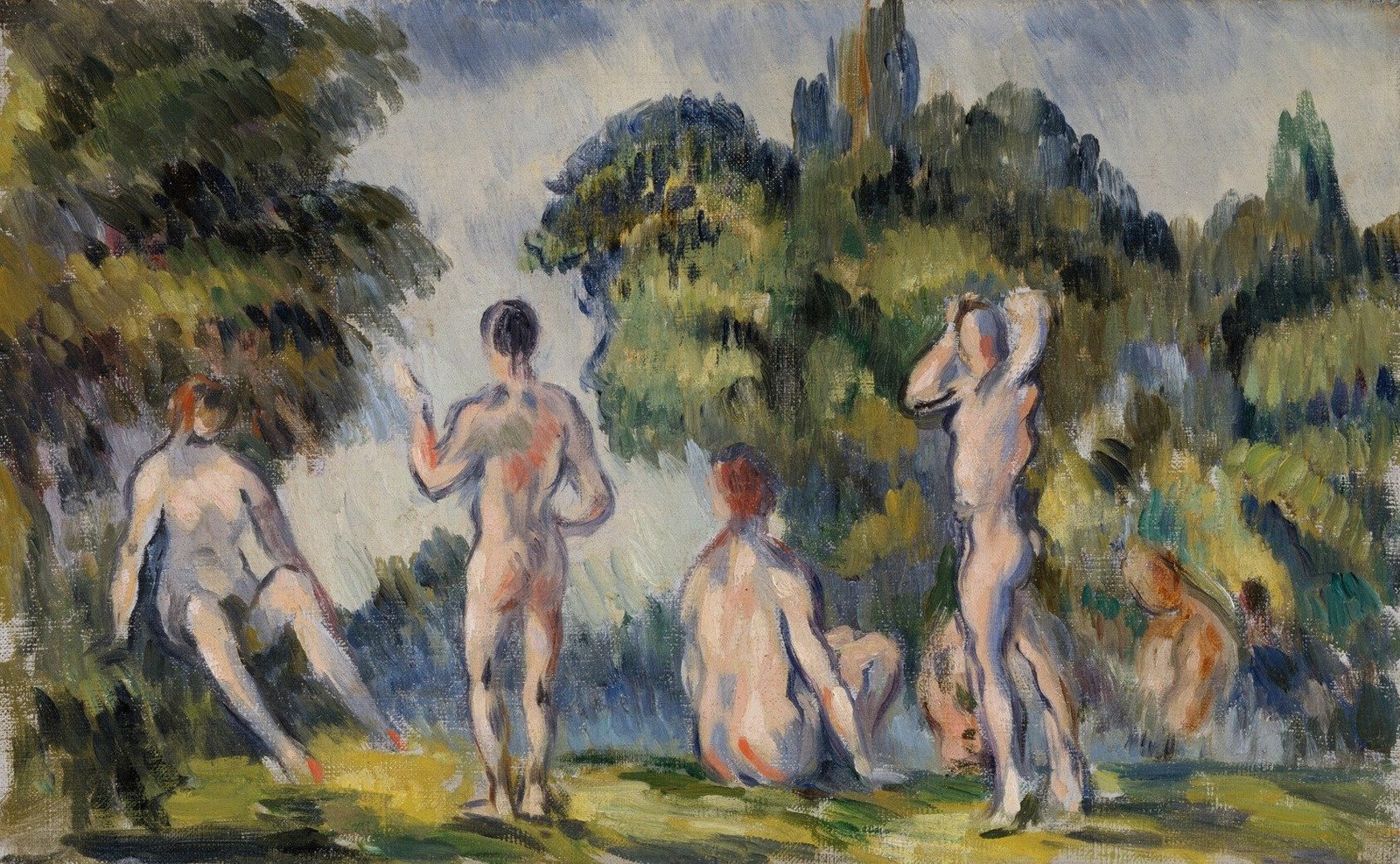
Bathers — Paul Cézanne, 1890–94
How Cézanne builds the human figure from the same strokes as the trees
- Artist
- Paul Cezanne
- Title
- Bathers
- Date
- 1890–94
- Medium
- Oil on canvas
- Museum
- Art Institute of Chicago
- Image
- Public domain (CC0)
Open in Simple Art
Watch this story on iPhone and iPad, with offline downloads and a painting every day.
About 5 minutes of looking, in 12 parts.
Five figures, one canvas of green and flesh
Five nude figures scattered across a stretch of grass, a wall of trees behind them, a pale sky above. This is Paul Cézanne's Bathers, painted across the early 1890s, and what looks at first like a quiet pastoral scene is in fact a laboratory for a new way of painting the body.
Cézanne's late bather tradition
Cézanne returns to the bather again and again in his late career, a classical theme he uses as a vehicle to test how far paint itself can carry the figure. Rather than modeling anatomy in the academic sense, he treats the human form as another patch of color, organized by the same laws that organize the trees.
A horizontal band, two vertical peaks
Look at the overall structure: a horizontal band of figures sits in the lower middle register, framed below by grass and above by a dense wall of foliage. Two standing figures act as vertical peaks that punch up into the tree line, giving the composition a gentle, irregular rhythm against the horizontals.
A bright gap, a dark silhouette
The light is diffuse and overcast, but there is a brighter passage where the trees thin out behind the central standing figure. Cézanne treats that gap as a flat plane of pale blue-white, and he places the darkest darks of the figure directly against it. The backlight you read is not painted as a glow — it is a hard value jump.
Cool blue shadows, warm peach highlights
Now watch the flesh itself, on the standing figure with raised arms. The skin is built from cool blue and lavender strokes placed beside warm peach and cream. There is no blended modeling; the volume comes from the eye mixing adjacent temperatures. Set against the green foliage, those pinks and peaches vibrate as complements.
Constructive diagonal strokes build the back
Closest on the central standing figure: her form is made of clearly visible parallel diagonal strokes, running from upper-left to lower-right across the back and hips. Each stroke carries its own hue. Warm pink-coral sits on the upper back and shoulder, while cool blue-grey describes the shadowed left side. The volume is constructed, not blended.
Where pink meets green, the edge lives
Look at the seam between this figure's lower back and the foliage. There is no drawn outline. The contour is the irregular boundary where warm peach strokes terminate against cool green strokes, each color advancing into the other as broken, faceted patches. The figure is not sitting in front of the trees; it is interlocking with them.
Foliage built the same way as flesh
Pull back to the tree canopy and you will see the same vocabulary repeated. Short, slanted strokes lean from upper-left to lower-right in dark greens and blue-greys, with a patch of warmer yellow-green reading as backlit leaves. The leaves have no outline either; each mass of foliage is just a cluster of adjacent color notes.
Leg and grass share the same axis
Now down to the seated figure's bent lower leg. It is painted with diagonal strokes of warm peach and ochre, and the grass below uses strokes in the same direction. The leg does not sit on the turf; it grows out of it. Shared stroke direction is what unifies the two zones optically.
A pose from a handful of color planes
Over to the bending figure at the far left, and notice how little anatomy Cézanne gives you. The whole pose is a few broad planes: a cool pale-blue back, a warm cream shoulder, a single diagonal stroke for the thigh, a rust smudge for a head with no features. The bend is read from the shapes alone.
A figure left deliberately unresolved
Finally, the crouching figure on the right is the most fragmentary. Her contour is interrupted by passages of background color laid directly into the silhouette, so the form is suggested by adjacency rather than closed. This is late Cézanne at his most unfinished — letting figure and ground share edges.
Body and tree, same brush, same hand
If you compare the back of the central figure with a passage of the tree canopy, you will see the same diagonal stroke, the same loaded pigment, the same refusal to blend. Body and landscape are not separate categories in this painting — they are cut from the same fabric of color planes.
Look closer
8 details, each checked against a close-up of the picture.
-
Central standing figure
The figure's form is constructed from distinct parallel diagonal strokes of pink and white.
The crop isolates a single standing nude viewed from behind, set against a brighter passage of sky and open foliage that functions as backlight. The body is built from clearly visible parallel diagonal strokes, running roughly from upper-left to lower-right across the back, buttocks and thighs. Warm pink-coral passages sit on the upper back, shoulder blades and the right glute, while cooler blue-grey strokes describe the shadowed left side, the inner leg and the underside of the arms. The contours are not drawn as lines but accumulate where pink/white body strokes meet green/blue background strokes, producing a faceted edge rather than a soft silhouette.
-
Flesh and foliage junction
The edge of the figure's back is defined by the juxtaposition of pink and green strokes without a hard outline.
The crop shows the lower back and hip of a nude figure on the left meeting a dense passage of foliage on the right. Flesh is built from parallel peach and pink strokes (#D89585) laid diagonally from upper-left to lower-right, with cool gray-violet shadow strokes (#8A8A9A) tucked into the recessed curve of the hip. The foliage on the right uses short, vertical-to-diagonal green strokes (#7A9A6E, #5E7A4E) with a brighter olive passage (#B5C4A8) reading as sky or backlit leaves. The contour of the back is not a drawn line; it is the irregular boundary where warm pink strokes terminate against cool green strokes, with each color advancing into the other's territory as broken, faceted patches.
-
Figure with raised arms
The skin contains cool blue and green tones mixed with warm peach highlights.
A standing nude figure with both arms lifted, head bowed, rendered against a background of dense greens and dark blues. The skin is built from adjacent—not blended—patches of cool blue-violet, green-grey, and lavender placed next to warm peach, cream, and pinkish highlights. Edges along the back, hip, and inner thigh are soft and broken, where the figure's contour meets surrounding foliage, while edges along the lit shoulder and outer arm are firmer. Parallel diagonal and vertical strokes follow the volume of the limbs and torso, with the strongest light passage catching the upper back, shoulder, and thigh.
-
Tree canopy texture
The foliage is made of repetitive, short, slanted strokes of dark green and blue-gray.
The crop isolates a dense band of tree canopy rendered in short, slanted strokes that lean from upper-left to lower-right. Dark blue-green and near-black passages dominate the upper and right edges, while a patch of warmer yellow-green sits at roughly u=0.45-0.65, v=0.35-0.55, reading as backlit foliage. A pale, thinly painted sky gap breaks through at u=0.00-0.15, v=0.05-0.35, where the underlying ground or canvas shows through the loose, scumbled marks. Edges are not drawn but built by juxtaposition: lighter strokes next to darker ones create the contour of individual leaf masses without a single outline stroke.
-
Backlit gap in foliage
The background consists of bright white and pale blue patches that create a backlight effect behind the central figure.
A figure viewed from behind occupies the lower-center, her dark bun and shoulders silhouetted against a pale blue-white passage that reads as open sky or a gap in the canopy. Thick, waxy green strokes mass on the right at roughly u=0.85–1.0, v=0.0–1.0, while cooler olive-drab strokes flank the left. The canvas weave shows through the thinner passages of the bright gap, giving the backlit area a granular, scumbled quality. The figure's warm peach and rose tones on the shoulders contrast sharply with the cool gray-blue halo behind her head.
-
Seated figure's lower body
The lower leg of the seated figure merges into the green of the grass through similar brushstroke directions.
The crop shows the bent lower leg and knee of a seated figure on the left, built from parallel, faceted strokes of warm peach, pink, and ochre flesh tones against cooler grey-violet shadow passages on the right side of the limb. Below the leg, a band of olive and yellow-green grass runs across the lower edge, painted with strokes that slant in roughly the same diagonal-vertical direction as the strokes describing the calf and shin. The edge where the warm leg meets the green ground is not a drawn contour but a zone of alternating, parallel strokes whose tips interleave, so the leg appears to grow out of the turf rather than sit upon it. Behind the figure, a dark band of muted green-grey and umber reads as the shadowed tree line, with no atmospheric blending separating figure from ground.
-
Seated figure on the left
The figure's pose is suggested by a few broad planes of light color rather than anatomical detail.
The crop shows a nude figure seated and leaning back, her legs stretched along the upper-left to lower-right diagonal of the frame. The body is built from a handful of broad, flat color planes: a cool pale-blue plane for the shadowed back and torso, a warm cream-pink passage along the upper back and shoulder, a single diagonal stroke for the thigh, and a small grey-blue for the calf. The head is reduced to a rust-orange smudge with no facial features at all. Edges between the figure and the background are soft and inconsistent — the lower leg and hip dissolve into the dark green-blue foliage, while the upper back is clearly silhouetted against the bright off-white sky passage. There is a tiny dabs of red-orange at the foot that acts as a chromatic accent.
-
Crouching figure on the right
The figure is rendered with fragmented, sketch-like strokes that leave the form partially unresolved.
The crop shows a crouching nude figure in warm ochre and rose-pink tones against a background of green, blue, and violet dabs. The contour of the head, shoulder, and bent knee is interrupted by passages where background color is laid directly over or beside the body, so the silhouette reads more as a cluster of adjacent planes than a closed line. Parallel, diagonal strokes descend across the torso and into the lower legs, alternating warm flesh notes with cooler shadow hues. Edges are soft and broken throughout; only the upper shoulder and the curve over the hip carry a slightly more continuous line, while the lower body dissolves into the surrounding grass-like marks.
Bathers in context
A small picture with a short record
The Art Institute dates this oil on canvas to 1890 to 1894 and gives its size as 22.6 by 35.4 centimetres [1]. Mrs T. Clifford Rodman gave it to the museum, where it holds the accession number 1973.672 and isn't currently on view [1]. The museum's record lists the work as Venturi 589, Rewald 750 and FWN 946, with that last number referring to the online catalogue raisonné of Cezanne's work [1].
Four bathers or five, and when
That online catalogue, now run by the Société Paul Cezanne, records several titles for the picture, among them Baigneurs et baigneuses, Baigneuses dans un paysage and Quatre baigneurs [2]. Its keywords class the figures as male and female bathers together [2]. The proposed dates have moved as well. Lionello Venturi's catalogue of 1936 gave 1890 to 1894, the revised Venturi catalogue gives 1885 to 1888, and John Rewald put it at about 1890 [2]. When it was shown in Paris in 1930 it was catalogued as about 1884 [2].
A question of attribution
The Art Institute's 2026 catalogue of its Cezanne paintings and watercolours does not give this picture an entry of its own [3]. It is mentioned only in a note to the entry on Standing Bather, Seen from the Back, which says that the figure from that study also appears here, but that this painting is likely to be a copy by another hand of FWN 955 [3]. The note cites articles by Mary Louise Krumrine (1992) and Theodore Reff (1997), and a 1989 letter from the scholar Richard Shiff in the museum's object file [3].
The online catalogue raisonné still includes the work, though it notes that Reff's review expressed doubts about the attribution [2]. And because the museum's object record continues to name Paul Cezanne as the artist, the question appears to be open rather than settled [1][3].
The painting in Philadelphia
FWN 955 is Groupe de baigneurs, a small oil of 21.5 by 30.8 centimetres in the Louise and Walter Arensberg Collection at the Philadelphia Museum of Art [4]. Rewald dated it to about 1895, while the 1936 Venturi catalogue gave 1892 to 1894 and its revised edition 1885 to 1888 [4]. A photograph of it survives in the archives of the dealer Ambroise Vollard, annotated 1885 [4]. The two canvases are close in size [2][4].
A figure seen from behind
In the Standing Bather entry, Paul Smith tracks one figure, a man seen from behind, across at least eleven paintings, four watercolours and a drawing of five or six bathers made around 1890 [3]. The figure holds a towel in just over half of that series [3]. Smith connects Cezanne's long attachment to bathers with his boyhood swimming in the river Arc near Aix alongside Émile Zola [3].
From Paris to Chicago
According to the catalogue raisonné, the painting belonged in turn to the Prince de Wagram, identified there as Alexandre Berthier, and to George Viau in Paris, George Barney in New York, and Marshall Field III and Mrs T. Clifford Rodman in Chicago, before reaching the Art Institute in 1973 [2]. Viau lent it to an exhibition at the Galerie Pigalle in Paris in 1930, and it was shown in Glasgow later that year and in Basel in 1989, in an exhibition devoted to Cezanne's bathers [2].
- Paul Cezanne, Bathers, 1973.672: object record, provenance and exhibition history . Art Institute of Chicago (public API)
- Baigneurs et baigneuses, c.1890 (FWN 946): catalogue entry, provenance, exhibitions and references . Société Paul Cezanne, The Paintings, Watercolors and Drawings of Paul Cezanne: An Online Catalogue Raisonné
- Cat. 3, Standing Bather, Seen from the Back, 1879-82 (note 10 on FWN 946): entry by Paul Smith, technical report by Kim Muir with Giovanni Verri, in Cezanne Paintings and Watercolors at the Art Institute of Chicago (2026) . Art Institute of Chicago
- Groupe de baigneurs, c.1895 (FWN 955): catalogue entry . Société Paul Cezanne, The Paintings, Watercolors and Drawings of Paul Cezanne: An Online Catalogue Raisonné