The minutes before
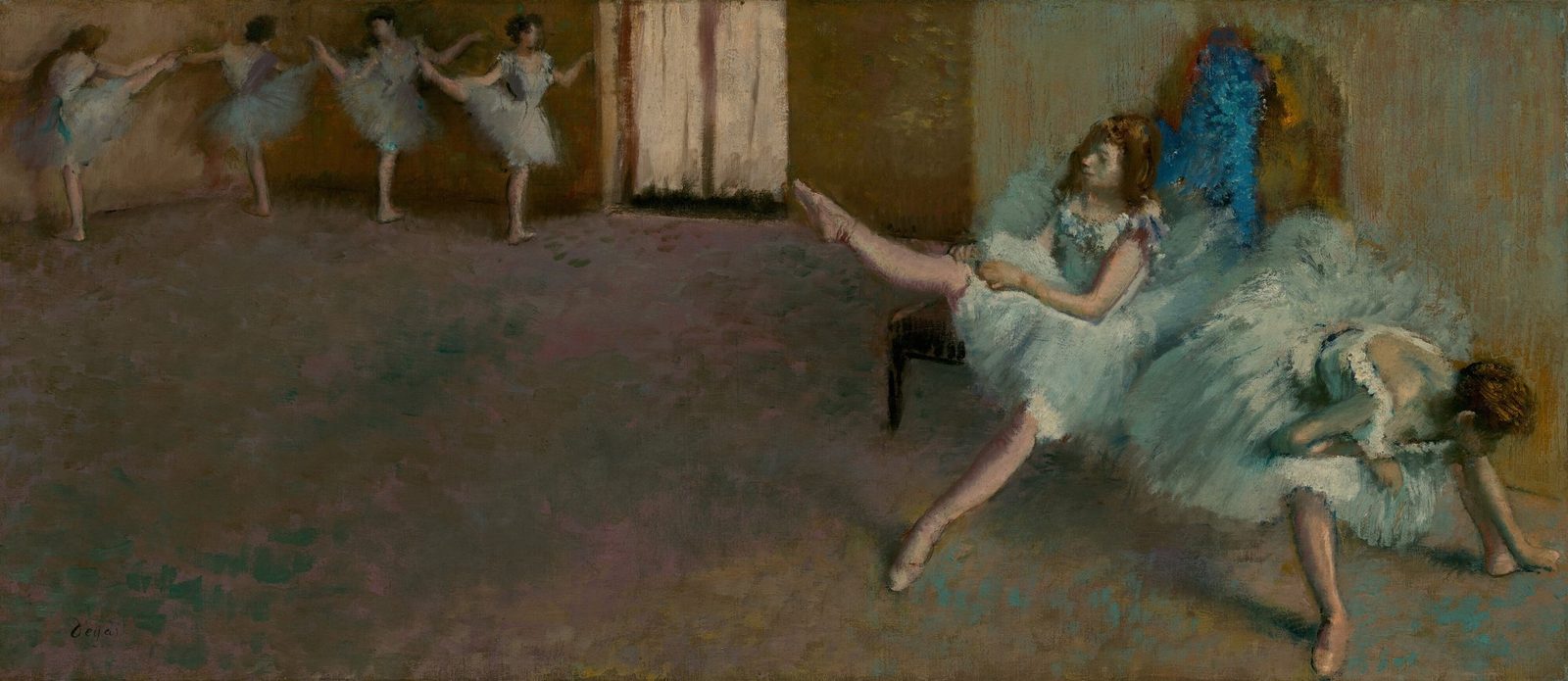
Degas fills a long, half-empty rehearsal room with dancers who are not yet performing
- Artist
- Edgar Degas
- Title
- Before the Ballet
- Date
- 1890/1892
- Medium
- oil on canvas
- Image
- Public domain (CC0)
Open in Simple Art
Watch this story on iPhone and iPad, with offline downloads and a painting every day.
About 4 minutes of looking, in 10 parts.
Before the Ballet
A long, low room, most of it empty floor. Far off, four small dancers practise along the wall. Close to us, two others stretch and bend, paying us no attention at all. Nothing has started yet, and that waiting is the real subject.
Degas, 1890 to 1892, oil on canvas
This is Edgar Degas's Before the Ballet, dated 1890 to 1892 and painted in oil on canvas. It belongs to the National Gallery of Art in Washington. The canvas is more than twice as wide as it is tall, and Degas makes use of every bit of that width.
Empty on the left, crowded on the right
Notice how the picture is split. The left half is almost bare floor, with the little dancers pushed up against the top edge. Everything heavy is crowded into the right. A long diagonal runs from the small figures' feet down to the corner, and it pulls your eye across the empty space.
The pale curtain
Halfway along the back wall hangs a pale curtain, the lightest patch in the room. Its vertical strokes of cream and pink sit against brown on either side. The soft light in the picture seems to come from this side, catching the limbs that face left.
Bent nearly double
Now the dancer in the corner. She is bent nearly double, reaching down towards her foot, while her tutu flares up behind her in pale strokes. Look at the far edge of the skirt. There's no outline. Short flicks of pale blue simply run into the brown wall.
The raised leg
Beside her, a seated dancer stretches one leg up and out to the left. The pink stocking looks built from a few long strokes, light along the top and softer underneath. Her hands are just a handful of dark marks, holding the leg near the knee.
A tutu made of separate strokes
Get closer to her tutu. It isn't filled in. It appears to be made of short, separate strokes of cream and pale blue, with the warm ground showing between them. From a few steps back, your eye mixes them into a soft, cool grey.
One strong blue
Behind her shoulder sits the strongest colour in the picture, a mass of bright blue, perhaps a shawl. It's laid on thickly over the brown wall. A thin rim of red-brown seems to edge it at the upper left, and that warm edge makes the blue look even colder.
Four dancers by the wall
Let your eye travel back across the floor to the four dancers by the wall. They are small and quickly done, pale tutus and thin pink legs dragged over brown. Their size alone pushes them far away, like the background of a snapshot.
A name on the floor
Down in the lower left corner, Degas has signed his name in dark paint, right on the floor. Around it, the floor is thinly scrubbed with rose and green. The signature sits inside the room rather than along the margin.
Look closer
9 details, each checked against a close-up of the picture.
-
Seated dancer's extended leg and tutu
The seated dancer's leg is raised and stretched out to the left, its pale pink stocking and slipper modelled with a smooth gradation against the brown wall and floor.
The crop centers on a seated dancer's leg thrust horizontally to the left, rendered in a soft rose-pink stocking that fades into a paler slipper tip. The tutu mass dominates the right half as a cloud of powdery blue, mint, and cream strokes that dissolve at the edges into the surrounding atmosphere. The leg's upper contour against the brown wall is a crisp, slightly serrated line, while its underside against the dark floor is softer and broken by short horizontal drag marks. Values climb from the deep umber floor (lower left) up through mid-olive greens into the near-white highlights catching the top of the stocking and the front of the tutu.
-
Bending dancer tying slipper
This dancer bends deeply at the waist, both hands working at her slipper while her tutu billows outward in pale strokes.
The crop isolates a dancer bent nearly double at the waist, her torso and head dropping to the right while her white tutu flares up and to the left in a fan of pale strokes. Her right leg extends downward, painted in a single column of warm flesh tone with a soft cast shadow running along its right edge. The hands descend toward the slipper area on the far right, rendered as a tangled cluster of cool grey and brown marks where form dissolves into the background. Edges are consistently soft and abraded: where tutu meets the cool teal drape on the left, the boundary is broken and scraped, not drawn. The palette splits into a warm ochre/terracotta field at the upper right against the cool blue-green and cream of the tutu, with flesh tones sitting in between as muted salmon-pink.
-
Seated dancer's tutu texture
The white tutu is constructed from short, separate strokes of pale blue and cream that leave visible gaps and canvas texture rather than a solid fill.
The crop centers on the seated dancer's tutu and supporting arm, rendered through short, parallel-to-slightly-curving strokes that follow the volume of the skirt. The strokes are visibly separate: between each cream and pale-blue mark, the warm-toned ground shows through, creating broken rather than blended edges. Shadows along the lower right (u 0.55–0.95, v 0.45–0.85) shift to cooler teal-grey, while highlights along the upper left skirt (u 0.20–0.50, v 0.20–0.45) lift with thicker cream and white strokes. The bodice area (u 0.30–0.55, v 0.10–0.30) is denser and more saturated in blue-green, contrasting with the airy, scratchy skirt below. A pale arm crosses horizontally, its flesh tone built from pink-cream strokes edged by a single cooler shadow stroke on the underside.
-
Row of four background dancers
Four tiny dancers stand in a line across the upper left, each figure differentiated by a small white tutu and pink legs against the brown wall.
The crop reads as a frieze of four ballerinas, each turned or angled differently, set against a flat brown wall. The tutus are built from cool, pale blue-grey strokes that sit on top of warmer brown underlayers, so the skirts appear to flicker between light and shadow rather than holding a single value. Legs are noted with thin, dry pinkish drags that often break in and out of the background, while torsos and faces are reduced to smudged passages of warm grey-violet. Edges throughout are open and porous; only the lit left-facing limbs and the white bodice of the right-most dancer carry firmer accents, letting the figures dissolve into the surrounding umber.
-
Blue cloak color accent
Thick strokes of saturated blue, perhaps a shawl or cloak, sit on top of the warm brown wall, contrasting sharply with the surrounding ochres.
A large, roughly triangular mass of saturated blue sits at the center of the crop, built from layered strokes that range from deep ultramarine at the core to lighter cobalt and a touch of cerulean in the highlights near the upper left. The blue's edges are broken and fuzzy, melting into warm umbers and orange-browns along the top and right, and into a cool blue-green where it meets the olive wall below. The surrounding wall reads as dry, scumbled ochre with faint vertical streaks, giving a rough, absorbent surface against which the wet, loaded blue strokes appear to float. A thin crescent of red-brown rims the upper left of the blue shape, an optical complement that intensifies the coolness of the cloak.
-
Hands gripping the raised leg
The seated dancer's hands, indicated by a few dark strokes, appear to hold her raised leg near the knee.
The crop shows a gestural intersection of two warm flesh-toned passages meeting a broad white-blue tutu form. A pinkish-peach limb descends from the upper left, its lower edge a soft smudged boundary where the tone dissolves into grey-pink rather than ending in a clean line. A warmer umber-brown arm arcs from upper center toward the right, tapering and ending near a small cluster of three to four short, dark greenish-brown strokes that read as fingers pinching a diagonal pinkish band (the stocking) against the white. The tutu below is a loose scumbled field of pale teal, off-white and cool grey, built from broken diagonal hatching that lets the dark green ground show through in spots. A dark mossy-green mass occupies the lower-left corner, its upper edge ragged and unresolved where it meets the tutu.
-
Dissolving edge of bending dancer's tutu
The right side of this dancer's tutu loses its contour entirely, dissolving into loose horizontal strokes of pale blue that merge with the brown wall.
The crop captures the dissolving right edge of a white tutu worn by a dancer bending sharply. The tutu's bulk is built from broad, loaded vertical and diagonal strokes of off-white and pale green, while the right margin breaks into short, parallel horizontal drags of pale blue (~#7FA8B0) and muted teal that sit directly on the warm brown wall without any drawn contour. The dancer's dark hair sits as a dense umber mass at upper right, separated from the tutu by a sliver of warm tan, and below it the white strokes taper into scumbled blue-green marks. There is no hard line where tutu ends and wall begins; the boundary is carried entirely by juxtaposed stroke direction and temperature shift from cool to warm.
-
Light-struck curtain panel
Vertical strokes of cream and pink in this curtain panel are distinctly lighter in value than the surrounding brown wall.
This crop isolates a curtain panel where vertical strokes of cream, pale pink, and warm beige read clearly lighter than the flanking brown wall passages. Three to four thin, darker vertical bands run top-to-bottom through the cream field, functioning as the shadowed valleys between folds. A dense, near-black horizontal smear sits at the base where the curtain meets the floor, with a soft greenish-brown bleed bleeding upward into the lower fabric. Edges between strokes are soft and broken, not crisp—strokes overlap and reveal the dark ground through gaps. A small sliver of pinkish form intrudes at the bottom right corner, and a pale vertical shape appears at the far left edge.
-
Degas signature lower left
The dark signature 'Degas' is placed low and isolated on the floor, surrounded by thin, scrubbed layers of rose and green paint.
The crop isolates the artist's signature 'Degas' in dark, looping cursive at left-center, set against a thinly worked, scraped ground of dusty rose and muted teal-green. The signature reads as a single confident pass of dark pigment, sitting crisply on top of the broken, scrubbed layer beneath rather than sinking into it. The background shows broad horizontal and slightly diagonal scraping marks where rose and green are dragged into one another, leaving the surface stippled and matte. A faint vertical darker band falls near the right third, hinting at a shadow or tonal shift in the original surface beyond this crop.
Before the Ballet in context
A long canvas from a long series
The National Gallery of Art dates Before the Ballet to 1890/1892 and records it as oil on canvas, 40 by 88.9 centimetres, signed 'Degas' at lower left [1]. A review of the 2019 to 2020 exhibition Degas at the Opéra notes that Degas first tried this shape, a canvas about twice as wide as it is tall, in 1878. He then sent The Dance Lesson to the Impressionist exhibition of 1879 [2]. Wikipedia counts some forty pictures in this frieze-like format and places Before the Ballet among them [3].
Writers have suggested several models for the format. The same review points to ancient friezes and the predella panels of early Italian altarpieces, to the asymmetry and cropping of Japanese prints, and to the sequential photographs of Eadweard Muybridge and Étienne-Jules Marey [2]. The Royal Academy adds that wide panoramic photographs of Paris may have played a part [4], and the Metropolitan Museum lists elongated formats among the qualities Degas took from Japanese art [5]. None of these is documented as the source for this canvas in particular, so they are best read as possibilities.
Figures that travel
Degas moved poses from one work to another. In Degas at the Opéra, a figure from Before the Ballet was shown alongside her appearances in Dancer Adjusting Her Slipper (1885) and Seated Dancer Massaging Her Foot (1881 to 1883) [2]. The reviewer explains that many of his large drawings of the 1890s and 1900s were made on tracing paper. This let him copy motifs and recombine them [2].
The dealer Ambroise Vollard recalled the old Degas saying that the dancer was for him a pretext for painting fabrics and movement [4]. The National Gallery's own description reads the nearer seated dancer as pulling on her pale pink tights, and the four dancers at the back as practising with raised legs near a pair of French doors [1]. It calls the arched area of blue and mustard yellow behind the seated pair difficult to interpret [1], which is why the story only offers 'perhaps a shawl'.
Oil that looks like pastel
By 1885, according to the Metropolitan Museum, most of Degas's more important works were made in pastel [6]. The Royal Academy calls pastel his principal medium after the mid-1880s [4]. When he did paint in oil around 1890, the result could take on pastel's look. The Met says that in its Dancers, Pink and Green, of about 1890, he mixed his colours with white to make them opaque and laid them on thickly in several layers, approximating his pastel technique [7].
No published technical study of Before the Ballet was found for this article, so it isn't certain how far it shares that method. The National Gallery describes its visible, soft brushstrokes as giving the studio a blurred, ethereal appearance [1]. The Met dates the start of Degas's failing eyesight to the late 1880s and says he then concentrated almost entirely on dancers and nudes [6]. The Degas at the Opéra review describes how, as his sight worsened, he looked for ways to make his colours more intense [2].
The ballet world behind the picture
For decades the Paris ballet's home was the opera house on the rue Le Peletier, which burned down in 1873 [2]. Its replacement, the Palais Garnier, opened in 1875. But the review reports that its grandeur didn't appeal to Degas, and that details of the old building linger in rehearsal pictures begun after the fire [2]. Only in 1885, it adds, could he afford a subscription that gave him access to all areas of the theatre [2].
The rehearsal room was a hard world. Girls, usually from poor families, joined the ballet at seven or eight, and promotion could depend on the backing of a wealthy male subscriber, an abonné [2]. The Metropolitan Museum's history of ballet adds that by the 1880s the inventive energy of the Paris ballet had declined along with its popularity, and Saint Petersburg had become the centre of the dance world [8]. Counts of Degas's ballet works vary. The Met gives approximately 1,500 [6], and the review nearly 1,300 [2].
From Durand-Ruel to Washington
The National Gallery's provenance begins with the private collection of the dealer Paul Durand-Ruel in Paris. He sold the painting in 1913 to Peter A. B. Widener of Lynnewood Hall, Elkins Park, Pennsylvania [1]. It passed through Joseph E. Widener and came to the gallery as a gift in 1942 [1]. Widener catalogues of 1915 and 1923 reproduced it under the title Le Foyer de la Danse [1].
The painting was shown at the Grafton Galleries in London in 1905 and has travelled often since. It went to Degas and the Ballet: Picturing Movement at the Royal Academy in 2011, and to Degas at the Opera in Paris and Washington in 2019 to 2020 [1]. It was also lent to a 2014 exhibition on Japanese inspirations in Essen and Zürich [1].
- Edgar Degas, Before the Ballet (1942.9.19): object record, provenance, exhibition history and visual description (Internet Archive copy) . National Gallery of Art, Washington
- Corrinne Chong, review of Degas à l'Opéra / Degas at the Opéra (Musée d'Orsay and National Gallery of Art), Nineteenth-Century Art Worldwide, Autumn 2020 . Nineteenth-Century Art Worldwide
- The Dance Lesson . Wikipedia
- Ann Dumas, Degas and the Ballet (2011) (Internet Archive copy) . Royal Academy of Arts, London
- Colta Ives, Japonisme, Heilbrunn Timeline of Art History (2004) (Internet Archive copy) . The Metropolitan Museum of Art, New York
- Ruth Schenkel, Edgar Degas (1834-1917): Painting and Drawing, Heilbrunn Timeline of Art History (2004) (Internet Archive copy) . The Metropolitan Museum of Art, New York
- Edgar Degas, Dancers, Pink and Green (29.100.42): object record (Internet Archive copy) . The Metropolitan Museum of Art, New York
- The Ballet, Heilbrunn Timeline of Art History (2004) (Internet Archive copy) . The Metropolitan Museum of Art, New York