Croquet Scene — Winslow Homer
Painting the social instant: how Homer stages four players around a single crouching focal point.
- Artist
- Winslow Homer
- Title
- Croquet Scene
- Date
- 1866
- Medium
- Oil on canvas
- Museum
- Art Institute of Chicago
- Image
- Public domain (CC0)
Open in Simple Art
Watch this story on iPhone and iPad, with offline downloads and a painting every day.
About 4 minutes of looking, in 10 parts.
A quiet croquet match, mid-swing.
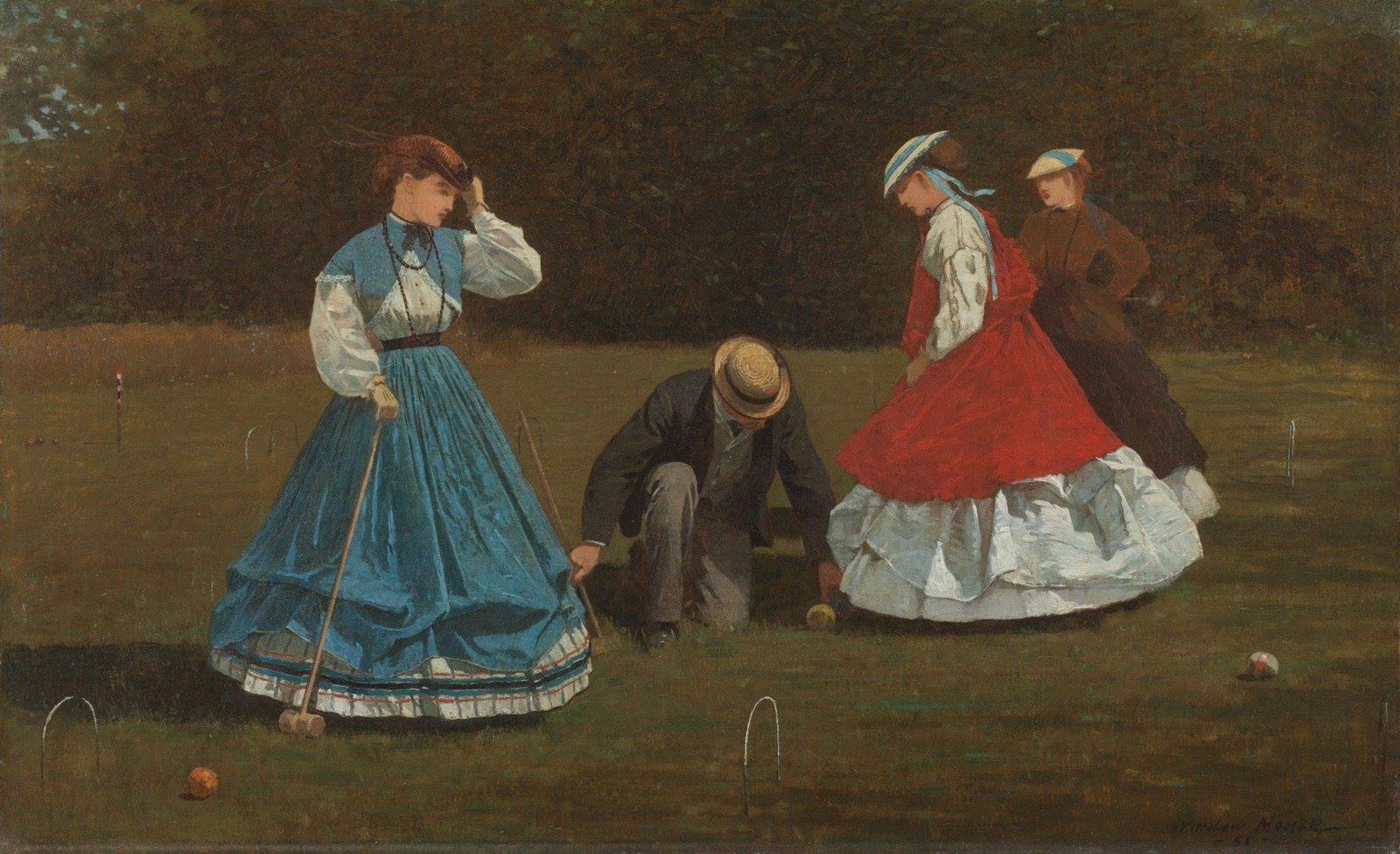
A picnic scene frozen in mid-motion, four figures and a man on a sunlit lawn. Saturated blue and vermillion meet across the canvas like two flags planted in the grass, and a lone straw hat bobs between them. Homer has arranged them into a single hush of a triangle around the crouching man at the center.
Winslow Homer, Croquet Scene, 1866.
Winslow Homer's Croquet Scene, oil on canvas from 1866, sits at the threshold of his American Realism. The subject is leisure, not labor, but the handling is already loosening, the broken foliage behind the figures hinting at the proto-Impressionist touches that will define his later work.
A triangle of players across the middle band.
Drop a horizontal at the canopy and the horizon sits just above center, with the figures clustered in a band beneath it. The two standing women flank a single downward-pointing triangle whose apex is the crouching man's head, while the mallet runs diagonally off to the left, leading the eye out of the apex.
Cool blue opposite warm vermillion.
Read the picture chromatically and you see a complementary scheme in operation: a cool teal blue on the left, a warm vermillion on the right, both pulled forward from the muted olive field. The two right-hand figures and the grass settle into a shared warm-olive middle that quietly recedes, leaving the chromatic anchors to do the loud work.
The vermillion dress anchors the eye.
That red skirt is the chromatic anchor. Broad, loaded strokes shift from bright red on the raised folds to deep maroon in the recesses, sitting above a pale, scumbled petticoat in cool whites and faint blue-greens. The hem is scalloped, not drawn: each lobe of red sits as a separate, slightly overlapping stroke against the white below.
The crouching man's unresolved face.
Now move down into the man at the apex of that triangle. His face is left as a single dark umber mass, no eyes, no mouth, just a shadow shape tilted downward beneath the straw brim. Homer has prioritized silhouette and posture over facial finish, and the squint test tells you everything his brush refuses to.
Light reads on the right of the hat.
The straw hat confirms the lighting: a loose patch of cream-yellow sits on the upper right of the crown, while the left side cools into tan and the brim deepens toward brown shadow. Concentric brushstrokes follow the curvature of the weave, so form and weave and light are read in the same gesture.
The mallet cuts a single straight line.
A single loaded tan stroke, the mallet's shaft, cuts diagonally down through the soft folds of the blue dress without bending to their curves. It anchors and unifies the composition, a sharp linear gesture laid over a complex undulating passage of fabric.
The blue dress models with cool variation.
That blue skirt across the way is built from mid-blue scumbles with deeper teal in the recesses and a paler cerulean riding the raised folds. The hem trim reads as a crisper, separate pass of white and red-orange piping, pushing the dress forward against the warmer field.
The foliage canopy, dabbed into atmosphere.
Behind them, the trees dissolve into short, broken dabs of olive and umber, never resolving into leaf shapes. Tiny punctuations of pale sky read through at the upper left, and a few warm ochre flecks catch the sun-flecked light above the figures. This is the proto-Impressionist handling the loose brush promised.
Look closer
9 details, each checked against a close-up of the picture.
-
The Crouching Man
The man's face is painted with summary, blurred strokes rather than detailed features.
The crop centers on a man crouched low in a croquet stroke, with the straw hat dominating the upper third. Beneath the hat brim, the face reads as a single dark umber mass with no eyes, nose, or mouth resolved — just a shadow shape tilted downward. The jacket is built from broad, loaded strokes of near-black with cooler blue undertones visible at the left sleeve seam and a warmer highlight along the right shoulder. The gray trousers show a few scumbled vertical strokes for the knee bend, with the edge against the jacket kept soft rather than drawn. The grass around the figure is dark olive-green with short, dry-brush dabs, and a small yellow croquet ball peeks in at the lower right.
-
Vermillion Dress
The saturated red of the dress is contrasted against the pale cream of the petticoat beneath it.
The crop is dominated by a single figure's lower half: a saturated vermillion overskirt with broad, loaded brushstrokes that shift from bright cadmium-like reds on the raised folds to deep maroon in the recesses, sitting above a pale petticoat painted in loose, scumbled whites, cool grays, and faint blue-greens. The hem where the red meets the petticoat is a scalloped, brushed edge rather than a drawn line—each lobe of red skirt is a separate, slightly overlapping stroke. Behind her, a second figure in dark brown is rendered more thinly, with the brushwork dissolving into the olive-green foliage. A sliver of a third figure in straw hat and dark trousers appears at the left edge, partially cropped. The grass plane is a single low-chroma olive, brushed horizontally.
-
Blue Dress
The dress uses various shades of blue and teal to define the deep folds of the fabric.
The crop isolates the woman in the blue dress from waist down to hem, plus a sliver of the man's dark sleeve at right. The skirt is built from broad, somewhat scumbled strokes of mid-blue mixed with deeper teal in the recesses and a paler cerulean in the raised planes. Edges between light and shadow are softened but legible, especially along the deep vertical folds that radiate from the waist. The white underskirt at the hem reads as horizontal layered strokes with thin red-orange piping, contrasting against the blue and pushing the dress forward. The wooden mallet forms a strong vertical diagonal cutting across the skirt, painted in warm browns.
-
Foliage Canopy
The background trees consist of short, broken, dabbing brushstrokes of green and brown.
The crop shows a dense wall of foliage rendered in short, broken, dabbing marks of dark olive, brownish-green, and umber, with tiny punctuations of cooler blue-green where the sky reads through at the upper left. Edges between individual marks are kept soft and never resolve into leaf shapes; instead the strokes stack into a textured atmospheric mass that recedes behind the figure. Lighter ochre and warm brown dabs are scattered across the upper register to suggest sun-flecked canopy, while the lower band sits in heavier, more saturated brown. The contrast between the wet, loosely handled background and the more deliberately modeled face and blue bodice makes the figure push forward.
-
The Mallet
The mallet's shaft is a single, long, thin line that cuts sharply across the blue dress.
The crop isolates the lower half of a blue-dressed figure and a long, diagonal mallet shaft running from a white cuff at upper right down to the cylindrical mallet head at lower left. The shaft reads as a single, almost uninterrupted tan-brown line that slices straight through the deeply folded teal dress without bending to the fabric's contours. At the top, a gloved/cuffed hand grips the shaft, and at the bottom the mallet head sits on a strip of grass just below a horizontally striped hem (red, white). The dress folds are built from layered strokes of deeper blue-green against shadow, while the shaft keeps a near-uniform width and value across its length.
-
Straw Hat Highlights
A bright white-yellow highlight is concentrated on the right side of the hat's crown.
The crop shows a near-overhead view of a straw hat with a clearly woven crown composed of concentric, circular brushstrokes that follow the curvature of the form. The right side of the crown is rendered in warmer, lighter cream-yellow tones, while the left side cools and darkens into tan and ochre browns, and the brim on the lower left deepens further into a dark brown shadow. Edges between the brim and the green-brown background are soft and slightly broken, with small flecks of background color left in the straw to read as weave rather than a continuous surface. The brightest pixels cluster in a loose patch on the upper-right of the crown, where short, pale strokes sit on top of the warmer mid-tone rather than blending into it.
-
The Croquet Ball
The yellow ball is rendered as a small, bright orb with a soft shadow on the grass.
The crop centers on a roughly circular yellow-ochre ball resting on dark, scumbled grass. Its upper-right rim catches a warm, near-white highlight while the lower-left curves into a cool olive-brown core shadow, and a soft, blurred cast shadow pools immediately beneath. Above, a wedge of vermillion fabric with a vertical white highlight enters the frame; its edge against the ball is lost in dark greenish-brown scumbling rather than sharply drawn. The grass is built from short, overlapping olive and bottle-green strokes, with hints of warmer brown showing through where the ball meets the ground, indicating wet-into-wet blending at the contact zone.
-
Hand to Forehead
The woman in blue has her left arm raised with her hand touching her hat brim at her forehead.
The crop centers on a woman's face and left arm raised to her brow. Her face is modeled with soft, blended passages in warm pinks and ochres against deep brown hair; the cheek on the right catches a subtle highlight consistent with overhead-right light. The blue bodice reads as a broader, cooler plane built from mid-value ultramarine with a few darker accents at the bow and along the arm seam. To the right, a loose passage of pale blue-white fabric (the raised sleeve or a companion figure's limb) is laid in with broad, visible strokes that leave the dark ground partially uncovered at the lower edge. Edges vary: the silhouette of the arm against the dark background is largely dissolved, while the cuff and necklace chain hold crisper, more linear marks.
-
Grass Texture
The grass is painted with loose, scumbled horizontal strokes of olive and ochre.
The crop centers on a patch of cropped lawn holding a vermilion croquet ball, with the lower edge of a blue dress, white petticoat bands, a mallet head, and the curved wire of a wicket intruding at the edges. The grass is built from short, near-parallel horizontal strokes that read as a continuous field rather than individual blades. Values shift in soft horizontal bands: a darker olive strip behind the ball and beneath the wicket, lifting to a warmer ochre passage in the sunlit foreground. Edges between stroke and ground are broken and slightly irregular, with hints of warmer earth showing through the cooler green, and the ball sits on a small soft shadow that anchors it without a hard contour.
Croquet Scene in context
A new game on American lawns
The Art Institute notes that croquet had recently been introduced to the United States from the British Isles when Homer painted this canvas, describing it as a game where women and men competed with one another [1]. The Buffalo AKG Art Museum dates its arrival to around the early 1860s, noting that it spread quickly as an outdoor pastime where both sexes could take part on equal terms [2]. The museum suggests that Homer, known as something of a dandy, may also have valued the game as a showcase for current fashions [2].
One of five
Buffalo says Homer made five croquet paintings between 1865 and 1870, with its own Croquet Players of 1865 being the earliest [2]. Wikipedia adds that his uncle's house in Belmont, Massachusetts, built in 1853, inspired several of his croquet pictures of the 1860s [3]. The Chicago canvas, measuring 40.3 by 66.2 centimetres, is signed 'WINSLOW HOMER/-66-' at the lower right [1].
A text on the Dutch site golfgeschiedenis.nl, which repeats the Art Institute's description, adds that Homer began to work in oil in 1862 and remained largely self-taught, and that his training as a draughtsman and printmaker shows in the broad, simple planes of this picture [4]. Buffalo also sees in Homer's work of these years a parallel with the Impressionists, who shared Homer's interest in sunlight and high-keyed colour [2].
Between war pictures and Paris
The croquet series sits alongside Homer's Civil War subjects. Wikipedia lists Prisoners from the Front as a painting of 1866, noting that he showed at the National Academy of Design every year from 1863 to 1866 and became a full Academician in 1865 [3]. He went to Paris for a year in 1867, while Prisoners from the Front hung at the Exposition Universelle [3].
Reading the gesture
That same golfgeschiedenis.nl text offers a further reading of the crouching man [4]. It says his gesture might be a chivalrous effort to help the woman keep a modest pose, or an attempt to glimpse her ankle [4]. And it notes how the dark foliage throws the bright dresses into high relief [4].
From a Boston family to Chicago
The museum records that William Sumner Appleton of Boston owned the painting from 1871 to 1903, after which it passed by descent to William Sumner Appleton, Jr. [1]. It was with C. C. Childes of Boston by 1941 and was sold through M. Knoedler and Co. to the Art Institute in 1942, bought through the Friends of American Art Collection and the Goodman Fund [1]. Frederick Sweet wrote about it in the museum's Bulletin in December 1943 [1].
It later travelled in Winslow Homer: The Croquet Game, an exhibition that opened at the Yale University Art Gallery in 1984 and came to Chicago that December, appearing as no. 20 in David Park Curry's book of the same name [1]. The painting was also shown in Coming Away: Winslow Homer and England at Worcester and Milwaukee in 2017 to 2018 [1].
- Winslow Homer, Croquet Scene: collection record . Art Institute of Chicago
- Winslow Homer, Croquet Players (1865) . Buffalo AKG Art Museum
- Winslow Homer . Wikipedia
- Croquet Scene, Winslow Homer, 1866 . golfgeschiedenis.nl