Don Antonio Noriega (Goya, 1801) — A Painting Walkthrough
How a state portrait becomes a portrait of character
- Artist
- Francisco Goya
- Title
- Don Antonio Noriega
- Date
- 1801
- Medium
- oil on canvas
- Image
- Public domain (CC0)
Open in Simple Art
Watch this story on iPhone and iPad, with offline downloads and a painting every day.
About 5 minutes of looking, in 12 parts.
A man caught between office and inwardness
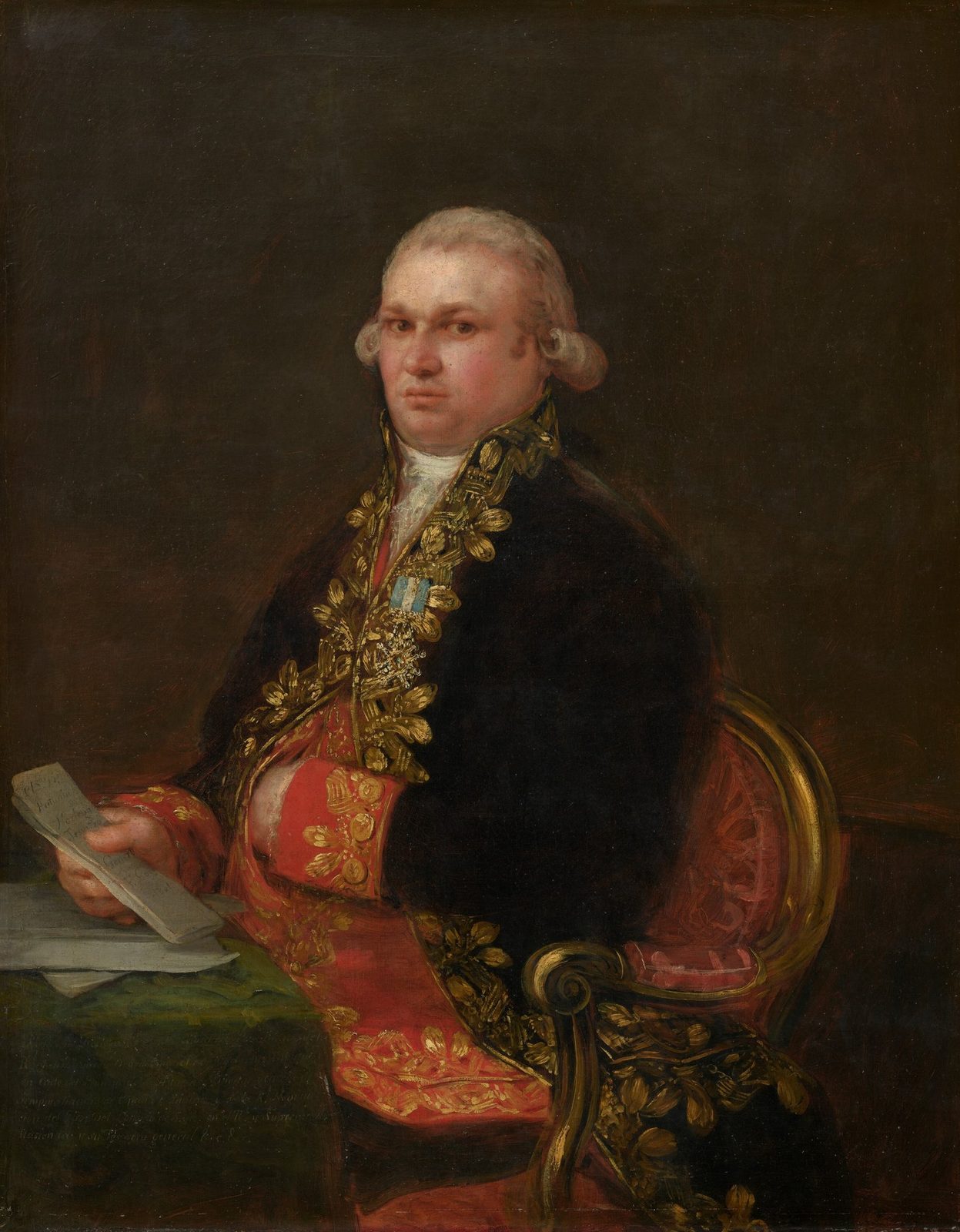
Meet Don Antonio Noriega — a Goya state portrait from 1801 that turns ceremonial into something quietly unsettling. The camera opens on the full canvas: a seated man in a gilded chair, half bathed in light, half lost to shadow, a folded document in his hand and a medal at his chest.
Late Goya, oil on canvas
Painted in 1801, this is a late-Goya manner: loose handling, theatrical light, and a sitter whose medal and document stage him as a man of office. Goya lets the rank-speak live in the costume, then quietly complicates it with shadow and an unsmiling gaze.
A pyramid built on diagonals
Stand back and you'll see a perfect pyramid: the head at the apex, the shoulders and embroidered lapels widening down through sleeves, sash, and table. The diagonals run from the bright face through the gold embroidery, down the red sleeve, and out to the folded paper in the lower left.
One key light, deep chiaroscuro
Watch the light. A single upper-left key light carves the face, throws the right side into soft shadow, and glints off every metal thread. The rest of the canvas is essentially dark support, with bright accents arranged almost like a constellation around the head.
The face is built from light, not line
Drop into the face. Forehead, nose bridge, and left cheekbone catch the highest value; the right cheek steps down through warm pinks into cooler browns that nearly meet the background. Goya models the head through light and shadow — not contour. There is no hard line where flesh meets the dark ground.
An edge that melts into air
Follow the gray side curl on the right. Its outer edge doesn't terminate in a line — the paint thins out and the value drops to almost match the background, so the form dissolves laterally. That lost edge is what makes the head feel atmospheric, not pasted on.
Loaded dabs, not drawn filigree
Now the gold embroidery on the lapel. Each motif is a comma-shaped or lozenge-shaped dab of loaded paint, thicker at the highlight tip, thinner at the trailing edge where the red ground shows through. This is real impasto catching real light — these strokes are dragged, not drawn.
A cool badge inside warm gold
At the center of the braid, a small pale-blue ribbon and a cream medallion break the warm gold field. Notice how the warm strokes actually cross over the cool shape — the badge of office is fused into the ornament, not outlined. The temperature contrast does the work of separation.
One red, shifted in value
The red sleeve moves from a warm, orange-leaning scarlet on the lit ridges to a cooler, darker crimson in the recesses. The hue stays in one family — only value and temperature shift to describe the volume. That's how you model saturated fabric without resorting to black.
Dark ground as half-tone
Drop down to the white cravat. It is just a few broken, off-white strokes laid over the dark imprimatura, with the ground itself doing the modeling. That negative space — the dark showing through the gaps — is half the form. The painter reserved the highlight for opaque dabs only where the cloth actually catches light.
White paper as a second light
The right hand grips a folded paper — the highest value outside the face. The brightest white of the sheet is saved as a crisp, hard-edged shape; only where the thumb crosses does the edge soften, suggesting pressure. That soft crossover is what makes the hand wrap the paper instead of floating on top of it.
The chair echoes the costume
Out to the right: the gilded chair back is painted with the same vocabulary as the embroidery. A single dragged stroke of ochre-and-umber runs along the convex arm, then short comma-flicks of bright paint read as carved relief. Pure dark fills the negative space between elements — the gold is made of light alone.
Look closer
10 details, each checked against a close-up of the picture.
-
Illuminated face and wig in chiaroscuro
The sitter's face is brightly lit from the upper left while the right cheek and temple dissolve into soft shadow.
The crop shows a man's head and upper shoulders against a dark brown ground. A strong key light from the upper left hits the forehead, the ridge of the nose, the left cheekbone, and the curls above the ear with the highest value; the right side of the face (viewer's right) steps down through warm pinks into cooler browns that nearly meet the background. The forehead is built from loose, visible, slightly hatched strokes of pink-white laid over a cooler underlayer, and there is no hard outline where flesh meets the dark backdrop—the right temple and ear dissolve into the ground. The hair is a few broad, broken strokes of white, gray, and umber rather than individual strands, while the gold-embroidered lapel is set down in thick, opaque, buttery touches of yellow ochre that read as metal against the flat black of the coat.
-
Gold embroidery impasto on coat and lapel
Thick, raised strokes of pale-gold paint create actual texture that reads as metallic embroidery.
The crop isolates the gold-embroidered lapel and front edge of a dark coat, where a dense skein of pale-gold and ochre strokes sits over a deep red ground and against a near-black background. The marks are clearly gestural, not filigreed: each 'floret' reads as a short, comma-shaped or lozenge-shaped dab of paint, sometimes loaded thickly, sometimes a dry drag that leaves a broken edge. A central rosette frames a small shield-shaped medal in blue and white, surrounded by a halo of lighter, more broken touches. Highlights cluster on the upper-left side of every motif, with the lower-right of each leaf falling back into a darker ochre or the red beneath, producing consistent modeling across hundreds of tiny strokes.
-
Hand and paper catching the key light
The white paper and the flesh of the hand are the highest-value shapes outside the face.
A right hand grips a folded paper, the thumb pressing the upper fold while the lower fingers curl beneath. The paper is the highest value in the crop, catching a cool off-white key light from the upper left, with brown ink cursive strokes visible on its surface. The flesh sits just below that peak value — warm peach-pink on the knuckles, falling to a ruddy umber in the creases between fingers and along the palm edge. A second sheet of paper lies flat at the bottom, slightly cooler in tone and lower in value, with a soft cast shadow under its lifted right edge. The red cuff and gold embroidery form a saturated middle-ground mass, while the green table cover drops into a deep olive-black at the lower edge.
-
Red sleeve with shifting warm scarlet tones
The red sleeve moves from deep crimson in the folds to bright scarlet on the light-struck ridges.
The crop isolates the sitter's forearm and cuff, dominated by a red sleeve broken into distinct value zones by loosely brushed folds. Gold embroidered trim with three circular buttons runs diagonally down the cuff, applied in thick, opaque strokes that sit on top of the red rather than being blended into it. The red on the upper-left lit area reads as a warm, orange-leaning scarlet, while the recessed fold running across the middle and the lower-right edge shift toward a cooler, darker red. Edges between the gold and red are soft, often letting one stroke of one color sit adjacent to a stroke of the other rather than meeting in a hard line.
-
Lost edge of side curl against background
The gray side curl on the right melts into the dark background with no hard contour line.
The crop isolates the right temple and a single gray side curl set against a very dark, near-black ground laced with fine craquelure. The flesh above is built from warm pink-ochre touches laid over a deeper reddish-brown shadow, with the highlights brushed in thin, broken strokes rather than blended smooth. The curl itself is a small comma of cool grayish-white, and its outer edge does not terminate in a crisp line; instead the pigment thins out and the value of the hair's silhouette drops almost to the value of the background, so the form dissolves laterally. A cluster of olive-gold and dark green touches at the lower left reads as the top of a gilded chair rail or embroidered coat edge, painted with short, loaded strokes that sit proud of the ground.
-
Blue ribbon and medal at the chest
A small pale-blue ribbon and a silver medallion are pinned at the center of the gold braid.
The crop centers on a pale blue ribbon, painted with short, loaded strokes that retain their bristle marks; the ribbon's edges are soft and broken, dissolving into the surrounding gold embroidery. A round medallion hangs below, built from pale cream and white dabs over a darker core, with a small connecting loop of darker paint. Thick impasto gold curls radiate outward in comma-shaped gestures, catching the key light from the upper left, while the right side drops into a near-black void. A sliver of deep red occupies the upper-left corner, reading as a separate sash or trim. The contrast between the cool blue-white center and the warm gold surround is the dominant value-and-temperature relationship.
-
Right hand gripping the folded document
The sitter's right thumb presses the top edge of the folded paper while the fingers curl beneath it.
A right hand grips a folded sheet of grayish-white paper that angles diagonally from upper-left to lower-right. The thumb, modeled in warm pink-tan flesh with a bright catchlight on its nail and knuckle, presses down along the paper's top fold, while the fingers disappear as a soft, cooler shadow mass beneath the sheet. The paper's surface is cooler and more neutral than the hand, with a thin dark line of cast shadow running along the crease where the thumb compresses it. Behind the hand, a saturated red sleeve trimmed with thick gold-leaf-like dabs recedes, and the lower half dissolves into a greenish-gray table surface scumbled with loose, broken strokes.
-
White cravat at the throat
The white cravat is painted with quick, broken strokes that leave the dark ground visible in the folds.
The crop centers on a soft, V-shaped cravat rendered with thick, broken off-white strokes that follow a generally downward and outward direction. The dark brown ground/underlayer reads clearly through the gaps between strokes, especially in the shadowed recesses on the right and along the diagonal cast shadow from the chin. Edges between the cravat and the gold-trimmed lapels are left soft and broken rather than drawn as a continuous contour. Cool blue-gray notes sit inside the warm white mass to suggest the depth of the folds, and the entire surface is fractured by a fine craquelure network.
-
Gilded armchair and red upholstery
The carved gilt arm and red upholstery are painted with warm impasto similar to the costume.
The crop isolates the right side of a gilded armchair, dominated by a broad C-shaped gilt arm curving from the top-right down to a tight spiral volute on the lower-left. The gold is built from thick, dragged strokes of yellow-ochre and raw-umber mixed in a single load, with a bright highlight ridge running along the arm's outer edge where the upper-left key light catches. Red upholstery appears in two zones: a vertical back panel of dark crimson brushed in long vertical swipes, and a small seat cushion where lighter salmon-red horizontal dabs sit on a deeper red ground. A heavily carved, scrolling gilt apron beneath the seat is rendered in short, comma-shaped flicks of ochre on a near-black ground, so the relief is read almost entirely through these bright notes rather than through modelled shadow. Edges throughout are soft and broken; the gilt arm dissolves into the dark background along most of its inner curve, while the outer edge carries a continuous impasto highlight.
-
Faint inscription in lower left corner
Barely legible cursive script is visible in the lower left beneath the table edge.
The crop reveals a thin, dark olive-brown paint field that has been inscribed with several lines of faint cursive script running horizontally across the upper-middle portion. The lettering appears to sit slightly above the surface tone, reading as pale tan/grey against the deeper umber ground, with letters formed by thin linear marks rather than broad strokes. On the right edge a sliver of saturated red-orange fabric is visible with ochre and white accents suggesting gilded embroidery, contrasting sharply with the muted inscription field. The whole surface shows fine craquelure, scattered pin-prick losses, and a slight sheen that hints at aged varnish. The lower portion of the crop is largely empty of inscription, dominated by horizontal scraping marks and warm umber scumbling that fades into near-black at the bottom edge.
Don Antonio Noriega in context
Two versions of a life
The National Gallery's 1990 catalogue of its Spanish paintings, by Jonathan Brown and Richard G. Mann, calls the sitter Antonio Noriega Bermúdez, born in Bada in Asturias, and says his date of birth is uncertain [2]. It describes him as a close friend of Manuel Godoy, the king's first minister, and notes that in 1799 he was appointed to the kingdom's general administration of public property and tax revenues [2].
Spanish Wikipedia gives a fuller and partly different account. It says he was born on 7 March 1769 at Castañera, near Arriondas, the natural son of a local judge. He went to Madrid in 1784 or 1785, entered the treasury in 1790, and was named royal treasurer by Godoy in 1800 [3]. These two sources disagree on his mother's name and birthplace, and neither can be settled here.
Titles written into the picture
Besides the letter in his hand, a longer inscription runs along the tablecloth at lower left [1]. It lists him as a knight of the Order of Charles III, delegate at the court of the Prince of Asturias, director general of the Temporalidades of Spain and the Indies and of the Real Negociación del Giro, a member of the king's finance council and its treasurer general [1][2]. The catalogue warns that this inscription is badly abraded and nearly illegible in places [2].
He was made a knight of the Order of Charles III on 23 July 1801, and the blue and white ribbon on his coat is the order's [2]. Spanish Wikipedia says the portrait was commissioned to mark that honour [3]. As treasurer general he ranked second in the finance ministry, and no account could be paid without his authorisation [2].
The court painter's officials
Goya had been appointed first court painter on 31 October 1799, the highest post open to an artist at the Madrid court [2]. After 1801, the catalogue says, he received few royal commissions, but he went on painting officials such as Noriega, whose rank is spelled out, alongside plainer, more intimate portraits [2].
Mann reads the picture as the image of a dedicated, worried administrator. He suggests the hand inside the jacket signals authority rather than any imitation of Napoleon [2]. The Norton Simon Museum adds that Goya painted Noriega's wife, Francisca Vicenta Chollet y Caballero, in 1806. The museum also notes that changes found by X-ray have led some scholars to think the two portraits were first planned as a pair [4].
Debt, arrest and the Guadiana
The catalogue judges his handling of state funds from 1801 to 1808 as disastrously inefficient and corrupt, noting the national debt rose from about 4,108 million to 7,204 million reales [2]. It says French soldiers seized and imprisoned him in Badajoz, and a Spanish mob later attacked and set him on fire, believing he was collaborating with Napoleon [2].
Spanish Wikipedia tells it differently. He was arrested after the Mutiny of Aranjuez in March 1808 and released, then detained in July by order of the Junta of Extremadura. He was held in Badajoz, where a crowd killed him on 16 December 1808 and threw his body into the Guadiana [3].
From an ambassador to the Kress Foundation
Ferdinand Eduard von Stumm, the German ambassador in Madrid from 1887 to 1892, bought the painting from a private collector there, and it was sold with his estate in Berlin on 4 October 1932 [1]. It passed through Wildenstein to the Samuel H. Kress Foundation in 1955 and came to the Gallery in 1961 [1]. In 2008 it returned to Spain for the Prado's Goya en tiempos de guerra, and was lent to the Museo de Bellas Artes de Asturias in Oviedo in 2009 to 2010 [1]. Examination found that a later hand had unfolded the left tacking edge and painted it into the picture surface [1].
- Francisco Goya, Don Antonio Noriega (1961.9.74): object record, inscription, provenance, exhibition history, technical summary and bibliography (Internet Archive copy, 31 March 2025) . National Gallery of Art, Washington
- Jonathan Brown and Richard G. Mann, Spanish Paintings of the Fifteenth through Nineteenth Centuries (Systematic Catalogue, 1990): Goya biography and entry for Don Antonio Noriega (Internet Archive copy) . National Gallery of Art, Washington
- Antonio Noriega de Bada . Wikipedia (Spanish)
- Francisco de Goya, Doña Francisca Vicenta Chollet y Caballero (1806) (Internet Archive copy, 7 February 2026) . Norton Simon Museum, Pasadena