One light for an invented place
How Canaletto makes a ruin, a hill town and a palace feel like a single real view
- Artist
- Canaletto
- Title
- English Landscape Capriccio with a Palace
- Date
- c. 1754
- Medium
- oil on canvas
- Image
- Public domain (CC0)
Open in Simple Art
Watch this story on iPhone and iPad, with offline downloads and a painting every day.
About 4 minutes of looking, in 9 parts.
English Landscape Capriccio with a Palace
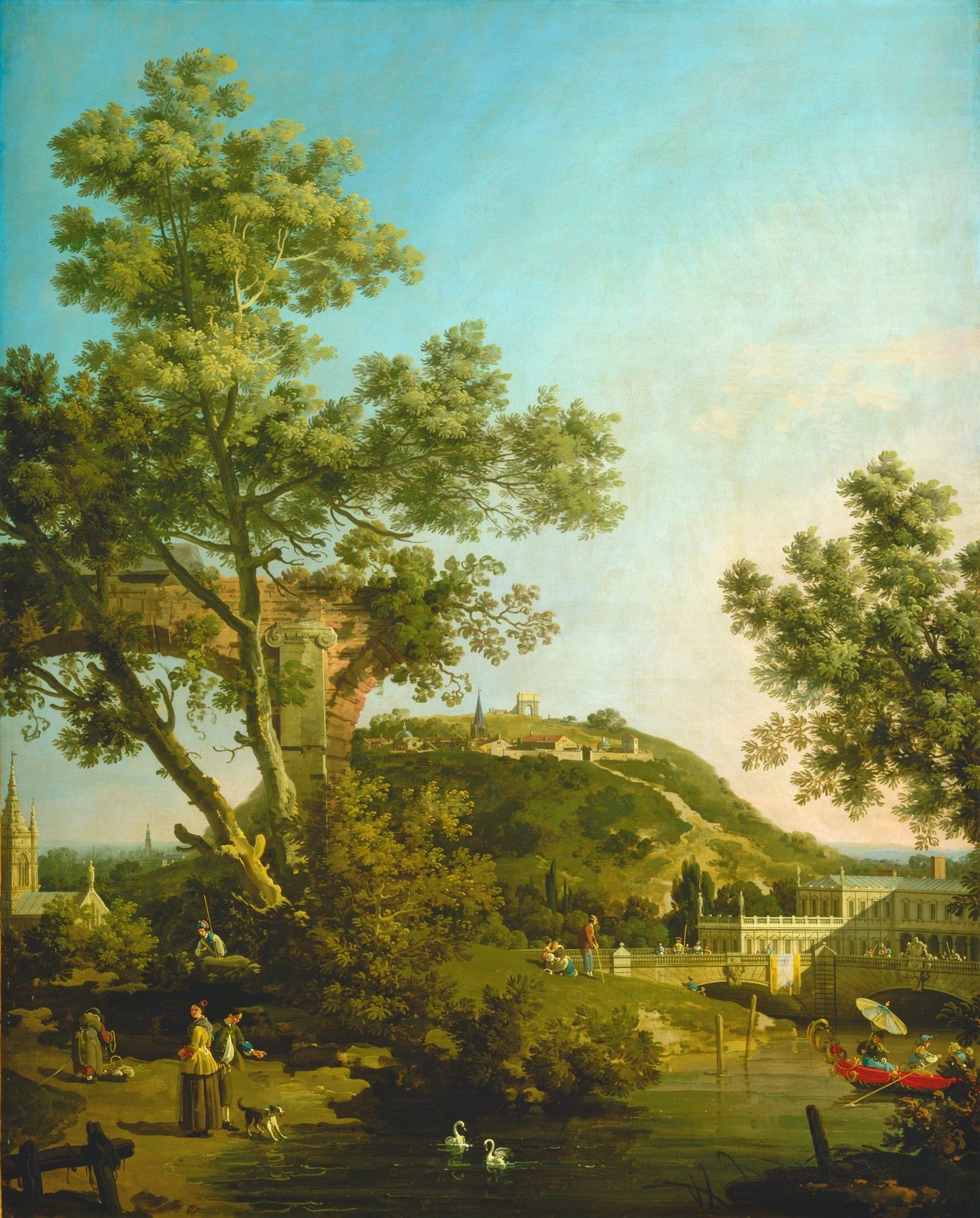
A huge tree, a ruined arch, a town on a hill and a pale palace by the water. It all looks like a real place on a fine afternoon. But this is a capriccio, an invented view, and the pleasure lies in seeing how it's put together.
Canaletto, c. 1754, oil on canvas
This is Canaletto's English Landscape Capriccio with a Palace, painted around 1754 in oil on canvas. It's a tall picture, well over a metre high. Its buildings seem to come from quite different places, which is exactly the freedom a capriccio allows.
Two masses in balance
The tall tree and the ruin fill the left side. On the right, a long, low palace and bridge answer them, and the green hill links the two. Try following a path: down from the treetops, across the hill to the palace, onto the red boat, then back along the water to the figures.
A pale town on the hill
Look up at the hilltop. The houses, the walls and a pale arch on the crest are painted in cream and ochre, clearly lighter than the green slope around them. There's no outline holding them in. The jump in tone is enough to lift them off the hill.
Tree and ruin, tangled together
Now the ruin on the left. A thick trunk rises diagonally in front of a broken brick arch, and beside it stands a square pier topped by a capital with two scrolls. Where the surface has worn away, warm brick courses show, set down in small, dry strokes. Notice the trunk's long, smooth strokes against the choppier marks of the stone.
Leaves in separate dabs
Lift your eye to the top of the tree. Up close, the leaves break into separate little dabs of yellow-green over a darker olive. The blue sky shows between them rather than being mixed in, which helps the crown look light and airy.
The palace and its bridge
Glide down to the palace on the right. A sharp roofline runs straight across, with a row of evenly spaced balusters below and tall, narrow windows in a steady rhythm. The light seems to come from the upper right, and the bridge arch underneath drops into cool shadow.
One red note
Just below, a boat with a scarlet hull sits on the water. It's the brightest colour in this corner, kept almost to a single tone, with gold scrollwork at the prow. Above it, a pale parasol shows a turquoise underside. Everything around it is quieter green and water.
Two swans on dark water
Drift back left along the water to the two swans. Each is only a few dabs of warm white with a yellow beak. Their reflections are short, soft vertical smears, kept close in tone to the dark water, so the surface stays calm and glassy.
Look closer
7 details, each checked against a close-up of the picture.
-
Crumbling aqueduct and crossing tree trunk
A crumbling stone arch with exposed brick courses and a carved capital is partly obscured by the thick tree trunk and hanging foliage.
A thick, diagonally-rising tree trunk cuts across the picture plane from lower right toward upper left, its pale olive-barked surface in high key against the cooler sky. Behind it, a fractured stone arch frames a sliver of pale cyan sky on the left, while a second arch on the right terminates in a clearly drawn Ionic capital with two scrolled volutes. The masonry reads as layered: warm terracotta brick courses sit exposed where plaster has broken away, the rectilinear courses painted with small, dry, slightly broken strokes that suggest mortar gaps. Values are organized so the lit capital and right-side wall sit in mid-key, while the underside of the arch and the deep recesses read as a warm near-black, pushing the trunk forward. Foliage tufts are dabbed in distinct clusters of yellow-green over a darker olive ground, with crisp calligraphic curls of twigs and tendrils silhouetted against the sky.
-
Red gondola chromatic accent
The gondola’s hull is painted in a flat, saturated scarlet that is the single brightest chromatic passage in the lower right quadrant.
The lower right quadrant is dominated by the gondola's hull, laid in as a broad horizontal band of saturated red that reads as the most chromatic passage in the area. The red is essentially one value, modulated only by a slightly darker shadow along the lower belly and a thin lighter rim where the gunwale catches the upper-right light. Edges against the water are soft and slightly blurred, while the upper edge against the seated figures is crisper. The prow scrollwork is dry-brushed in a warm gold over the red, with the gilt losing definition as it recedes toward the right. The parasol above is a pale ivory-yellow with a turquoise-blue underside, providing a near-complementary counterpoint to the scarlet below.
-
Palace terrace and bridge arch
The palace terrace shows evenly spaced balusters and crisp horizontal rooflines, while the bridge arch below falls into cool shadow.
The crop centers on a two-story palace façade with a pale, warm-toned wall lit from the upper right; a sharp horizontal roofline runs across the top, capped by small statues and rectangular chimneys. Below, a balustrade with thin, evenly repeated balusters tops the terrace, and tall narrow windows march in a regular rhythm across both stories. A stone bridge with a large arch sits in the foreground, its underside plunged into cool shadow, and a yellow-and-white banner/cloth hangs down from the terrace parapet. A diagonal cast-shadow line cuts across the bridge face, and the arch shows faint radial lines suggesting voussoir joints, though individual masonry units are blurred rather than crisply grouted.
-
Tree crown foliage and sky
Individual leaf clusters are built from discrete strokes of yellow-green and deep green that remain unblended against the blue sky.
The crop shows the upper canopy of a deciduous tree set against a fairly uniform turquoise sky. Foliage is built from clearly discrete, comma-shaped or finger-like strokes of yellow-green that sit unblended over deeper olive-green underpainting; the blue sky reads between the strokes rather than being mixed into them. Cluster edges are ragged and broken, formed by the tips of individual dabs rather than a continuous contour. A pale cream-toned curving branch (right of center) is painted opaquely over the green masses, while darker trunk and branch segments emerge only where foliage gaps occur, indicating the foliage was laid in after the branch structure.
-
Ruin masonry and arch detail
The ruined wall shows alternating stone and brick courses, chipped edges, and a deep shadowed arch interior next to the smooth bark of the tree trunk.
The crop centers on a fluted Ionic column whose volutes are picked out in pale olive-cream against a deep grey-green shaft. To the right of the column, an arched opening reveals a near-black green-brown recess, its inner curve marked only by a thin lighter edge along the pier. The masonry around the arch and above the capital is laid in horizontal courses that alternate warm orange-red brick with cooler tan stone blocks; the upper right corner shows the mortar lines as notched, chipped edges where the brickwork terminates in a jagged silhouette. The twisted trunk at left is rendered with long, smoothed strokes of warm grey-green and ochre highlight catching the rounded forms, contrasting with the squared, granular dabs of the ruin behind it. Foliage is massed in cool yellow-green at the lower right and as small leafy clusters around the column mid-height.
-
Hilltop temple in warm light
The hilltop building is rendered in pale cream and ochre tones that make it noticeably lighter than the surrounding dark green hillside.
The aqueduct-like hilltop structure sits in the upper left-center, painted with a pale cream-yellow body (#E8DCA0-ish) and slightly cooler grey shadows in the arch opening and along its right edge, while a darker brown-grey church spire anchors the far left. The surrounding hillside is built up in mid-value olive-green strokes that shift warmer toward the crest, then step darker into the foreground mass where the brushwork becomes broader and more opaque. A cluster of village roofs sits on the lower ridge in muted terracotta, pale stone walls, and a small blue-grey cupola, forming a tonal mid-band between the bright crest and the deep greens below. The sky is a thin, scraped-looking pale wash that lets warm underpainting show through, lifting the upper-right more than the left.
-
Swans on glassy water
Two white swans float on dark water, their reflections painted as short, soft vertical streaks kept close in tone to the water.
The crop isolates two small swans floating on a near-black, olive-tinted water plane, with a dense canopy of foliage above. The swans' bodies read as compact dabs of warm white and cream, with sharp yellow-ochre beaks that pop against the dark surround. Beneath each bird, reflections are rendered as short, vertical streaks of pale green and off-white that blur into the water, edged by faint horizontal scumbles of lighter pigment suggesting shallow ripples. The foliage overhead is built from loose, scumbled olive and black passages with a few warmer golden-ochre dabs that read as leaves catching raking light from the upper right. Edges between swan and water are crisp at the breast and softer along the wing backs, and the dark water reads as a single unifying value because the reflections are kept low-contrast.
English Landscape Capriccio with a Palace in context
A Venetian in London
Canaletto (1697-1768) made his name with views of his native Venice. But his popularity with British patrons took him to England in 1746, and he stayed for nine years [1][3]. Reviewing the 2006 exhibition on this period, Jeffrey Collins explains that the War of the Austrian Succession had disrupted tourist travel and dried up his business. So if his customers couldn't come to him, he would go to them [4].
In England he painted St Paul's Cathedral, Somerset House and Westminster Bridge, but also views of Venice and Rome and capriccios, imaginary scenes in which he freely combined Renaissance palaces and classical ruins [3]. Not everyone was impressed. Wikipedia reports that George Vertue suggested the man painting as Canaletto was an impostor, and that the artist answered with a newspaper advertisement inviting gentlemen to inspect his latest picture at his studio [5].
Pictures for particular rooms
Collins stresses that much of Canaletto's English work was decorative, commissioned for particular interiors and sometimes set into stucco frames above doors or chimneypieces [4]. In England, he writes, capriccios let elite patrons show the wit and learning they had picked up on their travels in the south [4].
This canvas belongs to a set the National Gallery of Art traces to the King family [1]. The Gallery says it was probably commissioned by Thomas King, later 5th Baron King (1712-1779), of London and Ockham Park in Surrey [1]. That view follows Francis Russell, who argued in 1993 that the overmantel of the series, the only picture signed and dated 1754, is dominated by a memory of Eton chapel, and that Thomas's son went to Eton; the canvases, Russell suggested, presumably hung first in the family's London house rather than at Ockham [1]. W.G. Constable recorded an older family tradition that the pictures were paid for with money from Thomas's 1734 marriage to Catherine Troye; the Gallery's note adds that, because one is dated 1754, they would then have been bought by the 3rd or 4th Baron, the view Russell later rejected [1]. Sotheby's, cataloguing a related picture in 2005, put it plainly: nobody knows exactly how or when the family acquired them [7].
How it was painted
The painting has a companion in Washington, English Landscape Capriccio with a Column, with the same provenance [2]. Thread counts show the two canvases came from different rolls [1]. Over a thin white ground, Canaletto built the picture up from the middle distance. He finished each part before painting the next layer of detail on top, so completed architecture or landscape often lies beneath the figures [1]. He sketched the figures quickly in a dark wash, let it dry, then coloured them with thicker opaque paint, lighter for the highlights and darker for the shadows [1]. A little red warms the sky, and X-radiographs show no changes to the composition [1].
Eton also appears in a real view by Canaletto in London's National Gallery. Painted around 1754, it was among the last pictures of his English stay. By 1755 he was back in Venice [6].
From Ockham to Washington
The set descended at Ockham Park to Peter Malcolm King, 4th Earl of Lovelace (1905-1964). He sold it at Sotheby's in London on 13 July 1937 [1]. Sotheby's lists seven Canaletto paintings in that sale, among them this picture and its companion [7]. Knoedler bought it. Philip Hill acquired it in 1938, and Mrs Philip Hill, later Mrs Warwick Bryant, owned it until 1959 [1]. After passing through Rosenberg & Stiebel in New York, Paul Mellon bought it in December 1960. He gave it to the National Gallery of Art in 1964 [1].
Afterlife
From 1964 to 1977 the painting was lent to the residences of American ambassadors, first in London and then in Brussels and Rome [1]. It appeared in Canaletto exhibitions at the Guildhall in London in 1959, the Metropolitan Museum of Art in 1989-90 and Birmingham in 1993-94 [1]. In 2006-07 it was included in Canaletto in England: A Venetian Artist Abroad, 1746-1755, at the Yale Center for British Art and Dulwich Picture Gallery [1][4]. The Gallery's 2023 page placed it in Gallery 31 of the West Building and noted that it hadn't been treated since acquisition [1].
- English Landscape Capriccio with a Palace (1964.2.2): object record, provenance, exhibition history and technical summary (Internet Archive copy, 29 March 2023) . National Gallery of Art, Washington
- English Landscape Capriccio with a Column (1964.2.1): object record (Internet Archive copy, 31 May 2023) . National Gallery of Art, Washington
- Canaletto in England: A Venetian Artist Abroad, 1746-1755 (publication page) . Yale Center for British Art
- Review of Canaletto in England: A Venetian Artist Abroad, 1746-1755 (Jeffrey Collins, 2007) . caa.reviews, College Art Association
- Canaletto . Wikipedia
- Canaletto, Eton College (NG942) . The National Gallery, London
- Bernardo Bellotto, Rome, a view of the Piazza di San Giovanni in Laterano: catalogue note (Old Master Paintings Evening Sale, 2005, lot 51) . Sotheby's