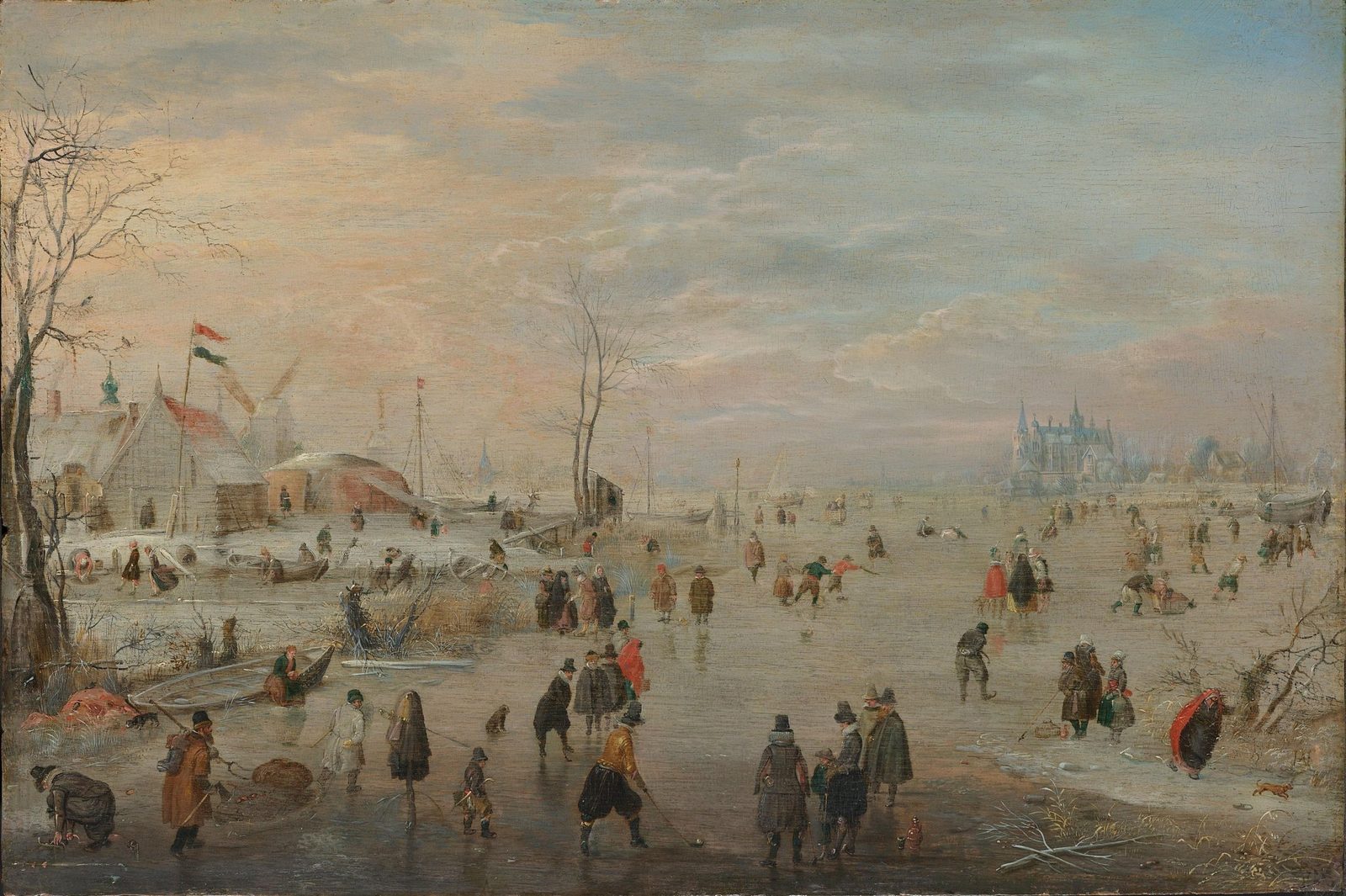
A game of kolf by the castle
How Avercamp fills a small panel with skaters and kolf players, and steers us with a few bright notes of colour
- Artist
- Hendrick Avercamp
- Title
- Enjoying the Ice
- Date
- c. 1610 - c. 1620
- Medium
- oil on panel
- Museum
- Rijksmuseum
- Image
- Public domain (CC0)
Open in Simple Art
Watch this story on iPhone and iPad, with offline downloads and a painting every day.
About 4 minutes of looking, in 10 parts.
Enjoying the Ice
A frozen waterway runs right across the picture, crowded with skaters, walkers, flags and boats. Everything is small, and almost everyone is busy. Before naming anything, just let your eye wander over the ice for a moment.
c. 1610 to 1620, oil on panel
This is Enjoying the Ice by Hendrick Avercamp, painted in oil on panel around 1610 to 1620 and signed with his monogram, H A, at the bottom right. The Rijksmuseum describes it simply: many figures skating and playing kolf on frozen water near a castle.
A stage with wings
The horizon sits about halfway up. Below it, a band of figures fills the foreground, and a tall bare tree on the left and a clump of reeds on the right act like the wings of a stage. Between them the ice draws you back towards the distant buildings.
A warm strip of sky
Look just above the far shore. There's a narrow band of warm, creamy peach, and above it the sky cools to blue-grey with no hard line between them. Masts, a flagpole and bare branches are drawn thinly against that glow.
The kolf player
Now come down to the front. A skater in a glowing gold-ochre coat bends forward, his kolf stick aimed at a small ball on the ice. He's the warmest, brightest shape down here, and the people in black and brown beside him, a child among them, seem to stand back and watch.
Tent, pennants and a windmill
Over on the left, in the middle distance, a low domed tent stands in terracotta and pinkish orange, with a cream highlight along its ridge. Beside it two pennants trail from a pole, one coral red and one dark green, and a tiny windmill sits behind. Each looks like the work of only a few quick strokes.
One red cloak
Now cross the ice to the right. A small hooded figure in a bright red cloak stands out at once. The red looks thick and solid, while the ice and reeds around it are thin and broken, so this one little shape carries your eye all the way across the picture.
The castle in the haze
Further back, the castle rises as a cluster of spires and gables, all in one cool blue-grey against the warm sky. Its edges are soft, with no drawn detail. The pale, close values are what make it seem far away.
How the ice is made
Look down at the ice under the figures' feet. It appears to sit on a dark, warm brown layer, with thin horizontal strokes of grey and pale blue-white drawn across it. That warmth showing through keeps the cold surface from looking flat.
The tree at the edge
Finally, the tree at the left edge. Its dark trunk splits into fine, tapering branches against the pale sky, and in places the twigs thin out so the sky shows through. It frames the view and nudges your eye back into the scene.
Look closer
7 details, each checked against a close-up of the picture.
-
Foreground Skating Group
A skater in a gold-ochre coat glides toward the right, followed by figures in dark brown and gray garments.
The crop centers on a skater in a luminous gold-ochre coat, bent forward and gripping a kolf stick aimed at a small ball on the ice, his dark breeches and boots anchoring the warm torso. To the right stands a group of dark-clad figures, one seen from the back in a black coat with a fur-trimmed collar, a child in muted green tucked between the adults. Upper left shows a small cluster of distant figures in dark brown and gray with a tiny dog and a wash of red flag. The ice reads as thin, scumbled warm grays and browns with horizontal striations, while the figures' edges are softened against the pale ground.
-
Red-Clad Figure
A small figure wearing a bright red cloak stands out against the pale blue-gray ice.
The crop isolates a hooded figure swathed in a saturated red cloak against a desaturated, cool blue-gray ground. The red reads as the highest chroma note in the frame, applied with what appears to be a fairly thick, opaque pass that retains brush texture along the curved edge of the hood and cloak hem. Inside the hood, a small dark face is indicated with a few quick strokes of dark brown and a pale dab for the cheek/forehead, the edges softened rather than tightly drawn. The surrounding ice and background reeds are handled with thin, dragged, broken strokes in ochre, gray, and pale blue, allowing the panel/silk ground to show through in many places, which makes the solid red mass read as a dense, opaque shape in contrast.
-
Tent and Flags
A low domed tent in terracotta and pinkish orange, with a cream highlight along its ridge, stands beside a pole with two pennants, one coral red and one dark green, near a small windmill.
The crop centers on a small windmill with X-shaped sail arms rendered in thin, brownish-ochre strokes that fuse into the pale peach sky. Two pennants hang from a thin pole at the upper left: a coral-red flag on top and a dark moss-green flag below, their tattered ends trailing rightward. To the right sits a low domed tent, painted with quick strokes of terracotta and pinkish-orange punctuated by a cream-white highlight along its ridge. A small dark staffage figure stands at the lower center against the tent's base. The entire surface is crossed by a fine web of craquelure, and edges between forms are softened rather than crisp.
-
Horizon Glow
The horizon line features a warm, creamy yellowish light that contrasts with the cool blue sky above.
The crop isolates the upper sky band and the distant horizon, where a narrow strip of warm creamy-peach pigment sits just above a faintly indicated landmass. Above this warm band the paint shifts into cool blue-grays, with the transition achieved through soft wet-into-wet blending rather than a hard edge. A pervasive web of craquelure runs across the entire surface, and thin scumbled passages reveal the lighter ground showing through in the upper sky. Bare tree branches on the left and the delicate verticals of a mast, flagpole, and crane-like sweep are silhouetted thinly against the glow, their dark accents anchoring the bright band beneath them.
-
Foreground Ice Texture
The ice is rendered with thin, mostly horizontal strokes of grey and pale blue-white over a dark, warm brown layer.
The crop shows the lower section of the ice surface, with the bases of three standing figures (a tree trunk and two pairs of booted legs) anchored along the upper edge. The ice itself is built on a dark, warm umber-brown ground that reads as wet and slightly reflective. Over this ground, the artist laid thin, mostly horizontal strokes of cooler gray and pale blue-white, breaking the surface into a network of scumbled marks. Small dabs of bright white and a single roundish pale blob (likely a snowball) sit on the lower surface. A few faint red touches appear in the upper-left corner, possibly berries or distant figures.
-
Distant Town Silhouette
The distant castle-like buildings are massed in muted blue-grey, with pointed spires and gables against a warm sky.
The crop reveals a castle-like town cluster rendered almost entirely in cool blue-grays against a warm pinkish-peach sky. Multiple pointed spires rise vertically, with the tallest central tower flanked by shorter turrets and stepped or triangular gables. Building edges are soft and slightly blurred, with no crisp architectural detail; the structure reads as a silhouette shaped by negative space rather than by drawn lines. Bare twiggy trees on the right share the same blue-gray key, while the foreground ground plane shifts to ochre and tan with small dark figure-strokes scattered along the bank. A pervasive network of fine craquelure covers the whole surface, confirming the age and oil-medium build-up.
-
Left Framing Tree
The dark, slender branches of the leafless tree overlap the pale sky on the left edge.
A slender leafless tree dominates the left edge, its dark trunk rising vertically and splintering into fine, tapering branches that fan across the upper two-thirds of the crop. The branches read as crisp, near-black silhouettes against a warm, pale peach-cream sky that subtly shifts to a cooler tone higher up. In the lower third, rooftops appear behind the trunk: a small green onion-domed turret, a brick-red chimney, and pale grey roofs touched with rust and pink, all sitting against the off-white ground. Fine craquelure networks the surface, and the tree's edges are slightly broken where pigment has thinned on individual twigs.
Enjoying the Ice in context
Which river, which castle?
In the Rijksmuseum's 2007 catalogue, Jan Piet Filedt Kok describes numerous figures on a frozen river, with a small village and a windmill on the left and the wall of a town with a castle in the right background [1]. People have named the location in different ways. A.M. van Luttervelt thought the castle was Breda Castle, but an 18th-century French label on the back of the panel identifies the places as Dordrecht and Zwijndrecht [1].
Albert Blankert went further and regarded the castle as a 19th-century addition [1]. Filedt Kok rejects this, noting that there isn't the slightest physical evidence to support it [1].
Early or late?
The museum dates the panel to about 1610-1620, but the date has been argued over [1]. Filedt Kok notes that it is far smaller than the other two Avercamps in the Rijksmuseum. He adds that its lower horizon, the absence of large trees acting as stage flats and the natural way the eye is led into the picture all point to a later stage in Avercamp's development [1]. Most authors have placed it after 1620 [1].
Filedt Kok is not convinced, since the only later ice scene with a date, of 1620, gives no clear support, and the type and dress of the figures, such as the old man with an axe and a pitchfork, look much like those of 1615-1620 [1]. Only the more tonal landscape might suggest a later date, and P. Roelofs, judging by the figures, preferred the more cautious range of about 1610-1620 [1].
Tree-ring dating helps a little. The youngest heartwood ring in the oak panel was formed in 1592, so the panel could have been ready by 1603. But a date in or after 1609 is thought more likely [1].
Thin paint, moved figures
The catalogue describes an off-white ground and a rather thin, transparent paint layer [1]. Many of the small figures were painted on top of the landscape, including over bushes, and some were moved, leaving numerous small pentimenti [1]. The reddish blue of the cloudy sky suggests that evening is approaching. And the palette becomes almost monochrome at the horizon, which suggests aerial perspective [1].
In 1978 the restorer M. Zeldenrust removed discoloured varnish and an overpainting of the ice before retouching and revarnishing the panel [1]. The museum rates the condition as fair, noting abrasion along the grain in the sky and in the figures of the lower half [1]. Two undated copies of the composition, catalogued as by followers of Avercamp, were sold in Munich in 2016 and in Basel in 2018 [1].
Kolf on the ice
The museum lists 'kolf' on the ice among the subjects of the panel [1]. The early Dutch club-and-ball game known as colf was played in streets and squares, and towns passed many ordinances against it [3]. When canals and lakes froze, players moved onto the ice, and the game often appears in paintings of frozen rivers [3]. Over time the Dutch game moved onto covered courses beside taverns and became the indoor game of kolf [3].
In September 2026 the Rijksmuseum and the Mauritshuis announced that they had jointly acquired Avercamp's Colf Players on the Ice of about 1625 [2]. CODART's report calls colf one of the oldest ball games in the Low Countries and a forerunner of golf. It says the painting would be shown first in Kampen from 3 October, in the exhibition Avercamp Back in Kampen [2].
From an oil executive to Kampen
Handwritten labels on the back show that the panel was in a French collection in the 18th or 19th century [1]. The Amsterdam dealer Nicolaas Beets had it in 1930 and advertised it in the journal Pantheon [1]. Sir Henri W.A. Deterding (1866-1939) of London gave it to the Rijksmuseum in 1936 [1].
Deterding was general manager of the Royal Dutch Petroleum Company from 1900 to 1936 and chairman of the combined Royal Dutch/Shell group [4]. In his last years he became an admirer of the German Nazi Party [4]. The museum cautions that its provenance was compiled with a special focus on 1933-1945 and may be incomplete [1].
Since 2011 the panel has been on loan to the Stedelijk Museum Kampen [1]. Kampen is the town where Avercamp's family settled in 1586 and where he was buried in 1634 [1].
- Hendrick Avercamp, Enjoying the Ice (SK-A-3247): object record and catalogue entry (Jan Piet Filedt Kok, 2007) . Rijksmuseum, Amsterdam
- Rijksmuseum and Mauritshuis jointly acquire iconic winter landscape by Avercamp (16 September 2026) . CODART
- Kolf . Wikipedia
- Henri Deterding . Wikipedia