Stone on the right, water on the left
How Canaletto walks your eye along the Venetian waterfront to the domes across the water
- Artist
- Canaletto
- Title
- Entrance to the Grand Canal from the Molo, Venice
- Date
- 1742/1744
- Medium
- oil on canvas
- Image
- Public domain (CC0)
Open in Simple Art
Watch this story on iPhone and iPad, with offline downloads and a painting every day.
About 4 minutes of looking, in 10 parts.
Entrance to the Grand Canal from the Molo
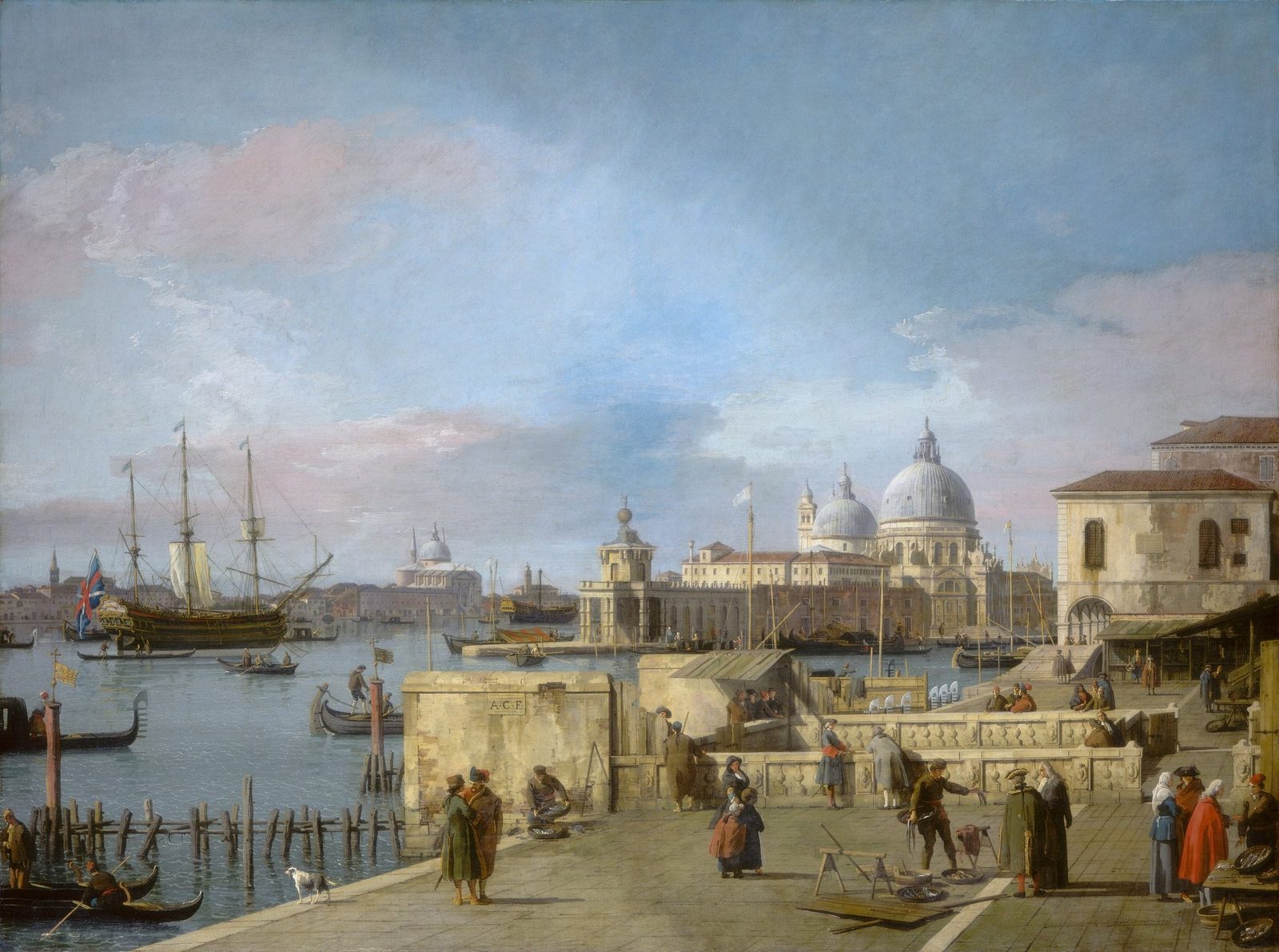
Warm stone on the right, cool water and sky on the left. The quay runs into the picture on a diagonal, crowded with people, and at its far end pale domes rise across the water. Let your eye follow the paving and see where it takes you.
Venice, 1742 to 1744, oil on canvas
This is Canaletto's Entrance to the Grand Canal from the Molo, Venice, painted in oil on canvas between 1742 and 1744. The Molo is the stone waterfront. Low down, just left of centre, is a small inscription. We will come back to it.
The diagonal of the quay
The quay and its railing run from the bottom of the picture up towards the right. That diagonal funnels you to the domes of Santa Maria della Salute and the customs-house tower. The open lagoon on the left balances all that weight of stone.
A dog and two long shadows
Start in the foreground. A small white dog stands by wooden posts at the water's edge, and two men talk beside it. Their shadows fall long and flat to the right, so the light comes from the left. The dog is just a few broken touches.
A red cloak against cool stone
Over at the lower right, a vivid red cloak stands out against a cool blue-grey wall. The two seem close in lightness, so it is the warmth of the red that does the work. A thin dark edge on the lit side is enough to bring the figure forward.
The letters A.C.F.
Now find that small panel. It carries the letters A.C.F., which the museum reads as Antonio Canal fecit, Antonio Canal made it, and describes as a cartellino, a painted label on the wall. Each letter is mostly one dark stroke, with a faint lighter touch along the top of some.
Sun above, shade below
On the building at the far right, the upper wall is warm, sunlit ochre. Beneath it, the arcade drops into cool violet-grey shade. The change is soft rather than a hard line, and the figures inside are painted in the same cool greys, which pushes them back into the shadow.
Domes and a tower
Follow the quay to its far end. The great dome seems built from paired vertical strokes, a pale rib beside a cooler groove. Then glance left to the top of the tower, where hair-thin lines and tiny dark openings make the stone look cut out against the sky.
A ship across the water
Now swing back across the lagoon to the tall ship on the left. The rigging is drawn in very fine dark lines, while the furled sails are soft cream shapes. A red, white and blue flag hangs at the stern.
Ripples in short strokes
Look closely at the water below. Over a cool blue-grey layer sit many short, slightly curved strokes of paler paint, in rough horizontal rows. Close to, they are separate flicks. From a few steps back, they merge into shimmering grey water.
Look closer
9 details, each checked against a close-up of the picture.
-
Salute domes and Dogana tower
The ribbed domes of Santa Maria della Salute rise to the right of the customs-house tower, with a thin dark pole carrying a small white flag against the sky between them.
The large ribbed dome dominates the right half with vertical ridges rendered as alternating pale lead-gray highlights and cooler shadow grooves; its scalloped lantern crown carries crisp white edges against a soft pinkish-cream cloud. A smaller secondary dome sits slightly left of center, sharing the same ribbed structure but reduced in scale, with its lantern barely catching the upper-left light. The Dogana tower occupies the left third: a stone drum topped by a darker putto-and-gold-globe finial, its arcaded loggia described with short, vertical, linear strokes of warm cream against gray-brown shadow. A thin dark vertical pole crosses the sky between the tower and domes, carrying a small white triangular flag rendered with a few soft, broken touches rather than a hard outline. The sky is built from a thin gradient—pale blue upper-left warming to cream-pink right—laid in continuous, blended passages that contrast with the firmer architectural edges.
-
Three-masted ship and flag
The vessel's masts and furled sails are drawn with dark thread-like strokes, and a red-white-and-blue flag flies from its stern.
Three tall masts rise vertically across the frame, their rigging drawn as extremely fine, dark hairlines that thread against a pale pinkish-blue sky. Furled sails hang as soft cream-yellow rectangles, their edges softened by thin halftones rather than crisp outlines, contrasting with the crispness of the rigging threads. The ship's hull forms a heavy dark mass across the lower third, edged along its upper strake with a thin gilded-yellow band that catches light. At the stern left, a flag of red, white and blue hangs in limp folds, its colors brushed as flat planes with minimal modeling. Small boats in the foreground carry figures rendered as quick dabs of brown and ochre, subordinated in finish to the ship above.
-
Red cloak against cool shadow
A figure's vivid vermilion cloak is set against a cool blue-grey shadowed wall, separated by a crisp vertical mortar line.
The crop isolates a group of three figures standing before a stone wall and tiled quay. A sweeping vermilion cloak dominates the right side, its warm hue pushing forward against a cool blue-grey recessed wall panel. The wall behind the figures shows faint carved relief ornament at upper left, then descends into flat shadow. A subtle vertical seam or mortar joint runs just left of the red cloak, acting as a tonal hinge between the warm figure and the cool architecture. The cloak's lower edge is not sharply cut but feathered where it overlaps the brown-clad figure, while its upper contour against the man's tricorn is crisp and dark.
-
Dogana tower finial details
The customs tower's upper lantern, sphere finial, and flanking windows are rendered with hair-thin straight lines and pinprick apertures.
The crop isolates the upper half of the customs tower, where a small standing figure (likely a weathervane statuette) tops a dark grey-brown sphere finial. Below the sphere, an octagonal lantern with tall arched openings sits on a moulded cornice. The arched apertures are read as crisp dark slits against pale cream stone, surrounded by pilasters defined with hair-thin vertical strokes. To the right, a separate slender column rises beside a lower building whose tiled roof is laid in repeated diagonal hatchings of warm terracotta. The sky is laid in as a continuous, slightly cool blue field that sits behind every silhouette, giving the linear architecture a punched-out clarity.
-
Lagoon surface brushwork
Short, slightly curved strokes of paler paint sit in rough horizontal rows over a cool blue-grey layer, merging into soft grey water from a distance.
The central field of water is built from a cool blue-grey underlayer overlaid with hundreds of small, short strokes in a paler value. These highlight marks are gently curved—almost comma-shaped or like flattened 'C's—rather than truly straight, and they sit in roughly horizontal rows that follow the implied plane of the lagoon. From close up each tick reads as a discrete flick of paint; from across a room they optically merge into the familiar soft grey of distant Venetian water. The strokes thin at their ends and thicken in the middle, and they are spaced just far enough apart that the darker ground shows between them, which keeps the surface shimmering rather than chalky.
-
Light on waterfront façade
The right-hand building façade shifts from warm sunlit ochre on its upper wall to cool violet-grey shadow under the arcade.
The crop isolates the right-hand building façade and its arcade at the Molo. The upper wall reads as a warm sunlit ochre with streaks of pinkish-brown weathering and a pale stone moulding running horizontally; below it, the triple-arch loggia drops into cooler violet-grey and blue-grey shadow, with the interior of each arch receding further into orange-brown umber. The transition from the lit wall to the shaded arcade is soft rather than crisp — paint lifts in gentle scumbles where the warm plaster tone meets the cast shadow — and a thin yellow-ochre band of reflected light catches the underside of the arcade's inner curve. Figures under the arcade are painted in the same cool grey-blue family, which pushes them back into the recess and makes the warm wall above feel brighter by contrast.
-
Foreground dog and figures
A white dog stands near wooden posts at the quay edge while two men converse beside it, their shadows cast flat to the right.
The crop isolates a small white-and-grey dog on a pale stone quay at lower left and a pair of standing men on the right, their long, flat-edged cast shadows running to the right across the pavement. Wooden pilings descend into rippled blue-grey water on the left, their dark verticals thinly painted with slightly soft, brushed edges. The men read as crisp silhouettes against a warm ochre wall, with a single accent of vermilion and Prussian blue in the right figure's cap, while the dog is built with looser, broken touches that let the ground show through. The water's surface is articulated by short, repeated horizontal dashes in lighter blue and white, reading as a pattern of small wavelets rather than a continuous tonal wash.
-
Gondolier poling
A standing gondolier holds a long oar, and the black gondola hull is separated from the water by a thin white reflection stroke.
A standing gondolier in a dark brown jacket and lighter breeches grips a pole with both hands inside a black, sharply edged gondola hull. Beneath the hull runs a thin, broken white stroke of reflected light that visually separates the dark wood from the blue-grey water. A second seated figure in dark clothing occupies the gondola's stern. A red-orange mooring post rises vertically through the center, painted with a lighter left face and shadowed right side, capped by a small directional flag. The quay wall on the right is built from warm cream and ochre horizontals, with cool grey shadow under the cornice and warm rust stains bleeding down the masonry. The water is rendered in short, layered horizontal strokes of pale blue, grey, and green, denser around the hull and sparser in open passages.
-
A.C.F. stone inscription
The letters A.C.F. on a small panel on the quay wall are painted mainly as single dark strokes, with a faint lighter sliver along the top of some of them.
The crop centers on a recessed rectangular stone panel incised with the letters A·C·F. set into a larger quay wall of warm cream and ochre tones. The carved letters are read mainly as a single dark olive-brown stroke forming each glyph, with a faint lighter sliver along the top of certain verticals and the horizontal of the A. The wall surface is broken by vertical damp streaks, small cracks and chipped patches where cooler gray-green underlayer shows through; a horizontal moulding line runs above the inscription and a brick course at lower left sits in deeper shadow. Below, three heads are cut off at the shoulders, one with a red-brown cap, one in blue, and one in dark olive, each blocking in with a single loaded shape against the wall. Values across the stone are compressed in a tight mid-light band, so the inscription reads through pigment value rather than drawn outline.
Entrance to the Grand Canal from the Molo in context
What the view takes in
The painting looks southwest along the Molo's stone quay towards the Grand Canal entrance, with the Fonteghetto della Farina at the far right [2]. That building went up at the end of the fifteenth century as the offices of the Magistrato della Farina, which controlled the city's wheat supply. From 1756 it housed the new Venetian Academy of Painting and Sculpture under Giovanni Battista Tiepolo, and today it is used by the port authorities [2]. The open foreground lay in front of the state granaries. These were demolished in the Napoleonic period to make gardens for the Royal Palace [2].
Across the water is the Punta della Dogana, the customs house where goods arriving by sea were unloaded and taxed, built in the late seventeenth century by Giuseppe Benoni [2]. On its cupola two bronze Atlas figures hold up a golden sphere topped by a figure of Fortune designed by Bernardo Falcone [2]. Beyond it rises Baldassare Longhena's Santa Maria della Salute, built between 1631 and 1681, and in the left background is the Giudecca with Palladio's church of the Redentore [2]. Among the ships in the basin, one prominently flies the Union flag of England and Scotland [2].
A fish market and a moving townscape
For centuries, this stretch of the quay hosted a fish market. That explains the eel sellers among the foreground figures, according to the catalogue [2]. The museum's summary describes a fishmonger showing his catch of eels to a pair of gentlemen in wigs. It reads the scene as morning activity near Saint Mark's Square [1].
Canaletto painted the entrance to the Grand Canal from several points along the Molo, but the museum calls this exact vantage point unique in his work [2]. A view of the same small harbour from the mid-1730s, now at Windsor, is taken from closer to the balustraded enclosure [2]. Comparing these views, the catalogue concludes that the wooden booths and shelters on the quay were put up and taken down from time to time, and that even the more permanent walls and balustrades were altered during the eighteenth century [2].
Changes under the surface
The technical notes record a coarse, loosely woven canvas with a fairly thick orange-yellow ground. This differs from the reddish brown ground of the companion view of Saint Mark's Square [2]. Canaletto painted the sky first, then the architecture, and only then the figures, foreground posts and boats. He drew the brickwork last with fluid paint and a very fine brush [2]. X-radiographs show he moved the dome of the Redentore to the right. He also made the smaller dome and the bell tower of the Salute smaller, and adjusted the roofline and chimney of the Seminario Patriarcale beside the Dogana [2].
A large vertical loss runs through the centre of the canvas, from the cupola of the Dogana down to the foreground wall [2]. This matches damage in the companion picture. Traces of that picture's flagpole were found stuck to the surface of this one, confirming that the two were once stored face to face [2]. The figure of Fortune on the Dogana had disappeared under damage and old repainting. When Michael Swicklik treated the painting in 1993, faint traces of its outline were strengthened to approximate the original, so the statue seen today is partly a reconstruction [2].
'Bought of Lord Carlisle'
Like its companion, the painting is thought to have been acquired by Henry Howard, 4th Earl of Carlisle, for Castle Howard in Yorkshire, although the date of purchase is uncertain [1][2]. It carries the initials A.C.F., for Antonio Canal Fecit, on a painted label on the wall at lower left [1]. The back of the lining canvas is inscribed 'Bought of Lord Carlisle / 1825 Gower', presumably copying an older inscription [1][2].
The museum reads this as evidence of a sale in 1825 and identifies Gower as George Granville (1758-1833), later 1st Duke of Sutherland [1]. Because the 5th Earl of Carlisle died that year, it suggests the seller may have been his son, the 6th Earl, dealing with the costs of probate [1]. It is not known when or how it went back to Castle Howard. The castle's archivist called this a puzzle [1]. The pair stayed there until 1938, when the trustees of Geoffrey Howard sold them to Barbara Hutton. She gave them to the National Gallery of Art in 1945 [1]. The museum dates the painting to 1742-1744 and shows it in Gallery 31 of the West Building [1].
- Canaletto, Entrance to the Grand Canal from the Molo, Venice (1945.15.4): artwork page, provenance, inscriptions and exhibition history (Internet Archive copy, 8 October 2025) . National Gallery of Art, Washington
- Diane De Grazia and Eric Garberson, with Edgar Peters Bowron et al., Italian Paintings of the Seventeenth and Eighteenth Centuries (Systematic Catalogue, 1996), Canaletto entries on 1945.15.3 and 1945.15.4, pp. 24-31 . National Gallery of Art, Washington