The moment before the leap
Toulouse-Lautrec stretches a circus act across an empty ring, held together by one whip and two hard looks
- Artist
- Henri de Toulouse-Lautrec
- Title
- Equestrienne (At the Cirque Fernando)
- Date
- 1887–88
- Medium
- Oil on canvas
- Museum
- Art Institute of Chicago
- Image
- Public domain (CC0)
Open in Simple Art
Watch this story on iPhone and iPad, with offline downloads and a painting every day.
About 3 minutes of looking, in 9 parts.
Equestrienne (At the Cirque Fernando)
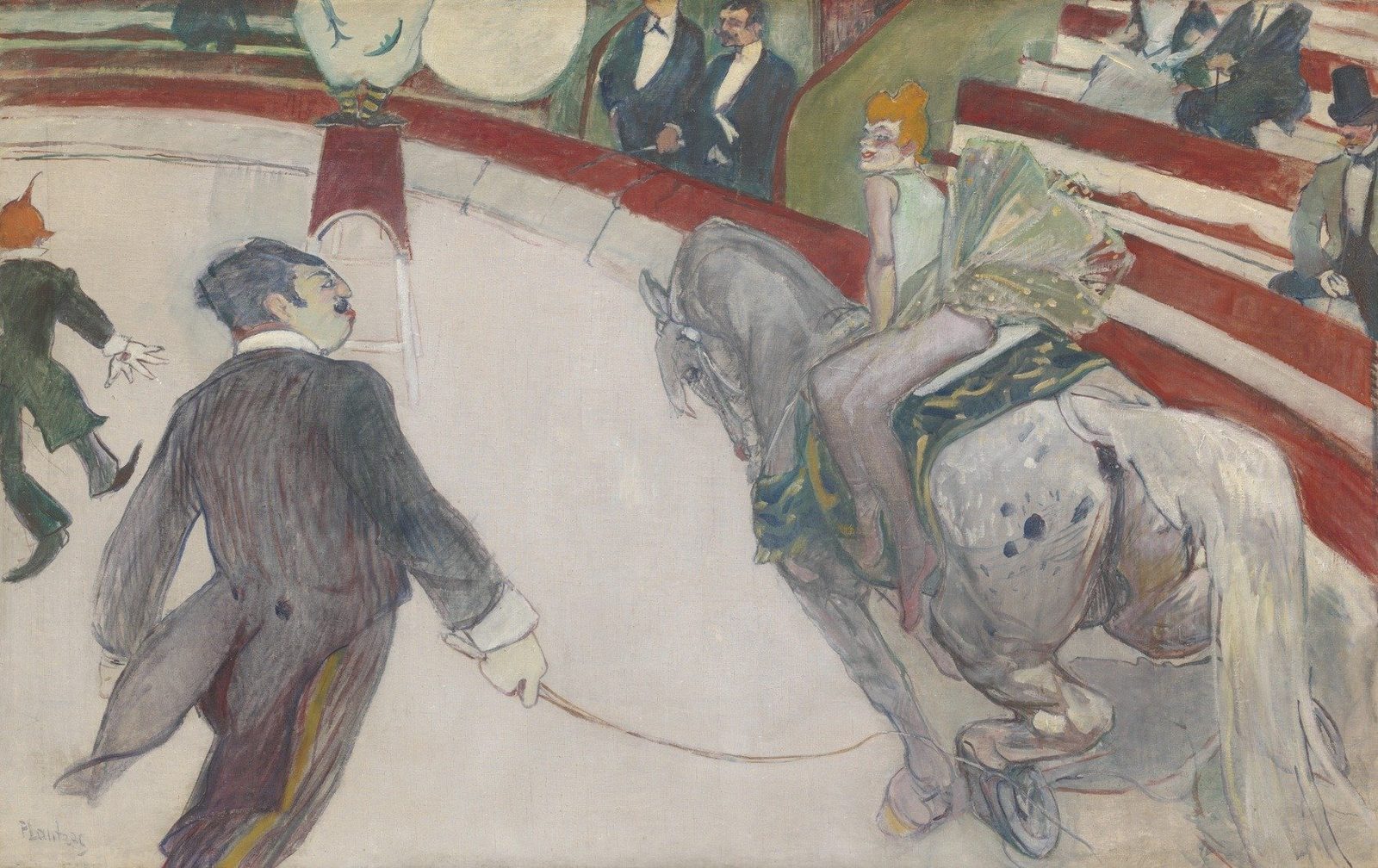
A circus ring, almost empty. A ringmaster in a black tailcoat stares across the sand at a woman on a grey horse, and she looks straight back at him. Between them lies nothing but pale floor and one thin whip.
Toulouse-Lautrec, 1887 to 1888, oil on canvas
Henri de Toulouse-Lautrec painted this in oil on canvas in 1887 to 1888. The Art Institute of Chicago describes a tense moment. The rider is about to stand on her horse and leap through a paper hoop held by a clown, while the famous ringmaster, Monsieur Loyal, drives the horse on with his whip.
A ring that tilts towards us
Look at how the ring is drawn. The red barrier swings in a great curve from the top left down to the right, and the floor seems to tilt up towards us. The ringmaster holds the left side, horse and rider the right, and the empty space between them carries the tension.
Two hard looks
Their faces tell the story. His is in sharp profile, the eye a small dark dash fixed on her. She turns back over her shoulder towards him. The museum reads her expression as a snarl and his as a glare. Whatever it is, it isn't friendly.
Orange hair, a few dark strokes
Get closer to her. The orange hair is one bold shape rather than strands. A touch of rose sits on the cheek, and the mouth is just a few dark, curved strokes. The museum suggests Lautrec may have based this rider on Suzanne Valadon, a former circus performer, model and artist.
Dapples left as marks
Down on the horse's hindquarters, the grey coat is a pale ground scattered with dabs of darker grey and blue-grey. They vary in size and direction, and none of them is blended. From a distance they read as dapples. Up close, they're simply marks.
One line for the whip
Follow the whip from his gloved hand. It's a single thin, dark line swinging in a long, low curve across the sand. It looks as if it was pulled in one stroke, thinning in the middle and flicking at the end.
The red barrier
Back up to the barrier. The red is laid in long strokes that follow the curve, with a darker red-brown along the lower edge for shadow. It's the strongest colour in the picture, and it keeps pulling your eye round the ring.
Watchers in the boxes
Above it, spectators look on from the boxes. These two are little more than dark coats and white shirt fronts, their faces set down in a few quick marks. They belong to the setting, not the show.
Look closer
7 details, each checked against a close-up of the picture.
-
The Ringmaster and Rider Interaction
The ringmaster, in profile, and the rider, looking back over her shoulder, face each other across the open floor of the ring.
The crop is dominated by a pale, scumbled sand-colored ground (the ring floor) interrupted by the dark vertical mass of the ringmaster's coat on the left and the bulky grey form of the horse on the right. The ringmaster's head is rendered in three-quarter profile with a thin dark line describing the nose, mustache and chin against an even lighter face; the eye is a small dark dash that reads as a focal point aimed rightward. The rider's face is a small, pale oval turned left, with a curved red mouth and a stippled pink cheek; orange hair sits as a flat, saturated cap above it. The horse's head is built from broad, smudged grey strokes with darker accents around the eye, nostril and bridle strap, and a halo of dapple spots indicated by short, dry marks. A thick red band (the barrier) curves across the upper third as a saturated horizontal divider, while the box above is suggested with only a few dark costume strokes and a sliver of green drapery.
-
Dappled Horse Coat
The horse's grey hide is rendered with small, broken dabs of darker grey and blue-grey paint.
The crop centers on the horse's flank and hindquarter, where a pale off-white ground is interrupted by irregular dabs of medium grey, cool blue-grey, and a few near-black spots. These dabs vary in size and orientation, with some reading as short comma-strokes and others as small rounded touches, scattered most densely where the body curves toward shadow. A dark grey-brown contour line traces the right edge of the torso, while a softer, broken line of pink-grey and mauve sketches the leg on the left. Above the grey hide, a band of olive-green and ochre-yellow with crimson underpainting suggests a saddle blanket or harness trim, applied in loose, gestural strokes.
-
The Red Ring Barrier
The barrier is a saturated red with darker red-brown strokes used for shading along its lower edge.
The crop centers on a curved red barrier that sweeps diagonally from upper-right toward lower-left. The upper band of the barrier is a saturated, fairly warm red applied in long, parallel diagonal strokes that follow the curve's arc. Below a narrow off-white piping rendered with broken, sketchy strokes, the lower band repeats the red but is deepened with red-brown strokes laid along its lower edge, suggesting a soft shadow on the under-curve. Edges between the white trim and the red are crisp where brushstroke ends meet, while the bottom of the barrier feathers loosely into the pale grey mass of the horse's body in the lower left.
-
The Rider's Face and Hair
The rider has orange hair, and her expression is set down with a few dark, curved strokes at the mouth.
The crop isolates the rider's head turned to the left, dominated by a mass of orange hair built with broad, vertical-to-diagonal strokes that read more as a shape than individual strands. The face is rendered with thin, pale flesh paint layered over the green ground, with a small rose-pink accent on the cheek and a few dark, comma-like curved strokes at the mouth that register as a smile. A narrow strip of red curves along the upper-right edge, suggesting the brim of a hat or headdress. Edges between hair and background are left soft and broken, while the contour of the nose and chin is sharper where a darker stroke defines it against the pale skin.
-
The Ringmaster's Whip
The whip is a thin, continuous dark line extending from the ringmaster's hand toward the floor.
The crop shows a pale, pinkish-cream canvas background with visible weave texture. In the upper-left, a roughly trapezoidal pale form—likely part of a hand or gauntlet—is rendered in cream tones with slightly darker, soft-edged shadows along its right side. A thin, continuous dark line (the whip) emerges from the lower edge of this form and sweeps in a gentle arc down and to the right, terminating near the lower-right edge with a small flick. The whip stroke is not uniform: it begins moderately thin near the hand, thins through its midsection, and shows a slight thickening plus a tiny vertical tick at its tip.
-
Spectators in the Boxes
The figures in the background are simplified into dark silhouettes with white shirt-collars.
Two male figures are rendered as dark masses with minimal interior modeling, their coats reading as near-uniform zones of deep blue-black. The white shirt fronts and collars function as high-value accents that carve the figures out from the background, and a small white bow-tie shape sits at the throat of each. Edges are loose and slightly broken, with the silhouettes of the shoulders and arms defined by a few confident strokes rather than careful contour. A flat green field sits behind the heads, and a thick red curved barrier runs across the lower portion, all painted with the same sketchy, unblended handling.
-
The Cropped Left Figure
A figure in a green suit is partially cut off by the left edge, with an open hand gesture.
The crop shows a figure cut off by the left edge, wearing a long dark green coat over matching trousers, with a tuft of orange-red hair at the top. The right arm extends across the picture plane, ending in an open hand rendered in pale cream-white with splayed, sketched fingers. Below, the legs taper into pointed reddish-brown shoes, while a second figure in dark navy enters from the right with a pale cyan halo behind the head area. The background reads as a warm cream ground where bare canvas shows through between loose, broken strokes.
Equestrienne (At the Cirque Fernando) in context
A circus in Montmartre
The Art Institute of Chicago dates Equestrienne (At the Cirque Fernando) to 1887 to 1888. It is oil on canvas, 100.3 by 161.3 centimetres, inscribed 'HT Lautrec' at lower left [1]. The museum identifies the setting as the same Montmartre circus that Renoir painted in his portrait of the acrobats Francisca and Angelina Wartenberg [1], a picture of 1879 that is also in Chicago [2].
Wikipedia's history of the circus says the Belgian performer Ferdinand Beert, known as Fernando, opened a permanent building at the corner of the boulevard de Rochechouart and the rue des Martyrs on 25 June 1875, and that it drew artists including Renoir, Degas and Lautrec to sketch the performers [3]. After a bankruptcy in 1897 it reopened as the Cirque Medrano [3].
Who holds the whip
The museum names the ringmaster as the famous Monsieur Loyal [1]. Exhibitions in 1914 and 1924 listed the picture under his name, for example as Le Cirque (portrait de Monsieur Loyal) [1]. Wikipedia's article on the circus instead identifies the man as Louis Fernando, the founder's stepson [3].
The museum also suggests, with a cautious 'may', that Lautrec based the rider on Suzanne Valadon, a former circus performer, model and artist [1]. Both identifications are best treated as open.
Before the posters
Lautrec was born in Albi in 1864 into an aristocratic family [4]. The Metropolitan Museum says frequent illness kept him in bed as a boy, that his favourite early subject was the horse, and that this probably owed something to his first teacher, René Princeteau, a family friend who painted sporting pictures [5]. After he broke both thighbones in separate accidents in his teens, his legs stopped growing. The Met puts his adult height at barely five feet [5].
In 1882 he moved to Paris and studied in the studios of Léon Bonnat and Fernand Cormon, where Vincent van Gogh and Émile Bernard also trained [5]. Wikipedia says he met Valadon in 1885 and painted several portraits of her [4]. The museum describes their relationship as lasting nearly three years [1]. In 1888 he was invited to show at Les XX in Brussels [4]. The museum's record lists, as a possibility, that this painting was among the works sent [1].
From the Moulin Rouge to Chicago
The first owner was Joseph Oller, who according to the museum bought the painting in 1888 for his café-concert, the Moulin Rouge, and kept it until 1914 [1]. The museum's text on At the Moulin Rouge says it hung in the lobby, and gives 1889 as the year the Moulin Rouge opened [6]. The 1888 purchase date and the opening don't quite line up, and the record doesn't explain the gap.
By 1914 the painting belonged to Baron Lafaurie, and by 1924 to the dealer Paul Rosenberg, who sold it to the Art Institute in 1925 with funds from Joseph Winterbotham [1]. The museum explains that the Winterbotham Collection was meant to hold 35 outstanding modern European paintings, and that its terms allow works to be sold or exchanged for better ones [7]. Lautrec returned to the circus a decade later. In 1899, recovering in a sanatorium, he drew circus scenes from memory to show his doctors that his health was improving [5].
- Henri de Toulouse-Lautrec, Equestrienne (At the Cirque Fernando) (1925.523): object record, provenance and exhibition history . The Art Institute of Chicago
- Pierre-Auguste Renoir, Acrobats at the Cirque Fernando (Francisca and Angelina Wartenberg): collection API record . The Art Institute of Chicago
- Cirque Medrano (formerly Cirque Fernando) . Wikipedia
- Henri de Toulouse-Lautrec . Wikipedia
- Cora Michael, Henri de Toulouse-Lautrec (1864-1901), Heilbrunn Timeline of Art History (2010) (Internet Archive copy) . The Metropolitan Museum of Art, New York
- Henri de Toulouse-Lautrec, At the Moulin Rouge: object record . The Art Institute of Chicago
- The Winterbotham Collection . The Art Institute of Chicago