Seurat's Bathers at Asnières — A Walkthrough
1883 final oil study, on the threshold of Divisionism
- Artist
- Georges Seurat
- Title
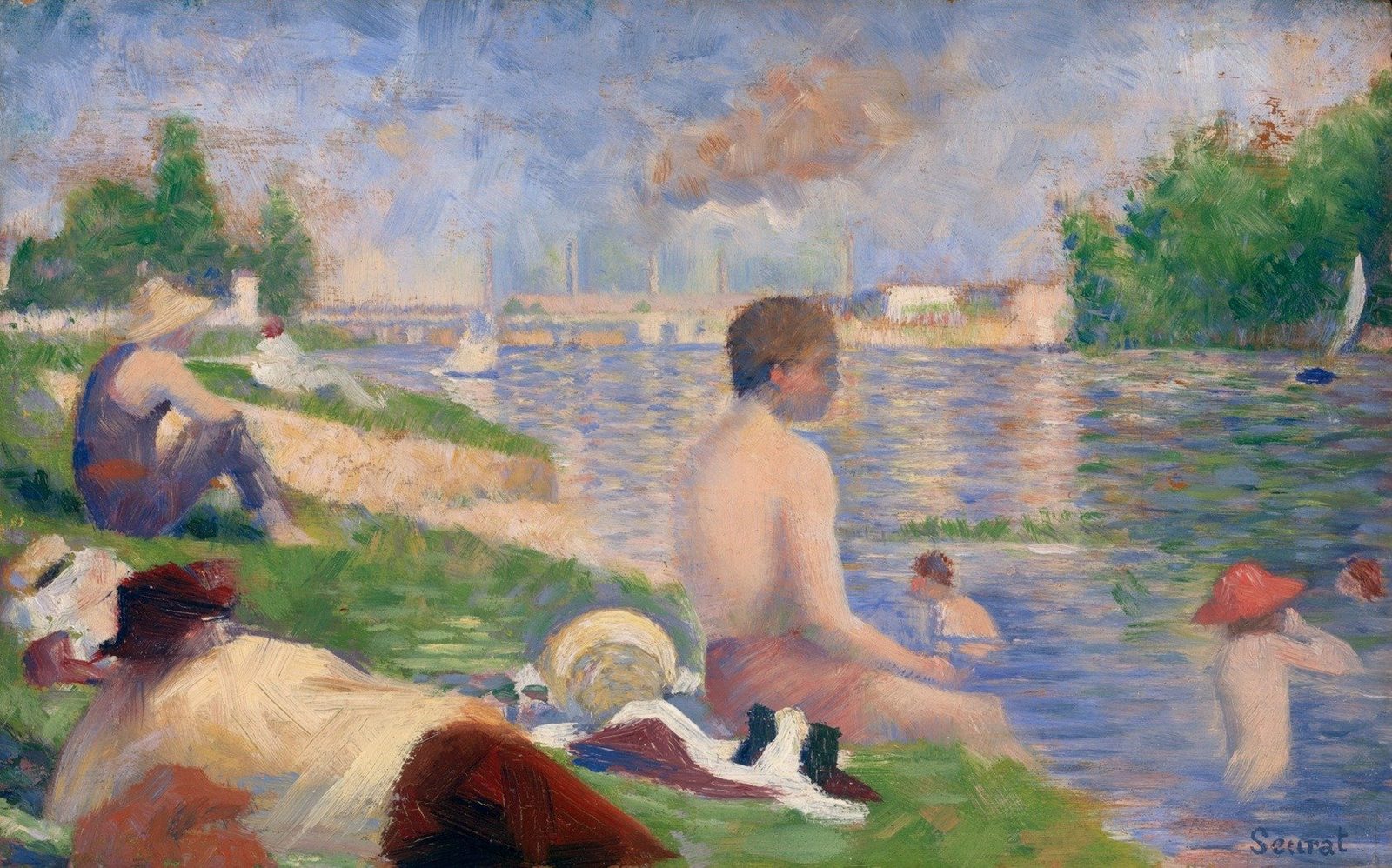
- Final Study for "Bathers at Asnières"
- Date
- 1883
- Medium
- Oil on panel
- Museum
- Art Institute of Chicago
- Image
- Public domain (CC0)
Open in Simple Art
Watch this story on iPhone and iPad, with offline downloads and a painting every day.
About 7 minutes of looking, in 11 parts.
A riverside moment, painted in 1883
We begin with the whole image before us — Georges Seurat's 'Final Study for Bathers at Asnières,' painted in 1883 in oil on panel. Five figures share a sunlit riverbank: a seated man on the left, a tall nude wading midstream, a reclining figure with a straw hat in the foreground, and two more swimmers to the right. Behind them, the river flattens into a pale horizontal band, and a distant town slides along the horizon.
Seurat before pointillism
This is Seurat on the threshold of his mature method. The tags place it in Post-Impressionism, but the read is closer to what art historians call proto-Divisionism — small, comma-like touches already laid side by side, but still loose enough to read as broken Impressionist stroke rather than the pure dots of his later 'A Sunday Afternoon.' Asnières was the suburb of factories and chlorine-washing water: the leisure here is real, the smokestacks are not far away.
A rigid horizon, a triangular group
Step back and let the composition register. A hard horizontal band of water cuts the canvas roughly at the upper third, dividing land from a high, hazy sky. Below that line, the figures pile into a near-triangular group anchored by the standing nude at center — the tallest vertical in the scene — with the seated man and reclining figure filling the lower corners. That triangular mass and the rigid horizon together make the picture feel almost like a constructed frieze.
High-key summer, cool with warm notes
The light is high and slightly from the right, confirmed by the lit right shoulders and the soft cast shadows under the hat and chin. The overall key is bright but not blinding — a hazy summer afternoon where the strongest darks are concentrated in the seated man's clothing and the hat's shadow. The palette is dominated by cool greens and blues, balanced by warm flesh tones and small notes of red — a saturated bathing cap, a sash — that act as chromatic anchors.
The brightest skin in the canvas
We push in on the central standing figure, Seurat's focal point and the brightest value passage in the painting. His skin is built from short, directional strokes of pale peach, warm pink, and cream — a comma across the deltoid, a vertical down the spine, horizontals across the thighs. There is no drawn outline anywhere: the silhouette emerges purely from warm flesh placed directly against the cool blue-lavender water behind him. The brightest cream notes catch the right shoulder, the nape, and the bend of the elbow — all consistent with that upper-right light.
A river built from juxtaposed dashes
Now drift out to the water surrounding the bather. This is the transitional brushwork: short, fingertip-length horizontal dashes of dusty blue, coral pink, sage green, and pale buttery yellow laid side by side with tiny gaps of underlying paint showing through. Each touch keeps its identity — they are not blended wet, and they are not yet pure points. Every mark still has a length and a direction, behaving like a stroke rather than a spot. Right side cooler, left side warmer: the water mirrors the light from upper right.
One red, against all that blue
Our eye follows the chromatic pull out to the right, where a saturated red bathing cap sits against the cool water. The cap is rendered with short, diagonally slanted strokes running from upper-left to lower-right, with deeper crimson and maroon tucked under the brim where the form turns away from the light. Crucially, the shadow side is a less saturated red rather than black, and the edge where red meets blue-green water is produced by hue contrast alone — no drawn line. That small note of red becomes the painting's echo to the distant smokestacks, binding foreground and far bank together.
A profile, leaning back into the light
Sweep back to the left now, to the seated man in the cream straw hat, drawn in left-facing profile with his torso tipped backward and his head lifted under the brim. His jacket is a stack of slanted strokes in deep ultramarine and lavender with a few warm orange notes — almost hatched rather than modeled. The hat dissolves into the foliage rather than cutting against it; the back of the figure is read through value shifts, not through contour. Notice the gesture: one curve down the spine, another from chin to lap, and the figure's angle is carried by value on the back, not by line.
Deep shadow under a bright hat
Drop down into the foreground, into the shadow zone under the reclining figure's straw hat. This is one of the deepest passages in an otherwise high-key canvas — dense maroon and near-black touches forming the shaded crown and back of the hat, with a warm rust-red zone carrying the shadow across the chest. The trick is that the shadow is not built from a single darkened local color: it alternates deep neutral darks with warm red notes so the area stays luminous rather than dead. A few straw-lit strokes are left to peek through, keeping the dark itself alive.
No line between grass and water
Tilt up to the diagonal where riverbank meets water. There is no painted contour here — instead, a negotiated strip roughly five to ten marks wide where mid-green grass touches, ochre bank warmth, and blue water marks all interleave. Stroke directions rotate slightly between the two passages so no continuous edge ever forms. The boundary dissolves into the same broken-seam vocabulary you saw on the figure's silhouette and the smokestacks against the sky: contour as negotiation, not as line.
Industry, kept back by temperature
Finally raise your eye to the horizon, where thin vertical strokes of cool gray-blue read as distant smokestacks against a hazy sky of pale blue and pinkish cream. Below them, a warmer horizontal strip of peach and buff suggests a sunlit far bank. Crucially, the stacks are set back in space by temperature rather than by dark contour — a cool gray-blue vertical placed directly next to a warm peach touch. Reserve your strongest lines for what needs to come forward; let atmosphere handle the distance.
Look closer
8 details, each checked against a close-up of the picture.
-
Central Nude Bather
The figure's skin is composed of pale pink, peach, and white strokes without hard outlines.
The crop centers on the back, shoulders, and lap of a seated nude youth seen in three-quarter rear, with a smaller background bather visible mid-right and the riverbank grass in the foreground. The skin is built from short, directional strokes of pale peach, warm pink, cream, and cooler violet-blue, with the brightest cream-white notes catching the right shoulder, the nape, and the bend of the elbow. There is no drawn outline: the figure's silhouette is produced purely by juxtaposed color against the blue-lavender water, with the lower torso edge becoming almost a vertical seam of pink against green grass and the white cloth. Cooler blue and lavender strokes tucked under the chin, along the spine, and on the left shoulder read as cast shadow, confirming a light source from the upper right. A few deeper russet touches sit on the cheek and ear, and the background bather is suggested by a quick cluster of pink plus a small dark hair cap.
-
Proto-Pointillist Water
The river surface consists of small, horizontal, juxtaposed dashes of blue, pink, and green.
The crop shows a field of short, horizontal, fingertip-length brushstrokes laid side by side with small gaps of underlying paint showing through. Strokes read as discrete dashes rather than blended passages, with clearly separable touches of dusty blue, coral pink, sage green, and pale buttery yellow, plus occasional violet and cream. Edges of individual strokes are soft but legible; colors sit next to one another rather than being mixed on the surface. The right side of the crop is denser and slightly cooler, while the left has warmer pink-orange passages, suggesting reflected sky and banked light rather than uniform tone.
-
Red Brimmed Hat
A saturated red hue is used for the hat, contrasting sharply with the surrounding blue water.
The crop centers on a figure whose head is crowned by a vivid, wide-brimmed red hat occupying roughly the upper third of the frame. The hat is built from short, diagonally slanted strokes running from upper-left to lower-right, with darker crimson and almost maroon touches tucked under the brim and along the lower right where it turns away from the light. Below the hat, broad vertical and slightly curving strokes in pale pinks, lavenders, and warm whites describe the figure's torso, each stroke left distinct rather than blended. The surrounding water is rendered in cool blues and blue-violets with scattered greenish and ochre flecks in the upper band, and the edge where the red hat meets the blue water is crisp enough to read as a clean contour even though individual brushstrokes remain visible at close range.
-
Industrial Smokestacks
Thin vertical gray lines represent distant smokestacks against the hazy sky.
The crop shows a hazy upper band of pale blue and pinkish-cream sky crossed by several thin vertical strokes in cool gray-blue that read as distant smokestacks. Below them sits a warmer horizontal strip of peach and buff tones, suggesting a sunlit far bank, broken by small green dabs that function as distant tree foliage. On the right edge a dark brown mass intrudes with a soft, broken contour against the lighter background. All edges are atmospheric rather than crisp: the verticals do not fully separate from the sky, and the horizontal bank fades into the upper register through overlapping warm and cool touches.
-
Foreground Figure Shadows
Deep brown and red strokes create a shadow area under the reclining figure's hat.
The crop centers on a reclining figure whose upper body is rendered in broad, radiating cream and ochre strokes that fan outward from the shoulder, suggesting a straw hat catching high light. Above and behind this lit passage, dense dark maroon and near-black touches form the shaded crown and back of the hat, reading unmistakably as cast shadow. Below the shoulder, a warm rust-red zone carries the shadow across the chest, built from short angled strokes that sit against the brighter cream without blending. The background is a loose tapestry of green, blue-green, and pale yellow juxtaposed touches, and the figure's silhouette against that green is left soft, with no hard contour.
-
Shoreline Transition
The boundary between the green grass and the blue water is a soft, broken edge.
The crop captures the diagonal meeting of riverbank and water across roughly its middle. Green grass at upper-left is built from short, comma-like strokes of mid-green, yellow-green, and olive, with occasional ochre flecks breaking the mass. Below the grass lies a sandy bank of warm ochre and pinkish-orange touches. The blue water on the right is a loose mosaic of cobalt, lavender, and pale blue strokes interspersed with reflected warm orange and ochre dabs from the bank above. The boundary between green and blue is not a line but a negotiated strip roughly 0.05–0.1 crop-height wide, where grass touches, ochre reflections, and water strokes interleave, leaving both edges frayed rather than sealed.
-
Seated Figure Pose
The figure on the left is seen from behind, hunched forward over his knees with an angled torso.
The crop centers on a seated figure seen from behind, facing right toward the river, the torso bent forward over drawn-up knees and the head lowered under a wide, cream-colored straw hat. The clothing is built from short, slanted strokes of deep ultramarine, lavender, and a few warm orange notes, with the brim casting a soft shadow across the face. Edges are softened by adjacent, contrasting touches rather than drawn lines: the hat melts into the green field behind it, and the back is read through value shifts, not a contour. A second figure in white sits far back at upper right, and the warm ochre path bleeds into cool grass through shared, interwoven marks.
-
Artist Signature
The name 'Seurat' is written in a dark, cursive script in the bottom right corner.
The crop is dominated by a soft, blurred vertical field. The upper three-quarters consist of pale dusty blue with subtle warmer peach and rose tints blended in, suggesting an out-of-focus sky with atmospheric haze. The bottom quarter introduces a series of dark, narrow vertical strokes in deep navy, rising against the lighter background. No cursive letterforms or legible writing are visible anywhere in the frame; the dark vertical marks read as reeds, branches, or perhaps tree trunks rather than script.
Final Study for "Bathers at Asnières" in context
Casts, copies and a year in Brest
Georges Seurat was born in Paris on 2 December 1859, the son of a former legal official who had grown wealthy from property speculation [2]. He first studied at a municipal school of drawing and sculpture run by the sculptor Justin Lequien, and in 1878 entered the École des Beaux-Arts, where he was taught by Henri Lehmann and drew from casts of antique sculpture [2]. In November 1879 he left for a year of military service with an infantry regiment at Brest [2].
Back in Paris he shared a studio with his friend Aman-Jean and spent about two years mastering drawing in black and white [2]. His first exhibited work, at the Salon of 1883, was a conté crayon portrait of Aman-Jean, and he also made notes on Delacroix's use of colour [2].
Sketchettes on panel
Wikipedia links Seurat's working method to the École's teaching that a large painting should be prepared through many studies [3]. César de Hauke's catalogue lists fourteen oil studies for the Bathers, most probably painted outdoors, while the National Gallery counts some 13 surviving oil sketches and 10 drawings [3][4]. Seurat called these small panels croquetons and hung them on his studio walls [3].
According to Wikipedia, the Chicago panel was the last of the oil studies and is very close to the final work except in size [3]. The figures themselves were worked out separately in conté crayon drawings, and the large canvas was painted in the studio [3][4].
A bathing place, not a resort
The National Gallery explains that the word baignade marked places on river maps where horses and dogs were watered, a place of work rather than middle-class leisure [4]. Wikipedia adds that the bank shown actually lies in Courbevoie, next to Asnières, with the railway bridge and the factories of Clichy beyond [3]. The gallery suggests that some of the men may have worked in the gas plant and factories on the far shore [4].
Refused, then shown in a beer hall
Seurat intended the large painting for the official Salon of 1884, but it was rejected [4]. He then became a founder member of the Groupe des Artistes Indépendants, whose first exhibition opened on 15 May 1884 in a temporary building near the Louvre [3]. According to Wikipedia, the Bathers hung in the exhibition's beer hall and didn't make much of an impression, though the novelist Paul Alexis called it 'a false Puvis de Chavannes' [3].
The National Gallery notes that Seurat later repainted parts of the canvas with dots, including the orange hat [4]. Félix Fénéon bought the painting in 1900, and it entered the British national collection in 1924 [3].
A gift to a writer
Seurat gave this study to the writer Robert Caze, and a list of owners in Seurat's hand names Caze as owner of an 'Esquisse de la baignade' [1]. French Wikipedia describes Caze as a naturalist novelist who received painters, Seurat among them, at weekly gatherings, and who died on 28 March 1886 after a duel [5]. The study passed to his widow, Louise, who died in 1887 [1].
The Art Institute's record then lists the dealer W. H. Sprenger, Wildenstein in New York by 1948, and David and Adele Levy of New York, who bought it in 1949 [1]. It came to Chicago in 1962 as a gift of the Adele R. Levy Fund [1].
- Georges Seurat, Final Study for "Bathers at Asnières", 1962.578: object record, label text and provenance . Art Institute of Chicago (public API)
- Georges Seurat . Wikipedia
- Bathers at Asnières . Wikipedia
- Georges Seurat, Bathers at Asnières (NG3908) . The National Gallery, London
- Robert Caze . Wikipédia (French)