Getting ready, four times over
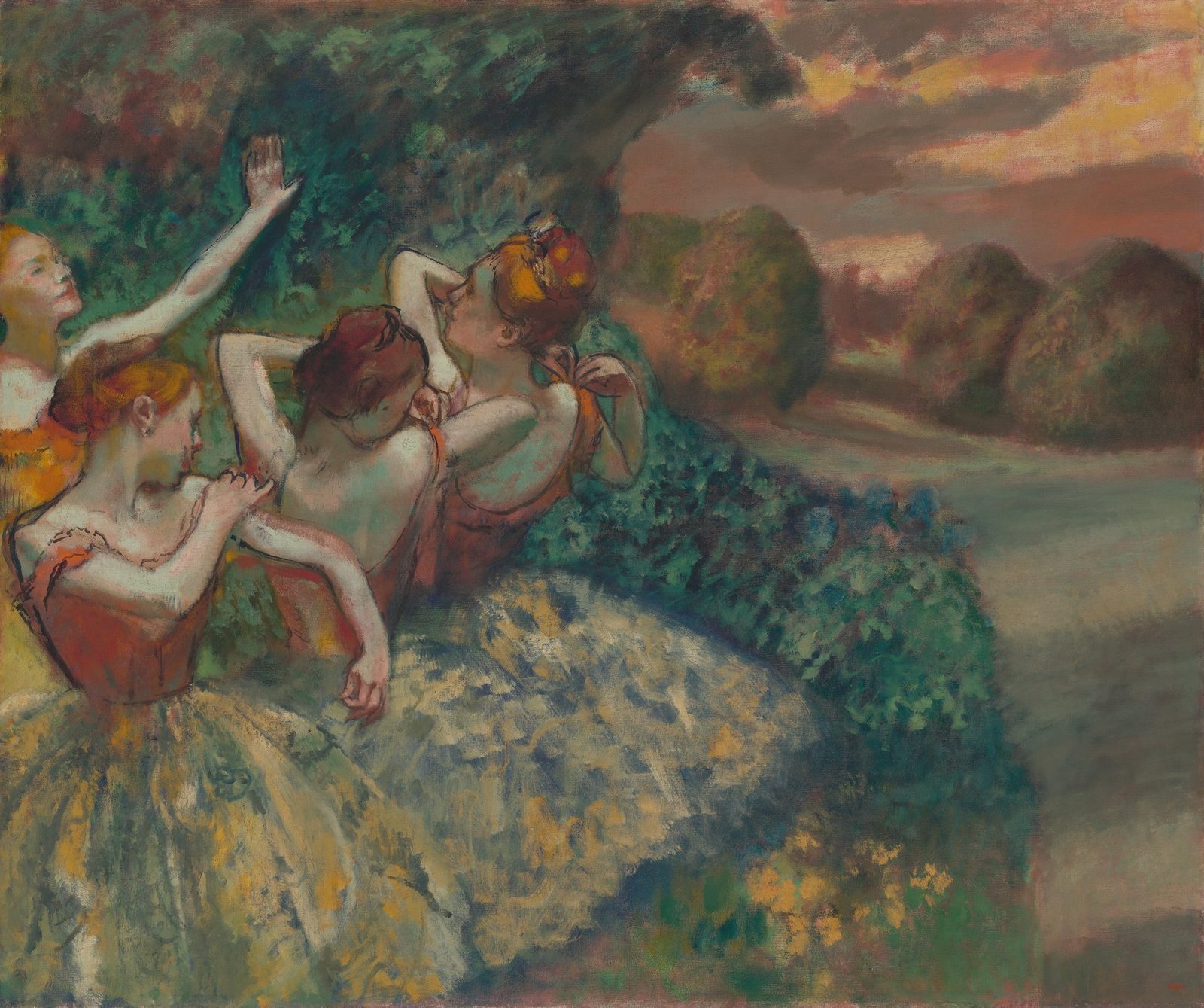
Degas lines up four dancers off stage so that their small gestures read like one movement unfolding
- Artist
- Edgar Degas
- Title
- Four Dancers
- Date
- c. 1899
- Medium
- oil on canvas
- Image
- Public domain (CC0)
Open in Simple Art
Watch this story on iPhone and iPad, with offline downloads and a painting every day.
About 4 minutes of looking, in 9 parts.
Four dancers, not dancing
Four dancers crowd into the left half of this picture, so close that their arms and shoulders overlap. None of them is dancing. Three are tugging at the straps of their bodices, and one lifts a hand high. To the right, everything opens out into a green field under a sunset sky.
Degas, about 1899, oil on canvas
This is Edgar Degas's Four Dancers, painted around 1899 in oil on canvas, and now in the National Gallery of Art in Washington. The museum calls it one of his largest and most ambitious late works. These are performers off stage, and the trees and sky behind them may be painted scenery.
A row running into the picture
Look at how they're arranged. Three stand in a row that starts at the lower left corner and runs back to the right, away from us. The fourth is tucked in beyond them at the far left. All that open land and sky on the right balances the crowd.
The nearest dancer
Start with the dancer nearest us. She turns her face away in profile, and the shadow under her cheekbone isn't a darker pink but what looks like a cool greenish grey. Her hand grips the strap at her shoulder, and the fingers are drawn with a few quick, dark lines rather than modelled.
One movement, passed along
Next, one dancer bows her head while a raised arm arcs up behind it. Beyond her, a dancer with orange-red hair turns in profile, hands at her strap. The museum notes that two of these poses repeat a model in photographs Degas owned. Read along the row, they could almost be one woman.
The fourth, barely there
The fourth dancer, at the far left, is the most lightly painted. Her upturned face is a thin wash of pink and ochre, with one small dark touch for an eye. Now follow her arm upwards. The forearm looks like a single broad, pale stroke, and the fingers are only a few dark notches.
Red-orange against green
The museum describes theatrical lighting that recolours the figures into a simple scheme of red-orange and green. You can see it here. Rust and orange in a bodice meet a mass of cool teal-green foliage along a soft, broken edge, and a smear of green turns up even on the pale skin.
A hand above the tutus
Drop down to a hand hanging loose at the edge of a skirt. Each finger seems to be its own pale stroke, with no outline around it. Then drift across the tutus. They're made of separate flecks of yellow and pale green over a muted blue, left unblended, so the skirts stay light and slightly blurred.
Sky and a fading edge
Up at the top right, the sky is laid in horizontal bands of violet, gold and orange, with no hard edge between them. Now slide down to where the field meets the far trees. Grey and dull violet strokes are dragged across the join, so there's no contour at all.
Look closer
9 details, each checked against a close-up of the picture.
-
Central dancers' heads
The centre dancer bows her head while a raised arm arcs up behind it, and beyond her a dancer with orange-red hair turns in profile with her hands at her shoulder strap.
The crop shows two dancers' heads and shoulders pressed close together against a softly brushed teal-green ground. The right dancer's head (u≈0.55, v≈0.30) carries a thick, loaded passage of cadmium-orange and carmine paint for the hair, with a small dab of impasto at the top suggesting a ribbon. The bowed head nearly meets the other dancer's raised arm near the center (u≈0.45, v≈0.40); the boundary between them is barely more than a wavering dark contour that dissolves into flesh pink. The right dancer's raised arms form a pale triangular gap behind her head, edged with a confident dark line at u≈0.28, v≈0.25 that turns into a soft rubbed edge as it descends. Canvas weave shows through thin, dragged scumbles across the shoulders, especially the cool blue-green passage over the right shoulder at u≈0.60, v≈0.85.
-
Sunset sky bands
The upper-right sky contains distinct horizontal bands of orange, pale yellow, and muted violet cloud that soften toward the horizon.
The crop shows a passage of sunset sky rendered in loose, horizontally dragged strokes where the canvas weave remains visible through thinner paint films. A dark violet-brown cloud band occupies the upper portion (y≈0.05–0.30), interrupted by a brighter yellow-gold passage (around x≈0.30, y≈0.20) that reads as a thin, scumbled highlight rather than opaque pigment. Below this, a warm orange-red band (y≈0.30–0.55) softens into a peachy-pink mid-band and finally into a muted grey-brown lower zone (y≈0.65–0.85). Edges between bands are wet-into-wet and feathered; no hard contour separates them, only shifts in value and chroma. Brighter weaves are noticeably thicker, while the cool violet passages appear thinly wiped, letting ground tone show through.
-
Upraised arm and hand
The upper-left dancer's arm is rendered with a broad pale stroke for the forearm that ends in a hand with visible finger separation.
The crop isolates a single upraised arm and hand, painted as a flat, pale diagonal thrust against a dark, gestural green ground. The forearm reads as one broad, low-saturation cream-pink stroke (#E8D4C0) with warm raking light catching its top edge near the wrist, while the underside falls into a cooler, slightly greenish shadow. The hand at the top is blocked in with a warmer, more broken cluster of ochre and rose touches, and the fingers are indicated only by short dark vertical notches rather than fully modeled shapes. The surrounding background is scrubbed in loose, broken greens and blue-greens (#1E4A3A) that let canvas weave show through, with a warm reddish-brown intrusion at upper left and a saturated red fabric shape at lower right. Edges between arm and ground are mostly soft and wet-into-wet, but the upper rim of the forearm keeps a crisp, calligraphic line where the pale stroke meets the dark field.
-
Orange bodice against green
Warm rust and orange in a dancer's bodice meet a cool teal-green mass of foliage along a soft, broken edge, and green also appears on the pale skin.
The crop centers on a rounded torso/bodice form occupying the upper-left two-thirds, with a darker green foliated mass filling the lower right. The bodice is a layered patchwork of cream, dusty pink, and a striking cool teal-green smear laid directly across the chest; warm rust and burnt-orange tones wrap its right edge and pool in the upper-right corner. The bodice and the green foliage meet along a soft, broken contour rather than a hard edge, with sketchy dark outline strokes wandering across the boundary. Canvas weave is clearly visible through thin, scumbled paint, especially on the lit upper curve of the figure. Values shift quickly: pale cream highlights sit next to deep teal-green shadows within the same handspan.
-
Tutu texture
The dancers' skirts in the lower middle are built from short, unblended strokes of yellow, pale green and blue-grey that remain visibly separate.
The lower-middle field reads as a mosaic of short, comma-like dabs of yellow-ochre, sage green, and cool blue-grey laid side by side with minimal blending. Strokes are placed wet-on-dry: each mark keeps its own shape, with crisp ridges where thicker paint sits beside thinner scumbles that expose the canvas weave. Cooler blue-grey and olive passages sit under the warmer yellow and orange notes, which sit highest in the impasto. A small hand at upper left is modelled more continuously, giving a useful contrast to the broken field below. There is no atmospheric haze here - adjacent strokes stay distinct, forcing the eye to mix colour optically rather than on the surface.
-
Hanging hand in foreground
A relaxed hand hangs at the edge of a skirt, its fingers rendered as separate pale flesh-toned strokes against yellow, green and blue-grey paint.
The crop isolates a downward-hanging forearm and hand dropping against a loosely painted tutu. The hand is constructed from discrete pale pinkish-cream strokes that read as individual fingers rather than as a single bounded contour; the digits curl slightly and the knuckles are suggested by short touches of warmer salmon-pink laid against cooler white-cream. The figure emerges from a saturated red-orange mass at upper left (drapery) and is silhouetted against the broken tones of the skirt. The ground area is built from short, hatched marks of yellow-green, olive, and blue-green, with raw canvas weave visible through thinner paint passages. Edges between hand and grass are softened by interposed half-tone strokes; no firm outline surrounds the fingers.
-
Nearest dancer's face and hands
The nearest dancer turns her face away in profile, with a cool greenish-grey shadow under the cheekbone, and grips her shoulder strap with a hand whose fingers are outlined in quick dark lines.
The crop centers on a dancer's right-facing profile with clasped hands in the lower right quadrant. The face is built from loose, scumbled flesh tones (pinks, ochres, grey-greens) with no sharp contour—edges dissolve into the warm orange ground at lower left and the cool green background. A greenish-grey tonal mass sits under the cheekbone/ear area, functioning as the facial shadow. The clasped hands are described by rapid, broken dark contour lines that loop and fork across the knuckles and finger joints rather than by modeled volume. Canvas weave is plainly visible through thin paint passages, especially in the hair and background.
-
Dissolved horizon on the right
The right-hand edge of the field dissolves into horizontal scrubbed strokes of grey and dull violet where it meets the distant trees, with no sharp contour.
The crop shows a transition zone where a green field meets a dark mass of distant trees. The upper third is dominated by deep reddish-brown and maroon tones in loose, vertically worked strokes, while the middle band is built from horizontal scumbles of muted grey-green and dull violet. No hard line separates the field from the trees; instead, the greenish strokes are dragged laterally into and over the darker mass, softening the boundary. The lower-left introduces blue-violet dabs that read as foliage or flower forms against the warmer field. Canvas weave shows through almost everywhere, indicating thin, washy paint handling rather than impasto.
-
Thinly painted leftmost figure
The far-left dancer's upturned face is a thin wash of pink and ochre with a small dark touch for the eye, and there is almost no definition below the shoulder.
The leftmost figure is rendered with a very thin, washy application of paint over a visible canvas weave. The face is a profile built from a warm yellow-ochre note on the forehead that drops into a soft pink/peach mid-cheek, with a small dark olive-black smudge suggesting the eye socket and a touch of reddish-ochre at the jaw. Below the chin, the neck and shoulder dissolve into a broad, pale cream stroke that bleeds into the surrounding green without a hard edge, and almost no anatomy is read in the torso. The dark green background reads as an underlayer or scumbled passage against which the warm face and the russet-brown shape at lower right sit as the only opaque passages.
Four Dancers in context
Stage or landscape?
The National Gallery of Art calls Four Dancers one of the most perplexing of Degas's ballet pictures [1]. Its label asks whether the dancers stand on a stage or in a dreamlike landscape with distant haystacks, and whether they are four women or one dancer turning through space and time, leaving the viewer to decide [1]. The Gallery's visual description hedges in the same way, calling what lies behind them a background or backdrop [1].
Three glass plates
An earlier version of the Gallery's page links two of the poses to a model in a unique set of three photographic negatives, taken between about 1895 and 1898 [2]. Degas owned the plates and may have taken the pictures himself [2]. The same model posed for all three, her hair piled up and her features indistinct, and the four dancers in the painting resemble her [2]. Over time the plates solarised into colours that resemble, in reverse, the oranges and greens of the painting [2].
Photography had absorbed Degas since the late 1880s. He photographed friends, often by lamplight, and used photographs of dancers and nudes as references for drawings and paintings [3]. He worked indoors from memory, photographs or live models, and often repeated a subject many times with changes [3]. The Gallery notes that Four Dancers exists in several variants, modified in different ways and to different degrees [2].
The studio years
Degas was about 65 when he painted this canvas [1]. Wikipedia describes his last decades as increasingly solitary [3]. During the Dreyfus Affair, by the mid-1890s, he broke with all his Jewish friends and remained an outspoken antisemite until his death [3]. His eyesight, poor for years, got worse after 1890. He is known to have worked in pastel until at least 1907, and apparently stopped working altogether in 1912 [3]. He died in Paris in 1917 [3].
A stamp, not a signature
The red 'Degas' at the lower right raises a small question. The Gallery's inscription record describes it as an atelier stamp, but its visual description says the artist signed his name in red paint [1]. The provenance is consistent with a studio stamp. After Degas himself, the first entry is the Degas sale at the Galerie Georges Petit in Paris on 6 May 1918, where it was number 10 [1]. That was the year after his death [3].
Copenhagen, Paris, New York
The firm of Trotti et Cie bought it at that sale. It next belonged to the Danish collector Wilhelm Hansen in Copenhagen [1]. Hansen, an insurance director, began collecting French art during the First World War and formed a buying consortium in 1918 [4]. The collapse of the Landmandsbanken in 1923 forced him to sell part of his collection [4]. The sources consulted do not say when or why this picture left him [1][4].
It then passed through the Galerie Barbazanges and Durand-Ruel in Paris to the New York collector Chester Dale, who bought it in November 1931 [1]. The sale made the front page of Art News, and Dale bequeathed the painting to the Gallery in 1963 [1]. It appeared in the Gallery's Degas: The Dancers in 1984 and 1985, and in Degas at the Opera in 2019 and 2020, shown only in Washington [1]. When the page was archived in October 2025, it hung in the West Building, Gallery 83 [1].
- Edgar Degas, Four Dancers (1963.10.122): object record, visual description, label, provenance, exhibition history and inscription (Internet Archive copy, 13 October 2025) . National Gallery of Art, Washington
- Edgar Degas, Four Dancers: earlier object page with overview text (Internet Archive copy, 30 October 2020) . National Gallery of Art, Washington
- Edgar Degas . Wikipedia
- Wilhelm Hansen (art collector) . Wikipedia