The Uncomfortable Mercy
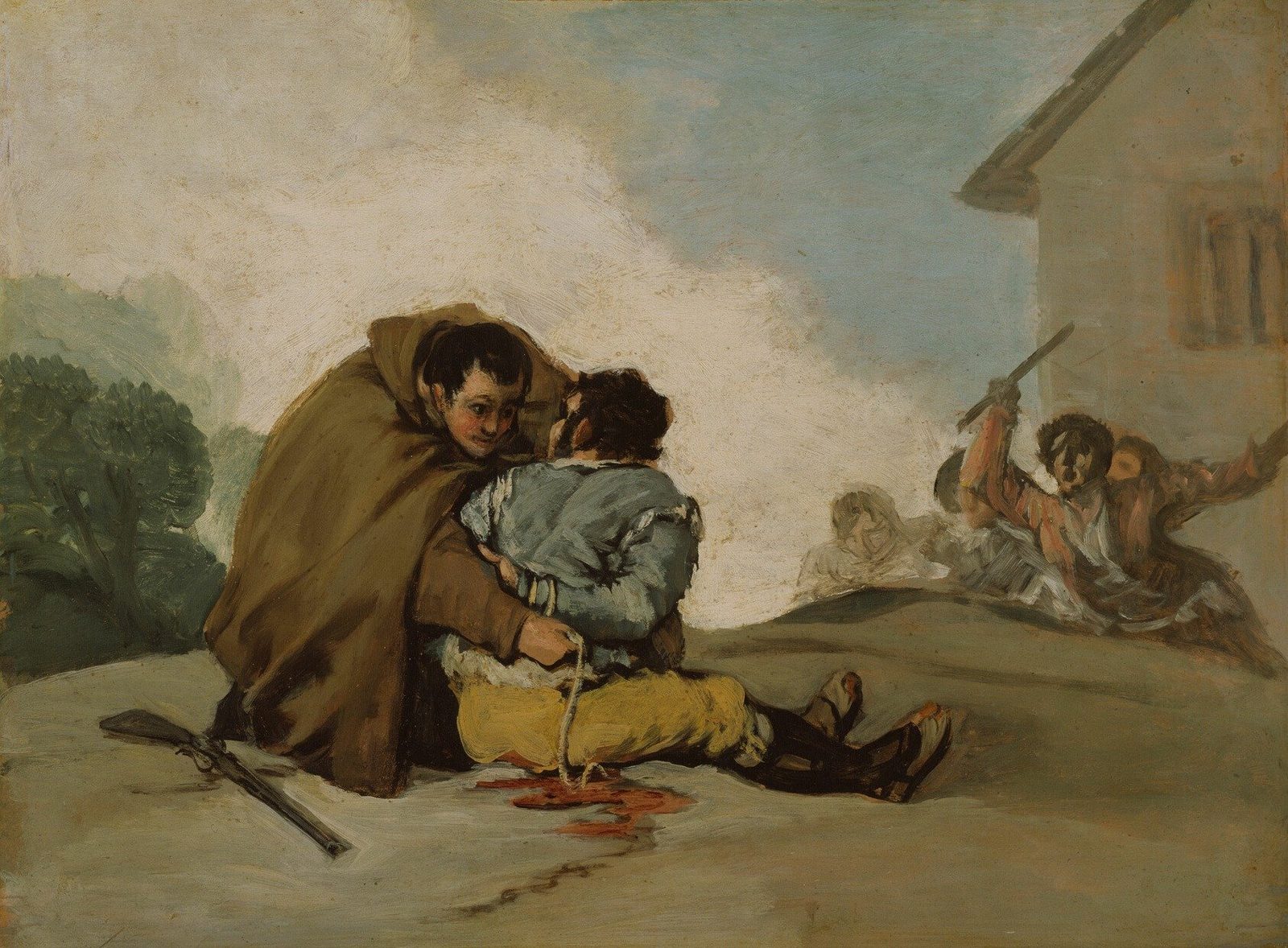
Friar Pedro Binds El Maragato with a Rope — Francisco José de Goya y Lucientes, c. 1806
- Artist
- Francisco José de Goya y Lucientes
- Title
- Friar Pedro Binds El Maragato with a Rope
- Date
- c. 1806
- Medium
- Oil on panel
- Museum
- Art Institute of Chicago
- Image
- Public domain (CC0)
Open in Simple Art
Watch this story on iPhone and iPad, with offline downloads and a painting every day.
About 7 minutes of looking, in 13 parts.
Two figures, one quiet act
We open on a small, almost sketch-like panel where two men crouch together on bare ground. A smoke-grey sky and a single, quiet moment of contact between a brown-robed friar and a wounded man — that is all the painter gives us, and it is already too much. Look closely, because this is one of Goya's most uncomfortable jokes.
Goya, c. 1806, oil on panel
This is Goya near the end of his court years, working around 1806, and he is no longer interested in polish. The oil is thin, the brush loose, and the panel is treated almost like a piece of tinted paper. What holds us is not the surface but the story: a friar, a bandit, a rope, and a small pool of blood.
Asymmetric triangle, anchored left
Stand back and look at the geometry. The two men and the rope form an asymmetric triangle anchored just left of center, while a strong diagonal — the discarded blade — runs in from the lower left. On the right, a tall, soft block of building balances the whole composition. The diagonals show us exactly where the tension lives.
Diffuse light from the upper left
Now notice the light. It comes from the upper left, soft and overcast, with no hard cast shadows anywhere in the picture. The sky reads as a luminous grey-white, and the strongest darks are tucked into the folds of the friar's robe and the foliage on the far left. The whole panel sits in a high key, with a single hot accent we are about to meet.
Earth tones, one cool jacket, one red accent
The palette is earth and ochre, pressed against a cool blue-grey sky. The prisoner's blue-green jacket is the only cool note among the browns, and against it Goya sets the most saturated mark in the painting: a small, hot crimson pool of blood. One warm, one cool, one red — and the entire drama lives in that triangle of temperature.
Where the two faces meet
Drift in to where the two heads meet near the center of the canvas. The friar's face emerges from a deep umber hood, painted with broad, loosely dragged strokes. The visible eye is a small, sharp black notch, and the mouth is just one upward-curving stroke of muted rose. Beside him, the prisoner's head is darker and cooler, almost merging with the hood — only a sliver of forehead catches the light. Notice how Goya saves his crispest accents for the friar and lets the second head dissolve.
The hand, the thumb, the grip
Drop down to the friar's hand. One small, opaque dab of warm flesh marks where the thumb presses into the prisoner's arm, and that single touch does all the work of grip. The brown sleeve is dragged in long, broken strokes that follow the forearm, and the rope coils to the right in little chevron flicks. There is no outline and no contour — only pressure, implied by a single bright accent.
A single stroke does the binding
Follow the rope as it descends diagonally across the blue-green jacket. It is one mostly unbroken stroke of off-white, darkening slightly where it crosses the warm brown hand. The jacket's lower edge is left soft and unresolved against the rope, and the ochre ground shows through the breeches in scumbled patches. One confident thread, and you instantly read the binding.
The single hot accent
Now drift down to the small pool of blood at the prisoner's hip. It is the most intense color in the whole picture: a concentrated crimson-brown at its core, dragged outward into rust, and finally feathered into the grey-green ground with broken, streaky touches. Goya laid the dense note first and pulled pigment outward with a brush that carried less and less paint. The edges were never drawn — they were wiped.
The discarded blade, in one stroke
Swing left to the lower foreground, where a long dark blade lies diagonally across the sandy ground. It is almost a single loaded stroke, dragged from upper-left to lower-right, with the tip fading into nothing. The metallic glint is not a highlight added on top — it is a sliver of the warm ground reserved between two dark passes. Negative painting does the work in one confident pass.
Scumbled shorthand for fabric
Come back up to the prisoner's jacket. Broad, scumbled strokes run roughly horizontally across the upper back and shift to longer diagonals as the torso turns. Lighter chalky blue-grey strokes catch the upper-left light on the shoulder, while deeper olive-teal passages recede into the folds. There is no contour line — only value shifts where cool grey-green meets warm brown.
Background figures, three strokes each
Glance to the right, where two ghostly figures sit in the haze. They are barely three or four gestural strokes each: a dark brown head shape with no features, a sweep of ochre and red-orange across the torso, dissolving into the pale sky. Goya is telling you that the story is here in the foreground, and everything else is just a smear of warm earth.
Atmospheric edges, mixed on the surface
One more thing to look at, off to the right: the edge where the warm building meets the cool sky. There is no hard line drawn here. Goya dragged a mid-tone of brownish ochre along the contour, and the two passages merged on the surface while still wet. This is atmospheric painting — letting the colors mix on the panel, not on the palette.
Look closer
9 details, each checked against a close-up of the picture.
-
Interaction of faces
The friar's face features a slight upward curve of the mouth and a dark, focused eye looking at the prisoner.
The crop is dominated by the friar's face emerging from a deep umber hood, painted with broad, loosely dragged strokes. His forehead and left cheek are built from warm peach-ochre dabs that sit atop a darker flesh underlayer, while the right side of his face falls into the hood's shadow. The visible eye is a small, sharp black-umber notch set into a lighter lid plane, and the mouth is suggested by a single upward-curving stroke of muted rose. At the right edge, the prisoner's head is rendered in much darker, cooler tones, almost merging with the friar's hood, with only a sliver of forehead and the bridge of a nose catching pale impasto. A cool blue-green jacket mass anchors the lower right, contrasting chromatically with the warm flesh and brown habit.
-
Blood pool
A saturated red-brown pigment is applied in a concentrated pool beneath the prisoner's hip.
A concentrated pool of saturated red-brown pigment sits on a muted gray-green ground, framed at the top by a thick band of ochre-yellow drapery (the prisoner's breeches) from which a twisted rope descends. The blood pool is darkest and most opaque at its core near [0.45,0.55]—a thick, almost crimson-brown mass—then diffuses outward through dragged, thinner strokes that lighten to a warm rust and finally feather into soft, broken touches that merge with the ground. The edges of the pool are never hard; they are created by wiping or pulling pigment, leaving streaks and irregular shapes rather than a clean contour. Visible horizontal and diagonal brushmarks in the surrounding ground show the panel's loose, sketchy handling beneath the figure.
-
Binding rope
A thin, light-colored line of paint represents the rope looping around the prisoner's torso and wrists.
The crop centers on a thin, pale rope descending diagonally from upper left to lower center, rendered with a single, mostly unbroken stroke of off-white paint that darkens slightly where it crosses a warm brown hand near the middle. Above, a mass of dark blue-green fabric (the jacket) is built with broad, dragged strokes of muted teal and olive, its lower edge left soft and unresolved against the rope. Below, the rope continues into an area of warm ochre breeches, where the yellow ground shows through in scumbled patches rather than being fully covered. The hand is a compact cluster of rust and umber strokes with a small crescent of pinkish flesh at a knuckle, and the rope appears to pass in front of the wrist area before trailing off into the yellow fabric.
-
Discarded musket
A dark, linear shape with a slight metallic highlight lies diagonally in the lower left foreground.
The crop isolates a long, dark musket oriented diagonally from upper-left to lower-right, with a thicker, slightly club-shaped end at the top and a tapering tip below. The musket sits against a warm, sandy-ochre ground laid in with broad, dragged strokes, and a dense, dark brown mass (the friar's habit) intrudes from the upper right, its edge soft and unblended. A thin, lighter metallic glint runs along the upper edge of the barrel, achieved by leaving a sliver of warmer ground tone between two dark passes rather than adding a true highlight. The lower portion of the barrel fades into the ground as the paint thins, suggesting the form is set down with loaded brushes that drag out into nothing.
-
The grip
The friar's hand is seen gripping the prisoner's arm with a small, opaque touch of skin tone.
The crop isolates a gripping gesture where the friar's warm-toned hand wraps around a bound arm, the fingers curling inward with a small bright dab of skin tone marking the thumb's contact point. The friar's sleeve is rendered in broad, dry brown passages with visible directional strokes that follow the form of the forearm, while the prisoner's blue-green jacket appears as a flat, darker field in the upper right. A cluster of pale and greyish brushstrokes to the right of the hand reads as twisted rope, with small chevron-like marks suggesting the binding's coiled structure. Edges throughout are soft and unresolved, with the fingers blending into the sleeve and the gripped arm into the rope, giving the contact a tactile immediacy rather than crisp contour.
-
Jacket texture
The blue-green jacket is rendered with broad, visible horizontal and diagonal scumbled strokes.
The crop centers on the back and right shoulder of the wounded man in a muted blue-green jacket. Broad, scumbled brushstrokes run roughly horizontally across the upper back and shift to longer diagonal sweeps lower down, following the cylinder of the torso. Edges are soft and broken, with no hard contour line; the jacket's silhouette is implied by value shifts where the cool grey-green meets the warm brown of the friar's sleeve on the left and the cream-toned wall on the right. Lighter, chalky blue-grey strokes sit on the upper shoulder and sleeve crown catching the upper-left light, while deeper olive-teal passages recess into the folds near the spine and at the rope-binding. The hand at lower center, gripping the rope, is modeled with small, more deliberate dabs in warm flesh tones set against the loose fabric strokes.
-
Friar's hood highlight
The top edge of the brown hood has a pale, creamy highlight indicating light from the upper left.
The crop shows the upper portion of the friar's head, framed by a brown hood whose crown catches a pale, creamy highlight along the top edge. The highlight is laid in as one or two thick, loaded strokes that read almost as a single tonal mass, sitting on top of the deeper umber of the hood body. The dark mass of the forehead and brow shadow descends into the eye sockets, while the cheek carries a ruddy, warm tone that contrasts with the cool cream above. Edges are soft and wet-into-wet where the highlight meets the hood, but the silhouette against the sky is firmer.
-
Distant figures
The figures on the right are composed of loosely defined masses of ochre and red paint with minimal facial detail.
The crop shows a loosely brushed background area dominated by warm earth tones. A dark brown mass at center-upper (around 0.45, 0.25) suggests a head shape with no facial features, sitting above a broader torso of ochre and red-orange strokes that sweep diagonally to the right edge. The rightmost figure is built from a few bold strokes of burnt sienna and dark umber that dissolve into a pale, hazy sky tone. Edges are soft and broken throughout, with no hard contours separating figure from ground; the paint is applied in single, confident gestures rather than blended modeling. The lower portion shows greyish-brown diagonal strokes indicating ground or drapery, while the upper left holds cooler grey-whites that contrast with the warm figure mass.
-
Sky-to-building transition
The edge of the building against the sky is soft and slightly blended rather than a sharp line.
The crop shows a diagonal meeting between a pale blue-green atmospheric sky in the upper left and a warm tan/ochre building wall occupying the right side. The transition is not a hard contour but a softened, blended zone where a darker brownish-ochre tone has been dragged along the meeting edge, creating a slightly feathered boundary. Visible brushwork in the sky consists of loose diagonal and horizontal strokes with thin, semi-transparent paint, while the building side reads as broader, more opaque passages. A small corner projection of the building sits at roughly the lower-left of the diagonal, with the darker accent tone pooling there.
Friar Pedro Binds El Maragato with a Rope in context
A bandit and a lay brother
El Maragato was the nickname of Pedro Piñero, a criminal whose death sentence had been commuted to forced labour. In 1804 he was working in the arsenal at Cartagena when he escaped and made his way to the country west of Toledo, robbing and seizing arms as he went [3]. The Art Institute says he spent about two months on the run, stealing food, guns and money [1].
On 10 June 1806, at a house at El Verdugal near Oropesa, he shut the household in a room and took the horse of the head guard [3]. The museum describes Pedro de Zaldivia, who had come to the house to beg for alms, as a lay Franciscan brother [2]. The friar fought back, seized the rifle and shot the bandit in the thigh [2]. Piñero was taken to Madrid, where he was hanged and quartered on 18 August [3].
News, ballads and a pamphlet
The friar's exploit spread across Spain through newspapers, pamphlets, ballads and prints [2]. The Fundación Goya en Aragón names a Madrid leaflet published about a month after the capture, the Noticia exacta of everything done by Pedro Piñero, as the narrative Goya followed [3][4]. In 1958 Eleanor Sherman Font published an article on Goya's source for the series in the Gazette des Beaux-Arts [1].
The Fundación also notes that the panels contain many changes made during painting, taking this as a sign that Goya worked in a spontaneous, even experimental way [3]. The museum's own catalogue spells the friar's surname Saldivia on this panel and Zaldivia on others in the set [1][2].
The last scene of six
All six panels belong to the Art Institute, each in oil on panel at about 29 by 38.5 cm [1][5]. The sequence runs from El Maragato threatening the friar with his gun, through the offer of shoes, the struggle for the gun, the blow with its butt and the shot as the horse bolts, to this binding [5]. The museum compares the set to a modern comic strip, and the Fundación likens it to the predella of an altarpiece or to a film storyboard [2][3].
In the printed account, as the Fundación summarises it, Providence supplied the rope, and the friar stopped the people who came running with sticks from attacking the wounded man, protecting him until he could be taken to Madrid [4].
Painted for himself
At the time Goya was chief painter to the king, yet the museum suggests he may have made the series for his own amusement rather than for a patron [2]. The six pictures were still in his house in 1812, when an inventory was drawn up after the death of his wife, Josefa Bayeu, to divide the property with their son Javier [1][3]. The entry reads 'Seis quadros del Maragato' valued at 700 reales, and the group was marked X8 and allotted to Javier. That mark has since been removed from this panel [1].
From Madrid to Chicago
The panels later belonged to the Lafitte collection in Madrid and were offered at the Hôtel Drouot in Paris on 7 March 1861, where they were bought in [1]. By 1911 they were with the dealer Julius Böhler in Munich, who sold them that May to Martin A. Ryerson of Chicago. Ryerson died in 1932 and the set came to the museum by bequest in 1933 [1].
The series was shown at the Metropolitan Museum of Art in 1928 and in Chicago's Century of Progress exhibitions of 1933 and 1934 [1]. It also appeared in the Prado's survey of Goya's small paintings, Truth and Fantasy, which opened in Madrid in 1993 and travelled to London and Chicago in 1994 [1][4].
- Friar Pedro Binds El Maragato with a Rope (collection record) . Art Institute of Chicago
- Friar Pedro Shoots El Maragato as His Horse Runs Off (collection record) . Art Institute of Chicago
- El Maragato Threatens Friar Pedro de Zaldivia with his Gun . Fundación Goya en Aragón
- Friar Pedro Binds El Maragato with a Rope . Fundación Goya en Aragón
- Francisco Goya: 10 The story of Friar Pedro . The Eclectic Light Company