No line anywhere
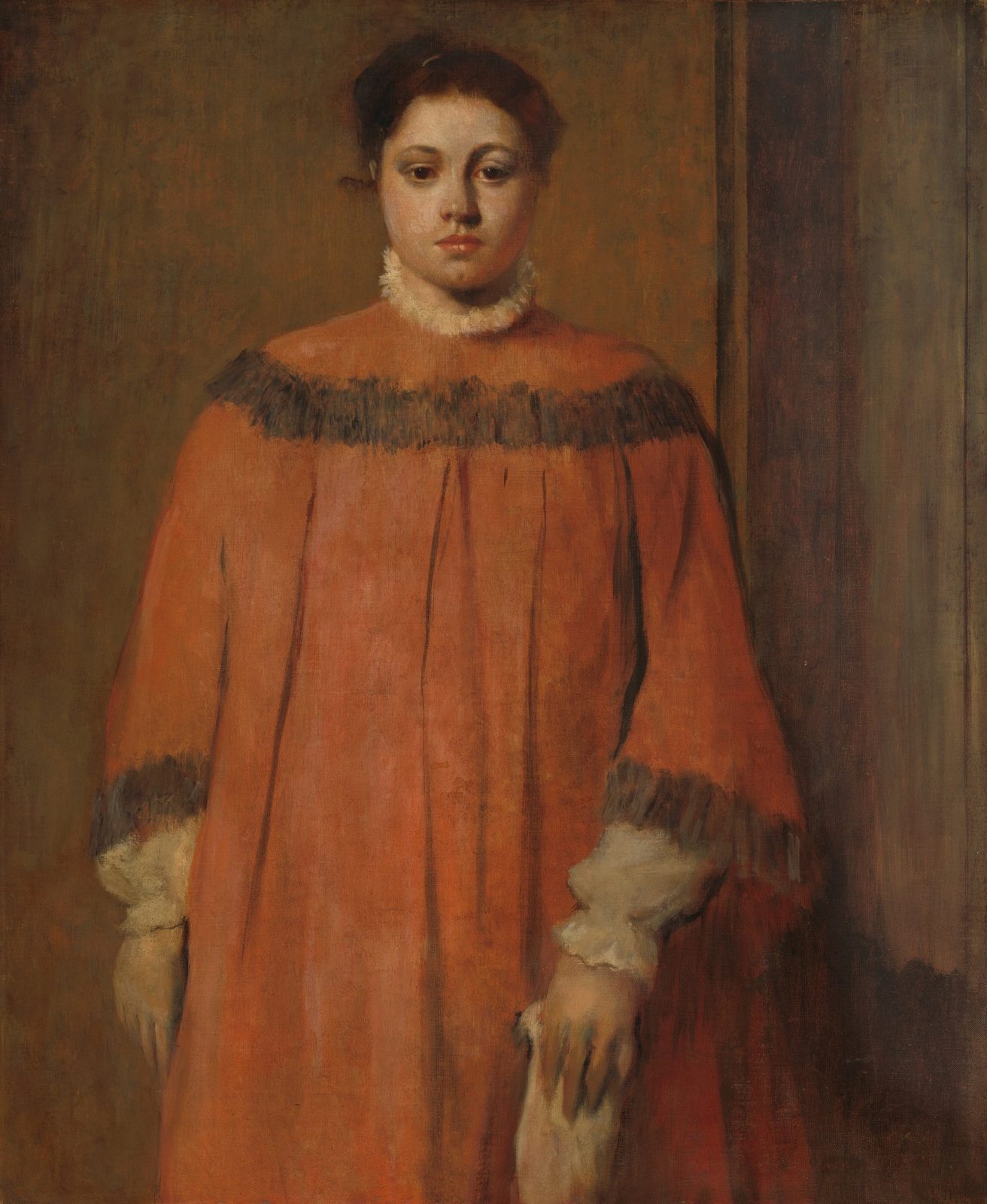
How Degas holds a girl in red steady with a formal pose, then leaves almost every edge open
- Artist
- Edgar Degas
- Title
- Girl in Red
- Date
- c. 1866
- Medium
- oil on canvas
- Image
- Public domain (CC0)
Open in Simple Art
Watch this story on iPhone and iPad, with offline downloads and a painting every day.
About 4 minutes of looking, in 10 parts.
Girl in Red
A young woman faces us squarely, her pale face set against a dim olive wall. Below it, the red dress is all visible brushwork. Try to find an outline anywhere in this picture. You'll have trouble.
Degas, about 1866, oil on canvas
This is Girl in Red by Edgar Degas, painted in oil on canvas around 1866. The pose is formal and still. The paint is anything but, and that contrast is what we'll follow.
A figure on the centre line
She stands almost exactly on the centre line, so the picture feels steady and symmetrical. Her shape widens towards the hem like a long triangle. The dark band of fur across her chest acts as a stop, catching your eye on its way down from the face.
Light from the upper left
The light seems to fall softly from the upper left. You can check it on the ruffled collar under her chin. The tops of the ruffles are warm cream and pale peach, while the folds beneath sink into a cooler grey-violet.
The most finished passage
The face is the smoothest part of the painting. Cream highlights on the forehead and cheekbone melt into rose-brown, and the far side cools towards a muted olive grey. Now look at the jaw and temples. They aren't drawn. They simply fade into what surrounds them.
Fur made of short strokes
Drop down to the fur across her chest. It isn't a solid band but a cluster of short, broken dabs of brown-black and dark olive. Along the lower edge the strokes look as if they were dragged downwards, so the fur frays into the red instead of stopping at a line.
Red, stroke by stroke
From a distance the dress reads as one red. Up close it breaks into separate vertical strokes of orange, vermilion, rust and chocolate brown. In the thinner places the weave of the canvas shows through, as if covering every thread simply didn't matter.
White that isn't white
At the lower right is a pale shape that looks like a handkerchief in her hands. Its lit side is warm ivory and its folds a cool grey-violet. Near the dress, faint pinkish tints creep into the white, as though the red were reflecting into it.
Folds from warm and cool
On the right side of the skirt, the folds turn without any drawn shadow line. Brighter orange streaks sit beside cooler, browner reds. That change of temperature is enough to suggest cloth bending in and out.
Two ways to lose an edge
Compare two places where the figure meets the wall. At the top of her head, the warm dark of the hair meets the cooler olive of the background with no line between them. At the shoulder on our left, red and olive-brown strokes sit side by side in a narrow band, and your eye does the blending.
Look closer
10 details, each checked against a close-up of the picture.
-
Face and expression
The face is the most smoothly blended passage, with soft cheek modeling and a distinct highlight on the forehead and left cheekbone.
The crop centers on a young woman's head and upper shoulders. The face shows the smoothest handling in the picture: soft, blended transitions from warm cream highlights on the forehead and the subject's right cheekbone down into rose-brown mid-tones across the cheeks and nose. The shadow side (subject's left, viewer's right) cools toward a muted olive-grey. The eyes are dark brown with tiny catch-lights at the upper rim, set under softly defined lids. Lips read as a muted coral-red, dabbed rather than blended. Below the chin a cream-white ruffled collar is laid in with broken, scrubby strokes against the red-orange dress, and the weave of the canvas is plainly visible across every passage.
-
Dress fabric strokes
Broad vertical strokes of orange, red, and brown are visibly separated and show the canvas weave in the central dress.
The crop is dominated by broad vertical strokes of warm orange-red paint, separated by thinner dark brown lines that read as creases or seams in the dress fabric. The canvas weave is clearly visible across the entire surface, with thinner passages where paint has been laid on more sparingly, exposing the raw support between strokes. Values shift subtly along each vertical band, from brighter vermilion-orange highlights to deeper rust and chocolate brown shadows, and small scumbled lighter marks appear mid-stroke where paint was dragged over a drier underlayer. The edges of the broader strokes are soft and broken, while the dark dividing lines are thin, loaded strokes that sit on top.
-
Fur trim across yoke
The dark fur band is painted with short, broken strokes that leave a soft, irregular lower edge against the red dress.
A horizontal band of dark, broken brushwork sits across the middle of the crop, separating a warm red-orange field above from a similar rust field below. The dark band is built from short, choppy strokes of brown-black, deep olive, and near-black, laid in vertical and slightly diagonal dabs that read as fur rather than as flat fabric. The lower edge of the fur is soft and ragged: paint has been dragged down in narrow tails and isolated drips, leaving the red ground to push up through the dark in a feathered contour. The red ground above and below shows broad, mostly vertical and horizontal drags with visible canvas weave, and several near-vertical dark streaks continue below the fur into the lower dress area.
-
White cuff and handkerchief
The white passages contain strokes of warm ivory, cool grey, and faint red that reflect the dress and background colors.
The crop is dominated by a large, softly modelled mass of pale paint in the upper portion, read as a handkerchief or frill, rendered with broad, blended strokes rather than tight detail. Warm ivory highlights sit on the upper-left faces while cool grey-violet shadows define the lower folds; faint pinkish-red tints bleed into the neutral whites, especially along the lower edge near the dress, confirming the claimed color reflections. The lower portion of the crop shows a hand or cuff where thin, broken strokes of warm cream and ochre sit over a darker ground, with edges that dissolve into the red-orange background rather than being drawn. The background is a vertical field of saturated red-orange on the left, shifting to a deep umber/olive on the right, and the weave of the canvas is visible through thinner passages, indicating a lean application in places.
-
Dress fold color modeling
Vertical folds on the right side of the dress are modeled by alternating streaks of warm orange and cool brown without drawn contours.
The crop shows a vertical swath of dress fabric dominated by warm orange-red washes (roughly #B85A2A to #A0491C) interrupted by a sinuous dark brown-black streak that descends from the top edge to the fur cuff below. The orange field is not flat: cooler brownish-red passages sit adjacent to brighter orange streaks, creating a sense of undulating fold without any hard contour line. At the bottom, a soft transition enters a loosely brushed grey-brown fur mass, where individual strokes of dark brown, warm grey and pale cream sit side by side with broken, unblended edges. Canvas weave is visible throughout, especially where the orange is thinly applied.
-
Left shoulder dissolve
The left edge of the dress lacks a contour line; red and olive-brown strokes interweave in a narrow band where the figure meets the wall.
The crop is dominated by a broad mass of warm orange-red dress paint on the right meeting an olive-brown background on the left. Along the boundary, there is no continuous contour line; instead, red and olive-brown strokes interlace in a narrow vertical band, with the canvas weave clearly visible through thin paint. At the upper right, dark blue-black fur-trim strokes are laid over the red with loose, broken, fan-like marks that read as separate tufts rather than a solid mass. A few faint vertical streaks descend through the lower dress area, slightly cooler and more diluted than the surrounding saturated red, suggesting thin glazes or drips rather than reworked passages.
-
Collar light and shadow
The white collar shows a warm lit top edge and cooler grey-violet strokes in the folds beneath, indicating light from upper left.
The crop centers on a ruffled white-cream collar set against a warm orange-red bodice, with a band of dark fur trim visible along the bottom edge. The upper crests of the collar ruffles are painted in warm cream and pale peach tones, while the recessed folds and the underside of the ruffle read as cooler grey-violet and lavender. Brushwork is loose and visibly broken, with the canvas weave showing through the thinner passages; edges between collar and bodice are soft and slightly feathered rather than sharply drawn. The value shift from the bright upper edge to the deeper, cooler shadow below establishes a clear tilt of plane, while the orange-red of the dress bounces a small amount of warm reflected light up into the lower edge of the collar.
-
Hair and top contour
The top of the head is separated from the background by a slight warm-cool shift rather than by a darker outline or contour.
The crop frames the crown of the head, the hairline, forehead, and both eyes against a muted olive-brown background. The hair is built from deep umber and near-black passages, but its outermost notes—along the parting and the left crown—are warmed with a burnt-sienna tint where the upper-left light catches it. The hair's silhouette against the background is not delineated by any drawn line; instead the cool, slightly desaturated olive of the wall meets the warmer, redder darks of the hair, so the contour is read through temperature as much as value. A small pale hairpin sits on the parting. The forehead reads as a warm peach-ivory that is brightest at the centre-left, falling off into a cooler, slightly greyer flesh tone toward the right temple.
-
Right background ambiguity
The dark vertical band at the right is painted with overlapping strokes of differing opacity, giving no clear clue whether it is a curtain or a wall seam.
A vertical slice dominated by two side-by-side tonal zones: a darker reddish-brown band occupies roughly the left two-thirds, and a lighter olive-brown field sits at the right, meeting in a soft vertical seam rather than a hard line. The fabric weave of the support is plainly visible through both zones, with warp threads reading as fine verticals under the thinner passages on the right. At the bottom-left corner a small wedge of saturated red-orange intrudes, bounded by a softly curved darker contour that reads as the figure's outer edge. Within the dark band, warmer rust-toned strokes show through cooler near-black scumbles, producing a mottled, multi-layered surface with no single defining edge.
-
Left fur cuff
The left cuff is painted with dark scumbled strokes that sit on top of the red sleeve, leaving a visibly ragged bottom edge.
The crop isolates the left cuff: a mass of dark, broken scumbled strokes (near-black to warm brown-grey) occupies the upper third, with individual bristle marks visible where the brush dragged dry pigment across dry paint. These dark strokes sit abruptly on top of the saturated red-orange sleeve, and the lower edge of the fur descends in a ragged, saw-tooth contour rather than a clean line — the pigment breaks into the lighter cream-ochre cuff area below, where the sleeve turns away from the light. A vertical fold/shadow runs down the right side of the red sleeve, painted as a slightly cooler, more violet-toned strip; canvas weave shows through the thinner passages, especially in the mid-tones of the red.
Girl in Red in context
What the Gallery records
The National Gallery of Art dates Girl in Red to about 1866 and records it as oil on canvas, 98.9 by 80.8 centimetres [1]. Both the current page and the version archived in 2022 name Edgar Degas as the artist [1][2]. No inscription or signature is recorded on either [1][2].
The sitter isn't named [1]. The bibliography is short. It includes Paul-André Lemoisne's catalogue of Degas's work, from 1946, and Jean Sutherland Boggs's Portraits by Degas, from 1962 [1].
What the Gallery describes
The Gallery's visual description sees a woman shown from the knees up in a voluminous rust-orange dress, with a band of charcoal grey across the shoulders and at the cuffs [1]. It's careful about the details the story also lingers on. The trim at the neck is perhaps lace or fur, and the light shape in her hand is an indistinct, loosely painted object [1]. She seems to stand in a corner, with a thinly washed brown and green wall behind her and a sienna-brown wooden panel to the right [1].
Degas in the mid-1860s
Around the date given to this picture, Degas was still showing at the official Salon, which accepted a number of his paintings between 1865 and 1870 [3]. His Scene from the Steeplechase: The Fallen Jockey, shown at the Salon of 1866, marked a turn towards modern subjects [3]. Wikipedia credits that change mainly to Édouard Manet. Degas had met him in 1864, perhaps while both copied the same Velázquez in the Louvre, though that story may be apocryphal [3].
He was also still working on The Bellelli Family, the large portrait of his aunt's household he began in 1858 and left unfinished until 1867 [3]. Wikipedia notes his portraits are known for psychological complexity and their portrayal of human isolation [3].
Out of the family
The first owner on record is the artist's brother René de Gas in Paris [1]. The painting was sold at René's sale at the Hôtel Drouot on 10 November 1927, as number 96, and bought by the Galerie Georges Petit [1]. By 1934 it belonged to Wildenstein and Co., who lent it that year to an exhibition at the Marie Harriman Gallery in New York [1].
Chester Dale's portrait
Between 1931 and 1941 the painting travelled widely in North America. It was shown at the Fogg Art Museum, the Art Gallery of Toronto, the Museum of Fine Arts in Boston and the Toledo Museum of Art, and lent to Colorado Springs [1]. Chester Dale bought it from Wildenstein in 1943 and bequeathed it to the Gallery in 1963 [1].
Dale made his fortune on the New York Stock Exchange and was president of the National Gallery of Art from 1955 until his death in 1962 [4]. His bequest included more than two hundred paintings [4]. The Gallery gives his birth year as 1882, while Wikipedia gives 1883 [1][4]. When the Gallery's page was archived in July 2025, Girl in Red wasn't on view [1].
- Edgar Degas, Girl in Red (1963.10.17): object record, visual description, provenance, exhibition history and bibliography (Internet Archive copy, 15 July 2025) . National Gallery of Art, Washington
- Edgar Degas, Girl in Red: earlier object page (Internet Archive copy, 2 July 2022) . National Gallery of Art, Washington
- Edgar Degas . Wikipedia
- Chester Dale . Wikipedia