Girl with the Red Hat
Light painted as dots: how Vermeer makes a small panel glitter
- Artist
- Johannes Vermeer
- Title
- Girl with the Red Hat
- Date
- c. 1669
- Medium
- oil on panel
- Image
- Public domain (CC0)
Open in Simple Art
Watch this story on iPhone and iPad, with offline downloads and a painting every day. This one is free in the app.
About 4 minutes of looking, in 11 parts.
A painting made of points of light
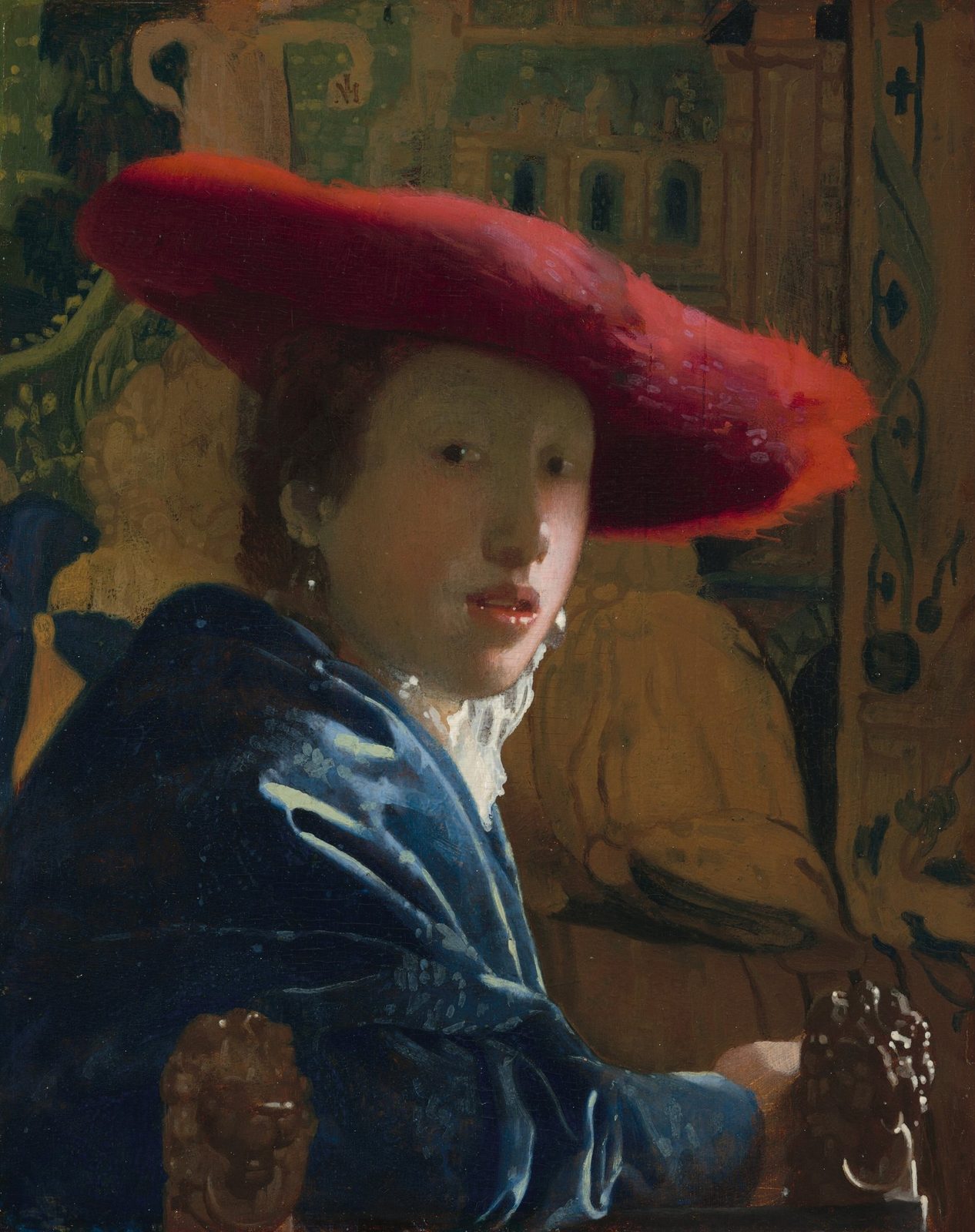
This panel is tiny, smaller than a sheet of paper, and it glitters. A girl in a flat red hat turns over her shoulder, lips parted, as if we had just said her name. Look closely and much of what seems sharp is a scatter of dots.
Delft, around 1669
It is catalogued as Johannes Vermeer, about 1669, and it is painted on a reused wooden panel, not canvas, which is one reason its attribution was argued over for years. A technical study for a 2022 exhibition concluded that it is by Vermeer, and found that he began by painting a portrait of a man in a wide-brimmed hat underneath.
Red tilts up, blue runs down
The design is two diagonals. The oval brim of the hat tilts up to the right and the blue wrap sweeps down to the lower right, with the face in the wedge between them. Your eye travels from the red down to the face, then down the blue to the glint in the bottom corner.
One line of shadow
The brim throws a shadow over the forehead and both eyes, so they sit in a warm olive brown. Below that line the cheek, the tip of the nose and the chin turn pale pink, almost white. The whole head is two values, shadow and light.
The last touch
On the lower lip are a few small white dabs, laid on top of the red and left unblended. They are the brightest points in the face, and they sparkle because everything around them is soft.
Sheen as scattered dots
Follow the brim to the right. Over the deep crimson lie dozens of pale blue-grey and pink dots and dashes that ignore the curve of the hat. They sit on the surface like light caught in feathers, and the tip dissolves into soft orange strokes.
Soft edges away from the face
At the other end of the hat, the red simply fades into the green tapestry, with no contour line at all. Vermeer keeps the edges soft wherever he doesn't want you to stop.
Blue, lit by a few strokes
The cool blue wrap answers the warm red hat. Its folds are almost black, and each lit ridge is one or two long, pale strokes of yellow-green and light blue, drawn in the direction the fold runs.
The whitest white
Right under the chin is the brightest area of the picture, the collar: thick, broken white paint with the darker layer showing through the gaps, so the lace is suggested instead of drawn.
A lion made of light
In the bottom right corner, the carved lion head on the chair is a dark brown shape covered in scattered white dots, with a curved stroke for the ring and no outline. From a step back it glints like carved wood; up close it is only dots.
Same object, less light
Its twin on the left is painted the same way but gets only a handful of dots. Same carving, less light: the number of highlights tells you where the window is.
Look closer
8 details, each checked against a close-up of the picture.
-
The face under the brim
The upper face, including both eyes, is in warm shadow from the hat brim, while the cheek, nose tip, lips and chin below the shadow line are lit.
The brim throws a shadow across the top half of the face: the forehead, both eyes and the bridge of the nose are a warm olive-brown, close in value to the tapestry behind. Below the shadow line the cheek, nose tip, upper lip and chin turn pale pink and almost white. The transition is soft but quick — a short gradation rather than a drawn line. The eyes are only a few dark touches with tiny catch-lights.
-
Dots on the red hat
Small pale blue-grey and pink dots are scattered over the red of the brim, sitting on the surface rather than following its folds.
The right side of the brim is deep crimson in shadow and a hot orange-red at its feathered tip. Across the crimson are dozens of small pale blue-grey and pinkish dots and short dashes. They do not follow the curve of the brim; they sit on the surface like scattered light. The outer edge dissolves into soft, feathery orange strokes.
-
The lion finial
The right-hand chair finial is built from scattered white and pale dots over a dark brown shape, with no continuous outline.
The carved lion finial is a dark brown shape against a lighter brown. Its surface is covered with scattered white and cream dots of different sizes; there is no line around the carving. A curved white stroke below reads as the ring in the lion's mouth. From a step back the dots read as glinting carving; up close they are just dots.
-
Light on the lips
The highlight on the lower lip is a separate small white dab laid on top of the red, not blended into it.
The lips are a soft red, darker at the parting line. On the lower lip several small, separate white dabs sit on top of the red, the brightest points in the face. Around them the flesh is blended smoothly, so the dabs stand out as distinct touches. At the right, the grey-white earring is also a few soft touches.
-
Blue wrap highlights
The highlights on the blue wrap are long pale strokes and dabs laid over a dark ultramarine ground.
The wrap is dark ultramarine, almost black in the folds. The lit ridges of the folds are long pale strokes of yellow-green and light blue, some flicked to a point. Smaller blue-grey dabs scatter over the mid-tones. At the top the white collar meets the blue with a sharp edge.
-
The feathered brim edge
The outer edge of the hat on the left is soft and feathered against the tapestry, with no hard contour line.
The left end of the brim is a rounded red shape against a dark green tapestry. Its outer edge is soft: the red fades into the green over a short distance with no contour line. The red is lighter and warmer along the top and darker underneath. Parts of the tapestry pattern show below in yellow-green.
-
The white collar
The white collar is built up in thick, opaque, lumpy white, lightest where it meets the blue.
The collar under the chin is thick, lumpy, opaque white paint, with a few grey strokes laid on top that suggest lace or folds. It is brightest along its lower edge where it meets the blue wrap. Above, it goes into the soft shadow under the jaw.
-
The left finial
The left-hand finial is darker and has far fewer highlight dots than the right-hand one.
The left finial is a dark brown carved head against dark blue. It has only a few small highlight dots, mostly along the top and one short pale mark in the middle. Compared with the right finial it is much darker and less sparkling.
Girl with the Red Hat in context
Vermeer at the end of the 1660s
Like his father, Vermeer worked as an art dealer in Delft as well as a painter. [1] No record of his training survives, but he became a master in the city's Guild of Saint Luke in 1653 and served as its head four times in the 1660s and 1670s. [1]
The years around this picture were hard ones. The National Gallery of Art's researchers describe him supporting a large family during an economic contraction, as the Anglo-Dutch wars and the French invasion of 1672 battered the Dutch Republic and the art market collapsed. [2] After his death in 1675 his widow testified that during the war he'd earned "very little or hardly anything at all". [2] He died heavily in debt. [1]
A small head on a reused panel
The painting is a tronie, a loose period term for a head or bust of an unidentified person, often in costume, used in inventories of the time. [2] At about 23 by 18 centimetres, it's Vermeer's smallest surviving painting and the only accepted work on an oak panel, though the wood hasn't been formally analysed. [2] The 1676 inventory of his household lists six unpainted panels in the room that was probably his studio, which the researchers suggest he may have meant for more tronies like this one. [2]
The panel had been used before. Rather than scrape off an unfinished portrait of a man in a large black hat, Vermeer turned the panel through 180 degrees and painted over it. [2] Tronies were usually modest, affordable pictures, and the NGA team suggests that Vermeer's turn to them may reflect an attempt to reposition himself within the art market. [2]
The attribution debate
Doubts have a long history. Frithjof van Thienen questioned the attribution in 1949, and several authors rejected it, including P. T. A. Swillens in 1950 and Albert Blankert and colleagues in 1975, a view Arthur Wheelock contested in a 1977 review. [2] Part of the problem was the support: the NGA researchers note that this picture and Girl with a Flute were doubted simply because they're the only panels associated with Vermeer. [2]
The hidden portrait raised its own questions. Wheelock suggested that Carel Fabritius might have painted it, Martin Bailey supported that idea, Walter Liedtke dismissed it, and Benjamin Binstock proposed that Vermeer's daughter Maria painted both layers. [2] The NGA team that published a multidisciplinary study in 2022 states that there was by then no longer any question that the painting is by Vermeer, and its findings present it as a key experimental moment in his career. [2] Who painted the man underneath remains unresolved. [2] The same research, in the team's words, compelled a reconsideration of the attribution of Girl with a Flute, and the NGA showed the panel in its exhibition Vermeer's Secrets in 2022-23. [2][1]
Dating has moved too. Tancred Borenius and Wilhelm Valentiner dated it to about 1660 and 1658, while others placed it at the end of the 1660s or in the early 1670s. Wheelock proposed about 1666/1667 in 1981, and the 2022 study argues for about 1669. [2]
From an Amsterdam sale to Washington
The early history is uncertain. The NGA lists Pieter van Ruijven and his heirs as possible owners, ending with the Amsterdam sale of Jacob Dissius on 16 May 1696, where the painting was probably lot 39 or 40. [1] Lot 38 was described as a tronie in antique dress, "uncommonly artful", and lot 39 as "Another ditto Vermeer". [1]
It reappeared in the Lafontaine sale in Paris in December 1822. [1] Family accounts disagree about whether Baron Louis Atthalin of Colmar bought it at that sale or after spotting it in a shop window, and it then descended in his family. [1] M. Knoedler & Co. sold it to Andrew W. Mellon in November 1925, the same year it was shown at Knoedler in New York and hailed in the press as a rediscovered Vermeer. [1] Mellon deeded it to his charitable trust in 1932, and it came to the National Gallery of Art in 1937. [1]
- Girl with the Red Hat (1937.1.53): overview, artist biography, provenance, exhibition history and bibliography . National Gallery of Art, Washington
- Alexandra Libby et al., "Experimentation and Innovation in Vermeer's Girl with the Red Hat: New Findings from the National Gallery of Art," Journal of Historians of Netherlandish Art 14:2 (2022) . Journal of Historians of Netherlandish Art