A village on the ice
How Avercamp fills a pale winter day with dozens of small, separate stories
- Artist
- Hendrick Avercamp
- Title
- Ice-Skating in a Village
- Date
- c. 1610
- Medium
- oil on panel
- Museum
- Rijksmuseum
- Image
- Public domain (CC0)
Open in Simple Art
Watch this story on iPhone and iPad, with offline downloads and a painting every day.
About 4 minutes of looking, in 9 parts.
Ice-Skating in a Village
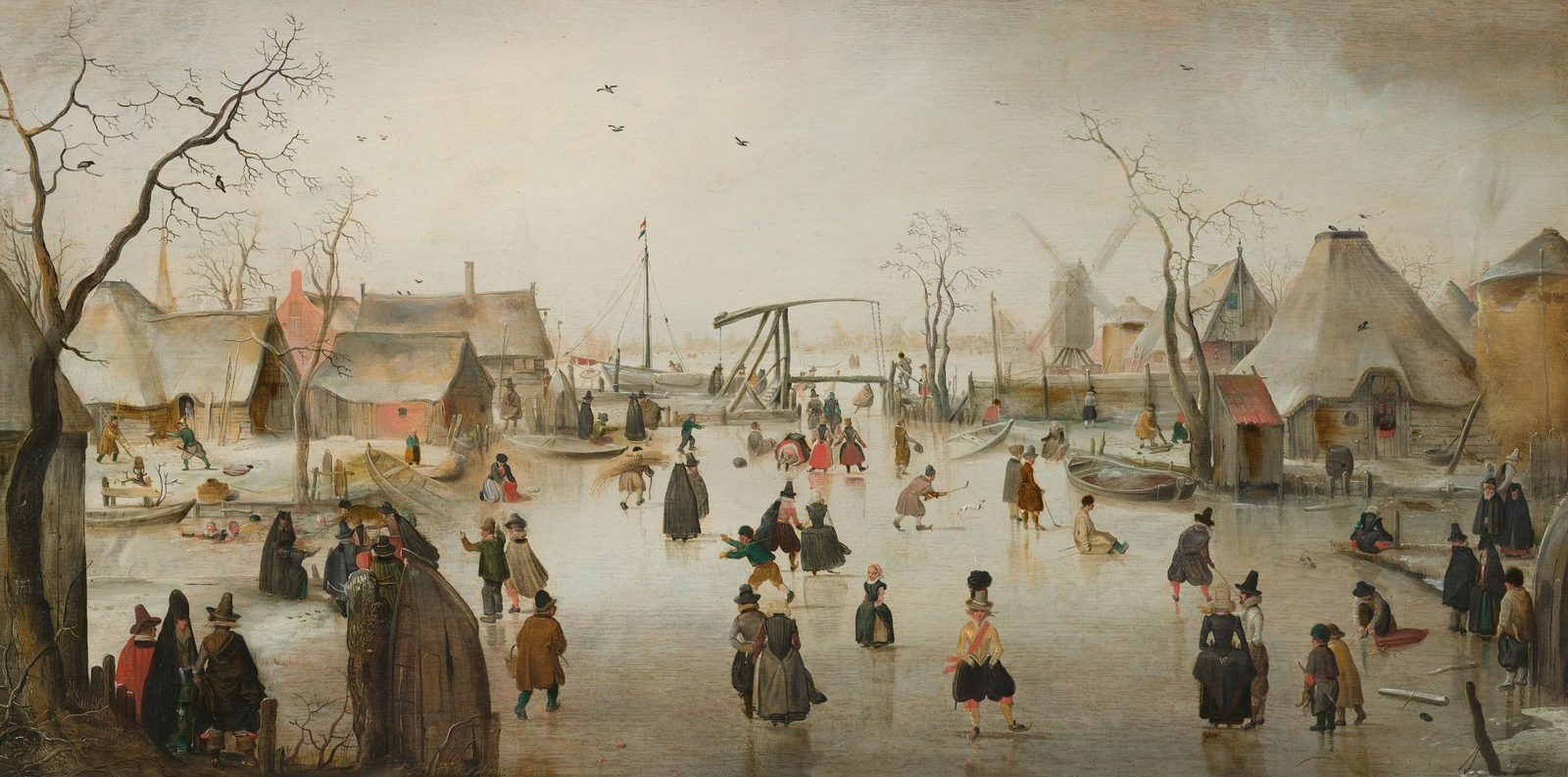
A whole village has come out onto the ice. People skate, chat, stumble and stand about, and nobody seems in much of a hurry. Before looking closely, notice how pale and quiet the scene feels, despite all that activity.
Hendrick Avercamp, c. 1610, oil on panel
This is Ice-Skating in a Village by Hendrick Avercamp, signed and painted around 1610 in oil on a wooden panel. It's small, about seventy centimetres wide, so each figure is only a few centimetres tall. Almost every one of them is doing something different.
Three bands and a busy middle
The picture is built in bands: ice across the bottom, a strip of houses, boats and trees through the middle, and a wide, pale sky above. Now look over to the left, near the boats. Two people have fallen through the ice, and you can just make out their heads above the water.
Distance turns grey
Follow the ice back to the windmill. It's painted in soft, pale greys that almost melt into the sky, and so is the snowy house beside it. Compare the bare tree trunks nearer to us, which are darker, warmer and sharper at the edges. That simple difference pushes the mill far away.
The red-sashed skater
Near the bottom, a little right of centre, one man stands out. He wears a tall plumed hat, a golden doublet, a red sash and pink stockings. His weight seems to rest on his front leg while the back one trails behind. Each skate blade is a dark stroke with a thin light line beside it.
Watchers at the edge
Down at the bottom left, a few people stand still and watch. Their tall hats and dark cloaks read almost as cut-out shapes against the pale ice. There's very little modelling inside them. Light against dark does nearly all the work, with one warm note in a red-orange cloak.
The drawbridge
In the middle distance is a wooden drawbridge, its long beam raised on tall timbers, with a moored sailing boat beside it. These dark, crisp lines stand out against the pale sky. Below them, the crowd is made of tiny dabs of paint: red skirts, a green jacket, black hats.
Painting the ice
Now look down at the ice itself. It's mostly warm beige and cool grey, crossed by thin pale streaks running from left to right, as if a dry brush had been dragged across it. The figures on it cast almost no shadows, which suits a dull, overcast day.
Small sparks of colour
Back near the centre, look for the colour. Most of the clothes are umber, charcoal and black. Against them, a crimson shirt, yellow ochre breeches and a thin red sash jump out at once. Avercamp seems to have saved his brightest colours for a few small touches, so your eye hops from one to the next.
Look closer
8 details, each checked against a close-up of the picture.
-
Central Ice Hub
A crowd of figures gathers around a raised wooden drawbridge, with a moored sailing boat beside it.
The crop centers on a raised wooden drawbridge rendered with crisp umber-brown lines over a pale cream sky, contrasted against a tall dark mast to the left that reads as a single vertical gesture. Figures cluster as small dabs of pigment—red skirts, a green jacket, black hats—sitting on a near-bare ground plane that shows only thin cool washes of grey-blue suggesting ice. Distant buildings dissolve into atmospheric haze with softened edges, while foreground figures and the drawbridge timbers hold sharper silhouettes, creating a clear near/far hierarchy. The transition between the warm sky and the cooler ice plane is handled with a very soft horizontal boundary rather than a hard line.
-
Skaters in Motion
The figure at [0.58, 0.78] is depicted mid-stride with one leg extended backward.
Two figures occupy a pale grey-beige ground that reads as ice. On the left, a woman in a black bodice, white ruff, and dark skirt stands with feet together; her edges are soft and slightly blurred against the background. On the right, a male figure wears a tall black plumed hat, a warm ochre-gold doublet crossed by a red-orange sash, very dark puffed breeches, salmon-pink stockings, and dark skates with thin pale blades. His weight rests on his forward (left) leg while his rear (right) leg trails behind, the skate blade extending out to the right of the foot at roughly [0.78, 0.92]. The brushwork is loose and small-scale; contours are softened, and the dark hat merges almost into the neutral sky tone above.
-
Red and Ochre Accents
Small, saturated red and yellow-ochre pigments are used for the clothing of specific figures.
The crop isolates a cluster of skaters and bystanders on pale, scratched ice. The most saturated passages are a crimson-pink shirt visible beneath the tall-hatted man's open coat, a yellow-ochre pair of breeches on the leaning skater in green, a thin red sash at that same skater's waist, and a small gold-and-red sleeve detail on the figure cropped at the right edge. These warm touches sit against largely neutral umber, charcoal, and black garments, so the reds and ochres read as deliberate focal points rather than ambient color. Edges on the small accents are crisp enough to read at this scale, while the ice and shadow passages are dragged with broader, softer strokes.
-
Atmospheric Perspective
The windmill and distant buildings have lower contrast and paler tones than the foreground figures.
The crop centers on a windmill whose body and sails are rendered in soft, low-contrast mid-warm grays that almost merge with the pale sky, while the snow-roofed house to the right shows a similarly muted ochre with a chalky white roof that bleeds into the atmospheric haze. By contrast, the bare tree trunks and branches framing the scene (especially the right-hand trunk) are painted in noticeably darker, warmer browns with crisper, more defined edges, and the small figures at the bottom register as the darkest accents. Edges in the background are softened and slightly feathered against the sky, whereas foreground trees show tighter, more deliberate contour lines.
-
Village Architecture
The large conical thatched roof is modelled with broad tonal sweeps, lighter on its right slope, while the small tiled roof below is made of short red dashes.
The crop centers on a tall, conical thatched roof rendered with broad, smooth, sweeping passages of warm grey-brown paint rather than fine repeated lines; tonal shifts (lighter ochre on the right-facing slope, cooler umber on the left) model the form, and the surface reads as a unified mass of paint with only faint directional marks following the roof's curvature. The smaller red tile roof at lower left shows a clear textural contrast, with individual rectangular tiles suggested by short, stacked dashes of red, orange and brown against dark gaps. Wooden walls, a small barrel, and a fence are blocked in with flat, opaque local colors, while edges between roof and sky are softly blended with no hard contour. Foreground figures are dabbed in with minimal detail, and the tree at left is drawn with thin, calligraphic dark lines for branches against a pale, scumbled sky.
-
Foreground Observers
Two figures on the left are standing still, facing the skating activity.
Two foreground figures on the left stand in profile-turned-three-quarter view, facing right toward the skating activity. The nearer one wears a tall conical hat over a red-orange cloak with a black collar band; behind, a second figure in a dark hooded cape with a tall black hat. The dark silhouettes read as flat, almost cut-out forms against the muted blue-grey ice, with thin highlight strokes along the hat rims and shoulders. Edges between figures and background are crisp where the dark clothing meets the lighter ice, while the contours of the cloaks dissolve slightly into the atmospheric haze. Value contrast is the primary modeling tool - there is minimal internal modelling, mostly dark masses with selective warm accents (the orange cloak, a hint of green dress below).
-
Ice Texture
The surface of the ice contains horizontal white streaks and soft gray reflections.
A wide, thin strip of frozen surface dominates the center, rendered in warm beige and cool gray tones with low value contrast. The marks are predominantly horizontal: thin pale streaks run left-to-right, suggesting a scraping or dragging motion across a still-wet ground. Two figures are cropped at the edges — a figure in a tan/brown coat with teal stockings on the left, and a figure with a dark basket and trailing olive-black skirt on the right — their feet casting no visible shadows, which flattens them against the plane. A small reddish-orange fleck sits near the lower center, the only chromatic accent in an otherwise muted, low-saturation field. The ice reads lighter than the figures but darker than the upper sky, consistent with diffuse overcast lighting.
-
Right-hand Figures
A group of figures near the right edge are huddled together in dark cloaks.
The crop shows a cluster of standing figures along the right edge, their dark, near-black cloaks forming a dense vertical mass that reads almost as a single silhouette against the warmer mid-tone ice. The man in the tall conical black hat and the woman beside him in a pale coif are suggested with minimal interior modeling—edges remain soft where the cloak folds, with a few thin, slightly warmer brown-grey strokes indicating volume rather than fully resolved form. A separate kneeling figure in the center-left bends over a vivid red cloth on the ice, the red being the most saturated note in the crop and acting as a chromatic anchor. The ice itself is built from a tan-brown ground with cooler grey-white horizontal scumbles catching ambient light, and a thin pale streak near the bottom right hints at a refrozen skate track.
Ice-Skating in a Village in context
The mute of Kampen
Hendrick Avercamp was baptised in the Oude Kerk in Amsterdam on 25 January 1585. In 1586 the family moved to Kampen, where his father became town apothecary [2]. The Rijksmuseum's catalogue says he was deaf and dumb from birth and was commonly known as 'de Stom' or 'de Stomme', the mute [2]. The National Gallery of Art is more cautious. They say he was unable to speak and probably also unable to hear [3].
A buyer at the 1607 studio sale of the painter Pieter Isaacsz in Amsterdam is recorded as 'the mute at Pieter Isaacsz's'. This is why Avercamp is thought to have trained with him [2]. He was back in Kampen by 1613 at the latest, and probably earlier. He stayed there for the rest of his life [2]. His mother expressed concern for her unmarried eldest son in her will, calling him 'mute and miserable' [2]. He was buried in Kampen on 15 May 1634 [2].
Painting a winter day
This small panel measures about 36 by 70 centimetres and consists of two oak planks. It is signed on a tree at the left with the monogram HA [1][2]. It is undated. Jan Piet Filedt Kok places it around 1610 because it resembles Avercamp's paintings dated 1608 and 1609 [2]. Compared with the slightly earlier Winter Landscape with Ice-skaters in the Rijksmuseum, the horizon is much lower. There are also fewer buildings and figures. But the farmhouses at either side still look like stage sets, giving the picture the rather theatrical look of David Vinckboons's landscapes [2].
A very sketchy black chalk underdrawing marks out the farmhouses [2]. Avercamp painted the houses, landscape and ice first. He then added the figures on top in thin, transparent layers, taking particular trouble over the reflections of the tree, the bridge and the skaters [2].
Work and play on the ice
Couples glide past, a boy pushes himself along on a sledge and players take part in kolf, an early form of golf [1][2][3]. A woman does her washing through a hole in the ice, and a man trudges under a bundle of reeds [2]. On the left a peasant hurries over with a ladder to people who have fallen through the ice. The museum's short description counts two of them, the catalogue entry four [1][2]. Near the bridge a woman has fallen over, a detail Avercamp took from Pieter Brueghel's print Skaters by St George's Gate in Antwerp [2].
The Little Ice Age
Avercamp mainly painted winter scenes, known in the seventeenth century as 'wintertjes' [2]. The National Gallery of Art sets them in the Little Ice Age, a climatic phenomenon that peaked in the seventeenth and early eighteenth centuries, with severe winters that arrived early and lasted well into spring [3]. His earliest dated painting, of 1608, followed a winter in which temperatures averaged well below freezing [3]. Most of his settings, the Gallery adds, are imagined Dutch waterways and villages, though he often included things drawn from nature, such as the wooden lift-bridge common on Dutch canals [3].
From Enkhuizen to The Hague
The earliest recorded owners are Dirck Semeyns van Loosen (1696-1757) and Maria Bontekoning of Enkhuizen [2]. The panel passed by descent to Pieter Opperdoes Alewijn of Hoorn, whose planned sale in 1875 was not held, and then to his niece, Jonkvrouw Maria Margaretha Snouck van Loosen [2]. At her sale in Enkhuizen on 29 April 1886 the Rijksmuseum bought it for 315 guilders, through the dealer C.S. Roos [2].
Since 1924 it has been on loan to the Mauritshuis in The Hague. J.J. Susijn carried out a complete restoration there in 1984 [1][2]. The figures are well preserved, with slight abrasion in the ice and sky [2].
Afterlife
Painters like Arent Arentsz, Adam van Breen, Antonie Verstralen and Avercamp's nephew Barent worked in a very similar way. It isn't clear whether he taught them or they simply imitated him [2].
In 2010 the picture went to Washington for Hendrick Avercamp: The Little Ice Age. This was the first exhibition devoted to the artist, organised by the National Gallery of Art and the Rijksmuseum, and shown first in Amsterdam [3]. The Gallery's text singled out one detail: the man rushing to fetch a ladder for the skaters who have gone through the ice [3].
- Ice-Skating in a Village (SK-A-1320): object record . Rijksmuseum, Amsterdam
- Hendrick Avercamp, Ice-Skating in a Village, c. 1610 (catalogue entry and artist biography by Jan Piet Filedt Kok, 2007, in Dutch Paintings of the Seventeenth Century in the Rijksmuseum) . Rijksmuseum, Amsterdam
- Hendrick Avercamp: The Little Ice Age (exhibition, 21 March to 5 July 2010; Internet Archive copy, 3 December 2023) . National Gallery of Art, Washington