Reading a Cathedral Interior: Neal's St. Mark's
A tonal walkthrough of David Dalhoff Neal's 1869 oil on canvas
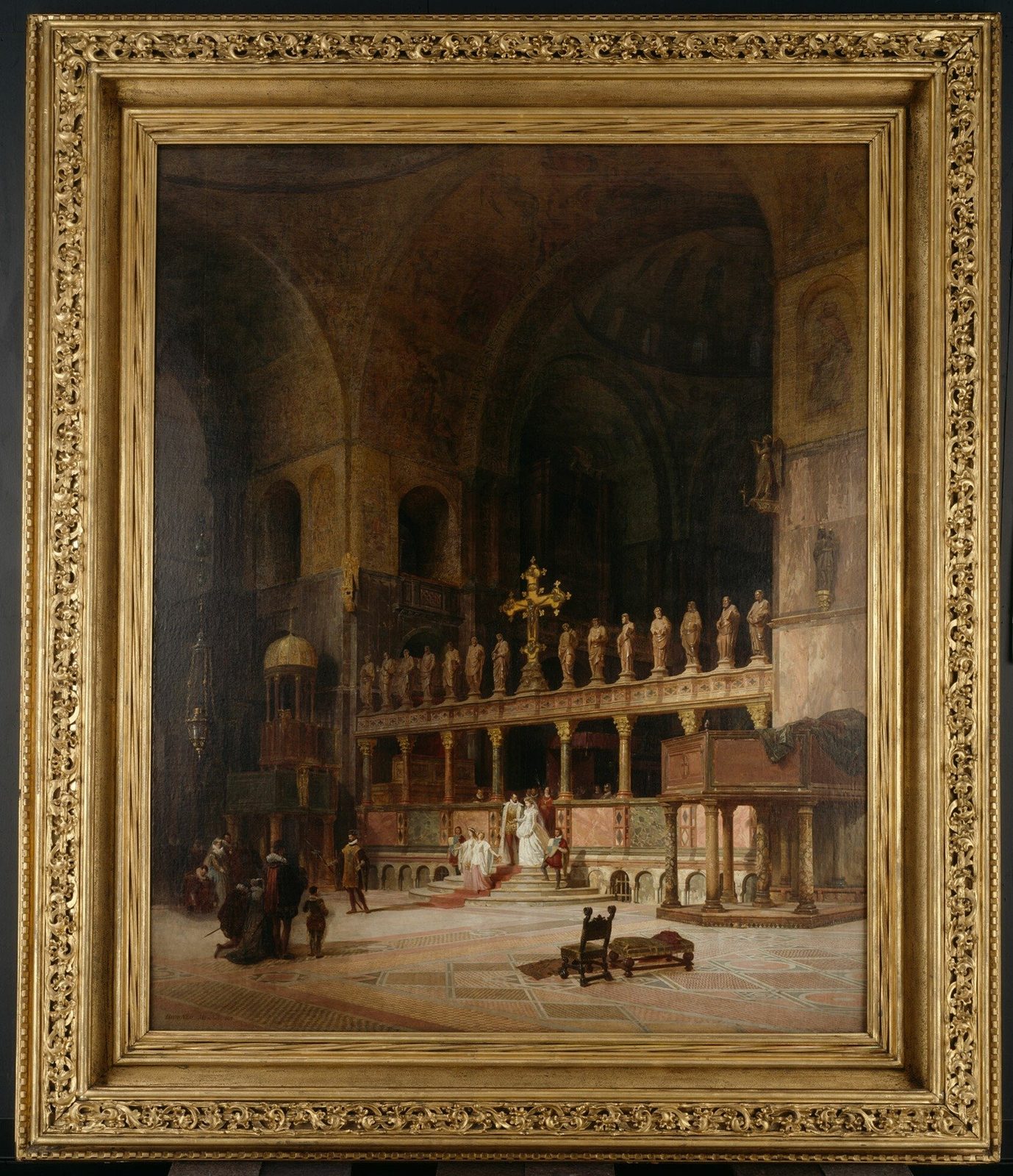
- Artist
- David Dalhoff Neal
- Title
- Interior of St. Mark's, Venice
- Date
- 1869
- Medium
- Oil on canvas
- Museum
- Art Institute of Chicago
- Image
- Public domain (CC0)
Open in Simple Art
Watch this story on iPhone and iPad, with offline downloads and a painting every day.
About 5 minutes of looking, in 11 parts.
Interior of St. Mark's, Venice
We step into a hushed basilica, the air heavy with incense and shadow. A single golden crucifix glows at center — the brightest point in a painting built on deep chiaroscuro. Watch how Neal anchors an entire Venetian cathedral around one luminous axis.
David Dalhoff Neal, 1869
Neal painted this in 1869, working in oil on canvas in the mid-nineteenth-century American academic tradition, with the architectural intimacy of the Düsseldorf school. He gives us not a guidebook view, but a quiet liturgical gathering, dressed in seventeenth-century costume.
Centered on the Cross
The composition is ruthlessly symmetrical. A vertical axis runs straight through the gilded cross, bisecting the rood screen, while a strong horizontal band divides the canvas into a dim vault above and an illuminated floor below. Notice how the orthogonal marble tiles push our eye inward toward that center.
Top-Down Drama
Diffuse top light pours over the rood screen and central steps, then dies into the cavernous dome. The contrast is enormous: near-black vaults pressed up against the warm glow of the cross and white vestments. Neal reserves the highest values for the sacred center.
Warm Earth, Single Gold
The palette is built from umber and ochre — a quiet warm earth-tone architecture. Cool neutrals are kept for the shadowed dome stone, but gold appears only once in the canvas, on the cross and a handful of trim marks. The sacred is announced by chromatic scarcity.
Bench and Marble Floor
Our eye begins here, on the carved wooden bench at the lower right and its geometric marble floor. Notice the crispest edge is where the bench foot meets the pale tile, that contact point, while the bench's upper profile softens into the room. The marble seams read as drawn with a fine liner, but with subtle variation — painted, not taped.
Seventeenth-Century Witnesses
Following the floor inward, we meet a small cluster of visitors in seventeenth-century dress. They are shaped almost entirely as silhouettes, cut against the lighter architecture rather than drawn with edges. The only drawn mark is the high white collar — letting the lightest costume accent do the drawing for you.
Row of Apostles
Up the crimson-carpeted steps, the rood screen unfolds as a row of pale apostle statues. Each figure is the same creamy off-white; differentiation comes entirely from silhouette — tucked chins, raised arms, contrapposto hips. Even the drapery is faceted into broad light and dark planes, not fine lines.
The Gilded Crucifix
And here, at the heart of the painting, the gilded crucifix. The brightest paint in the entire canvas is reserved almost exclusively for the upper arms of the cross and the torso of Christ. The silhouette has a sharp gold-to-dark edge on the left, then softens into an atmospheric halo, drawing the eye upward.
Atmospheric Vault
Follow the cross into the dome and watch the handling change. Up here the edges dissolve into soft umber haze, mosaic decoration is only suggested by a few small opaque dabs, and the brush grows loose. The vault reads as cavernous precisely because Neal refused to draw every detail.
Faint Inscription
Down in the lower left, on the warm brown band of the floor, a faint inscription rests. Neal applied it as a thin, semi-transparent lighter wash so the text only emerges at close range — integrated into the surface rather than floating on top of it, just as he integrated the human ceremony into the architecture.
Look closer
6 details, each checked against a close-up of the picture.
-
The Golden Crucifix
The crucifix is the brightest point of the composition, featuring high-contrast gold highlights against a dark background.
The crop centers on an ornate gilded crucifix whose terminal finials catch the strongest yellow-gold highlights, with the body of Christ rendered in a slightly more muted ochre that steps down in value. The cross sits against a near-black architectural void, producing a sharp luminance edge along its silhouette. To the left, a bride in a white gown is modeled in soft cool grays, its left side barely lifting off the dark wall; to the right, a smaller standing figure in pale buff reads as a secondary value peak. Edges throughout are softened with atmospheric blending rather than crisp lines, and the dark verticals of a column on the far left frame the lit zone. The brightest paint is reserved almost entirely for the upper arms of the cross and Christ's torso, so the eye is funneled upward.
-
Foreground Chair and Floor
The edges of the wooden chair and the lines of the marble tiles are rendered with sharp, precise brushwork.
The crop centers on a dark, carved high-backed wooden chair with ball-footed legs beside a lower footstool holding a crumpled red cloth, all set on a geometric marble pavement of pink, cream, and grey tesserae. The chair silhouette reads as a dense, near-black mass with softly modulated internal modeling on the backrest carving rather than crisp linear definition. Marble seams between differently colored stones are visibly drawn with thin but slightly variable strokes, and small tonal flecks at junctions suggest the paint was applied with a loaded brush rather than taped or ruled. The highest contrast occurs at the chair feet meeting the lightest tile, where edges read hardest, while the upper curves of the backrest bleed more gently into the background.
-
Atmospheric Upper Vault
The architectural details in the upper dome are softer and hazier than those on the lower floor.
The crop is dominated by a deeply shadowed upper vault rendered in warm umber, raw sienna, and oxidized red-brown passages that bleed into near-black recesses at the upper edges. Vault ribs and mosaic-like decorative banding read only as suggested shapes, their edges blurred by soft transitions rather than drawn lines. A curved arch sweeps in from the left and a larger opening on the right shows a faintly indicated figure and a candle-flame-like warm spot, while the lower arcade of small arched bays retains slightly crisper silhouette edges. Texture varies from thinly scumbled passages where underpainting shows through, to small denser dabs of opaque pigment along the most legible decorative bands.
-
The Apostles' Statues
Each figure on the rood screen has distinct drapery folds and unique poses.
The crop centers on a gilded crucifix flanked by a horizontal row of roughly eleven pale stone apostle statues standing on a projecting cornice. Each figure is rendered with the same creamy off-white value, but the artist has differentiated them through silhouette alone: tucked chins, bent elbows, raised forearms, contrapposto hips, and head tilts all shift the contour against the deep umber background. Drapery is carved into broad planar facets rather than fine lines—each fold reads as a discrete lighter or darker patch, with the deepest shadows pooled at the inner thigh, beneath the supporting elbow, and inside the crook of bent arms. The central golden cross contrasts through warm yellow-gold against the neutral statues, while the balustrade below breaks into small rectangular marble inlays of rose, ochre, and grey. Edges against the dark background are crisp where light rims the figures, but soften into atmospheric haze where the statues recede toward the left and right ends of the row.
-
Visitors in 17th-century Dress
The figures on the left are rendered in dark silhouettes with distinct hats and robes.
The crop frames a cluster of dimly lit figures in 17th-century costume against the marble steps of a basilica. On the left, a seated woman in a pale grey-blue gown and white headscarf is paired with a small child in reddish-brown; their forms are loosely brushed with soft edges that blend into the warm brown background. In the center, a tall standing figure in a dark cloak and white collar leans forward toward a second figure wearing a wide-brimmed black hat, both rendered as nearly flat silhouettes. To the right, a small attendant in russet-orange doublet and hose faces away, while a brighter figure in a yellow-gold robe stands at the screen, providing the highest value accent in the crop. Edges are wet and softened throughout, with costume details (hats, collars, sash) suggested by small lighter touches rather than drawn contours.
-
Lower Left Signature Area
There is faint script and possibly a date inscribed on the lower left floor area.
The crop is divided into three horizontal zones: the upper third shows a perspectival geometric floor pattern in warm orange-browns with darker gridded lines forming a checkered or diamond layout; the middle third is a flat reddish-brown horizontal band (a step or threshold) bearing faint, partially legible script in a lighter ochre tone, with letterforms that appear to trail off to the right where the paint is abraded; the lower half is the gilded moulding of the picture frame, outside the painted surface. Edges are soft and slightly blurred, and the script sits very low in value contrast against its ground, making it readable only at close inspection.
Interior of St. Mark's, Venice in context
From Lowell to Munich
David Dalhoff Neal was born in Lowell, Massachusetts, in 1838 [2]. Wikipedia says he worked as a draughtsman on wood for engravers in San Francisco from 1857, becoming a portrait painter there before leaving for Munich in 1861 [2]. At the Royal Academy he studied under Kaulbach and learned architectural perspective from the glass painter Max Emanuel Ainmiller, marrying his daughter Marie in December 1862 [2].
Venice, painted for Munich
According to Wikipedia, it was under his father-in-law's direction that Neal travelled to Italy to paint the interior of St Mark's, and then to England to paint Westminster Abbey, where he needed a letter from the Dean, Arthur Penrhyn Stanley, before he was allowed to work [2]. Wikipedia's list of his works also includes On the Grand Canal, Venice, of 1869 [2]. The canvas is large, 184.2 by 148.9 centimetres, and is signed at the lower left 'David Neal. München. 1869' [1]. The Munich inscription suggests that the picture was finished in his studio there, though the museum record does not say so [1]. In the same year, Wikipedia says, he entered the studio of Alexander Wagner and then that of Karl von Piloty [2].
The screen and the floor
The setting can be matched to the basilica's chancel. Wikipedia describes a Gothic altar screen dated 1394, topped by a bronze and silver crucifix and flanked by statues of the Virgin, Saint Mark and the Twelve Apostles [3]. The church floor dates from the late eleventh or early twelfth century and is mostly opus sectile, laid with geometric and animal designs in coloured marbles [3]. Above, the domes and vaults are covered with gold-ground mosaics [3].
A career in history and portraits
Neal stayed in Munich for the rest of his life, keeping his American citizenship while travelling to sell and exhibit [2]. Wikipedia credits his The First Meeting of Mary Stuart and Rizzio with the great medal of the Royal Bavarian Academy, the first given to an American, and says he painted some seventy portraits before his death in Munich in 1915 [2].
A Chicago banker's collection
The painting came from Samuel M. Nickerson (1830 to 1914) of Chicago, and the Art Institute's record gives 1887 as the year it was given [1]. The Driehaus Museum, which occupies the Nickersons' former house, quotes a Chicago Daily Tribune report of January 1900 announcing that the couple had given their whole collection, including oil paintings, to the Art Institute [4]. The sources do not explain the difference in dates. The same report says the foundation of Nickerson's picture collection was a group of Belgian paintings, and that in recent years he had bought modern works [4]. The Driehaus also notes that Nickerson stepped down in 1900 as president of the First National Bank of Chicago [5].
- David Dalhoff Neal, Interior of St. Mark's, Venice: collection record . Art Institute of Chicago
- David Dalhoff Neal . Wikipedia
- St Mark's Basilica . Wikipedia
- History of the Nickerson Mansion: 1900 . Richard H. Driehaus Museum
- History of the Nickerson Mansion . Richard H. Driehaus Museum