A hand on the heart
How Rembrandt lets one tender touch, one red and some very thick paint carry a whole painting
- Artist
- Rembrandt van Rijn
- Title
- Isaac and Rebecca, Known as ‘The Jewish Bride’
- Date
- c. 1665 - c. 1669
- Medium
- oil on canvas
- Museum
- Rijksmuseum
- Image
- Public domain (CC0)
Open in Simple Art
Watch this story on iPhone and iPad, with offline downloads and a painting every day.
About 4 minutes of looking, in 10 parts.
Isaac and Rebecca
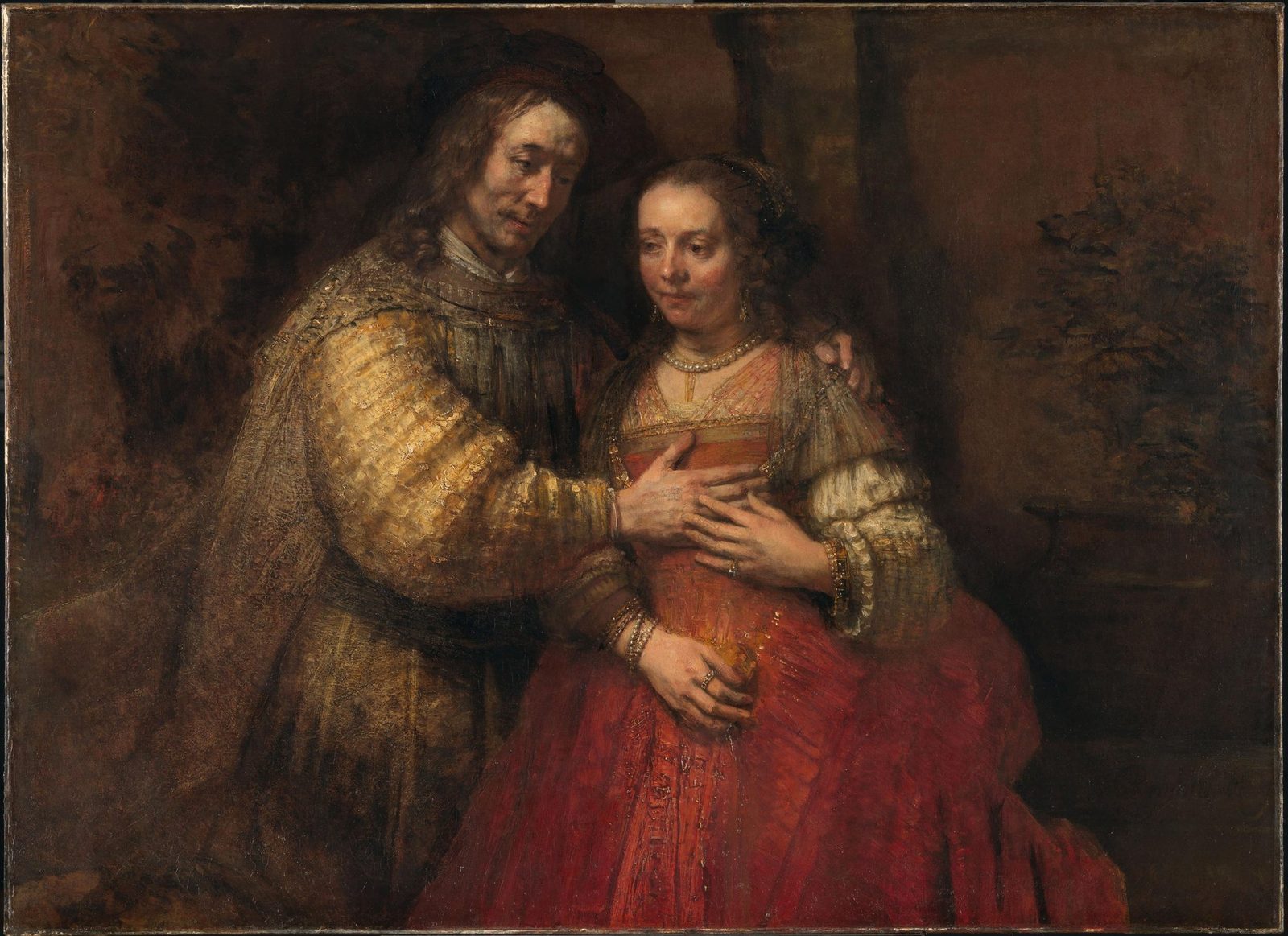
Two people stand close together against a dark ground. His hand rests on the front of her red dress, and her fingers lie lightly over it. Nobody speaks, nobody looks at us, and the whole picture turns on that one quiet touch.
c. 1665 to 1669, oil on canvas
This is Rembrandt's Isaac and Rebecca, known as The Jewish Bride, painted in oil on canvas around 1665 to 1669. The Rijksmuseum reads it as a biblical story. Isaac pretended Rebecca was his sister, to keep them both safe, until a moment of intimacy gave them away. Rembrandt paints that tender moment.
A triangle around the hands
The two heads sit near the top, and the joined hands make the low point of a broad triangle. His arm cuts a long diagonal from upper left to lower right across her body. Wherever you start, the design walks you back to the hands.
Light from the upper left
The light comes from the upper left. On his face it catches the forehead, the bridge of the nose and the top of the cheek, in thick warm cream and pink. The far side of his face simply slips into the dark, with no outline to mark where it ends.
One saturated red
Nearly everything is gold, ochre and brown, with one exception: her dress. Its red runs from deep oxblood in the shadows to bright orange-vermilion along the folds that face the light. Those brightest streaks look thick, as if dragged on late, down the fall of the cloth.
Gold built up in ridges
Now follow his gold sleeve. The paint stands up in heavy diagonal ridges that catch the light on their crests, with dark troughs between them. The museum notes that Rembrandt applied the paint thickly and scratched into it with the butt end of his brush, and you can find a few such lines here.
Two hands as one
Come down to the hands. Her fingers are a cooler, paler pink; his hand beneath is warmer and slightly darker. Where they meet, the edges soften and the shadows between the fingers merge with the dress, so the two hands read almost as one shape.
Her lowered eyes
Lift your eyes to her face. Light falls on her forehead and steps down softly into the brow. Her eyes look slightly downward under heavy, blended upper lids, and the lower lids are barely there at all. That restraint gives her a look of inward attention.
Pearls as single dabs
Below her throat runs a string of pearls. Each one is a single small dab of paint, greyish in the middle tone, with a brighter touch towards the upper left, where the light comes from. A few broken strokes of ochre link them together.
Thick above, thin below
Compare his sleeve with the bottom of her skirt. Up top, the paint is crusty and raised. Down below, the reds look thinner, dragged over a darker layer that shows through between the strokes. The same painter uses paint as relief in one place and as a veil in another.
Look closer
8 details, each checked against a close-up of the picture.
-
Intertwined Hands
The woman's pale fingers overlap the man's larger, darker hand on the red bodice.
The crop centers on a stack of fingers resting against a red bodice, with a gold-embroidered sleeve and pearl strands visible at the edges. Flesh tones range from a cool pale pink on the uppermost hand to a warmer, slightly darker ochre-pink on the hand beneath, the two interlocking fingers with soft, melted edges where they meet. The red fabric is built from dragged vertical strokes that leave streaks of darker crimson and lighter vermillion exposed, while a sharp horizontal highlight on the upper knuckle marks the brightest passage. Shadows pool in the crevices between fingers and the cuff, fusing the hands with the dress.
-
Gold Sleeve Impasto
The gold paint is applied in thick, raised diagonal ridges, with a few thin lines scratched into the surface; the embroidery is suggested by the relief rather than drawn.
A heavily impasted gold-ochre field dominates the left and center, where thick ridges of paint run diagonally from upper-left to lower-right, forming a quilted or basket-weave pattern. The raised strokes catch light along their crests while the troughs between them fall into deep umber shadow, creating a strongly directional texture. To the upper right the gold gives way to a vertical, dark brown-to-black passage laid in long parallel strokes, and a small wedge of warm reddish-brown paint appears at the far right edge. The paint surface is crusted and cracked, with bright highlight flecks clinging to the tops of ridges and a few thin scratched lines scoring through wet-looking passages.
-
Man's Face Highlight
Light hits the forehead and nose, while the side of the face blends into the dark background.
The crop shows a man's face tilted downward, eyes lowered, with light raking from the upper left across the forehead, the bridge of the nose, and the upper cheekbone. The lit passages sit in thick, warm cream-and-pink impasto that catches the eye, while the right side of the face (viewer's right) loses its edge entirely into the deep umber-black ground. Browsed hair strands fall across the brow in loose, ruddy-brown strokes that feather into the skin tone rather than meeting a hard line. The skin is built from overlapping scumbled warms—pinks, ochres, and umber—over a darker undertone, and a fine craquelure network runs across the whole surface. The transition from highlight to shadow on the cheek is gradual, with no drawn boundary.
-
Woman's Pearl Necklace
The pearls are rendered as small, distinct dabs of white and cream paint.
The crop centers on a curved strand of pearls resting against warm flesh tones, with a glimpse of crimson drapery at the right edge and deep umber shadow on the left. Each pearl reads as a discrete, slightly irregular dab of paint—roughly oval to round—with a brighter white or pale cream highlight placed off-center toward the upper left, surrounded by cooler grey-tinged midtones that give each sphere volume. A thin gold-ochre thread or wire links the pearls, rendered as quick broken strokes rather than a continuous line. The flesh around the strand shows loose, scumbled brushwork where warm pinks, ochres, and browns are blended wet-into-wet, while the pearl highlights sit on top as more opaque, raised touches.
-
Red Gown Saturation
The dress uses a range of deep crimson to bright red highlights in the folds.
The crop centers on two interlocking hands against a saturated red gown, with thick impasto highlights running vertically down the fabric folds between roughly x=0.3-0.5. The crimson ranges from a deep oxblood near the right edge and bottom (around y=0.6-1.0) to bright vermilion-orange highlights catching the upper-left light across the central pleats. The flesh tones of both hands sit warmer and paler than the dress, with the lower hand showing cool pink-white passages on the knuckles and a cooler shadow on the underside of the fingers. Craquelure is visible across the entire surface, particularly in the darker passages on the right where the paint layer appears thinner. The pearls on the wrist and ring are indicated with small opaque white dabs accented by dark touches, while edges between hand and gown are softened by wet-into-wet blending rather than hard contours.
-
Woman's Expression
The eyes are slightly downcast under softly blended upper lids, while the lower lids are barely modelled.
The crop shows a close-up of a woman's face with warm, ruddy flesh tones dominated by pinks, ochres, and rose hues in the cheeks. The forehead catches light from the upper left, with the value stepping down softly into the brow and then into shadowed, smudged eye sockets. The eyes sit under heavy, softly blended upper lids and look slightly downward; the lower lids are barely modeled, fading into the cheek. The hair is a near-black mass with subtle warm umber touches, and a network of fine craquelure runs across the paint film, especially on the brow and cheek.
-
Man's Shoulder Grip
The man's left hand rests lightly on the woman's shoulder, barely emerging from shadow.
The crop centers on a heavily worked passage where thick, gestural strokes of ochre and gold-leaning umber pile up to suggest a sleeve or shoulder of embroidered fabric. A hand shape — three or four pale, salmon-pink dabs with a brighter flesh-tone highlight along the upper ridge — emerges from the surrounding umber mass, its lower fingers lost into a near-black passage that reads as the woman's shadowed shoulder. Edges between the hand and the dark area below are unresolved, built from broken, scumbled strokes rather than a clean contour. A diagonal sweep of red-brown on the right sets off the hand against a darker ground, while scattered pinpricks of warmer light (pearl-white and burnt sienna) sit along the upper-left boundary, telling us the light source.
-
Lower Gown Scumbling
The paint is applied in broad, thin, semi-transparent layers at the bottom of the dress.
The crop isolates the lower skirt area of the red gown, showing broad, vertically-oriented brushstrokes in layered reds. Thicker, more opaque crimson ridges sit over a darker, more transparent burgundy ground, with the weave of the support faintly visible through the thinner passages. Small, raised pearl-like dots and short, crisscrossed highlight strokes break the vertical flow, while the edges between adjacent strokes are soft and feathered rather than sharply defined.
Isaac and Rebecca, Known as 'The Jewish Bride' in context
A name from an inventory
The title by which the painting is best known doesn't go back to Rembrandt. Marilyn Aronberg Lavin and Irving Lavin trace its recorded history to the London dealer John Smith. He bought it in 1825 and described the man as the woman's father [2]. Smith sold it in 1833 to the Amsterdam collector Adriaan van der Hoop, whose inventory described a Jewish bride being adorned with a necklace by her father [2]. By 1855, when a catalogue of the collection was published, the picture was simply 'known under the name of the Jewish Bride' [2].
Van der Hoop (1778-1854) was a banker and one of the richest men in the Netherlands, who left about 250 paintings to the city of Amsterdam [3]. His collection was shown in his former house on the Keizersgracht and was merged with the newly built Rijksmuseum in 1885 [3]. The museum still credits the painting as on loan from the City of Amsterdam, from the A. van der Hoop Bequest [1].
Who are the couple?
The Lavins sort the many proposals into four groups: genre scenes, Old Testament subjects, portraits and allegories [2]. Wilhelm Valentiner suggested Rembrandt's son Titus and his fiancée Magdalena van Loo, who married in 1668 [2]. Jacob Zwarts argued instead for the Sephardi poet Miguel de Barrios and his second wife, Abigail de Piña [2].
The link with Isaac and Rebecca emerged around 1925. That was when Valentiner, Cornelius Müller-Hofstede and Hans Kaufmann connected the composition with a Rembrandt drawing of King Abimelech discovering the couple [2]. According to the Lavins, an X-ray shows that the pair were first painted seated, with the woman on the man's lap, just like the drawing [2]. The Rijksmuseum's present title follows this reading, while earlier titles in its own record call the picture a portrait of a couple as figures from the Old Testament [1].
Not everyone accepts this reading. In 2006 the Rijksmuseum's Bulletin published an article by the journalist Bert Natter that reconsidered the earliest known interpretation of the painting [4]. A Dutch blog summary of the article reports that Natter found an 1828 London sale catalogue describing the picture as Jephthah and his daughter, and argued for a father and daughter rather than a couple [5]. The same account says the museum did not change its label in response [5].
A date left incomplete
The signature at the lower right reads 'Rembrandt f. 16...', so the last two digits of the date are missing [1]. Experts place the painting between 1662 and 1666, the Lavins write [2]. Meanwhile, the Rijksmuseum dates it more broadly to about 1665-1669 [1].
The museum's own description is precise about the gestures. The man lays his right hand on the woman's breast and his left arm over her shoulders, while she rests her left hand on his and holds her right hand in front of her body [1]. Cut off at the knee, the two are shown standing before a wall [1].
Van Gogh in front of it
Vincent van Gogh spent three days in Amsterdam in October 1885, mostly in the museum [6]. Writing to his brother Theo, he called The Syndics the finest Rembrandt, but said of the Jewish bride: 'what an intimate, what an infinitely sympathetic painting' [6]. The editors of his letters note that he travelled with his friend Anton Kerssemakers of Eindhoven, who later wrote down recollections of the trip [6].
A more famous remark comes from those recollections rather than from Van Gogh's own letters. CODART's notice of the Van Gogh Museum's 2006 exhibition Van Gogh and Rembrandt reports that he said he would gladly give ten years of his life to sit for a fortnight in front of the picture [7]. Van Gogh already knew the painting through Théophile Thoré. Writing as W. Bürger, Thoré described it at length in his Musées de la Hollande and praised both the expression of the figures and the handling [8].
- Rembrandt van Rijn, Isaac and Rebecca, Known as 'The Jewish Bride' (SK-C-216): object record, description, inscription and titles . Rijksmuseum, Amsterdam
- Marilyn Aronberg Lavin and Irving Lavin, 'Rembrandt's Jewish Bride: Sister and Spouse' (English version, 2013) . Institute for Advanced Study, Princeton
- Adriaan van der Hoop . Wikipedia
- Bert Natter, 'Het Joodse bruidje: de vroegst bekende duiding opnieuw bekeken', The Rijksmuseum Bulletin 54, no. 2 (2006), pp. 162-81 . Rijksmuseum, Amsterdam
- Vanwege Rembrands verjaardag: Isaak en Rebekka, beter bekend als Het joodse bruidje (15 July 2014) . HANTA
- Letter 534, Vincent van Gogh to Theo van Gogh, Nuenen, on or about 10 October 1885, with notes . Van Gogh Museum and Huygens ING, Vincent van Gogh: The Letters
- Van Gogh en Rembrandt (exhibition, Van Gogh Museum, 24 February to 18 June 2006) . CODART
- Letter 430, Vincent van Gogh to Theo van Gogh, notes 10 and 11 . Van Gogh Museum and Huygens ING, Vincent van Gogh: The Letters