Renoir's Quiet Conversation: Eyes and Hands at Work
A guided look at Pierre-Auguste Renoir's Jean Renoir Sewing, 1899–1900
- Artist
- Pierre-Auguste Renoir
- Title
- Jean Renoir Sewing
- Date
- 1899–1900
- Medium
- Oil on canvas
- Museum
- Art Institute of Chicago
- Image
- Public domain (CC0)
Open in Simple Art
Watch this story on iPhone and iPad, with offline downloads and a painting every day.
About 5 minutes of looking, in 11 parts.
A child, lost in sewing
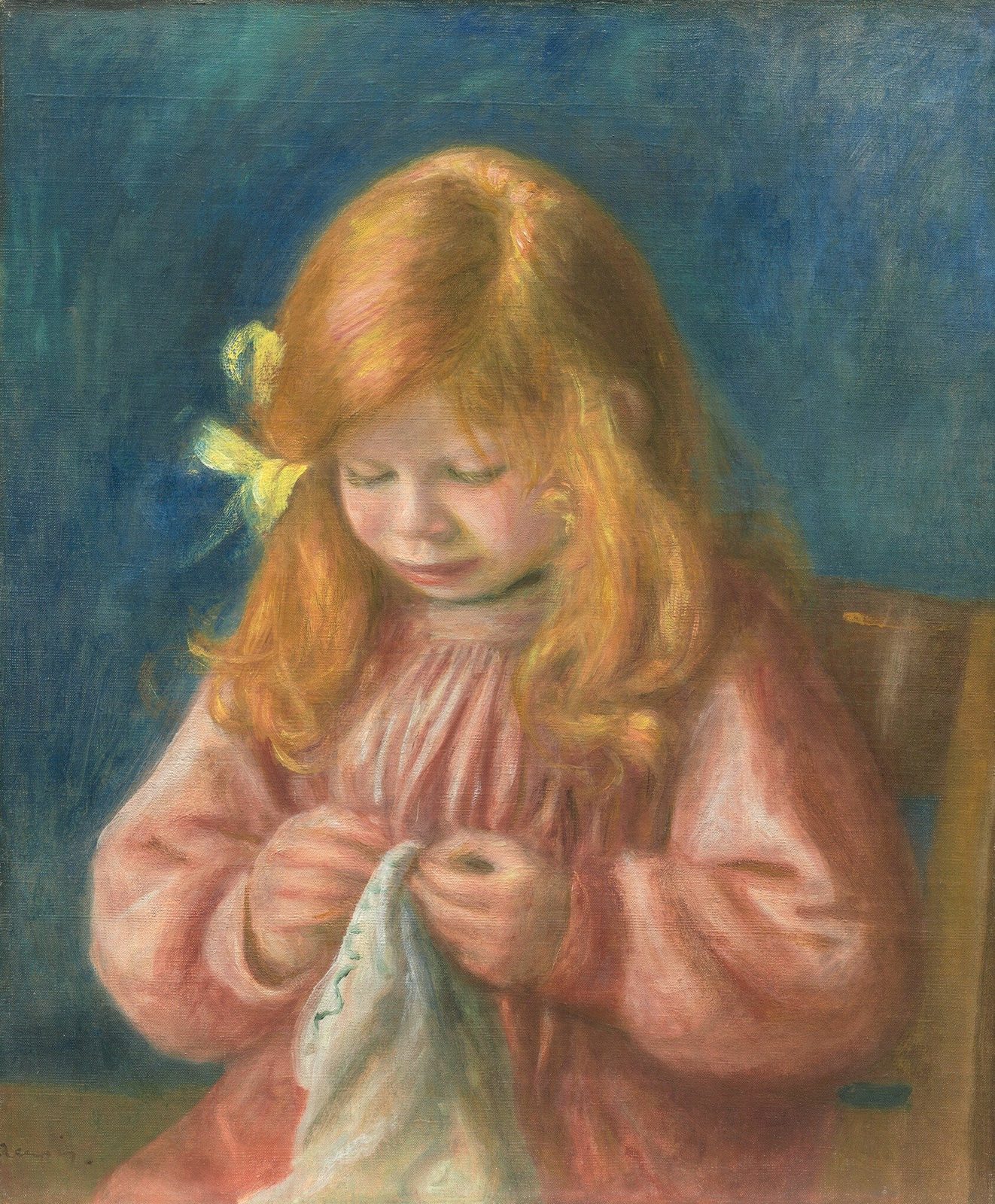
Before you is a quiet, intimate portrait — a child with head bowed, absorbed in the small work of sewing. The painter is Pierre-Auguste Renoir, and this is Jean Renoir Sewing, an oil on canvas dating from 1899 to 1900. Everything about the image pulls you inward, toward that downward gaze.
An ambiguous sitter
Although the title records the sitter as the artist's son, the painted figure reads to many viewers as a young girl — the long hair and pink dress leave sex and age deliberately ambiguous. Renoir is less interested in naming the child than in capturing one concentrated moment of domestic life.
A triangular structure
Step back and look at the structure. Renoir builds a pyramid: the head near the top vertex, the shoulders widening downward to a broad base at the lap and the cream cloth. The downcast face and the working hands sit almost on the central cross — the two poles of the child's attention.
Light from the upper left
Now follow the light. It falls from the upper left: the left side of the face, the yellow bow, and the left shoulder catch the strongest illumination, while the right side of the hair and dress soften into shadow. The whole image reads high-key, with the deepest notes tucked into the upper-right blue background.
A face without pupils
Zoom into the face. The eyes are not drawn at all — just soft almond smears of pinkish flesh edged with a few olive-violet strokes where lashes would be. Notice how Renoir models form without a hard contour: a single muted violet stroke beside the nose does the work of cast shadow.
Hands as a single mass
Drop down to the hands. The fingers almost merge into one another, blocked in first as a single rounded mass of warm peach and pink. Across the lower-left, a cream cloth with a cool greenish-grey shadow folds — its edge is a soft, broken line, not a drawn contour.
Cool light beneath the cream
Look closely at that cream cloth in the lap. Beneath the warm highlights you can sense a cool blue-grey underpainting tinting the folds. The canvas weave shows through the thinner scumbles, telling you Renoir dragged a fairly dry brush so the cool tone breathes through the cream rather than mixing on the palette.
The brightest accent
Sweep up to the yellow bow at the upper left — the highest-value accent in the painting. Those pale-yellow and near-white dabs are the thickest paint on the canvas, sitting in crisp ridges against the thinly dragged teal field behind. Surrounding blue is one step cooler and thinner, so the bow pops through both tone and paint body.
Hair in directional flow
Drift through the hair. Long, sweeping strokes of gold, ochre, and warm orange follow the downward arc of the locks, laid wet into a still-tacky underlayer so the edges stay soft. The lit ridges are the last, most opaque marks; the shadow passages are thinner paint, in places letting the canvas tone show through.
Cool purple shadows, not black
Move along the dress folds. Where you might expect brown or black shadow, Renoir uses cool dusty mauves and purplish-pinks — the shadow of the local color's complement. Warm peach-pink rides the crests, cool purple sits in the recesses, and the two optically mix to give volume without ever going heavy.
A broken, atmospheric field
And finally, the background. It reads as a tapestry of short, multidirectional dabs in a narrow value range — teal, blue-green, faint warm notes — built with a fairly dry brush in crossing passes. This broken field sets off the fluid, directional strokes of the figure, the way quiet wallpaper sets off a portrait.
Look closer
7 details, each checked against a close-up of the picture.
-
Face and Downcast Gaze
The eyes are rendered as soft, blended shapes without distinct pupils or sharp outlines.
The crop isolates a child's face with downcast eyes rendered as soft, almond-shaped smears of pinkish flesh tone edged only by a few darker olive-violet strokes where the lashes would be; no pupils are drawn at all. Warm flesh is built from adjacent daubs of pale yellow-ochre, salmon pink, and cooler rose, each placed rather than blended into a smooth gradient. The shadow on the right side of the nose and cheek is a single muted violet-grey stroke that sits on the form without a hard contour. Hair is laid in with loose, curving yellow-ochre strokes over a deeper russet undertone, leaving visible canvas texture between marks. Edges between face, hair, and background are deliberately unresolved, melting into one another.
-
Hands Sewing
The fingers are depicted as rounded, fleshy forms with minimal separation between them.
The crop centers on soft, bulging finger forms rendered in warm peach and pink flesh tones, with the fingers almost merging into one another rather than reading as discrete digits. A cream-white cloth with cool greenish-grey shadow folds crosses the lower-left area, its edge painted as a soft, broken line rather than a crisp contour. Highlights cluster on the upper-left knuckles and the cloth's top edge, while the lower-right pockets of the fingers fall into deeper rosy-brown shadows. Brushwork stays loose and blended, with the weave showing through in places and only a few small, paler scumbled marks picking out light along the upper rim.
-
Yellow Hair Bow
The brightest highlights of the bow are applied with thick, opaque strokes of pale yellow and white.
The crop isolates the upper-left portion of a yellow bow against a teal-blue background, with warm orange-brown hair masses entering from the right. The brightest passages read as thick, loaded strokes of pale yellow and near-white paint sitting on top of the weave, with crisp ridges that catch light differently than the surrounding passages. A mid-value yellow-green underlayer is visible where the highlights thin out, and the bow's edge against the blue is built with short, broken strokes rather than a single hard contour. The teal-blue field shows horizontal drag marks and canvas grain showing through the thinner paint, contrasting with the buttery, raised quality of the highlight dabs.
-
Hair Texture
Long, sweeping brushstrokes of gold, ochre, and orange follow the downward curve of the hair.
The crop is dominated by long, downward-sweeping marks of gold, yellow-ochre, and warm orange that arc from upper-left toward lower-right, tracing the fall of hair. Highlights are the most opaque passages, laid in as broken, slightly thick strokes that sit on top of thinner, more diluted warm-browns. Edges are soft and irregular; where strokes overlap they produce mid-value olive-greens, and where the hair meets the face on the left, a few cooler pink-ochre touches creep in. The weave of the support is visible through the leaner passages, especially in the upper shadow area, and there is no hard outline anywhere.
-
Pink Dress Folds
The shadows in the dress folds are rendered using cool purples and muted pinks rather than black.
The crop isolates the cascading folds of a pink dress, where vertical, slightly curving brushstrokes describe the fabric's drape. Highlights on the raised crests read as warm peach-pink, while the recesses between folds shift into cool dusty mauves and purplish-pinks rather than darkening to black or brown. At the lower edge a piece of cloth appears, painted in cool sage-green and cream-white strokes that sit in soft, feathered contact with the warmer dress above. Edges are consistently soft and broken, with no hard outline separating the folds; neighbouring strokes of warm and cool pink optically mix to create the sense of volume.
-
Fabric in Lap
The cream cloth contains faint blue and grey under-painting and visible canvas grain.
The crop isolates a section of cream-white cloth held in the child's lap. The lit areas read as warm pale cream (approx. #EFE5CC) while the folded/shadowed portions shift to muted blue-grey (approx. #9AB5AD), confirming the under-painting claim. A seam or fold line runs diagonally from upper-left to mid-right, edged with a soft cool shadow on its right side. The weft and warp of the canvas weave are clearly visible through thinly dragged scumbles, especially in the mid-tones where pigment is sheer. Edges between the cream cloth and the surrounding pink dress (left) and warm background (right) are blended wet-into-wet rather than drawn with a hard line.
-
Background Texture
The background consists of short, multidirectional dabs of blue, green, and grey paint.
The crop reveals a heavily worked background composed of short, overlapping dabs of paint in a narrow value range. Marks are clearly multidirectional—some run roughly vertical, others diagonal or near-horizontal—creating a cross-hatched tapestry rather than a single sweeping stroke. Colour shifts from cooler teal in the lighter passages to deeper blue-green in the shadowed pockets, with grey and faint warm yellow-green notes woven between. Canvas weave is visible through thinner paint passages, especially where a slightly lighter scumble sits on top of a darker underlayer. Edges are soft throughout; no hard contours appear, only the gentle boundaries where one dab overlaps another.
Jean Renoir Sewing in context
A winter at Magagnosc
Jean Renoir later wrote that he clearly remembered the preparations for this picture, and that it was painted at Magagnosc, near Grasse, where his parents had rented a villa on the mountainside [2]. In January 1900 Renoir's wife Aline, five-year-old Jean, his nanny Gabrielle and the cook and model Marie Dupuis, known as La Boulangère, joined the painter at the Villa Raynaud for a four-month stay [2]. Renoir had been wintering in the south for years, looking for relief from rheumatoid arthritis [2].
The tin camel Jean was sewing for had been a present from Monsieur Raynaud, the owner of the villa, and the coat was made of satinette [2]. The catalogue observes that sewing was a subject Renoir usually kept for women in genre scenes [2].
The year 1900
The catalogue calls 1900 a notable year for the painter [2]. In January the Bernheim-Jeune brothers opened their first Renoir exhibition of sixty-eight works in Paris. In May and June eleven of his paintings hung at the Exposition Universelle, and in August the State made him a Chevalier of the Légion d'honneur [2]. That same January he gave a simpler bust portrait of Jean, dated 1899, to the city of Limoges, where he was born [2].
Hair, and its cutting
The Renoirs followed the bourgeois habit of letting small boys' hair grow to the shoulders, though Jean's memory of being teased by neighbourhood children suggests they took it further than most [2]. The whole household was present in 1901 when seven-year-old Jean's hair was cut, as his entry to the Jesuit Collège Sainte-Croix in Neuilly required [2]. The catalogue suggests that the muted earth tones of a later picture, Jean Renoir Drawing, may reflect the loss of that colourful subject [2].
The nanny in the story, Gabrielle Renard, was also a cousin of Jean's mother [3]. Wikipedia says she largely raised him, and Jean went on to become a film director known for La Grande Illusion and The Rules of the Game [3].
Two versions
A second version of the picture is in the Wallraf-Richartz Museum in Cologne, and there is no record of why Renoir painted two [2]. The catalogue thinks they were probably made at about the same time [2]. Both canvases have similar double commercial grounds and thread counts, suggesting they were bought together, and both show revisions that would be unexpected in a later copy [2]. The Chicago version has cooler shadows, a darker background and a strong light from the upper left, while the Cologne picture is lit more evenly [2].
Scraped and repainted
Technical study shows a canvas worked over many times [2]. Renoir repeatedly scraped back paint with a palette knife and painted again, leaving a pockmarked texture where paint was removed from the tops of the canvas threads [2]. In the hair he did not scrape but kept adding paint to soft, oil-rich layers, and the paint there has wrinkled as it dried [2]. The chair and the brown area at lower left may have been added late, since blue background paint shows beneath them [2].
Into the Ryerson collection
The painting was possibly with Durand-Ruel in Paris by April 1912, when it was shown there as Portrait de Jean, 1900 [1]. Martin A. Ryerson of Chicago bought it in 1914. After his death in 1932 it passed to his wife Carrie, who bequeathed it to the Art Institute in 1937 [1].
- Pierre-Auguste Renoir, Jean Renoir Sewing, 1899-1900 (1937.1027): object record, provenance and exhibition history . Art Institute of Chicago (public API)
- John Collins and Kelly Keegan, 'Cat. 24, Jean Renoir Sewing, 1899/1900', in Renoir Paintings and Drawings at the Art Institute of Chicago . Art Institute of Chicago
- Jean Renoir . Wikipedia