Warm dabs, cool ground
How Monet builds a bouquet from separate touches of colour, with no outlines at all
- Artist
- Claude Monet
- Title
- Jerusalem Artichoke Flowers
- Date
- 1880
- Medium
- oil on canvas
- Image
- Public domain (CC0)
Open in Simple Art
Watch this story on iPhone and iPad, with offline downloads and a painting every day.
About 4 minutes of looking, in 9 parts.
Jerusalem Artichoke Flowers
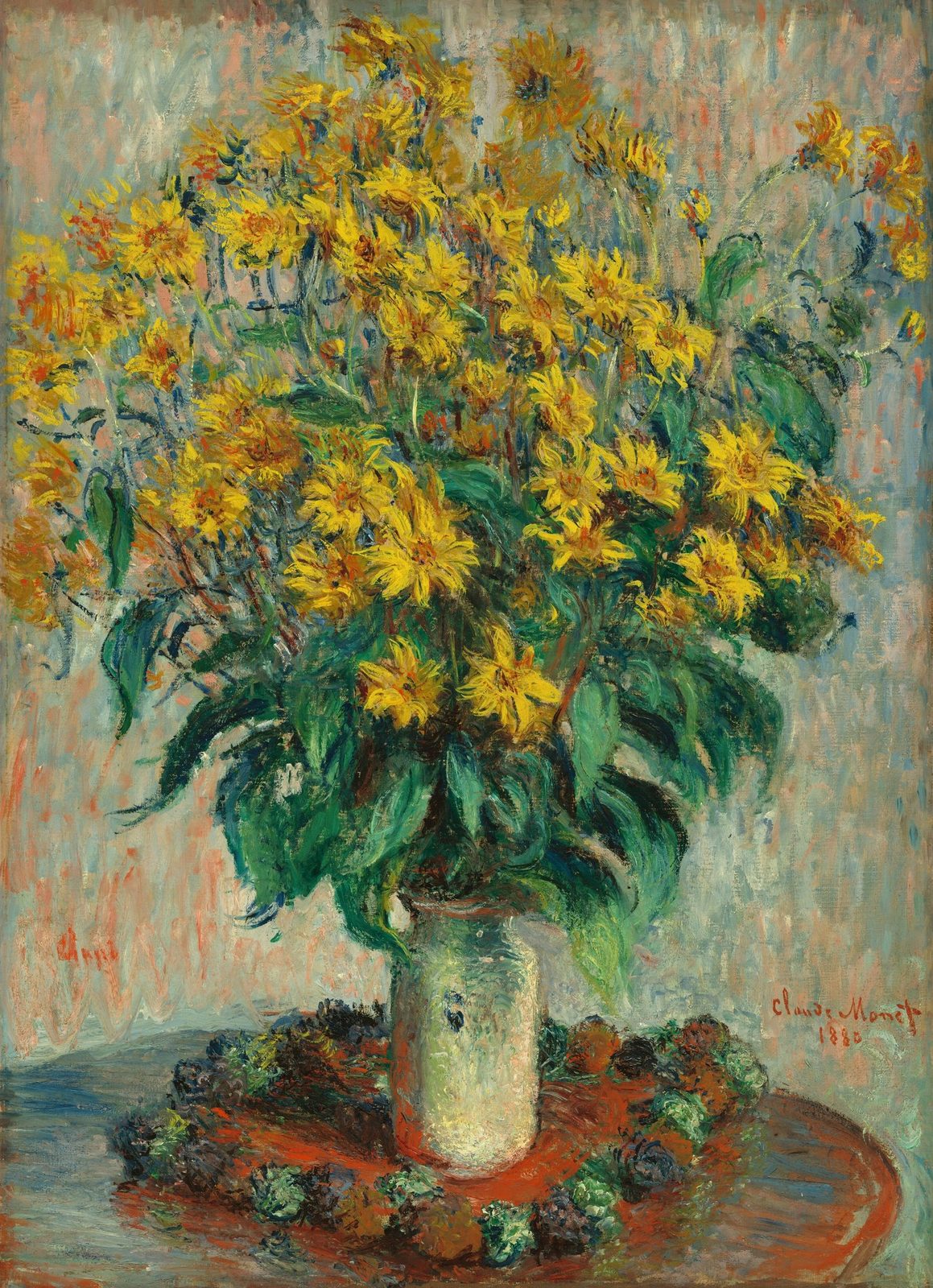
A tall bunch of yellow flowers bursts out of a pale vase. It stands on a reddish tray against a cool, brushy green-blue wall. Nothing here is fussy. The whole picture is made of visible dabs of paint, and those dabs are what we're going to look at.
Signed and dated 1880
Down at the lower right, Monet signed his name in red, with the date beneath. This is Claude Monet's Jerusalem Artichoke Flowers, painted in oil on canvas in 1880. The red letters cross both pink and green patches of background, as if added once everything else was done.
A broad fan on a slim stem
The shape is simple. The bouquet spreads into a wide fan near the top edge, then narrows through the leaves to the slim neck of the vase and its small base. Because the design is so plain, colour and brushwork are left to do the talking.
Soft light on a pale vase
The light is soft and even, with no strong shadows on the wall. The vase shows it best. Its pale body is made of upright strokes of cream, cool grey, pink and greenish white, left side by side. The roundness comes from those shifts in colour, not from dark shading.
Warm flowers, cool ground
Over on the right, a small cluster of yellow and orange flowers sits against a blue-grey ground. Warm colours tend to come forward and cool ones to sink back, so the flowers seem to float in front of the wall. Even the ground is flecked with pale coral, so it never goes flat.
Broken colour on the tray
Drop down to the tray. From a distance it reads as one reddish brown. Up close it is a patchwork of rust red, dark green and blue-grey strokes, laid next to each other and never smoothed out. Your eye does the mixing, and the surface stays lively.
Petals without outlines
Now the heart of the bouquet, the brightest yellow in the picture. Each flower is a pile of short, curved dabs, with orange at the centres and cool blue-green tucked between the petals for shadow. Follow it down to the dark leaves. There is no line there, only one colour stopping against another.
Strokes that radiate
In the upper left, notice the direction of the marks. The yellow strokes fan out from darker orange centres, so direction alone tells you these are flower heads. A grey-mauve layer shows between them. At the very top of the bouquet, the touches get thinner and sparser, flicked out against the pale background.
Leaves in one sweep
To the left of the vase, long leaves droop in sweeping strokes of deep green. Each looks thick where it begins and thinner towards the tip, where the brush seems to have run dry and the paler background shows through. One curving stroke gives you both the shape of the leaf and its weight.
Look closer
9 details, each checked against a close-up of the picture.
-
Central yellow mass
This region shows a dense cluster of saturated yellow and orange petals built from overlapping impasto strokes with no visible contour lines.
The crop is dominated by a tightly packed bloom of saturated yellow petals built from short, loaded, curved dabs that overlap one another at varying angles. Cadmium-bright yellows sit next to deeper ochre and orange passages, with small accent dabs of red-orange marking the warmer recesses that read as flower cores. Cool blue-greens and a muted dusty-mauve run through the interstices between petals, supplying the shadow side without any drawn contour. All edges are broken and softened by neighbouring strokes; there is no continuous outline around any single petal, and the paint body sits up as impasto in the brightest touches.
-
Upper-left petal strokes
Thick, directional strokes of yellow and orange fan out from darker centres, with a grey-mauve layer showing between them.
The crop shows dense clusters of yellow flower forms built from short, loaded, radiating strokes that fan outward from darker orange-red centers. The petal marks are thick, comma-shaped and vary from buttery lemon to deeper chrome yellow, with small touches of red-orange nestled at the stroke junctions. These bright strokes sit on top of a muted grey-mauve and pale pink ground that reads clearly between the petals, so each 'petal' is really the negative shape around the yellow dabs. Edges are unresolved and feathered: pigment thins toward the tips of the strokes and blends wet-into-wet with adjacent greens and blues, leaving no hard contour anywhere.
-
Yellow-green contour
Bright yellow strokes end abruptly against deep blue-green strokes here, forming a soft vibrating edge without drawn outline.
The crop captures the abrupt meeting of saturated chrome-yellow petal strokes against dense blue-green foliage passages. Where the flower rays terminate, the yellow is left as a ragged, loaded dab with no halo or drawn contour; the teal underpainting shows through the gaps, producing a vibrating, optical edge between warm and cool complements. Orange flecks sit inside the yellow dabs as centers, and the woven canvas texture is visible in thin, scumbled areas between marks. Several yellow strokes overlap the green at acute angles, so the boundary is essentially a colour-to-colour seam rather than a line.
-
Drooping leaves left of vase
Long leaves here are painted with sweeping strokes of viridian that become lighter and thinner toward their tips.
The crop is dominated by a cluster of elongated, drooping leaf forms rendered in deep viridian green, with creamy peach and pale pinkish-grey passages reading as either background or as the lighter body of the vase/flowers behind. Leaf edges are not drawn but built from thick, loaded brushstrokes that curve from upper-right toward lower-left, becoming noticeably thinner and cooler as they taper. White, pale blue, and ochre flecks sit on top of the dark green, catching diffuse light along the upper ridges of the leaves. The weave of the canvas is visible through the thinnest areas, confirming leaner paint at the leaf tips.
-
Vase surface
The vase surface is built from vertical strokes of pale grey, pink, and greenish-white that remain physically unblended.
The vase's curved body reads as a column of mostly vertical, slightly curving strokes that follow the cylindrical form. Individual marks remain distinct: pale cream-white sits beside cool grey, touches of pink and yellow-green, and a small dark blue-black cluster left-of-center that sits as a separate accent on top of the lighter ground. Where the vase meets the greenish-blue wall on the right, no hard contour is drawn — the edges are produced by adjacent strokes of contrasting hue rather than a line. The lower edge dissolves into a thick reddish-brown band (tray) carrying tiny darker dabs (florets), again built with loaded, unblended paint.
-
Topmost flower strokes
Thin, flicking strokes of yellow and orange describe the smaller flower heads at the top of the bouquet.
The crop isolates the upper cluster of flower heads, where thin, flicking strokes of cadmium yellow and warm orange radiate outward from cooler blue-grey centers. These petal marks are short, tapered, and unblended, sitting on top of a loosely brushed background of pale cream, soft blue-green, and muted ochre. Edges between flower and background are broken rather than drawn — the painter lets negative space and color contrast, not contour lines, separate the forms. Within each flower head, a small pool of deeper blue or reddish-brown anchors the eye, while the surrounding yellow strokes grow thinner and more sparse toward the top edge.
-
Tray broken color
The reddish tray contains broken strokes of burnt sienna, dark green, and blue-grey that sit side-by-side without smoothing.
A textured surface is composed of unblended, side-by-side brushstrokes of varying lengths. A dominant layer of reddish-orange paint is applied horizontally and diagonally, interrupted by separate strokes of dark green, blue-grey, and lighter yellowish-green. The edges of these individual color patches overlap irregularly, leaving visible ridges and bristle marks that create a rough, impasto surface. There is no smooth blending between adjacent areas of contrasting hues; instead, the colors remain physically separated.
-
Right-side isolated cluster
An isolated cluster of yellow-orange flowers on the right is set against a cool blue-grey ground.
The right side shows a loose cluster of yellow and orange petal forms built from short, loaded dabs that read as Jerusalem artichoke blooms. Edges between the warm flowers and the cool ground are soft and broken — the orange-red tips feather into the blue-grey rather than terminating in a hard contour. The background is scumbled: a muted blue-grey (#8FA5A8-ish) is overlaid with pale coral and pinkish flecks, so the ground itself has warm-cool vibration rather than reading as a flat tone. Values are kept close; the brightest yellows are only one or two steps above the background, which keeps the cluster luminous without popping out abruptly.
-
Red signature
A red painted inscription in the lower right reads 'Claude Monet', with the date 1880 beneath.
The crop isolates the lower-right corner of the painting where Monet's signature 'Claude Monet 1880' is inscribed in a warm red over a previously dried, mottled field of salmon, pale teal, and ochre washes. The letterforms are cursive and confident: the 'C' begins with a hooked entry, the 'M' has two sharp angular descents, and 'onet' resolves into a loose trailing loop. Edges are crisp at the start of each stroke and slightly feathered where the brush lifted, with pigment thinning from a loaded dark-red body to a translucent pinkish tail. To the left, a dark green-black mass of foliage reads as loose loaded dabs; the rest of the ground is scumbled and uneven, with the red signature crossing both pink and green passages without alteration.
Jerusalem Artichoke Flowers in context
A sunflower by another name
The flowers in the vase belong to Helianthus tuberosus, which the Missouri Botanical Garden describes as a type of sunflower, native to North America and in the same genus as the common sunflower [2]. It grows six to ten feet tall and bears yellow flower heads in August and September [2]. The French explorer Samuel de Champlain reportedly saw it growing on Cape Cod in 1605, and its tubers, taken back to Europe, had become a common vegetable in several areas by about 1650 [2]. The garden explains that the plant isn't an artichoke, nor is it connected with Jerusalem, and that the name probably comes from a mispronunciation of the Italian girasole, sunflower [2].
Monet painted true sunflowers too [3]. The Metropolitan Museum of Art's Bouquet of Sunflowers shows flowers that grew along the path to his garden at Vétheuil, the village where he was living at the time [3].
A title lost and found
The canvas is signed and dated 'Claude Monet 1880' in red at the lower right [1]. For decades the National Gallery of Art's own publications called it Vase of Chrysanthemums, from the Chester Dale catalogue of 1942 to the Gallery's illustrated catalogue of 1985 [1]. The current title matches the one used when it was first exhibited in 1882, Fleurs de topinambour [1].
Sold within the year, shown in 1882
The Gallery records that the picture went from the artist to a M. Cahuzac in Paris in November 1880, the year inscribed on the canvas [1]. Cahuzac still owned it in 1882, when he lent it to the seventh Impressionist exhibition in Paris, where it hung as number 57 [1].
The Met reports that critics at the same exhibition praised the 'brio and daring' of Monet's technique in its Bouquet of Sunflowers [3]. The museum also links that picture to a letter of November 1888, in which Vincent van Gogh reported Gauguin's praise for a very fine Monet of sunflowers in a large Japanese vase, though Gauguin said he preferred Vincent's [3].
The doctor and his heirs
The painting next belonged to Georges de Bellio (1828-1894) in Paris, then passed by inheritance to his daughter Victorine and her husband Ernest Donop de Monchy, who still had it in 1897 [1]. The Académie des Beaux-Arts describes De Bellio as a doctor and friend of the Impressionists who acquired works by Monet, Pissarro, Renoir and Sisley, including Monet's Impression, Sunrise [4]. In 1957 Victorine Donop de Monchy gave part of her father's collection to the Musée Marmottan in Paris [4]. This canvas had already left the family by then, as its later owners show [1].
A prince's purchase
From the Donop de Monchys it went to Alexandre Berthier, 4th Prince of Wagram (1883-1918), and in 1914 to Durand-Ruel in Paris [1]. Léa Saint-Raymond and Hadrien Viraben show that the prince bought most of his collection between 1905 and 1908, often in bulk and at high prices, and that the son-in-law of Georges de Bellio was one of his four main sources for Impressionist pictures [5]. In December 1905, for example, he bought fourteen Impressionist paintings from Donop de Monchy, through Barbazanges, for 100,000 francs in total [5]. The sources consulted here don't say whether this canvas was among them.
Historians remain divided over whether Berthier was a passionate collector or a speculator. Anne Distel opened this debate by pointing out that many of his purchases were never delivered to him [5]. Durand-Ruel sold the painting to Chester Dale in 1929, and it entered the National Gallery of Art with Dale's bequest in 1963 [1]. It was shown in the Gallery's 1986 exhibition The New Painting: Impressionism 1874-1886, and the archived record of September 2026 places it in Gallery M80 of the West Building [1].
- Claude Monet, Jerusalem Artichoke Flowers (1963.10.181): object record, inscription, provenance, exhibition history and bibliography (Internet Archive copy, 16 September 2026) . National Gallery of Art, Washington
- Helianthus tuberosus: Plant Finder . Missouri Botanical Garden
- Claude Monet, Bouquet of Sunflowers (29.100.107): object record (Internet Archive copy, 14 June 2026) . The Metropolitan Museum of Art, New York
- Musée Marmottan Monet . Académie des Beaux-Arts, Paris
- Léa Saint-Raymond and Hadrien Viraben, 'The Virtual Collection of Alexandre Berthier, Prince of Wagram', Nineteenth-Century Art Worldwide 19, no. 2 (Autumn 2020) . Nineteenth-Century Art Worldwide