One patch of sunlight
How Jacob Isaacksz van Ruisdael lets a single sunlit slope carry a stormy dune landscape
- Artist
- Jacob Isaacksz van Ruisdael
- Title
- Landscape with Ruins
- Date
- 1650 - 1682
- Medium
- oil on canvas
- Museum
- Rijksmuseum
- Image
- Public domain (CC0)
Open in Simple Art
Watch this story on iPhone and iPad, with offline downloads and a painting every day.
About 4 minutes of looking, in 9 parts.
Landscape with Ruins
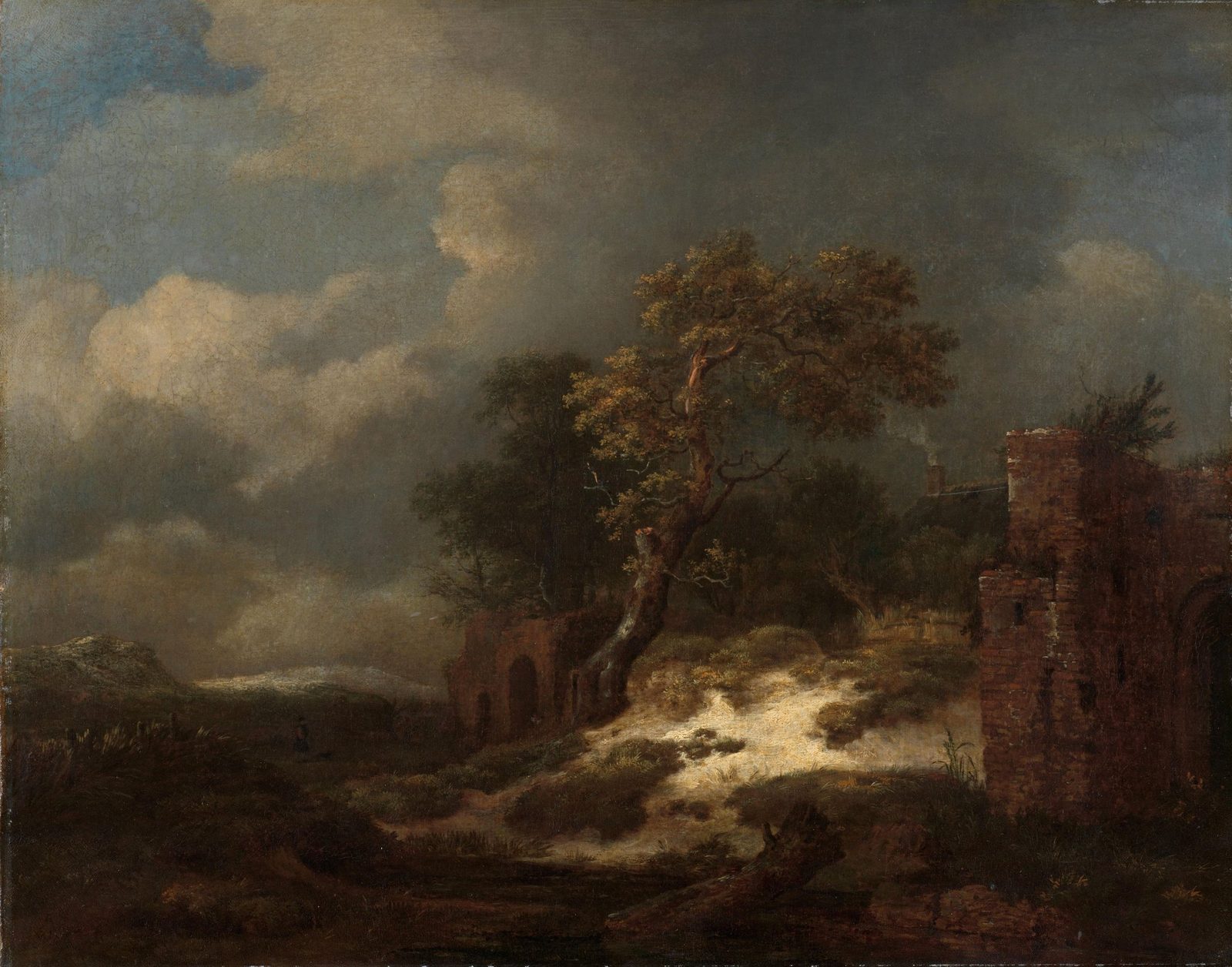
A storm is gathering over a stretch of dunes. Most of the land lies in shadow, but one patch of sand in the middle has caught the sun and almost glows. Around it stand a leaning tree and two crumbling brick ruins.
Jacob van Ruisdael, oil on canvas
The canvas is signed JvRuisdael, and the Rijksmuseum lists Jacob Isaacksz van Ruisdael as the painter. It dates the work only broadly, to between 1650 and 1682. The museum describes it as a dune landscape with brick ruins, and a pool of water with a broken tree trunk in the foreground.
A tree, two ruins, one bright slope
The picture is mostly sky, with the land pressed into the lower half. The leaning tree is the tallest form. One ruin sits low behind it, and a taller one stands at the right edge. Your eye probably lands first on the bright sand, then climbs the trunk and crosses to the brick wall on the right.
A break in the clouds
Up at the top left, the cloud cover thins. Close up, a warm yellow-ochre patch fades softly into cool grey-blue cloud, with no hard edge between them. A fine web of cracks runs across it all, the ordinary ageing of an old paint surface.
Leaves made of dabs
Now the crown of the tree. No single leaf is drawn. Instead there are small dabs and comma-shaped strokes of ochre and sienna, brightest on the upper left of each cluster, with the dark ground showing in between. From a step back, those dabs read as leaves catching the light.
The leaning trunk
Follow the trunk down. It rises from the lower left and leans towards the upper right, with a broken stub jutting out about halfway up. The lit side seems to be laid in with thin, warm strokes against near-black, and the turn from light to shadow is soft rather than sharp.
Sun on the sand
Here is the brightest part of the picture. The museum calls this a dune landscape, and this pale patch looks like bare sand in sunlight. Up close it isn't one solid white. It's broken, creamy strokes with warmer brown showing through the gaps, so the light seems to flicker across the ground.
Two brick ruins
On the right stands the taller ruin. Its edges are picked out with paired marks: thin dark lines for the joints, and small pale flecks on the lips of the bricks. Now drift across to the lower ruin behind the tree. A rounded archway there falls almost to black, with just a faint warm rim along its curve.
The dark foreground
Down in the foreground, the paint drops into very dark browns and blacks, with hardly a brushstroke to be seen. The museum mentions a pool of water down here and a broken tree trunk, though in this light they're easy to miss. This darkness is a large part of why the sand looks so bright.
Look closer
8 details, each checked against a close-up of the picture.
-
Sunlit Sand
Broken strokes of pale cream paint, with warmer brown showing between them, pick out the brightest patch of open, sandy-looking ground.
The crop centers on a roughly triangular luminous zone of broken, creamy off-white paint (≈u 0.35–0.85, v 0.30–0.70) sitting atop a sloping rocky bed. The whites are not continuous: they are laid in short, diagonal-to-vertical streaks of varying length, with warm ochre and umber passages breaking through between them, so the surface reads as scumbled light rather than a solid bright mass. Edges of the white strokes are soft and feathered, not crisp, and the surrounding darker passages are mostly thin, dark brown/olive glazes and dragged brushwork that frame the light. Value contrast is high (near-white against near-black umber at lower left), but the white itself is modulated by the warm tone of the ground showing through gaps.
-
Break in Storm Clouds
The brightest part of the sky is a warm yellow-ochre passage with broken, scumbled-looking highlights that fades softly into cooler grey-blue cloud.
The crop shows a heavily crackled, aged oil-paint surface dominated by a warm yellow-ochre passage in the upper right, which grades through a soft, diffused edge into a cool grey-blue cloud mass in the upper left, then down into a neutral grey-olive across the lower field. The brightest highlights read as broken, granular touches where warmer ground shows through, rather than as solid opaque white. Edges between the lit break and the cooler cloud are soft and irregular, with no hard contour, and the network of fine craquelure runs uniformly across both warm and cool zones.
-
Ruined Brick Texture
The edges of the brickwork on the right are defined by a mix of dark outlines and light-colored mortar highlights.
The crop is a tight view of stacked, weathered brickwork in deep reddish-browns, ochres, and umbers, with craquelure running across the entire surface. The right-hand edge of the ruin is read against a darker shadowed zone, and that edge is articulated by both thin dark seams (the recessed mortar joints and shadow lines between bricks) and small light-toned flecks and dashes (pale ochre/whitish highlights catching the mortar ridges and brick corners). Stepping bricks and broken courses are visible in the lower half, where lighter dabs sit on the upper lip of each offset, reinforcing a left-to-right light falloff. A faint diagonal scratch/paint line crosses the upper left, and the overall value range is compressed, with most contrast gathered along the right vertical silhouette rather than across the face of the wall.
-
Tree Foliage Highlights
The foliage is created through dabs of ochre and sienna paint applied over a dark underlayer.
The crop isolates the upper canopy and a few lower foliage clusters of the central tree, with a sliver of dark sky visible in the upper left. Foliage mass is built from small, irregular dabs and short comma-shaped strokes clustered in loose bouquets, leaving the dark olive-brown ground to show through the interstices. The brightest marks are warm ochre-yellow at the upper-left edges of the clusters, stepping down through raw sienna and umber into near-black recesses where the underlayer is barely covered. Edges of the foliage are soft and broken — no leaf contours are drawn — so the silhouette dissolves into the surrounding gloom through a halftone of mid-value brown dabs.
-
Leaning Trunk Structure
The main tree trunk curves diagonally from the center towards the upper right.
The trunk rises through the center of the crop, its mass thickest near mid-height and tapering slightly upward; the upper portion angles toward the upper right, with a lighter, warmer face catching the light. A broken stub projects to the left at roughly mid-height, and another branch sweeps right and downward. The lit edge of the trunk is painted with thin, warm umber and ochre strokes against a near-black ground, so the terminator between light and shadow is soft rather than sharp. The surrounding foliage and sky are blended into dark olive-brown glazes, and fine vertical craquelure runs through the trunk's body, evidence of an aged oil-on-canvas support.
-
Deep Shadow Palette
The lower foreground is a near-monochrome field of very dark browns and blacks with few visible brushstrokes.
The crop is dominated by a near-monochrome field of very dark browns and blacks in the lower and central zones, with the upper-right corner showing a slightly warmer, lighter passage where a pale tan strip suggests the beginning of a path or stream edge. A network of fine craquelure lines is visible across the surface, particularly catching the light in the upper-left quadrant. The paint surface appears thinly and smoothly applied in most areas, with only a few faint horizontal and diagonal marks in the lower-right where slightly more impasto registers as a marginally lighter value. Edge quality between forms is almost entirely soft and dissolved, with no sharp boundaries visible.
-
Archway in Ruins
A dark, rounded archway is recessed into the brick wall on the left side of the ruins.
The crop centers on a deeply recessed, rounded archway cut into a brick ruin; the arch's interior falls to near-black, while its curved upper edge catches a faint, warmer rim of light against the surrounding masonry. The wall is built from warm reddish-browns layered over darker umber shadows, with broken, irregular transitions where individual bricks are barely legible beneath the glazes. Faint vertical streaks of craquelure and possible aged varnish run top to bottom, and a soft pale patch in the lower right reads as a sun-touched ledge or ground plane. Edges throughout are soft and fused rather than crisp, especially around the arch mouth, where the dark interior bleeds into the wall through wet-into-wet blending.
-
Surface Craquelure
A fine network of age-related cracks is visible across the paint film in the sky area.
The crop shows a paint film crisscrossed by a fine, irregular web of dark cracks (craquelure) running in all directions, with no single dominant fracture pattern. The surface divides into two soft-edged zones: a warm golden-ochre passage occupying the upper and right portions, and a cooler grayish blue-green passage along the lower edge and in a small patch at the upper-left corner. The warm and cool zones meet through a softly blended, slightly diagonal transition rather than a hard line. The crack network is denser and darker over the warm ochre area, while the cooler passages show slightly more visible underlying blue. Edges between color zones are broken and granular, with no sharp contours anywhere in the fragment.
Landscape with Ruins in context
A painter from Haarlem
Jacob van Ruisdael was born in Haarlem in 1628 or 1629. We know this from a 1661 document where he gave his age as 32 [2]. His father, Isaack van Ruisdael, was a little-known painter who also dealt in pictures and made frames [3]. Who taught Jacob is disputed. The National Gallery in London says he probably trained with his uncle Salomon van Ruysdael. But Wikipedia, citing Seymour Slive, says his teacher is unknown and there is no evidence for that assumption [2][3]. His earliest dated paintings and etchings are from 1646, and in 1648 he joined the Haarlem painters' guild [2][3].
From Haarlem to Amsterdam
Around 1650 he travelled to the hilly country around Bentheim, across the German border, and afterwards his landscapes took on a more heroic character [2][3]. By 1657 he had settled in Amsterdam, a prosperous city that probably offered a bigger market, and he stayed there for the rest of his life [2][3]. There he added city panoramas and seascapes to his subjects [2].
He seems to have lived comfortably, and his pictures were valued fairly highly. In inventories of 1650 to 1679 a Ruisdael averaged 40 guilders, against 19 for attributed paintings in general [2]. He died in Amsterdam on 10 March 1682 and was buried in Haarlem [2][3].
Ruins, water and a broken tree
The Rijksmuseum describes this canvas, 53 by 66 centimetres and signed 'JvRuisdael', as a dune landscape with brick ruins. In the foreground sits a pool of water with a broken tree trunk [1]. The museum dates it only broadly, to between 1650 and 1682 [1]. Dating his work is hard in general, because Ruisdael almost entirely stopped dating his pictures from 1653 [2].
Ruins recur in his work. The ruins of Egmond Castle near Alkmaar were a favourite subject and appear in The Jewish Cemetery [2]. Writing about a fallen birch in another of his pictures, A Landscape with a Ruined Building, the National Gallery calls it a common device for giving depth that also hints at the destructive power of nature [4]. No seventeenth-century document records what Ruisdael meant his landscapes to convey, and how most of the others should be read is much disputed [2].
Into the Rijksmuseum
The museum's provenance begins with the Amsterdam dealer J. Goudstikker in 1920-22 [1]. The painting then belonged to Dominicus Antonius Josephus Kessler (1855-1939) and his wife A.C.M.H. Kessler-Hülsmann (1868-1947), of Kapelle op den Bosch near Mechelen [1]. Mrs Kessler-Hülsmann gave it to the Rijksmuseum in March 1940, together with other objects. It appeared, as no. 41, in an exhibition of acquisitions made in 1940-46 [1]. The museum notes that this provenance was compiled with a focus on the years 1933 to 1945 and may be incomplete [1].
Reputation
Ruisdael's work was in demand in his lifetime. The Rijksmuseum, the National Gallery in London and the Hermitage now hold the largest collections of it [2]. English painters studied him closely. Gainsborough copied a Ruisdael in the 1740s, Turner made many copies and even painted views of an imaginary 'Port Ruysdael', and Constable admired him from a young age [2]. The Rijksmuseum lists this picture among the illustrations in Gevaar en schoonheid, a Dutch catalogue on Turner and the tradition of the sublime [1]. Slive described him as, by general consent, the leading landscape painter of the Dutch Golden Age [2].
- Landscape with Ruins (SK-A-3343): object record, provenance and documentation . Rijksmuseum, Amsterdam
- Jacob van Ruisdael . Wikipedia
- Jacob van Ruisdael (artist biography) . The National Gallery, London
- Jacob van Ruisdael, A Landscape with a Ruined Building . The National Gallery, London