Degas's Madame Camus — A Walkthrough for Painters
An oil on canvas from 1869/1870 read through light, edge, and gesture
- Artist
- Edgar Degas
- Title
- Madame Camus
- Date
- 1869/1870
- Medium
- oil on canvas
- Image
- Public domain (CC0)
Open in Simple Art
Watch this story on iPhone and iPad, with offline downloads and a painting every day.
About 5 minutes of looking, in 11 parts.
Madame Camus, 1869/1870
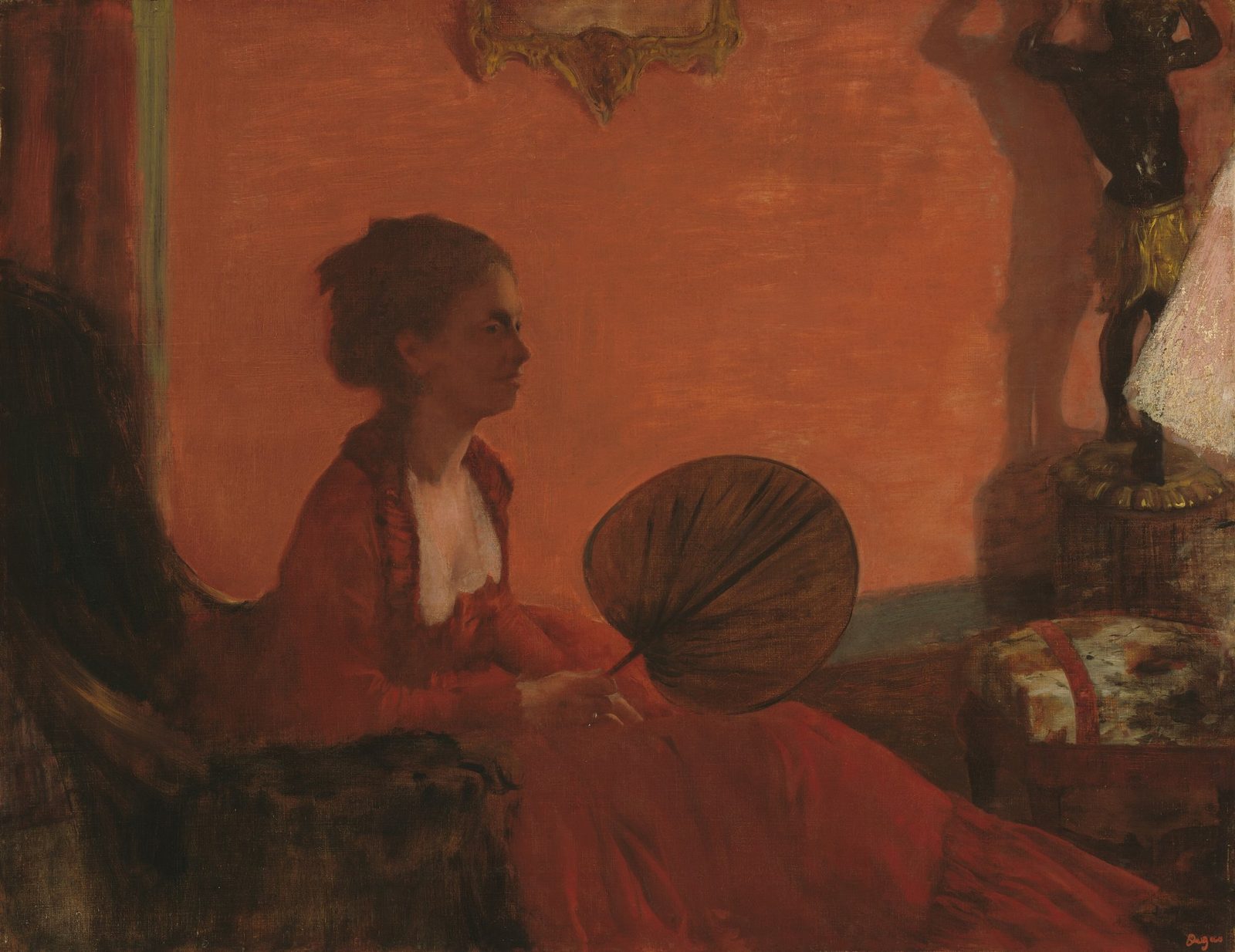
We are looking at Edgar Degas's Madame Camus, an oil on canvas from 1869 to 1870. A woman sits in profile against a glowing orange wall, her deep red dress sweeping diagonally across the frame. Notice how her stillness contrasts with the painterly energy of the loose, broken strokes around her.
A candid bourgeois interior
Read this as a candid slice of bourgeois leisure. Degas crops the scene like a snapshot, with a gilded cartouche hanging behind the sitter and a sculpture set to the right. The closed dark fan rests quietly across her lap, a horizontal punctuation in an otherwise warm, glowing room.
Asymmetrical triangle
Now look at the structure. The composition forms an asymmetrical triangle anchored by the seated woman, with a strong diagonal sweep of the red skirt from the upper left down to the lower right corner. The focal point sits high and slightly left of center — her profiled head silhouetted against the warm wall.
Soft light from upper left
Drift down to the white blouse and throat. The brightest, near-white passages sit along the left side of the throat and collarbone, while the right side sinks into pinkish shadow. This tells us the light is soft and diffuse, coming from the upper left. Degas models volume not with line, but with warm-cool value shifts in a compressed range.
Profile dissolved into warmth
Push in on the profiled head and upper torso. The silhouette is not drawn with a hard contour — the dark hair at the top and back dissolves into the orange wall through soft, feathered edges where umber and burnt sienna ride over the background. A wedge of pale cream-white blouse sits directly beneath the chin, framed by deep red on either side.
Edges built from paint, not line
Now follow the jawline as it meets the orange wall. The boundary is not drawn but built from short, broken middle-value strokes in muted red-brown that let the two areas intermingle. Tiny flecks of the orange ground visibly intrude into the figure and vice versa — the edge is discovered through paint texture, not contour.
Folds without a single line
Slide down to the red skirt in the lower right. The folds are built from long, diagonal strokes of lighter and darker red that overlap and shift direction. Notice there is no enclosing contour anywhere — instead, juxtaposed reds themselves create the pleated effect. Pure gestural strokes carry the entire narrative of drapery.
One cool note in a warm sea
Now glance across to the right side of the composition. A patch of distinctly blue-green paint interrupts the otherwise warm red-orange field. This is the painting's small complementary accent, and isolating it proves how a single cool passage can activate an otherwise monochromatic warm scheme.
Suggestion at a distance
Look up at the gilded cartouche on the wall behind her. Up close, the object collapses into abstract marks — only at a distance does the eye read it as ornament. A few hooked touches of pale ochre and greyish-yellow over a darker ground suggest the curls. The wall itself sits as one thin scumbled layer of warm orange-red.
Silhouette and one lit plane
Drift to the sculpted bust at the right. Degas reduces a complex sculptural form to a near-black silhouette with a single pale shoulder patch catching the diffuse light. No facial details are drawn — the eye reconstructs volume from one well-placed light note set into pure dark.
Dry-drag scumble
Finally, look down at the dark form at the lower left. It is fused to the background by dry, dragged scumbles of umber that leave the canvas weave visible between strokes. Even solid objects are treated as extensions of the surrounding dark field, holding the painting's quiet atmospheric unity.
Look closer
9 details, each checked against a close-up of the picture.
-
Profile and upper torso
The woman's profile is separated from the orange wall only by softly blurred edges that merge her hair into the background, and a white triangular blouse sits directly below the chin.
The crop isolates the head and upper torso in profile against a warm orange field. The silhouette is not drawn with a hard contour: the dark hair at the top and back of the head dissolves into the background through soft, feathered edges where strokes of umber and burnt sienna ride over and into the orange. A wedge of pale cream-white (the blouse) sits directly beneath the chin, framed by two patches of deep red. The lit left side of the face shows a warm peach highlight along the cheekbone, nose bridge, and brow, while the eye socket and jaw recede into a cooler, redder shadow. The ear is a small smudge of mid-tone, and a tiny dark dab suggests an earring. Visible craquelure and loose brushwork confirm an oil medium worked wet-into-wet.
-
White blouse and throat
The blouse is highest in value on the left side of the throat and chest, then sinks into pinkish shadow toward the right, showing the soft upper-left light source.
The crop isolates the throat and upper chest, where a pale blouse rises from deep crimson surrounds. The brightest, near-white passages sit along the left-center of the throat and the leading edge of the collarbone, while the right side of the chest cools into muted dusty pink and soft brown-pink shadow. Brushwork is broad and gestural: thick, broken strokes of cream and pale grey-white are laid against thinner, more transparent reddish scumbles, so the warm canvas shows through and unifies tone. Edges are wet-into-wet and rarely crisp—the transition from lit blouse to red fabric is a feathered boundary of mixed reds and pinks rather than a drawn line. The orange field at upper right reads as ambient reflected bounce, not direct light.
-
Dissolving jawline
The boundary between jaw and orange background is formed by broken middle-value strokes that let the two areas intermingle rather than meeting in a clean line.
The crop isolates the descending jaw and upper neck meeting the orange background wall. The contour is not drawn but is built from short, broken mid-tone strokes in a muted red-brown that sit between the deep umber of the neck shadow and the saturated orange of the wall. Tiny flecks of the orange ground visibly intrude into the figure and vice versa, with vertical and slightly diagonal hatch marks bridging the two zones. The crackle network of the aged oil film runs across both areas, confirming the transition is made of paint rather than drawn line. Lower left shows softer, fleshier scumbling in warm peach lifting toward the throat highlight.
-
Skirt folds lower right
The red skirt here is built from long, diagonal strokes of lighter and darker red that overlap and shift direction, with no enclosing contour.
The crop is dominated by broad diagonal passages of red paint, with folds that run from upper-left down toward the lower-right. The folds on the right side are constructed from multiple parallel strokes that shift direction slightly, creating a pleated or gathered effect where lighter crimson strokes sit alongside darker maroon ones. No single enclosing line defines any fold; instead, the edges are formed by juxtaposed value changes within the reds themselves. The paint surface shows visible craquelure and the underlying canvas weave in thinner areas, and the upper right contains a darker, browner passage that reads as deep shadow or background.
-
Cool accent at right
A patch of distinctly blue-green paint interrupts the warm red-orange field at the right side of the composition.
A horizontal band of muted blue-green paint crosses the middle of the crop, sitting on top of and beside a warm red-orange field that fills the upper portion. The blue-green is applied in broad, horizontal strokes that taper and feather at their edges, leaving the orange visible beneath in several spots. Below the band, a darker red-brown passage is laid in with looser, more broken marks, and the lower-right shows a small lighter ochre patch where the canvas weave is visible. The transition between the blue-green and the orange on the right is soft and slightly blurred, while the upper edge of the band is more crisply defined where it meets the brighter orange.
-
Dark statuette at right
The right-hand statuette is a black silhouette with a gilded wrap, set beside a pale pink lampshade, with no facial details drawn.
The crop is dominated by a near-black vertical mass that reads as a sculptural silhouette against a warm orange-red background, with the form dissolving into soft, unresolved edges rather than terminating in a crisp contour. Centered within the dark mass sits a cluster of gold-ochre and olive-yellow brushstrokes, layered wet-into-wet, describing the statuette's gilded wrap. At the lower right, a single broad patch of pale cream and grey-pink pigment sits as the only light passage, reading as the edge of a pink lampshade beside the statuette. No eyes, mouth, or facial planes are drawn anywhere in the dark form, confirming it functions as a pure shape-vale rather than a portrait.
-
Gilded cartouche
The gilded cartouche is rendered with pale ochre and grey strokes over a darker ground, its ornamental curls indicated by a few hooked touches of lighter paint.
The crop isolates the lower portion of a gilded cartouche hanging against a flat, brick-red wall. The wall is a relatively even, thinly scumbled layer of warm orange-red through which the canvas weave reads clearly. The cartouche is built up in a few darker brown-red passages that mark the recessed inner shapes, then overlaid with loose, hooked strokes of pale ochre and greyish-yellow that pick out the projecting scrolls and the central pendant point. Edges are blurred everywhere — the ochre touches blend wet-into-wet into the dark ground rather than sitting as crisp lines. The ornamental curls are suggested by only two or three commas of lighter paint rather than fully drawn, and the lowest tip resolves into a small, soft triangular lobe of mixed ochre and brown.
-
Dark form lower left
The dark form at lower left is fused to the background by dry, dragged scumbles of umber that leave the canvas weave visible between strokes.
The crop is dominated by deep umber and near-black values with a single sweeping arc of warmer ochre crossing from upper left to mid-right, its leading edge soft and broken. The canvas weave is plainly visible through the paint, especially in the lower half where the pigment sits as a thin, dragged film rather than an opaque layer. Diagonal and near-vertical streaks record the path of a lightly loaded brush pulled across the weave, leaving bare threads between the scratches of colour. A small red-orange flare in the upper right corner is the only saturated note; everywhere else, the dark form at lower left shares value with the ground so closely that its edge is implied rather than drawn.
-
Degas signature
The signature 'Degas' appears in small reddish script at the lower right, its paint the same tone as the surrounding skirt.
The crop is dominated by a thickly worked, near-black field of warm umber with scumbled lighter brown passages, against which a luminous rust-red passage intrudes from the left edge. In the lower right, a small cursive inscription reads 'Degas' in the same red-orange key as that adjacent passage, with a second shorter flourish of red to its right. The canvas weave is plainly visible through the dark passages, and the red script sits on top of the dark ground rather than being absorbed by it. Edges between the red and black are soft and brushed, not hard, indicating wet-into-wet blending rather than a dry re-marking.
Madame Camus in context
Portrait de Mme C. at the Salon
Degas sent this picture to the Salon of 1870, where it hung as no. 758 under the discreet title Portrait de Mme C. [1]. Schulman's online catalogue raisonné lists it as Lemoisne no. 271 and calls it Mme Camus en rouge, with the alternative title Femme à l'éventail, woman with a fan [2].
Catherine Meneux, writing for the Impressionnismes dictionary, notes that Degas showed regularly at the Salon from 1865 to 1870. The jury never refused him, but he didn't really find his place there [3]. His later entries, she says, met mixed responses that pointed to their strange poetry, and she names this portrait among them [3]. It was the last Salon in that run [3].
Portrait, le soir?
The Gallery also lists the painting, with a 'probably', in the second Impressionist exhibition of 1876, as no. 43, Portrait, le soir [1]. Schulman's catalogue gives the same entry with a question mark [2]. Wikipedia's list of that exhibition explains the doubt: two pictures have been proposed for no. 43, this one and the much smaller Melancholy in the Phillips Collection, and only one of them was shown [4].
A doctor's wife and her piano
The Web Gallery of Art identifies the sitter as the wife of Doctor Camus, a friend of Manet and Degas and a lover of Japanese art, noting she had a fine reputation as a pianist [5]. Degas painted her a second time, seated at the piano, in a picture the same source describes as balanced between a personal and an official portrait [5]. The Bührle Collection dates it 1869 [6].
That second canvas, now in the E.G. Bührle Collection in Zurich, has had a harder history. It sold at the first Degas sale in 1918 to the collector Alphonse Kann for 32,000 francs, was confiscated by the Nazi looting agency ERR, passed to Hermann Göring and traded away in 1941 [6]. Emil Bührle bought it from the Galerie Fischer in Lucerne in 1942, returned it to Kann after a Swiss court case in 1948, and bought it back from Kann's heirs in 1951 [6].
Manchester, Paris, New York
The red portrait stayed in Degas's studio and was sold at the first Degas sale in May 1918, as no. 96, to Paul Rosenberg [1]. According to a letter from Rosenberg to Chester Dale of 13 April 1938, kept in the Gallery's files, Rosenberg sold it through the Goupil Gallery in London to Herbert C. Coleman, a Manchester cotton dealer, and bought it back when Coleman retired [1]. Rosenberg sold it to Dale in March 1938, and it came to the Gallery in 1963 [1].
Since then it has appeared in exhibitions like The New Painting in 1986 and Degas at the Opera in 2019 to 2020, and Schulman also records it in the Manet Degas exhibition at the Musée d'Orsay in 2023 [1][2].
- Edgar Degas, Madame Camus (1963.10.121): object record, visual description, provenance, exhibition history and bibliography (Internet Archive copy, 26 April 2026) . National Gallery of Art, Washington
- Mme Camus en rouge [Femme à l'éventail] (MS1647) . Michel Schulman, Edgar Degas: catalogue raisonné numérique
- Catherine Meneux, Edgar Degas . Impressionnismes
- Second Impressionist Exhibition . Wikipedia
- Edgar Degas, Madame Camus at the Piano: commentary . Web Gallery of Art
- Edgar Degas, Madame Camus at the Piano: provenance, exhibitions and literature . Foundation E.G. Bührle Collection, Zurich