A calm face, restless hands
Cézanne paints his wife with a masklike face and hands still full of the marks that made them
- Artist
- Paul Cezanne
- Title
- Madame Cezanne in a Yellow Chair
- Date
- 1888–90
- Medium
- Oil on canvas
- Museum
- Art Institute of Chicago
- Image
- Public domain (CC0)
Open in Simple Art
Watch this story on iPhone and iPad, with offline downloads and a painting every day.
About 3 minutes of looking, in 8 parts.
A woman in red, in a yellow chair
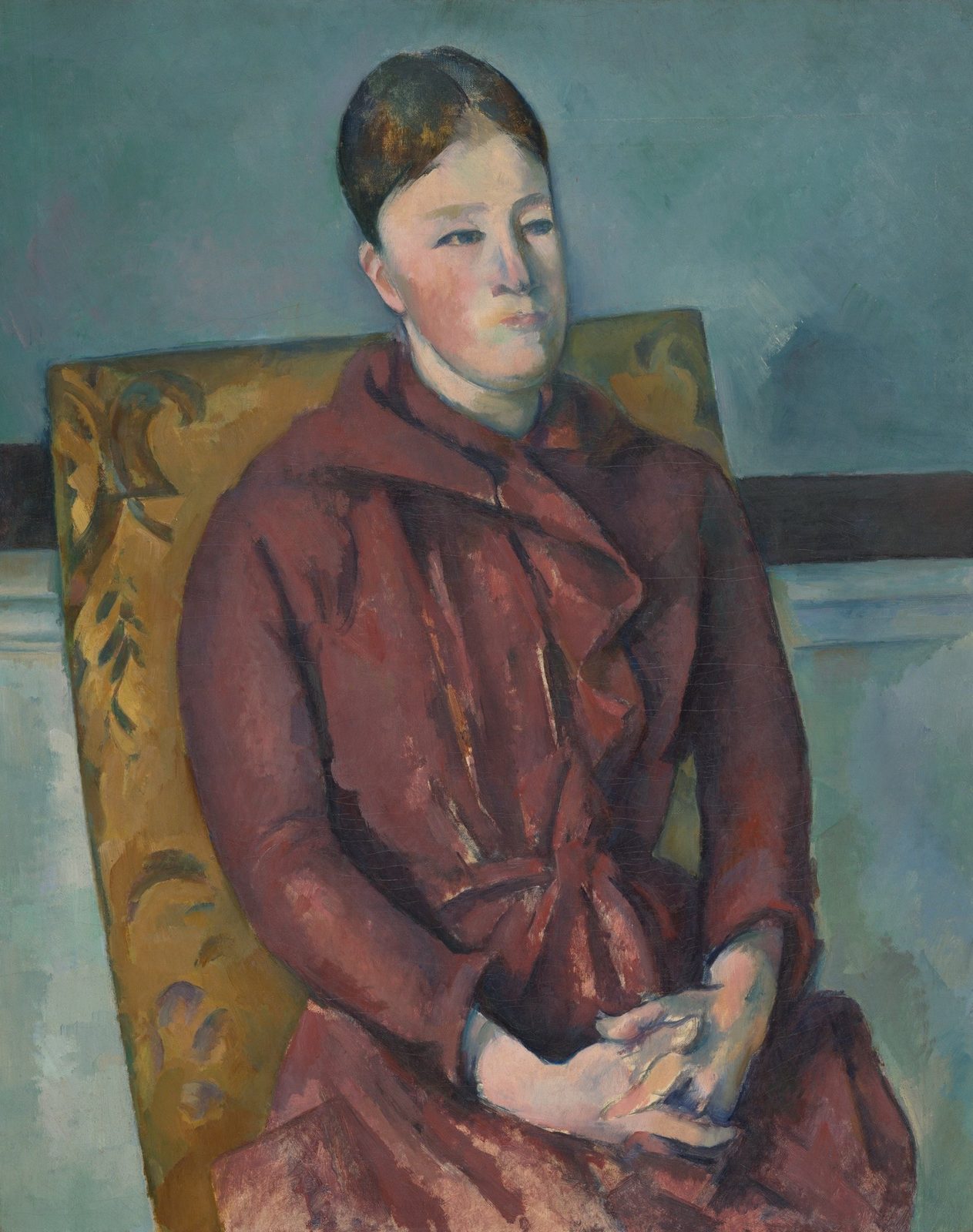
A woman in a dark red dress sits in a tall yellow armchair, hands folded in her lap, against a blue-green wall. Her face is calm, almost blank. Her hands are another matter. Keep both in mind as we look.
Cézanne, 1888 to 1890, oil on canvas
This is Paul Cézanne's Madame Cézanne in a Yellow Chair, painted between 1888 and 1890 in oil on canvas, and now in the Art Institute of Chicago. The sitter is his wife, Hortense Fiquet, whom he met when she worked as an artist's model. It's one of a series of four portraits he made of her.
Figure, chair, wall
The figure makes a broad, steady shape, widening from her head down to her lap. The chair back fills the left side, and behind her a dark band crosses the wall at about shoulder height. Everything is set out in a few large, simple areas of colour.
A face like a mask
Come in to her face. The museum describes her expression as masklike, and you can see why. The skin is the most smoothly painted passage in the picture, pinks and creams melting into one another, while the hair is laid in as separate dark patches. Down her cheek, warm cream gives way to cooler mauve with no hard edge.
Yellow against red
Now the chair. Its yellow upholstery is built from broad patches of ochre and gold, with darker leaf-like shapes in the pattern and cooler olive tucked into the shadows. Where it meets the red dress, the two areas simply butt against each other along a slightly jagged edge.
Folds in patches
Drop into the dress. The folds appear as separate patches rather than smooth shading: bright crimson beside deep maroon, a near-black streak for the deepest crease, and cooler blue-grey where a fold turns away. Each stroke keeps its own colour.
Restless hands
Here are her hands, and they're far from calm. The museum points to the crisscrossing brushstrokes, and to the dark-blue outlines Cézanne used to sketch the forms, still visible in the finished work. Pale planes stand for fingers, and single dark strokes mark the gaps between them.
Edges against the wall
Look at her side, where it meets the wall. There's no outline, just a narrow strip of deeper, wine-coloured red between the dress and the blue-green. Then drift across to the dark band on the wall, a broad horizontal laid against the lighter blue below.
Look closer
7 details, each checked against a close-up of the picture.
-
Face and Head
The face is more smoothly blended with softer transitions than the surrounding dress and chair.
The crop centers on a woman's head and shoulders against a teal-blue wall. The face is built with soft, closely knitted transitions: pinks and creams feather into pale ochre on the lit left side, while a cooler pink-grey settles into the right cheek and jaw. The hair, by contrast, is laid in as distinct patches of dark umber, raw umber, and a few ochre flecks where light glances across the crown. A thin band of deep red dress at the bottom and a sliver of yellow-ochre chair at the right read as more discrete, separate strokes than the flesh. Edges of the face are softened by color similarity where it meets the wall; the hairline against the wall stays relatively crisp.
-
Chair Contrast
The yellow upholstery of the chair is composed of varying shades of ochre and gold beside the red dress.
The crop isolates the junction between the chair's carved upper crest and the figure's deep red dress. The yellow upholstery is built from broad, parallel patches of ochre and warm gold, with cooler greenish-olive shadows tucked under the carved scrolls at the top left. A crisp, slightly zigzagging vertical edge separates the chair from the dress; the red mass beside it reads as a flatter, more uniform plane of crimson and burgundy with very little internal modeling. The carved cartouche on the chair is articulated with dark, nearly black accents that read as incised shadow rather than drawn line, and the highlight along the topmost scroll curves reads as the brightest passage in the crop, consistent with the upper-left light source.
-
Dress Folds
Folds in the dress are indicated by shifts in color temperature from bright red to deep maroon.
The crop shows interlocking patches of red paint that suggest the folds of a dress through shifts in color rather than smooth gradation. A vertical band of warm yellow-gold runs along the left edge, likely a trim catching light. A near-black vertical streak near center reads as a deep crease or shadow between fabric planes. Parallel diagonal strokes of bright crimson (#b32d2a) lean next to deeper maroon patches (#5b1a1f), and cooler blue-grey edges appear where folds turn away. Canvas weave and fine craquelure are visible across the surface, and individual stroke edges remain slightly soft but distinct, not blended.
-
Folded Hands
The fingers are defined by broad planes of pale color and dark linear accents rather than anatomical detail.
The crop shows two hands folded in the lap, built up from broad planes of pale cream, peach and cool pink-tinged flesh tones rather than blended modeling. Dark blue-violet linear accents—almost calligraphic—describe the separations between fingers, the crease at the wrist, and the deep hollow between thumb and forefinger. The hands rest against a deep reddish-brown dress occupying the upper and left regions, with a sliver of yellow-ochre chair upholstery visible at the right edge. The left side of the lower hand is the brightest zone, consistent with upper-left light, while the right hand and lower fingers fall into cooler, slightly greenish shadow.
-
Figure-Background Boundary
The edge between the red dress and the blue-green wall is defined by a darker red line.
The crop isolates the left contour of a seated figure, where a large mass of red dress meets a blue-green wall and a dark horizontal dado at the top. The boundary runs on a gentle diagonal, and along it one can read a clearly darker red–almost wine-coloured stroke that marks the silhouette of the shoulder/torso against the wall. The red field is built from juxtaposed warmer and cooler reds in vertical patches rather than smoothed gradients, while the wall is laid in broader horizontal-ish strokes of teal and grey-green. The dark edge does not read as a single hard drawn line; it is the cumulative effect of a thin strip of deeper red placed directly against the lighter wall.
-
Left-side Highlight
The brightest highlights are concentrated on the left side of the face and the left shoulder.
The crop captures the sitter's right temple, ear, cheek, and a sliver of her right eye set against a teal wall. Warm cream-pink highlights run down the temple and along the ridge of the cheekbone, while the hollow beside the nose and the area below the ear drop into cooler mauve-pink shadow. The ear is built from a stack of small pink-orange and pale-rose facets, edged with a thin blue shadow on its lower rim. A crimson-red mass of dress fabric occupies the lower left, painted in long diagonal strokes, and the dark hair at top is laid in with thick, opaque brown-black dabs. The brightest passages are the temple patch and the upper cheekbone, both receiving the upper-left light; the dress and hair are the darkest values in the frame.
-
Horizontal Dado
A distinct dark horizontal line separates the wall color from the lower background section.
The crop is dominated by two broad color zones stacked vertically: a deep blue-black band across the top and a muted teal-blue field below, with a crisp horizontal edge between them where the dark band ends. Along the left side, a warm reddish-brown shape (the back of the dress) intrudes and is bounded on its right by a thin darker edge, overlapping both the dark band and the teal below. The dark upper zone shows faint diagonal scoring or scrape marks catching the light, and a few pale scuffs run across its surface. Values shift subtly within each band rather than reading as flat: the dark area has cooler and warmer passages, and the teal shows slight greenish and greyish modulations. A thin lighter halo just above the dividing line hints that the dark paint was laid over a slightly lighter ground or underlayer.
Madame Cézanne in a Yellow Chair in context
Hortense Fiquet
Marie-Hortense Fiquet probably met Cézanne in 1869, although some suggest they met around March 1870 [2]. She was nineteen and he was thirty-one [2]. Her father was a bookbinder from the Jura, and she sewed paperback books together in a Paris bindery. She may sometimes have modelled to supplement her income [2]. Their son, Paul, was born on 4 January 1872 [3].
Cézanne's mother knew about the relationship, but he hid it from his father for fear of losing his allowance [2]. In 1878 his father opened a letter from the collector Victor Chocquet that mentioned "madame Cézanne" and "little Paul" [2]. Cézanne denied the relationship [2]. Wikipedia reports that his father then halved his allowance for a time [3].
A late marriage
The couple married in Aix on 28 April 1886, with his parents present [3]. The Art Institute's catalogue says the marriage came shortly after Cézanne's affair with a servant, Fanny, and may have been urged by his religious sister Marie [2]. His father died that October, and the inheritance made Cézanne's finances much easier [3].
Early biographers were dismissive of Hortense. The catalogue answers that her three surviving letters show an educated and intelligent woman [2]. It also records that she had little fondness for his paintings, and once told Henri Matisse that Cézanne did not know how to finish a picture [2]. A three-month trip to Switzerland in 1890 nearly ended the relationship. In later years it settled, with the two often living apart, one in Paris and the other in Aix [2].
An apartment on the quai d'Anjou
The catalogue places the painting in the apartment the family rented at 15, quai d'Anjou on the Île Saint-Louis in Paris, from 1888 until early 1890 [2]. In 1938 a later tenant found an envelope behind the mirror, dated January 1890 and addressed to Monsieur and Madame Cézanne and their son [2]. And the wine-coloured dado behind the sitter also appears in two other portraits of her [2].
This is one of four portraits of her in the same dark-red housedress. The others are in Basel, São Paulo and New York [2]. The Chicago and Basel pictures share a composition. The catalogue concludes this one was traced or copied from the Basel canvas and then developed in Cézanne's studio without the model [1][2]. Which pair came first is debated, but the catalogue thinks the Basel and Chicago portraits probably did [2].
Making the mask
X-rays show the face was first painted much like the more naturalistic face in Basel [2]. Cézanne then painted over the eyelids, laid a long stroke over the upper lip and added blue-green touches, so the mouth looks almost sealed [2]. He also repainted the parting of her hair late on, in a red lake that glows under ultraviolet light [2].
Sittings were intense, and Cézanne told the poet Joachim Gasquet that his wife said his eyes bulged and turned bloodshot while he worked [2]. Wikipedia counts 26 known paintings of Hortense from the early 1870s to the early 1890s, making her the person he portrayed most often [3].
After Cézanne
Vollard gave Cézanne his first one-man show in Paris in November 1895 [3]. This portrait may have been included, but there was no catalogue, so it can't be confirmed [2]. On 13 June 1906 Vollard sent it to Galerie Bernheim-Jeune [1]. That October Cézanne collapsed while painting outdoors in a storm, and he died in Aix on 22 October 1906 [3].
After his death the picture changed hands quickly. It went to Bernheim-Jeune in February 1907, to the critic Théodore Duret in April 1907, and back to Bernheim-Jeune. In 1909 it was sold to the painter August Deusser in Düsseldorf [1][2]. Thannhauser and Paul Rosenberg had it on 30 November 1923. The museum's online record prints this year as 1823, an evident slip [1][2]. Alphonse Kann bought it in 1929, Rosenberg again in 1947, and the Art Institute in April 1948 [1].
- Paul Cezanne, Madame Cezanne in a Yellow Chair, 1948.54: object record, label text and provenance . Art Institute of Chicago (public API)
- Cat. 7, Madame Cezanne in a Yellow Chair: catalogue entry by Paul Smith, with technical report, in Cezanne Paintings and Watercolors at the Art Institute of Chicago (2026) . Art Institute of Chicago
- Paul Cézanne . Wikipedia