Madame René de Gas — a portrait that stays half-finished on purpose
A 2-minute walkthrough with Edgar Degas, 1872–1873, oil on canvas
- Artist
- Edgar Degas
- Title
- Madame René de Gas
- Date
- 1872/1873
- Medium
- oil on canvas
- Image
- Public domain (CC0)
Open in Simple Art
Watch this story on iPhone and iPad, with offline downloads and a painting every day.
About 6 minutes of looking, in 12 parts.
A portrait that refuses to behave
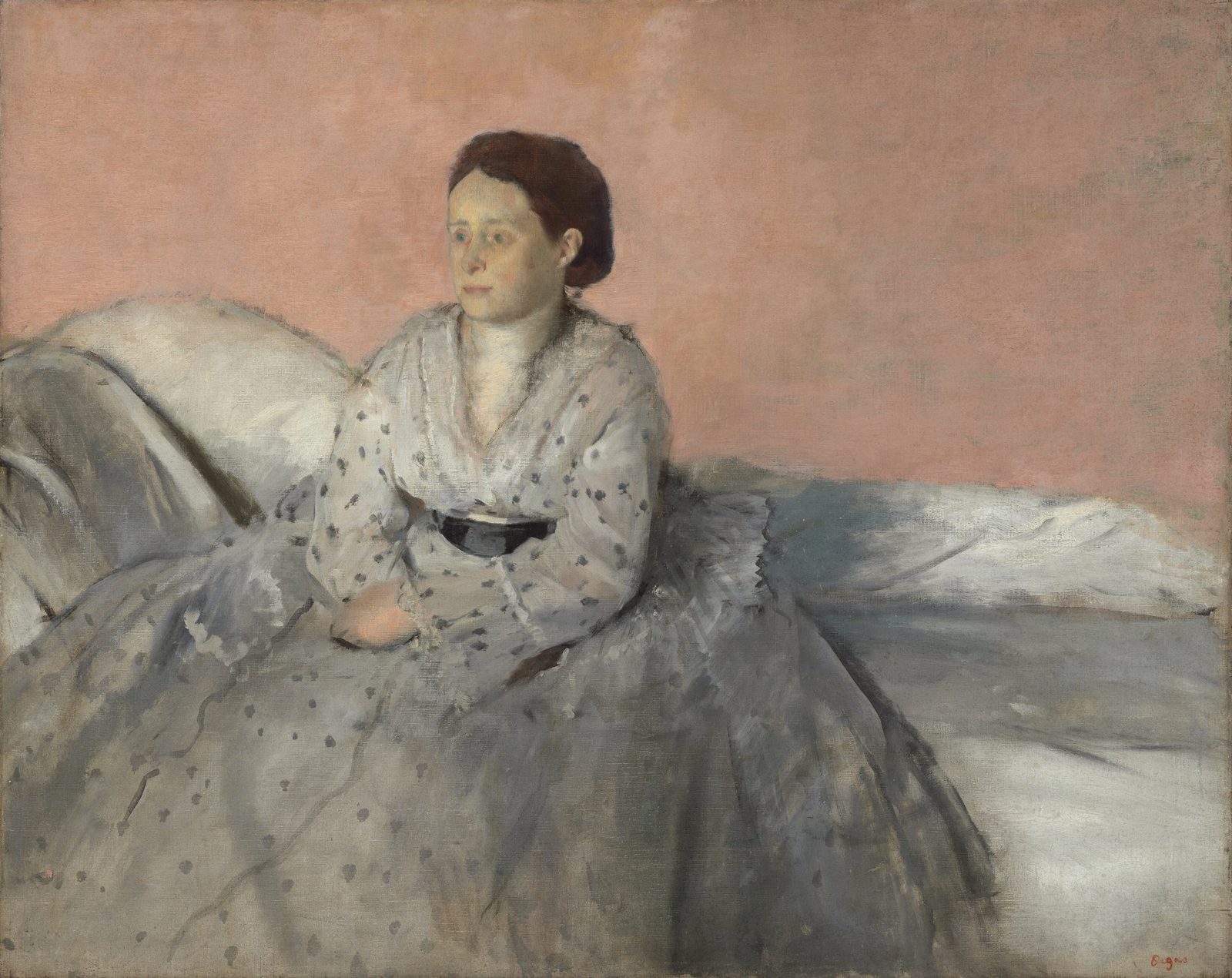
We are looking at Edgar Degas's Madame René de Gas, a seated portrait where the figure seems almost caught mid-thought against a flat salmon-pink wall. Notice how unfinished the surface feels — Degas has concentrated his care on the face and hands while letting the dress and sofa dissolve into broken notation. This is a painting that asks you to read both likeness and gesture at the same time.
Degas, 1872–1873, oil on canvas
Degas painted this in 1872 and 1873, in oil on canvas, during his mature 1870s period when his handling was famously sketch-like and provisional. Rather than a polished society portrait, this feels like a working study where the artist's decisions are still visible. The sitter is his sister-in-law, posed indoors in diffused daylight.
A pyramid with the face as apex
Step back and read the structure: the head sits as the apex of a pyramid, with the dress flaring outward toward the lower corners. A strong horizontal sofa-back bisects the lower half, anchoring the figure. Watch how your eye falls onto the face near the upper-left third, then travels down through the clasped hands and out into the patterned skirt.
Warm wall, cool figure
The salmon-pink ground is pushed warm to isolate and advance the cool grey-and-blue figure. The temperature jump does the separating work — there is no dark cast shadow between bodice and wall. Notice how the warm field even bounces into the shadowed passages of the dress, quietly unifying the whole surface.
The face: where finish concentrates
Now the camera pushes into the focal center — the face and upper bodice. Here the blending is tight: soft transitions along the cheek and jaw, carefully softened edges where flesh meets the pink wall, and small distinct dabs that resolve the eyes. The hair and shoulders, by contrast, are blocked in with looser directional strokes against the same pink.
Warm light, cool shadow
Hold on the face to see how Degas models form without blending wet-into-wet. The left cheek is laid in with warm creams and peaches; moving across the nose, the paint shifts into cooler grey-greens and violet-greys on the shadow side. The two temperatures sit side by side in broken strokes, and the terminator is a soft band, not a drawn line.
Hair that breathes into the wall
Drop down the right side of the head. The boundary between dark hair and pink wall is not a contour line — Degas feathers the edge with translucent scumbles so the salmon reads through. Within the hair, strokes vary from near-black to warm umber, and the outermost ones are dragged dry enough that the canvas texture still speaks beneath them.
Hands: a few strokes are enough
Slide down to the clasped hands. This is a narrative gesture, but Degas treats it as pure economy: a few flattened flesh-toned strokes suggest folded fingers, dissolving into the dress with no drawn contour at all. A single confident dark pass marks the sash — value alone tells you those are hands resting in lap.
Dots dabbed, not drawn
Look at the bodice pattern. The polka dots are not drawn circles — they are dabbed with a bristled brush held nearly perpendicular, so each mark varies from a round blob to a short diagonal dash, and some trail off into thin streaks. A uniform, mechanical dot would kill the liveliness of the surface; this variation is what animates the white ground.
Soft edge, no shadow line
Now look where the right bodice meets the salmon wall. The fabric is a cool grey-cream with loose dark spots, and the wall is a warm mid-value pink laid thinly. Their boundary is soft and broken — pink encroaches into fabric, fabric frays into pink — and crucially there is no dark seam between them. The temperature contrast plus a fuzzy edge implies separation without any added darks.
Broken strokes, exposed weave
Follow the eye path down into the skirt. Long slanting grey passages read as falling fabric, but the strokes are deliberately disjointed — a dark diagonal band cuts through, vertical streaks sit beside a smear of warm umber where the toned canvas reads through. Degas mixed his cool greys directly on the canvas, leaving the weave exposed between strokes to do the unifying work.
The unfinished periphery
Pull to the lower right, where the painting stops disguising itself. Broad horizontal sweeps block the sofa back and seat, the dress shadow on the left is a single loaded triangle, and patches of salmon pink and pale cream read through thinly scumbled paint. This is the painting's raw, provisional edge — canvas weave openly visible, no softening attempted.
Look closer
10 details, each checked against a close-up of the picture.
-
Face and upper bodice—the portrait's focal center
The face is modeled with soft, blended edges and distinct eyes, while the hair and shoulders are painted with looser strokes against the flat pink ground.
The face is rendered with tight, blended transitions along the jaw, cheek, and forehead, with carefully softened edges where the cheek meets the pink ground. The eyes are the most resolved feature: small, distinct dabs of pale green and ochre form the irises, ringed with darker lash lines. The hair, by contrast, is blocked in with broader, more directional strokes of dark brown-black, its silhouette against the pink ground kept crisp but its interior left relatively unblended. The polka-dot dress is brushed wetly—white and pale lavender strokes host loosely dropped dots of grey-blue, with visible weave showing through in the lower passages. The salmon-pink ground is a single thin, brushed layer that allows the canvas weave to read in places, creating a flat, decorative field that contrasts with the modeled face.
-
Clasped hands and dark sash
The clasped hands are indicated by a few flattened flesh-toned strokes and a dark sash, with the fingers dissolving into the dress fabric.
The crop shows a zone of pale dotted fabric interrupted by a horizontal band of dark brown-black paint (the sash) roughly across the upper-middle, and a cluster of warm flesh-toned strokes in the lower-left that suggest folded hands. The white ground is not pure: it reads as warm cream with cooler grey-violet passages along the right edge and at the centre seam where the fabric falls. The polka dots are painted as quick dashes and ovals rather than circles, varying from near-black to softer blue-grey, with several appearing to be dragged with a loaded brush. Edges between the flesh passage and the dress are deliberately unresolved, with pinkish strokes bleeding into cream and grey rather than being contained by a contour.
-
Face: warm light vs cool shadow
The left cheek is painted with warmer, lighter flesh tones, while the right side of the face shifts into a cooler, grey shadow.
The crop shows a close-up of a woman's face, rendered with loose, visible brushstrokes that leave the canvas weave partially exposed. The left cheek and forehead are built up with warm, light flesh tones—creams, pale pinks, and soft peaches—that sit in higher key value. Moving across the bridge of the nose and toward the right side, the paint shifts into cooler, greyer mixtures with muted browns and violet-greys, creating a soft shadow. The edges between the lit and shadow areas are deliberately softened, with no hard contour; the warmth and coolness interpenetrate through broken, sketch-like strokes. The eye on the lit side is more sharply described with a dark pupil, while the right eye is barely indicated, merging into the surrounding cool shadow.
-
Lower skirt with loose, broken brushwork
The grey skirt is rendered with loose, broken strokes and disconnected grey washes that leave visible canvas texture between them.
The crop is dominated by long, slanting grey passages that read as the bulk of a skirt falling from upper left toward lower right. A hard-edged dark diagonal band cuts from the top center down to the lower right, separating a cool, thinly painted upper field (pale blue-greys and off-whites) from the denser body of fabric below. The lower passages break into clearly disjointed strokes: a vertical dark streak near the left, a smear of warm umber/sienna at lower center, and short cross-hatched grey marks that barely link up. Where strokes are sparse, the warm-toned canvas weave reads through, giving the surface a granular, almost scraped appearance. The right edge dissolves into a pale ground tone with no hard contour, leaving the form open to the background.
-
Right bodice showing warm-cool contrast with wall
The right side of the grey bodice sits against the salmon-pink wall, showing a visible temperature shift from cool fabric to warm ground without a dark intervening shadow.
The crop shows the right contour of the bodice on the left side meeting the salmon-pink wall on the right. The fabric reads as a cool, pale grey-cream with loosely dabbed dark spots scattered across it; the wall is a warm, mid-value pinkish-orange laid in broad horizontal strokes. The boundary between bodice and wall is soft and irregular, with the pink encroaching into the fabric edge in places and the fabric edge fraying outward into the pink; no distinct dark cast shadow band sits between them. The canvas weave is openly visible through thin passes of paint in both regions, especially along the bodice edge where the underlayer shows through.
-
Polka-dot pattern on the bodice
The polka dots on the bodice are painted as distinct dark grey dashes and spots over a broken white ground, varying in size and density.
The crop centers on a bodice section where a salmon-pink background meets a loosely painted white-and-grey ground. The polka dots read as small dark charcoal marks scattered across a broken, off-white surface that shows warm ochre and cool grey modulation beneath. Dot shapes vary: some are short, blunt dashes oriented diagonally, others are rounder blobs, and a few trail off into thin streaks. The weave of the canvas is plainly visible through thin, scumbled passages, and a dark horizontal band — the sash or belt — runs across the lower third with pooled blackish pigment and softer grey transitions into the fabric above.
-
Hair against pink background: soft edge
The boundary between the dark hair and the pink background is a soft, indistinct edge with no hard contour line.
The crop shows the right side of a woman's head where dark, loosely brushed hair meets a salmon background. The boundary is genuinely soft: the hair does not end in a crisp line but feathers out through translucent scumbles that allow the pink to show through the dark mass. The pink ground itself is uneven, with horizontal and vertical brush textures visible and slightly cooler passages near the hair that read as reflected light rather than painted edges. Within the hair, strokes vary from near-black to a warmer umber, and the outermost strokes are broken and thin enough that the background texture remains legible beneath them.
-
Lower-right sofa and dress periphery
The lower-right corner shows broadly blocked grey sofa paint and loosely indicated dress folds that continue to the canvas edge without refinement.
The crop is dominated by broad horizontal bands of cool grey paint in the upper and middle thirds, suggesting a sofa's back and seat, with a lighter cream-grey passage in the lower right that continues to the canvas edge. A dark, roughly triangular mass enters from the lower left, its edge soft and partially unresolved where it meets the grey sofa paint. The upper-right corner reveals patches of warm salmon pink and pale cream where the ground or background shows through thin, scumbled paint, and a small dark smudge sits just below it at roughly the right edge. Canvas weave is plainly visible through much of the surface, especially in the thinner mid-tone passages, confirming dry, dragged application rather than wet blending.
-
Left sofa back: broad tonal masses
The sofa back is divided into two broad tonal masses—a light grey highlight and a cool grey shadow—with almost no linear detail.
The crop shows the left sofa back as two broad, painterly value blocks set against a flat salmon-pink field at the top. A pale, off-white mass occupies the upper-right and center, applied with long, predominantly horizontal strokes that leave the linen weave partly visible where the paint is thinnest. A cool, blue-grey shadow pool fills the lower-left, its edge into the light read as a soft, curved transition rather than a hard line. Small notes of greenish-grey and warmer ochre sit inside the shadow, preventing it from reading as a single flat tone.
-
Artist's signature in lower right
The reddish signature 'Degas' sits directly on the unmodulated grey sofa in the lower right corner.
The crop isolates the artist's signature 'Degas' written in a thin, fluid reddish-brown line against an unmodulated cool grey field representing the sofa upholstery. The grey is not flat: faint horizontal scoring marks run across the upper portion, and the underlying canvas weave is visible through thin paint, creating a slightly mottled, abraded appearance with cooler blue-grey passages and warmer neutral grey patches. The signature letters are cursive and rapid, with the 'D' looping into 'e', 'g', 'a', 's'; the descender of the 'g' sweeps downward and curls, while the final 's' ends with a small trailing tick. The reddish strokes sit cleanly on top of the dried grey with crisp, unblurred edges.
Madame René de Gas in context
Estelle Musson
The National Gallery of Art identifies the sitter as Estelle de Gas, Degas's first cousin and sister-in-law, and says he painted her in New Orleans, where she lived [1]. She was a daughter of Michel Musson, the brother of Degas's Creole mother, Célestine Musson [2][3]. According to the Encyclopedia of Louisiana, Degas first got to know her during the American Civil War, when his aunt took her daughters Désirée and Estelle, with Estelle's baby, to Paris for about three years [2].
Estelle's first husband died in the war [2]. Degas's brother René moved to New Orleans in 1865 to work in the business of their uncle Michel Musson, Estelle's father, fell in love with his cousin, and married her in 1869 [2]. The painting's title uses her married name, Madame René de Gas [1].
A crowded house on Esplanade Avenue
Degas stayed in New Orleans from October 1872 to March 1873, in the Esplanade Avenue house that Michel Musson rented after the collapse of the cotton trade forced him to sell his Garden District mansion [2][3]. The whole extended family lived there together [2]. At Christmas Estelle had another child, and Degas became its godfather [2].
Christina Vella, writing for the encyclopedia, describes a visit that tested him. With six children in the house, the household wore on his nerves, and he wasn't entirely satisfied with the family portraits he was producing [2]. Only in the last weeks did he start the major work of the trip, A Cotton Office in New Orleans [2]. Vella nonetheless sees in the family portraits an early form of his gift for ambiguous mood and enigmatic psychological states [2].
Two kinds of failing sight
Degas's own eye trouble had come to light two years before the journey [3]. During rifle training in the National Guard in 1870 his eyesight was found to be defective, and from then on it was a constant worry [3]. The Gallery says Estelle was nearly blind and that Degas was deeply affected by her condition [1]. The encyclopedia's image notes repeat the idea, more cautiously, that his interest in her may have come from knowing his own sight was fading [4].
The Gallery's own reading is that the diffuse light, blurred details and almost monochromatic palette may suggest dimming vision, while the portrait still keeps Estelle unknowable [1]. That is an interpretation, though, not a statement Degas left on record.
What came after
The family story darkened soon after the visit. Vella writes that René later abandoned his blind wife and their children to leave with another man's wife, and that Michel Musson then turned his back on the Degas brothers for good [2].
Kept in the studio
The portrait never left Degas's hands in his lifetime. It was sold at the Degas atelier sale at the Galerie Georges Petit in Paris, 6-8 May 1918, as number 97 [1]. The Gallery records the mark at lower right as an atelier stamp, even though its visual description calls it a signature in red [1]. The dealer Jacques Seligmann bought it for his own collection, and after his sale in New York in 1921 it went through Knoedler to Henry D. Hughes of Philadelphia [1]. Chester Dale bought it on 10 November 1928, and Maud Dale's 1929 catalogue of the Dale collection listed it as Portrait in White [1]. It came to the Gallery with Dale's bequest in 1963 [1].
- Edgar Degas, Madame René de Gas (1963.10.124): object record, visual description, overview, provenance, exhibition history and bibliography (Internet Archive copy, 15 September 2025) . National Gallery of Art, Washington
- Christina Vella, Edgar Degas, 64 Parishes: Encyclopedia of Louisiana (published 14 February 2011; Internet Archive copy, 18 November 2019) . Louisiana Endowment for the Humanities
- Edgar Degas . Wikipedia
- Portrait of Estelle Musson Degas: image entry, 64 Parishes (Internet Archive copy, 28 November 2022) . Louisiana Endowment for the Humanities