Degas's Mademoiselle Malot: A Lesson in Selective Finish
An oil sketch turned portrait, c. 1877
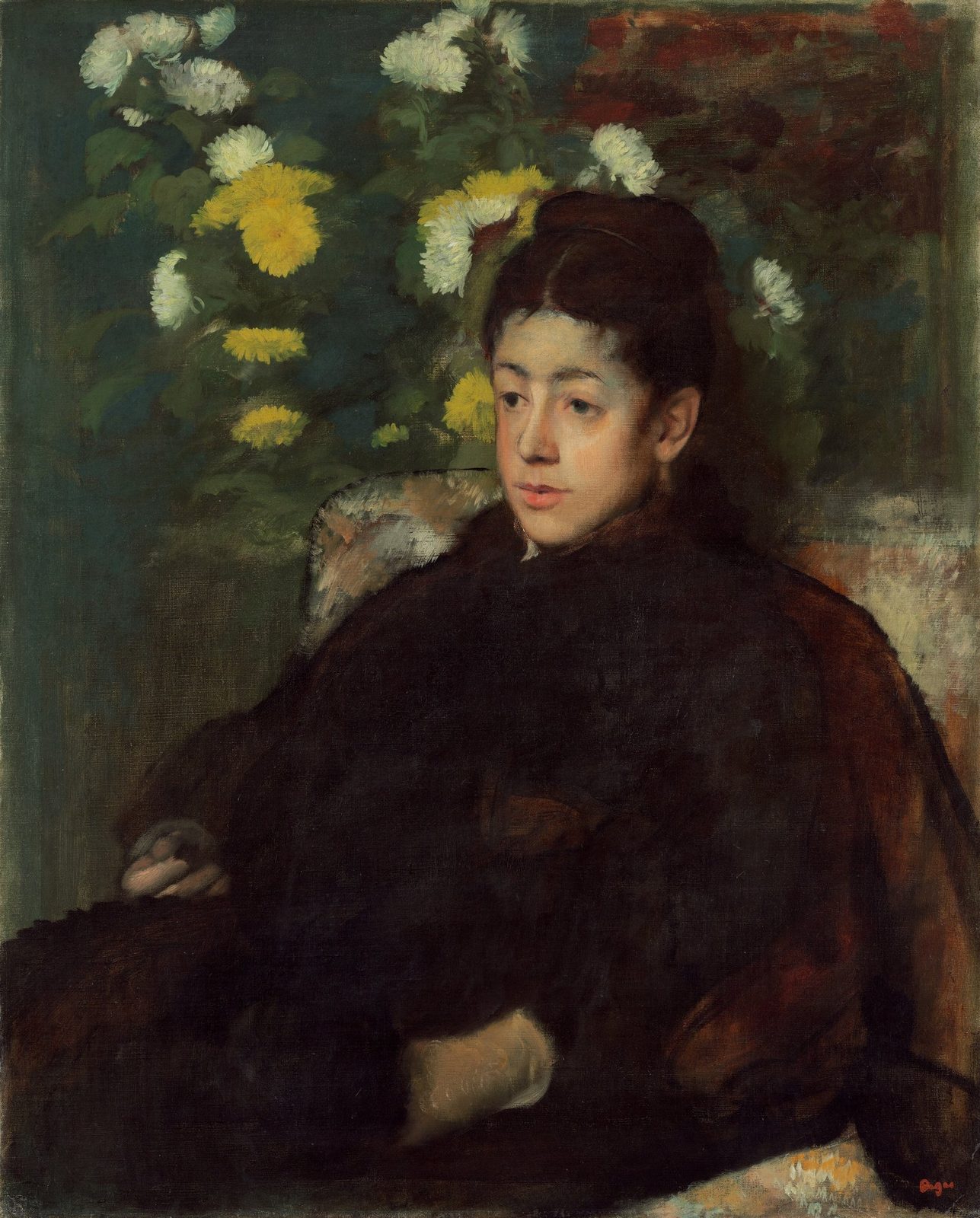
- Artist
- Edgar Degas
- Title
- Mademoiselle Malot
- Date
- c. 1877
- Medium
- oil on canvas
- Image
- Public domain (CC0)
Open in Simple Art
Watch this story on iPhone and iPad, with offline downloads and a painting every day.
About 5 minutes of looking, in 11 parts.
A portrait, but cropped tight
Before you is a seated young woman in a dark dress, posed before a towering bouquet of chrysanthemums. Notice how the bright blossoms in the upper left pull your eye in, and how the rest of the room seems to fall away into shadow. This is not the formal, full-length portraiture of the Salon — it is something stranger and more intimate.
Degas, c. 1877
This is Edgar Degas's Mademoiselle Malot, painted around 1877, oil on canvas, working in his mature Impressionist mode. It is a portrait, but stripped of the formal setting you would expect from the genre: no pedestal, no curtain of attributes, no traditional backdrop. Just a sitter, a bouquet, and a wall.
The triangle and its diagonal
Look at the overall geometry. Degas builds an asymmetrical triangle with its apex up in the flower cluster, widening down through the figure to a broad base of dark dress across the lower third. A diagonal runs from that bright bouquet through the face and out toward the lower right — that is the path your eye is being asked to walk.
One source, two poles
Light comes from the upper left, the same side as the flowers, and rakes across the sitter's face. The whole picture is organized around a high-key face and bright blossoms set against a deep low-key mass of brown dress, with the teal-green wall and rust-red drape holding the mid-tones between those poles. The complementary tension between warm yellows and rusts and cool teal-greens is what pushes the figure forward.
Yellow without a transition
The entry point of the eye is this thickly painted yellow chrysanthemum, where the petals are built from short loaded strokes radiating outward from a brighter core. Degas lays bright yellow and white directly next to the dark teal-green without any transitional mixing — that sharp chromatic edge is what makes both flowers read so brilliantly.
Where the finish lives
The eye then drops down and right, into the most resolved passage on the canvas: the face. Here the brushwork tightens, the modeling is blended, and warm peach and cream gradate into cooler grayish-rose along the shadow side of the nose and cheek. This is where Degas spent his blend-time budget — the focal center, the highest value, the most finish.
Raking light, no highlights
Watch how the light falls across the face. The left cheekbone carries the highest warm flesh value, while the right side slopes into a soft, cool half-shadow down the nose and along the jaw. The lit eye shows a small dark pupil against a pale blue-gray iris; the shadowed eye reads cooler and darker. There are no specular highlights anywhere — the quality is soft and diffused, a single dominant source.
An edge that is not painted
Above the forehead, the dark hair dissolves into the green background with no drawn outline at all. Small interlocking dabs of brown and green marry at the boundary, so the eye reads an edge that is not actually painted. This is the opposite of a hard contour — it is form turning into atmosphere, and it tells you how little definition a lost silhouette really needs.
A dress with almost no modeling
Below the face, the dress is laid in with broad, slightly dragged dark-brown strokes running roughly horizontal. The value range is extremely compressed, the canvas weave shows through the thin paint, and a single small warm pocket just right of center hints at a fold. That is all the modeling this passage gets, and that is all it needs.
A hand that is barely there
Down at lower center, the resting hand is barely described at all. A roughly triangular patch of warm flesh tone sits in the dark surround, with small dabs of lighter ochre and pinkish ivory suggesting knuckles, and a cooler stroke curling down the wrist. The form emerges through subtle temperature shifts, not strong contrast — the dark ground does most of the work.
A drape that stays gestural
Up in the upper right, the rust-red drape is built from long horizontal sweeps dragged over a darker brown ground. Patches of teal-green show through where the brush has skipped, and a small white chrysanthemum intrudes at the lower left. The strokes stay loose, dry, and visibly unblended — a deliberately unfinished surround that frames the figure's silhouette.
Look closer
11 details, each checked against a close-up of the picture.
-
Face with blended modeling
The face is rendered with smooth blended modeling, showing soft transitions on the cheeks and nose that contrast with the looser paint around it.
The crop centers on a face turned in three-quarter view, where the skin is built from softly blended passages of warm peach and cream that gradate into cooler grayish-rose along the right (shadow) side of the nose and cheek. The forehead, lid, and cheek show gentle half-tone transitions with no hard ridges, while the lower lash line and nostril are picked out with small, slightly more deliberate touches that still read as fused. Around the head, the hair is set down in longer, looser dark strokes and the chrysanthemum to the left is a smear of bright cadmium-leaning yellow with only a few petal marks, so the face reads as the most resolved passage in the field. Crizzling and fine canvas weave are visible through thinner paint at the lower jaw and the white collar edge.
-
Raking light on cheek and eye
Light from the upper left falls across the left cheek and eye, leaving the right side of the face in softer shadow with no specular highlights.
The crop shows a tightly framed face with the light clearly striking from the upper left: the left cheekbone (viewer's left) carries the highest warm flesh value, while the right side of the face slopes into a soft, cool half-shadow. The lit eye is rendered with a small darker pupil and a pale blue-gray iris against warm rim, while the shadowed eye reads darker overall with cooler tones. Brushwork is loose and scumbled along the jaw and into the hair/dress, but the central modeling around nose, cheek and mouth shows soft wet-into-wet blending. Edges are diffused—no hard outlines—except where the lit cheek meets the shadow side of the nose and the dark brow line of the eye. The canvas weave is clearly visible through thin paint passes, especially in the shadow cheek and around the ear.
-
White and yellow chrysanthemums
White and yellow chrysanthemums are painted with separate, visible strokes that leave feathery petal edges unblended against the teal-green wall.
The crop isolates white and yellow chrysanthemums against a deep teal-green field. White petals are built from short, separate strokes of cool off-white and pale blue-grey that retain crisp, feathered edges where they meet the dark background without blending. The yellow blooms show thickly loaded paint applied in radiating strokes pulled outward from a brighter core, with little smoothing across petal-to-petal transitions. Darker olive-green strokes sit between flowers as loose foliage suggestions, and patches of bare canvas weave show through thinly painted background passages.
-
Hard contour of jaw and ear
A sharp, unbroken line defines the contour of the right jaw and ear against the darker hair.
The crop shows a tight detail of the right side of a face: a partial eye, the side of the nose, the lips, the right ear, and the jaw fading into dark hair. The skin is modeled in warm cream and ochre tones against deep umber hair, with cooler mauve-greys in the eye socket and along the side of the nose. Contrary to the claim, the jawline is not a sharp unbroken line; it is a soft, broken edge where mid-tone flesh dissolves into shadowed hair, with visible canvas weave and slightly feathered brushwork. The ear is constructed through stacked value planes rather than contour lines, its rim catching a thin warm highlight while the concha sits in a reddish-brown half-shadow.
-
Yellow flower cluster
Bright yellow paint is placed directly next to white and teal-green pigment without intermediate mixing in the upper-left bouquet.
The crop centers on a thickly painted yellow chrysanthemum whose petals are built from short, loaded strokes of bright cadmium-like yellow radiating from a slightly warmer core. Above the yellow cluster sits a white bloom whose petals visibly abut the yellow without a transitional blend, and the dark teal-green foliage on the left meets the yellow and white edges in the same way. Canvas weave shows through the thinner background passages at the lower right, while the flower masses sit as opaque, impasto ridges of pure pigment placed side by side. Values drop sharply from the high-key petals into the near-black green voids between blooms, producing a crisp lost-and-found edge where the brushwork resolves into the background.
-
Soft hair edge against green
The hair dissolves into the green background above the forehead with no hard contour line visible.
The crop shows the crown of the head and forehead against a mottled green background. Dark umber-brown hair is built with loose, scumbled strokes; its upper edge bleeds directly into the surrounding teal-green wall through small interlocking dabs rather than any drawn outline. A faint pale sliver crosses the crown, possibly a comb or highlight reflection. The forehead below transitions from warm peachy flesh into cooler olive shadows on the right, with no firm boundary between hairline and skin. At the top and upper-left corner, buttery yellow and white chrysanthemum dabs sit loosely against deeper green, with canvas weave showing through in thinner passages.
-
Dragged strokes of dark dress
The dress is built from broad, slightly dragged dark-brown strokes that reveal canvas texture and remain within a narrow value range.
The crop is dominated by a field of very dark brown pigment applied with broad, slightly dragged strokes running roughly horizontal across the canvas. The weave of the canvas is clearly visible through the paint film, indicating a thin, broken application rather than an opaque cover. A small, warmer brown oval sits just right of center (roughly 0.58, 0.55), reading as a lifted passage or pocket of light on a fold. The overall value range is extremely compressed, hovering within a few steps of near-black, with only faint hints of warmer umber distinguishing form. Edges are soft and broken; no contour is sharply drawn, only implied by subtle shifts in pigment density.
-
Resting hand at lower center
Flesh-toned paint at lower center describes a resting hand or glove against the dark brown dress.
A roughly triangular patch of warm flesh-toned paint sits in the upper-center, its upper edge soft and almost dissolving into the dark surround. Within this patch, small dabs of lighter ochre and pinkish-ivory suggest knuckles or creases, while a thicker, slightly cooler stroke runs down the right side, curling into a hook-like edge that reads as either a glove seam or the outer curve of a wrist. The dark surrounding field is a thinly applied umber over an already-dark ground, with the canvas weave visible through many passages and a few small scumbled warmer touches near the lower-left that may hint at supporting fingers or folded fabric. Values stay compressed in the upper mid-range against the near-black ground, so the form emerges through subtle temperature shifts rather than strong contrast.
-
Cream sofa cushion behind shoulder
A cream-colored cushion behind the left shoulder bridges the dark dress and teal wall with warm mid-tone paint.
The crop centers on a rounded cream-colored cushion or sofa back wedged between a dark brown-black dress (lower right) and a teal-green wall (upper left). The cushion is built from loose, broken brushstrokes in warm peach, ochre, and off-white, with cooler grayish passages laid over warmer underlayers. The upper edge of the cushion is sharp and dark where it meets the wall, while the lower edge dissolves into the dress through a soft, broken transition. Canvas weave is clearly visible through thin, scumbled passages, especially in the lighter mid-tones, and a thin sliver of warm skin (the neck) appears at the upper right edge.
-
Rust-red drape upper right
The upper right background is composed of separate rust-red and brown strokes that remain visibly summary and unblended.
The crop isolates the upper right background, where broad horizontal sweeps of rust-red sit over a darker brown ground, with patches of teal-green showing through on the right side and lower edge. The strokes are loose, dry, and visibly unblended—you can see individual ridges of paint and the weave of the canvas between marks. A scalloped, broken edge separates the warm red drape from the cooler wall, with no hard contour painted. In the lower left a small white flower form intrudes, its impasto highlight contrasting with the thin, scumbled surround.
-
Artist's signature
The red signature 'Degas' sits in the lower right corner on top of the brown dress.
The crop is dominated by a very deep brown-black field with strong canvas weave showing through. On the right of center, slightly below the midline, the cursive word 'Degas' is painted in a warm vermillion red, sitting roughly 0.55 along the horizontal axis and 0.62 along the vertical. The signature's strokes are fluid, slightly dry at the transitions between letters, and you can see where the brush barely loaded between the 'g' and 'a'. The left third of the crop shifts to a warmer, scumbled ochre-and-umber zone that reads as the lit edge of a form (likely the dress), with hard dry-brush transitions into the dark. A few thin scratches/scuffs in the dark film suggest surface abrasion or a scraping through a thin layer.
Mademoiselle Malot in context
One sitter, three canvases
Michel Schulman's online catalogue raisonné of Degas lists three oil portraits of the same young woman, all dated to about 1877 [2][3][4]. The Washington canvas, 81 by 65 cm, is Lemoisne no. 441. The catalogue gives it a second title, Jeune femme assise avec fond de chrysanthèmes, a seated young woman against a background of chrysanthemums [2]. Lemoisne no. 442, a smaller canvas of 64 by 53 cm, belongs to the Detroit Institute of Arts. And no. 443 is a small study in oil on paper laid down on card, 30 by 25 cm, now in a private collection [3][4].
Schulman records the stamp of the Degas sale at lower right on all three [2][3][4]. But the Detroit museum describes the mark on its picture as a signature in red script [5].
A name with a question mark
The sitter's identity isn't as settled as the Washington title suggests. Detroit calls its version simply Portrait of a Woman. Its list of references shows that Lemoisne catalogued it as 'Portrait of Mlle. Malo?', question mark included, while Ronald Pickvance's 1993 catalogue for Martigny named her Thérèse Mallot [5]. Schulman keeps the question mark for the Detroit picture but spells the name Malo for the other two [2][3][4]. When the Washington canvas was exhibited at the Galerie Georges Petit in 1930, it was listed without a name, as Jeune femme assise [1].
Dates have moved too. Detroit's references include a 1940 Art News article that placed its picture about 1865, and the 2002 Degas and the Dance catalogue, which gave a span of about 1868 to 1893 [5]. None of the sources read here says who Mademoiselle Malot was.
A link to the ballet?
Both larger pictures, and the study, have been shown in exhibitions about Degas and the dance. The Detroit canvas and the small study were nos. 241 and 240 in Degas and the Dance at Detroit and Philadelphia in 2002 to 2003 [3][4]. The Washington canvas was no. 269 in Degas at the Opera, the joint exhibition of the Musée d'Orsay and the National Gallery of Art in 2019 to 2020, where it was shown only in Washington [1]. The sources consulted don't explain the connection, so whether the sitter belonged to the world of the Opéra remains an open question.
The question of finish
The Gallery's bibliography points to a 2017 study of finish in Degas's work by the curator Kimberly A. Jones and the conservator Ann Hoenigswald, which discusses this portrait on pages 34 to 36 with two illustrations [1]. The Art Newspaper's report on that study notes that Degas reworked pictures even after exhibiting them, kept many in the studio, and signed some works more than once and others not at all, so the usual signs that a picture was finished are unreliable in his case [6]. Jones told the paper that the aim was to open a discussion rather than to settle it [6].
Two pictures, one route
The Washington and Detroit canvases left the studio together. Both were sold at the first Degas sale at the Galerie Georges Petit in May 1918, as nos. 86 and 64. Both were bought by the dealer Jacques Seligmann, and both were sold again at his sale in New York on 27 January 1921, as nos. 45 and 56 [1][5]. Detroit's picture was bought that year through Reinhardt Galleries, as the gift of Ralph Harman Booth [5].
The Washington picture went to Scott & Fowles, then to Henry D. Hughes of Philadelphia, and was sold through Marie Sterner Galleries to Chester Dale on 10 November 1928 [1]. It came to the Gallery with his bequest in 1963 [1]. The small study took another path, through the second Degas sale, the dealers Nunès et Fiquet and the Friedmann family to a Christie's sale in London on 7 February 2005 [4].
- Edgar Degas, Mademoiselle Malot (1963.10.18): object record, visual description, provenance, exhibition history and bibliography (Internet Archive copy, 24 June 2025) . National Gallery of Art, Washington
- Mlle Malo [Jeune femme assise avec fond de chrysanthèmes] (MS799) . Michel Schulman, Edgar Degas: catalogue raisonné numérique
- Portrait de Mlle Malo ? (MS800) . Michel Schulman, Edgar Degas: catalogue raisonné numérique
- Mlle Malo (MS798) . Michel Schulman, Edgar Degas: catalogue raisonné numérique
- Edgar Degas, Portrait of a Woman (21.8): object record, provenance and published references (Internet Archive copy, 27 November 2024) . Detroit Institute of Arts
- Never can say goodbye: how Degas struggled with the art of letting go (19 October 2017) . The Art Newspaper