Mahana no Atua: A Tahitian Ritual in Flat Color
Reading Gauguin's Day of the God, 1894 — vertical hierarchy, bold outlines, and non-naturalistic light
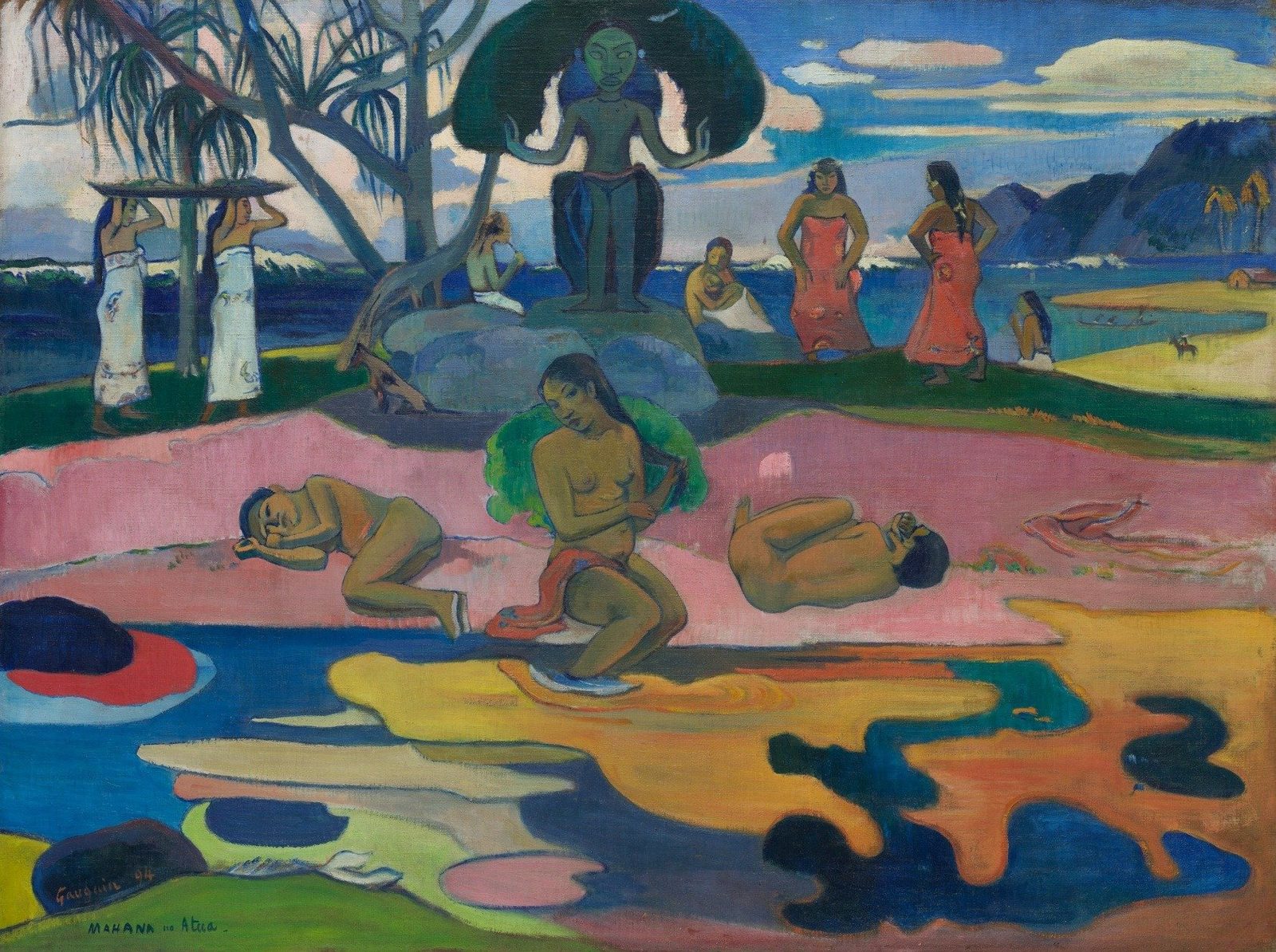
- Artist
- Paul Gauguin
- Title
- Mahana no atua (Day of the God)
- Date
- 1894
- Medium
- Oil on linen canvas
- Museum
- Art Institute of Chicago
- Image
- Public domain (CC0)
Open in Simple Art
Watch this story on iPhone and iPad, with offline downloads and a painting every day.
About 5 minutes of looking, in 10 parts.
A dark green idol crowns a pink Tahitian beach
Pause here. Before you stands Paul Gauguin's Mahana no atua — Day of the God — a Tahitian ritual scene where an idol, worshippers, and a pink beach are stacked into a single vertical column. Let the dark green figure at the top catch your eye first; everything else will fall into place beneath it. The eye path is fixed: idol, then seated figure, then the two flanking women, then the mirrored color shapes below.
Painted in 1894, oil on linen, far from Paris
Gauguin painted this in 1894 in oil on linen, working far from Paris in the tropics. Forget naturalistic light and academic modeling — what he offers instead is a deliberately flat, decorative surface where color and outline do the storytelling.
Three stacked registers on one central axis
Step back and notice the structure: a tall central idol at the top, a seated figure at the middle, two reclining women flanking her, and a mirrored zone below. The canvas is built in three stacked registers, almost symmetrical, with the strong central axis pulling your gaze from the idol straight down through the seated figure and into the foreground shapes.
No cast shadows — diffuse tropical daylight
Look at how evenly lit the scene is. There are no cast shadows, no deep chiaroscuro — the tropical daylight is diffuse and flat. This shadowless illumination is the canvas's first deliberate choice: it lets color lead instead of light. The deep greens of the idol and tree mass provide the darkest accents, set against the bright pink mid-ground and yellow lower band.
Hard pink-to-yellow boundary, no blend
Now drop your gaze to where the hot pink ground meets the yellow foreground. Watch the boundary: it is a hard, unblended edge. The pink is laid in with short curving strokes, the yellow in long horizontal sweeps, and they meet without a wet-into-wet transition. The meeting line itself reads as a contour — that is the Cloisonnist effect.
Idol face built from outline and color-steps
Drift up to the central figure and look closely at the idol's face. The cheeks and forehead read as one continuous field of green. Modeling is minimal: just a thin dark outline traces the nose, the almond eyes, and the lips, with a slightly cooler green step on the temple suggesting form. No blending — the contour and the color-step do all the work.
Silhouette in deep green, arms lifted
Pull back to see the whole idol in deep teal-green. Notice the silhouette first: arms raised symmetrically, hands simplified into mitten-like shapes, a darker green contour brushed against the pink and blue sky. The figure is laid in flat, then a few lighter accents scumbled over the dry surface. It advances against the sky through value contrast alone — not atmospheric perspective.
Bold dark contours separating flat planes
Now study the women flanking the central tree. Each figure is bounded by a bold dark contour — the outline is the meeting point of two flat color fields, never smudged or blended. The dress hems carry internal dark bands, and the foliage above reads as separate flat shapes each bounded by darker edges. Edges are doing the work that shading would normally do.
Red wraps, three values, no blending
Move right to the two standing women in saturated red wraps. The wraps are flat color fields; only a few darker red lines hint at folds along the hems and inner edges. A single serpentine dark stroke renders the braid of the figure on the right. Three values carry the whole figure: the red, a darker red, and the warm olive skin.
Wet-into-wet reflections vs flat figures
Now drop to the lowest band and notice something different. Here the paint is fluid — soft tongues of orange and yellow blend wet-into-wet with deep blue, with no hard contours and canvas weave showing through the thinner passages. Compare that to the flat, outlined silhouettes above. Gauguin uses two different handlings on one surface: rigid planarity for the sacred figures, blended fluidity for the mirrored earth.
Look closer
7 details, each checked against a close-up of the picture.
-
The Central Idol
The idol is rendered in a deep green with a simplified, stylized face and raised hands.
The crop centers on a standing figure painted almost entirely in deep teal-green, with the silhouette locked against a sky of pale pink clouds and muted blue. The face is reduced to broad planes: a long vertical stroke for the nose, two small dark almond eyes, and a thin horizontal mouth, all set inside a darker green outline that reads as a hard edge rather than a shadow. The arms are held out and up in a symmetrical gesture, the hands simplified into mitten-like shapes with only a thumb suggested in a slightly lighter green. Below the chest, a horizontal band of dull rose cuts across the waist, and the lower body continues in the same green mass, broken only by a faint vertical highlight that hints at the legs' separation. Background tree foliage above is a near-black green that pushes the figure forward through value contrast rather than atmospheric perspective.
-
Cloisonnist Outlines
The figures are defined by dark, bold outlines that separate them from the background colors.
Two women in white dresses flank a dark green vertical form (tree or idol) at this edge crop. Bold dark contours trace the outer silhouettes of the women against the blue background, and a thick outline runs down both sides of the green central mass, separating it from sky and ground. The dress hems show horizontal dark bands that act as internal outlines, and the foliage at top reads as separate flat shapes each bounded by darker edges. The pink foreground meets the green ground along a clearly drawn, slightly wavy contour rather than a wet-into-wet blend.
-
Pink-Yellow Transition
The transition from the pink ground to the yellow foreground is a sharp, unblended boundary.
The crop is split roughly in two: the upper third is a warm pink field, the lower two-thirds a saturated yellow ground. Where the two meet, the pink ends in a slightly ragged but essentially unblended edge against a thin band of dark blue that runs horizontally across the image, then the yellow begins immediately. Yellow paint is laid in long, sweeping horizontal strokes that leave the weave of the canvas visible between ridges of pigment; pink is laid in shorter, more vertical curving strokes. A red-orange arc and two dark blue patches sit on top of the yellow, painted after the yellow was dry, with crisp edges against it. No wet-into-wet transition zone exists between the pink and yellow planes.
-
Foreground Reflections
The lower shapes are mirrored, fluid forms with soft blending between blue, yellow, and orange.
The crop shows organic, undulating shapes that read as fluid reflections. A dark navy-blue mass pools across the lower two-thirds, with soft, irregular tongues reaching upward into warm orange and mustard-yellow passages. The transitions between blue and warm hues are blended wet-into-wet in places, with no hard contours separating the pools. Canvas weave is faintly visible through the thinner yellow passages, while the densest blue passages sit more opaquely. A muted pink-mauve band crowns the top edge, sitting cooler and flatter than the mixing below.
-
Standing Women in Red
The women on the right wear red wraps with simplified folds indicated by darker red lines.
Two standing figures in pinkish-red wraps dominate the foreground against a blue sea and sky. The wraps read as flat color fields with only a few darker red lines hinting at folds along the lower hems and inner edges. Dark hair frames each head, with the right figure's braid rendered as a single serpentine dark stroke down the back. Skin is painted in a warm olive-brown that contrasts sharply with the saturated red of the garments, and shadows on the body are suggested with minimal modeling rather than blended transitions.
-
Face of the Idol
The face of the idol has minimal shading, appearing almost flat against the green body.
The crop isolates a green-painted face framed by a near-black blue background. The facial features—brow line, almond eyes, nose, and lips—are set down with thin dark contours rather than gradual tonal shifts; the planar green of the cheeks and forehead reads as one continuous field, with only a faint cooler green along the left temple and a small darker patch beside the right nostril hinting at form. The eyes are closed or downcast, indicated by curved strokes filled with the same green as the surrounding skin, edged in dark line. Two small rounded shapes (ear ornaments or lobes) sit at the sides, and a dark band crosses the neck, all rendered with hard edges against adjacent colors. A peach-pink passage intrudes at the right edge, offering the only warm note in an otherwise cool, flat head.
-
Artist Signature and Title
The text 'Gauguin 94' and 'MAHANA no Atua' are written in the bottom left corner.
The crop shows two lines of handwritten text layered over a field of broad, flat color. The upper inscription reads 'Gauguin' followed by what appears to be '94' in orange, painted across a saturated ultramarine band and a yellow patch. The lower inscription 'MAHANA no Atua.' sits over a chartreuse-green ground with a small pink form intruding from the left edge. The signature strokes are thin, slightly wavering, and the same value throughout, suggesting a single loaded brush pass. Underlying color edges where the blue meets the green and yellow are crisp and unblended, consistent with wet-on-dry application of adjacent planes.
Mahana no atua (Day of the God) in context
A Tahiti made in the rue Vercingétorix
Gauguin painted the picture in his Paris studio at 6, rue Vercingétorix, after returning from Tahiti in late August 1893 [2]. According to the Art Institute's catalogue, it followed his exhibition at the Galerie Durand-Ruel in November 1893, where only three of the forty-one Tahitian paintings, sculptures and carvings sold [2]. Partly to explain his work to a puzzled public, he spent late 1893 and 1894 on Noa Noa, a semi-fictional account of his stay, and on a suite of ten woodcuts, and motifs from both reappear here [2]. The catalogue calls it the most hieratic and symbolic image of Tahiti he made before 1897 [2].
The title is painted at the lower left in dark blue, and the signature 'Gauguin 94' in orange [2]. A dictionary cited by the catalogue translates mahana as sunlight, day or heat, and atua as god, though the word can also mean a warning or curse [2].
A goddess put together from many sources
Most commentators identify the central statue as Hina, the female creator deity and moon goddess, who appears often in Gauguin's paintings, prints and carvings [2]. Because missionaries had largely erased Tahiti's old religious artefacts, he relied on European written accounts, especially Jacques-Antoine Moerenhout's 1837 travel book, and on what people told him [2]. The catalogue notes that he modelled most of his Polynesian gods on other cultures, notably on reliefs from the Javanese temple of Borobudur [2].
The reading of the women in white as figures of death also rests on these European sources. A note in the same catalogue reports that the anthropologist Bengt Danielsson insisted white was never the colour of mourning in Tahiti, so the association may have existed mainly in Gauguin's mind [2].
Figures traced and moved
According to the technical study, the two reclining figures beside the bather were late additions, painted over the first layers of sand [2]. Registration marks show that the left one was transferred with a tracing, probably from a watercolour monotype of 1894, Reclining Tahitian [2]. The right one, whose pose the catalogue links to a Peruvian mummy Gauguin studied at the Trocadéro museum in Paris, was painted once and then traced and repainted three more times in slightly different places [2]. And the central woman first had a larger belly, possibly to show pregnancy, while her arms and hair were placed differently [2].
A violet sand and a later woodcut
Analysis found two red lakes, cochineal and alizarin, in the sand [2]. One has faded almost completely, and strips protected by the frame still show the original deeper, violet hues [2]. The pale square to the right of the bather is a white underlayer whose red cover has faded away [2].
Gauguin later cut a woodblock print, Mahana atua, after the painting [2]. In the print he moved Hina towards the centre, and he played down the abstract pool by filling half of it with a cartouche [2].
From Degas to Chicago
Edgar Degas bought the painting from Gauguin's studio in December 1894 for 500 francs, while Gauguin was selling what he could before leaving again for Tahiti in 1895 [1][2]. At the Degas sale in Paris in March 1918 it was lot 43, and it sold for 12,600 francs to Jos Hessel under the title Le Repos au bord de la mer (Tahiti) [1]. George Bernheim of Paris shipped the work to the Art Institute in 1924, and museum records show it was sold to Frederick Clay Bartlett in 1925 [1]. It entered the collection in 1926 as part of the Helen Birch Bartlett Memorial Collection [1].
- Paul Gauguin, Mahana no atua (Day of the God), 1926.198: object record, label text, provenance and exhibition history . Art Institute of Chicago (public API)
- Cat. 72, Mahana no atua (Day of the God), 1894: entry by Richard R. Brettell and Genevieve Westerby, technical report by Kristin Hoermann Lister, in Gauguin Paintings, Sculpture, and Graphic Works at the Art Institute of Chicago . Art Institute of Chicago (public API)