The letter and the open door
How Pieter de Hooch hands over a letter indoors, then leads our eye out of the house to the canal and the street beyond
- Artist
- Pieter de Hooch
- Title
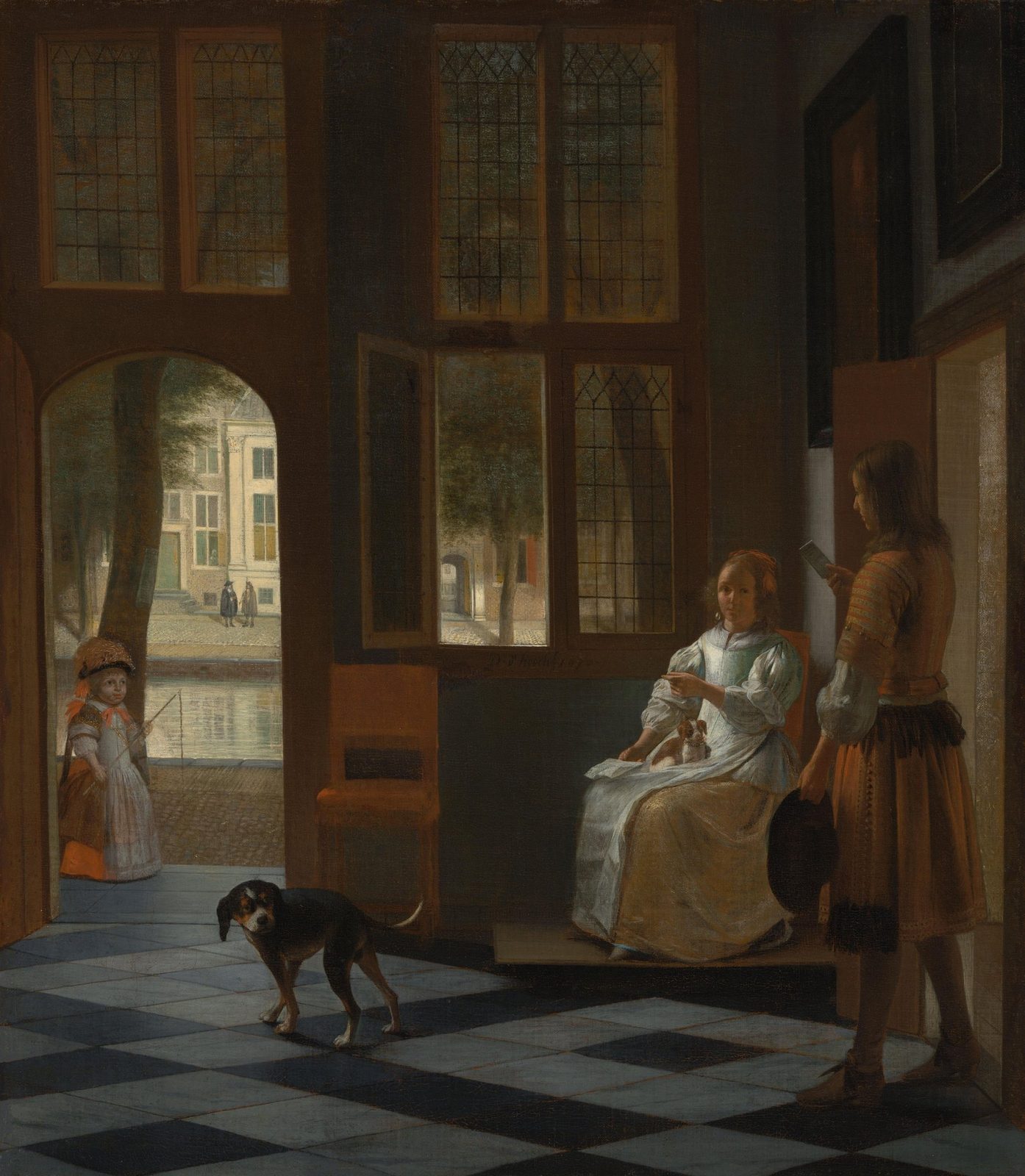
- Man Handing a Letter to a Woman in the Entrance Hall of a House
- Date
- 1670
- Medium
- oil on canvas
- Museum
- Rijksmuseum
- Image
- Public domain (CC0)
Open in Simple Art
Watch this story on iPhone and iPad, with offline downloads and a painting every day.
About 3 minutes of looking, in 9 parts.
Man Handing a Letter to a Woman
A woman in white sits by the window with a little dog in her lap, and a man leans in to hand her a letter. Behind them, the door stands wide open. Outside, a child plays in the sunshine. Two worlds share one picture.
1670, oil on canvas
This is Pieter de Hooch's Man Handing a Letter to a Woman in the Entrance Hall of a House, painted in oil on canvas and signed and dated 1670 below the window. The Rijksmuseum points out that every window and door of this canal house is open.
Inside right, outside left
The picture splits in two. On the right, the people gather around the letter. On the left, the open doorway shows the bright world outside. The museum describes how de Hooch leads our gaze from one to the other, and the diagonals of the tiled floor help pull us across.
Daylight on a white dress
Start where the daylight falls, on the woman. Her dress is brightest on the folds that face the window. Look into the hollows, though, and the shadows aren't simply darker white. They turn a cool blue-grey, with warmer ochre deep in the recesses.
The lapdog
In her lap sits a small dog with a white face and brown ears. Around it, the cloth is smooth and soft-edged. The dog's eyes and nose, by contrast, are crisp dark dots, so the tiny animal stays sharp against all that pale fabric.
Follow the dog
Now find the second dog, standing on the tiled floor near the door. It's black with tan on its muzzle, chest and legs, and its shadow stretches across the tiles to the right. Its body points the way out, and the museum invites us to follow it.
A child with a whip
Just beyond the doorway stands a child in a bonnet, with an orange-red bow at the neck. The museum describes the child as playing with a whip; here it's a single thin, broken line running down from the hand. The child is lit against the cooler greys behind.
The sunny street opposite
Look past the child, across the canal. The far buildings glow in pale cream and yellow, with a dark mass of trees above. Two small figures in dark coats stand in the sunlight, each throwing a short, soft shadow. The dark door frame makes that brightness seem even stronger.
Lead lines on glass
Back inside, look up at the tall windows. The glass is a muted field of greens, ochres and browns, and the lead lines are drawn over it in thin, dark strokes. They are careful, but not mechanical; their weight varies slightly, which keeps them looking hand-made.
Look closer
8 details, each checked against a close-up of the picture.
-
The lapdog
A small white and brown dog sits nestled in the woman's lap, looking towards the man.
The crop centers on a small lapdog with a white face and brown ears, cradled in the folds of a woman's pale gown. The dog's muzzle is built from short, blended strokes of warm cream and cool grey, with crisp dark dots forming the eyes and nose; the brown ears are rendered with looser, slightly broken brushwork that lets the ground tone peek through. The white fabric around the dog resolves into broader, smoother passages that turn from cool highlight to warm grey shadow in soft gradients, contrasting with the harder, more defined edges of the dog's features. A woman's hand hovers above with a softly modeled, slightly blunt fingertip, and a second hand at left edge emerges from shadow with cooler flesh tones. Fine craquelure runs across the entire surface, and the value key stays narrow in the mid-tones, with the deepest darks reserved for the dog's eye and the recesses between the drapery folds.
-
Sunlit street across the canal
Bright, pale yellow light falls on the buildings and trees seen through the open doorway.
The crop shows a view through a dark archway onto a sunlit street across a canal. The right-hand building reads as pale warm cream with greenish window casements, and the wall plane is built from soft, blended strokes of yellow-ochre and light grey that lose edges where shadow meets the tiled roof. Foliage at upper left is a dense mass of dark sap-green, painted with short, slightly broken touches that feather against the sky. Two small figures stand on a pale grey-beige ground, their dark coats anchoring the bright zone, while a child's head with an orange-red cap intrudes at lower left, its face lit from the right against the deep brown of the arch. The crackle pattern is visible across all light passages, indicating aged oil glazes over a slightly warmer ground.
-
Child in the archway
The child wears a bonnet and holds a thin stick or switch in their right hand.
The crop centers on a child in a doorway, framed by a dark vertical post on the left and a sunlit canal view to the right. The bonnet reads as a textured mass of warm browns with fine white flecks catching light along its top, contrasting with the smoothly modeled face. The white-grey dress is rendered with long vertical strokes that suggest folds, accented at the neck by a bright orange-red bow. A thin, broken diagonal line—the stick—runs from the figure's right hand down toward the lower left, painted in a warm mid-tone that nearly dissolves into the dark drapery. The background canal view is loosely brushed in cool greys and greens, pushing the figure forward through edge contrast rather than line.
-
Woman's white dress
The white fabric of the dress contains cool blue and grey shadows in the folds.
The crop captures the lower half of a seated woman, focusing on a voluminous white dress draped over her lap with a small brown-and-white spaniel nestled at her midsection. The fabric is rendered with smooth, blended brushwork showing clear value structure: brightest highlights (near-white) along the left-facing ridges, descending through mid-tone warm greys into cool blue-grey and deeper ochre-brown shadows in the recesses. Fold edges are soft and slightly lost where the cloth turns away from the light source on the left, while cast-shadow transitions remain gently graded rather than sharply demarcated. A fine craquelure network is consistent across the surface, and the warm underpainting seems to show through in the deepest folds.
-
Tile perspective
The diagonal lines of the black and white floor tiles converge toward a vanishing point on the right.
The crop shows the lower half of a dog (legs, belly, curled tail at upper right) standing on a checkered floor of dark and light tiles. The tile seams run as two sets of diagonals: one set slopes up to the right, the other recedes more steeply toward a vanishing point off the right edge, consistent with the claim. The dog's white-tipped paws and the cast shadow stretching to the right are clearly defined against the tiles. Fine craquelure covers the entire paint surface, and the light tile reads as a warm gray rather than pure white where it falls in shadow.
-
Leaded window panes
The lead cames of the windows are rendered as thin, precise dark lines over a muted background.
The crop isolates two tall, narrow leaded windows set in warm brown wooden frames. At the top of each window, the cames form pointed Gothic tracery with diamond/lozenge patterns, transitioning below into a regular rectangular grid. The glass behind reads as a muted, low-contrast field of grayish greens, dusty ochres, and warm umbers, with no crisp reflections or sharp highlights—light is filtered and diffuse. The lead lines themselves are thin, dark, and slightly irregular in weight, painted over the glass color rather than impressed into it. A network of fine craquelure crosses the entire surface, most visible against the mid-value glass tones.
-
The floor dog
A black and tan dog stands on a white tile, casting a soft shadow to the right.
A tricolor hound stands in profile on a tiled floor, rendered in oil with a warm dark background wall. The dog's black coat shows soft transitions into tan on the muzzle, chest, and lower legs, with a small white tail tip. A network of fine craquelure covers the whole crop, confirming aged oil on canvas. The tiles are laid in a perspectival grid running toward the right, with grout lines painted as thin cool-gray strokes. A cast shadow extends from the dog's belly and legs toward the lower right, indicating a strong light source from the upper left.
-
Distant figures
Two small, dark figures are visible standing on the sunlit street beyond the canal.
The crop shows two small standing figures rendered in dark tones against a pale cream-beige architectural background, with the right edge dominated by a vertical dark band that reads as an archway jamb. Visible craquelure runs across the entire surface in a network of fine dark lines, indicating aged oil paint. The left figure is rendered almost entirely in dark brown-black with a small hat silhouette and a pale hand/sleeve accent, while the right figure shows a brown coat, lighter face area, and dark hat, with both figures casting short, soft-edged shadows on the sunlit ground plane. Edges of the figures are loose and broken rather than crisp, and the ground is built up in a warm pale yellow-beige with subtle tonal variation rather than a flat wash.
Man Handing a Letter to a Woman in the Entrance Hall of a House in context
Light from behind
The Rijksmuseum notes that every window and door of this canal house stands open, and that De Hooch uses light and figures to lead the eye outside, past the dog and the child with a whip to the sunny far side of the canal [1]. The view also continues through the gate on the right [1]. The painting is signed and dated 'P. de hooch. f. 1670.' in the middle, below the window [1].
In its story on the artist, the museum calls the lighting bold. The scene is lit from behind, with sunshine outside and subdued light within [2]. It also points to the dull reflection of sunlight on the marble floor [2].
The museum's Dutch description identifies the canal outside, with a question mark, as the Kloveniersburgwal in Amsterdam [1]. That caution fits the museum's wider remark that De Hooch's interiors were carefully conceived in the studio rather than based on real rooms [2].
From Rotterdam to Delft
Pieter de Hooch was baptised in Rotterdam on 20 December 1629, the son of a master bricklayer and a midwife [3]. His only recorded teacher was the landscape painter Nicolaes Berchem. He studied with Berchem in Haarlem alongside Jacob Ochtervelt, and his earliest paintings are almost all barrack-room scenes [3].
He is first recorded in Delft on 5 August 1652, and in 1653 he was documented as painter and servant to the merchant Justus de la Grange, whose collection held eleven of his paintings by 1655 [3]. In 1654 he married Jannetje van der Burch of Delft, and in 1655 he joined the Delft painters' guild [3]. Wikipedia reports that he couldn't pay the admission fee of 12 guilders [4]. The National Gallery of Art in Washington judges his work between about 1655 and 1662, mostly calm interiors and courtyards with a few figures, to be his finest [3].
The Amsterdam years
Sometime between mid-1660 and April 1661 De Hooch settled in Amsterdam, and apart from a visit to Delft in 1663 he seems to have stayed there [3]. Burial records for two of his children in 1663 and 1665 place the family on the Regulierspad and the Engelspad, outside the old city walls in an area known for its poor inhabitants [4]. In 1668 he was living in the Konijnenstraat near the Lauriergracht, where he stayed for at least two years [4]. And by 1674 he was too poor to appear in the tax registers [4].
In Amsterdam he painted for wealthier patrons, and his interiors and their occupants became grander, with cooler colours and more precise handling [4]. The Rijksmuseum notes that he never became rich from his paintings, even though they inspired other artists, Vermeer among them [2]. The National Gallery of Art is less generous about this phase, writing that by the end of the 1660s his work had lost much of its delicacy, with grander compositions and harsher light and colour [3]. This canvas, dated 1670, comes from exactly that moment, which makes it a useful test of the judgement [1].
An uncertain end
It was long believed that De Hooch died in 1684 in the Amsterdam dolhuis, the city's asylum. But its records show that the Pieter de Hooch who died there was the artist's son of the same name [3]. The son's admission in 1679 is the last record of the painter in Amsterdam, and his own date of death is unknown [4]. His last dated painting, however, is from 1684 [3]. The Rijksmuseum's record for this work still gives his dates as 1629-1684 [1].
A banker's bequest
The painting is on loan to the Rijksmuseum from the City of Amsterdam, from the bequest of Adriaan van der Hoop [1]. Van der Hoop (1778-1854) was a banker whose collection included works by Vermeer, Ruisdael, Rembrandt and Jan Steen, and who left about 250 paintings to the city [5]. They were first shown in his former house on the Keizersgracht and joined the new Rijksmuseum in 1885 [5].
- Pieter de Hooch, Man Handing a Letter to a Woman in the Entrance Hall of a House (SK-C-147): object record, description and inscription . Rijksmuseum, Amsterdam
- Pieter de Hooch: an artist who transformed light and space into poetry . Rijksmuseum, Amsterdam
- Arthur K. Wheelock Jr., 'Pieter de Hooch', artist biography (Internet Archive copy, 30 April 2025) . National Gallery of Art, Washington
- Pieter de Hooch . Wikipedia
- Adriaan van der Hoop . Wikipedia