The wall behind Tehamana
Gauguin surrounds a Tahitian girl in a mission dress with borrowed signs and gods
- Artist
- Paul Gauguin
- Title
- Merahi metua no Tehamana (Tehamana Has Many Parents or The Ancestors of Tehamana)
- Date
- 1893
- Medium
- Oil on jute canvas
- Museum
- Art Institute of Chicago
- Image
- Public domain (CC0)
Open in Simple Art
Watch this story on iPhone and iPad, with offline downloads and a painting every day.
About 4 minutes of looking, in 9 parts.
Merahi metua no Tehamana
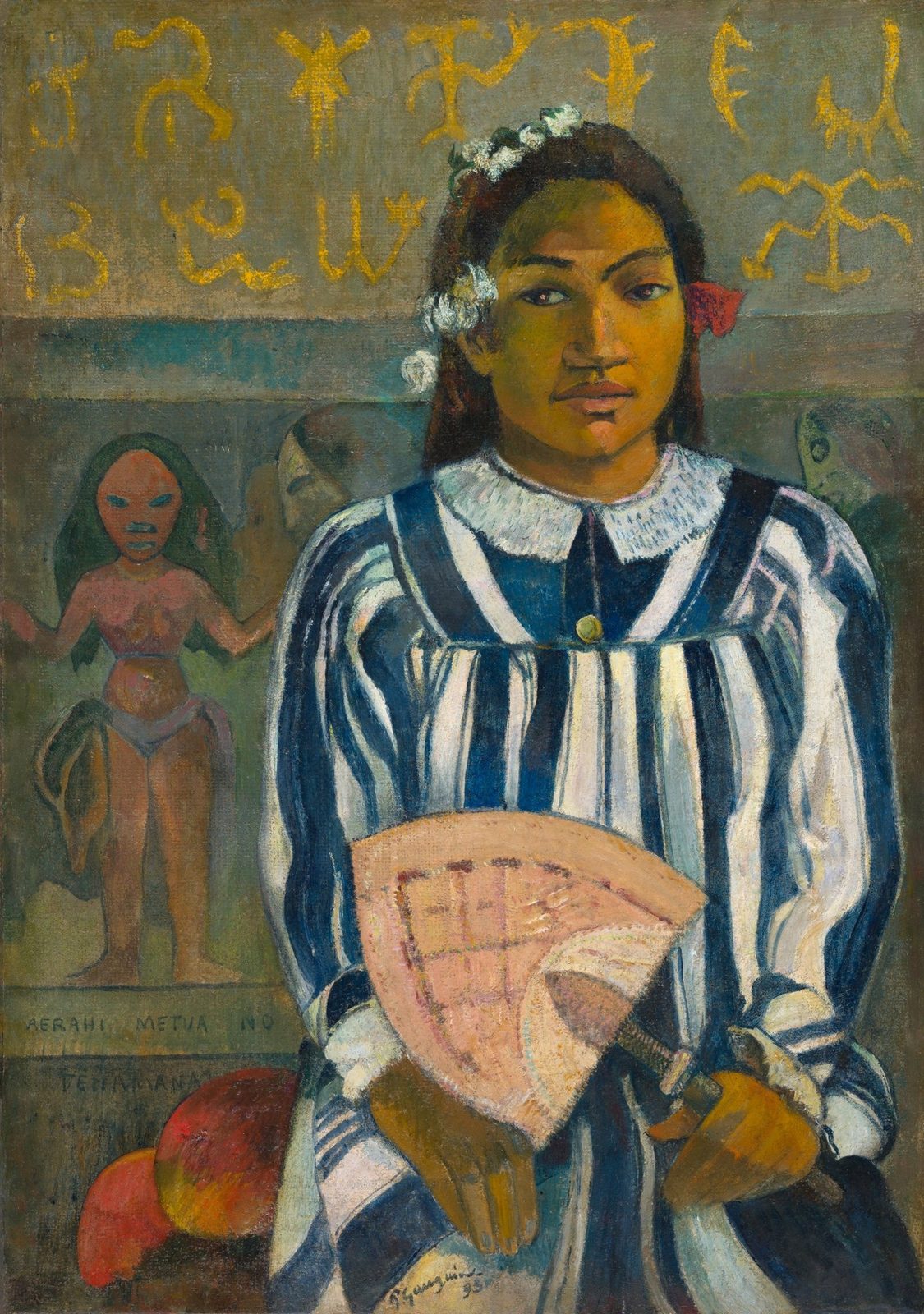
A young Tahitian girl faces us, shoulders square, in a long blue-and-white striped dress with a white collar. She holds a fan, and white flowers are tucked into her dark hair. Behind her, the wall is covered with golden signs and painted figures.
Gauguin, 1893, oil on jute
This is Paul Gauguin's Merahi metua no Tehamana, painted in 1893 in oil on jute canvas, and now in the Art Institute of Chicago. The museum identifies the sitter as Tehamana, a thirteen-year-old girl whom Gauguin took to live with him as his wife during his first stay in Tahiti. The title is translated as Tehamana Has Many Parents, or The Ancestors of Tehamana.
A wall in three bands
The museum's catalogue describes the wall behind her as three horizontal zones. At the top are two rows of golden signs. In the middle are painted figures. At the bottom is a ledge with two mangoes. She fills almost the full height of the canvas, a little right of centre.
Signs from Easter Island
Look up at the top band. These golden signs come from rongorongo, a script carved on wooden tablets from Easter Island, and the catalogue traces at least ten of them to a single tablet. Neither Gauguin nor the people he lived among could read them. He enlarged them and spaced them out, so each one seems to float.
Hina, and a head in profile
On the left stands a full-length figure the catalogue identifies as Hina, goddess of the moon, which Gauguin drew partly from Hindu and Buddhist sources. She is flat and boldly outlined, with almost no shading. Just beside her, a head in profile stands for a spirit of the dead.
Flowers in her hair
Now come to her head. White blossoms sit along the top of her dark hair and above one ear, laid on in thick, opaque dabs. On the other side is a single red flower, painted flatter. The museum describes her expression as stoic, her gaze unflinching.
The mission dress
Her long, high-collared dress is a missionary dress, the kind European missionaries encouraged Tahitian women to wear. Gauguin builds it from blue and white stripes of uneven width that bend as they follow her body. Drift up to the collar, a pale field of small white dabs that suggests lace without drawing a single thread.
A plaited fan
She holds a fan whose shape, the catalogue says, suggests the plaited fans of Samoa. Here it's a pale pink and cream shape crossed by a loose grid of darker lines. Infrared imaging shows that Gauguin drew its outline several times before settling where it should go.
Her name and two mangoes
At the lower left, Gauguin has painted the title in dark letters across the ledge. Below it sit two mangoes, red and golden orange, which the museum reads as an allusion to fertility. Their tops are firmly shaped, but the lower fruit seems to dissolve towards the bottom edge.
Look closer
9 details, each checked against a close-up of the picture.
-
Hibiscus and Hair Decoration
A small red flower and white blossoms are placed against dark hair with distinct, opaque brushstrokes.
The crop isolates the upper portion of a Polynesian woman's head. On the right side, a small red flower (hibiscus) is rendered with several flat, saturated carmine touches sitting against the dark mass of hair. On the left, a cluster of white blossoms is built from thick, opaque dabs of cool white and pale grey, with hints of green leaf tucked between them. The hair itself is laid in with broad, opaque strokes of near-black and deep brown, reading as almost silhouette-like against the warm ochre face. The face transitions from a yellow-green mid-tone on the lit planes to deeper olive shadows along the jaw and temple, with a soft but distinct contour where hair meets forehead.
-
Painted Figure of Hina
The full-length female figure painted on the wall has a dark outline and flat brown, pink and rust planes with minimal internal shading.
The crop centers on a frontal tiki figure rendered with a continuous dark contour that locks the silhouette against the muted olive-green background. The face reads as a single flat plane of warm rust-orange, with facial features reduced to two short blue-green dashes and a thin dark slash for the mouth — there is no modeled shading on the cheeks, nose, or chin. The torso and legs break into adjacent brown and ochre shapes that butt against one another rather than blending, giving the body an almost paneled appearance. To the right, a narrow vertical strip of the sitter's blue-and-white striped dress intrudes, its crisp diagonal stripes contrasting with the tiki's soft, blotchy passages of pigment. At the lower edge, pale ochre script reads 'AERAHU METUA NO' in a thin, slightly irregular hand.
-
Yellow Top Glyphs
The yellow characters are painted with thick, gestural strokes over a teal background.
The crop shows yellow calligraphic glyphs painted across the upper portion of a muted teal-grey ground. The yellow marks vary in saturation and value, ranging from a bright cadmium-like yellow on the more loaded passages to duller ochre where the stroke thins out or overlaps the cooler underlayer. Edges of the yellow shapes are soft and slightly feathered rather than crisp, with visible bristle marks and small voids showing the toned ground beneath. The teal background itself is uneven, showing warmer and cooler shifts along with subtle vertical weave texture. The lower right corner intrudes with the top of the sitter's dark hair, a dab of white floral paint, and a small red accent.
-
Striped Blouse Detail
The blue stripes are applied in vertical, slightly irregular bands of paint.
The crop isolates a section of blue-and-white vertical stripes painted over a curved body form, likely a torso or shoulder area. The blue stripes vary in saturation from deep navy to mid-cobalt, applied in bands of inconsistent width that bend and shift as they follow the underlying volume. White stripes between them are not pure white but carry warm cream, pale pink, and faint yellow tones, with edges that feather and bleed into the adjacent blue. The boundary between stripes is a soft, broken line where brush tips from neighboring passes intermix, rather than a crisp contour. A pale collar section appears in the upper right with similar striped patterning, and the canvas weave is visible through thinner passages.
-
Pink Paper Fan
The fan consists of pale pink and cream tones with a grid-like pattern of darker lines.
The fan occupies most of the frame as a broad, roughly pentagonal plane of pale peach, cream and salmon-pink pigment, traversed by a loose grid of dark reddish-brown vertical and horizontal strokes that suggest a paper lattice. Edges of the fan are softened rather than hard-cut: pigment is dragged outward with short, broken strokes that bleed into the surrounding blue-and-white vertical stripes, creating a feathered transition. Small dabs of yellow-green and pale blue sit atop the grid intersections, and the canvas weave reads through thinner passages near the upper edge. A white/grey shape intrudes at lower left, while saturated yellow-ochre brushstrokes anchor the lower right.
-
Mangoes and Text
Red and yellow-orange fruits are placed next to dark handwritten text on an olive-brown ground.
The crop centers on a horizontal olive-green band inscribed with the dark blue/black text 'MERAHI METUA NO', beneath which a darker brown ground carries a fainter second line of script reading 'TEHAMANA'. At the lower right sit two rounded fruits: the upper fruit is rendered in deep red with a yellow base, while the lower fruit glows in red-orange; both show directional strokes that model volume through warm-to-cool transitions. The background wall reads as a mottled olive-brown with visible weave of canvas and thin scumbled layers. A thin vertical strip of blue-and-white striped fabric intrudes at the upper right edge, painted with crisp alternating strokes.
-
Collar and Neckline
The white lace-like collar is defined by a series of small, dabbing white strokes.
The crop isolates the V-shaped lace collar and the upper bodice of a striped dress, with the sitter's jawline cropping off at the top edge. The collar sits as a roughly triangular cream-white field bounded above by a warm ochre-orange neck/chin plane and below by the dark V outline of the bodice neckline. The lace texture is constructed from clusters of small, short, dabbing white strokes arranged in loose rows, accented by faint pink-lavender dabs that read as decorative patterning rather than literal embroidery. A heavy dark navy-black contour runs the perimeter of the collar and bisects the bodice as the V edge, while the bodice itself is built from broad, flat blue and white vertical bands of similar width, each separated by a darker blue-to-black rule line. Visible canvas weave shows through thinner passages, especially in the lighter areas of the collar.
-
Jute Texture
The coarse weave of the burlap/jute support is visible through the paint layers.
The crop shows three horizontal bands of paint - a warm ochre-gold zone at the top with partial arcs of saturated yellow (likely the lower curves of the script letters), a middle band of deep teal, and a lower band of dusty brown-tan. Across all three bands a regular orthogonal weave pattern is clearly visible, with lighter horizontal ridges (weft) crossing darker vertical troughs (warp). The paint reads as a thin, semi-translucent film: pigment sits in the hollows of the burlap while the raised fibers catch more direct light, producing a stippled, almost hatched optical surface. No directional brushstroke dominates; the texture belongs to the support, not the stroke.
-
Artist Signature
The signature 'P. Gauguin' is written in a cursive script with a date '93'.
The crop isolates a dark cursive signature reading 'P Gauguin' followed by '93' (the date 1893), brushed in a deep blue-black pigment against a warm yellow-ochre ground. The lettering is fluid and slanted, with the initial 'P' and the 'G' of Gauguin formed as the most heavily inked, rounded loops. The surrounding ground shows visible canvas weave and a thin, uneven paint application, with patches of greenish-blue (verdigris-like) showing at the upper edges where a thicker layer of colour has been laid over the warmer ground. The signature sits on top of this ground, not within the main painted figure area, with crisp edges that have softened slightly from age-related sinking of the medium.
Merahi metua no Tehamana in context
A sitter known mostly from his own pages
The Art Institute of Chicago identifies the sitter as Tehamana, the girl Gauguin lived with as his vahine during his first stay in Tahiti, from 1891 to 1893 [1][2]. Its catalogue says that most of what is known about how they met comes from Noa Noa, his semi-fictional account of that stay [2]. In the first draft he wrote that he met her in the village of Faone, about twenty-two miles from his home at Mataiea. After talking with members of her family, he was allowed to take her back with him. In later drafts he renamed her Tehura [2].
This is the only work Gauguin inscribed with her name, the catalogue adds. He never named her in his letters, and no surviving photograph can be firmly identified as her [2]. In 2019 the art historian Elizabeth Childs went further. She suggested that the Tehamana of Gauguin's writing may partly be an amalgam of several women. Linda Goddard described the earlier research identifying her as hints rather than conclusive evidence [3].
Thirteen, by his account
The museum's label gives her age as thirteen, and the catalogue calls her the thirteen-year-old [1][2]. That figure comes mainly from Gauguin himself, who called her a child of about thirteen in Noa Noa. The Art Newspaper notes that he was 43 at the time [3]. It also reports that marriage at that age was not unusual in Tahiti then, and that thirteen was the age of consent under French law, which governed the island. Gauguin, however, was still legally married to his Danish wife, Mette Gad, and probably never told Tehamana [3].
In a letter to his friend Daniel de Monfreid, Gauguin wrote that he would soon be a father again in Oceania. Scholars have dated the letter variously, and it is unclear whether it refers to Tehamana or whether a child was born [2][3].
How museums now frame it
The Art Institute's own label says that the borrowed emblems around her build a generic sense of foreignness and mystery, "transforming Tehamana into the embodiment of his own desire" [1]. The catalogue observes that although the missionary dress was meant to cover the body, Gauguin made its stripes trace the curves of her figure [2].
The painting was the lead image for the exhibition Gauguin Portraits, shown in Ottawa and then at the National Gallery in London in 2019 [3][4]. Artnet News reported that one London wall text said Gauguin had undoubtedly exploited his privileged position as a Westerner. The outlet also reported that the National Gallery of Canada edited texts during the Ottawa showing to be clearer about the power dynamics involved [4]. The same article judged one caption euphemistic, adding that the text in a later room reverted to type [4].
Two readings of the title
Gauguin painted the title at the lower left [2]. The Swedish anthropologist Bengt Danielsson argued that the direct translation is Tehamana Has Many Parents [2][3]. In Polynesian families children often had foster parents as well as birth parents, and in Noa Noa Gauguin describes having to win over both her birth mother and her foster mother [2]. The other reading, The Ancestors of Tehamana, comes from the French title Les aïeux de Tehamana, used when the picture was shown at the Durand-Ruel gallery in Paris in 1893 [2]. That November exhibition was largely organised by Degas and met with mixed reviews [5].
Changes under the surface
X-rays and infrared images show that Gauguin first gave her hair falling down the front of her dress, along with two large discs that look like earrings. He abandoned these discs at the underpainting stage and covered them with hair [2]. The catalogue connects them, cautiously, to an episode in Noa Noa where Tehura insists that he buy her a pair of earrings [2]. The canvas is coarse jute that Gauguin primed himself. At some point, probably on its arrival in France, it was folded onto a smaller standard stretcher and later returned to its original size. A restorer also once turned the first letter of Merahi from an M into an A [2].
From the Drouot sale to Chicago
The painting was offered at Gauguin's sale at the Hôtel Drouot in Paris on 18 February 1895, as lot 32. It was bought in for 300 francs [1]. Gauguin then gave it to Daniel de Monfreid [1]. Degas bought two pictures at the same sale, one of them Vahine no te vi (Woman with a Mango) [5]. The Art Institute's catalogue says that this painting too may show Tehamana [2].
Monfreid's family sold the portrait to Jacques Seligmann in 1937. It belonged to Stephen C. Clark in New York by 1938, and to Mr. and Mrs. Chauncey McCormick of Chicago by 1955 [1]. The painting then passed by descent to Charles Deering McCormick, who lent it to the Art Institute in 1970. He and his wife gave it to the museum in 1980 [1].
- Paul Gauguin, Merahi metua no Tehamana (Tehamana Has Many Parents or The Ancestors of Tehamana), 1980.613: object record, label text and provenance . Art Institute of Chicago (public API)
- Cat. 50, Merahi metua no Tehamana: catalogue entry by Richard R. Brettell and Genevieve Westerby, with technical report, in Gauguin Paintings, Sculpture, and Graphic Works at the Art Institute of Chicago . Art Institute of Chicago (public API)
- Martin Bailey, Gauguin's Tahitian lover may be more fantasy than reality (7 October 2019) . The Art Newspaper
- Javier Pes, How curators are addressing Gauguin's dark side in a new show at the National Gallery in London (10 October 2019) (Internet Archive copy, 22 November 2025) . Artnet News
- Paul Gauguin . Wikipedia