Moulin de la Galette — A Toulouse-Lautrec Walkthrough
Reading an 1889 oil sketch of the dance hall, from the foreground bowl to the receding crowd.
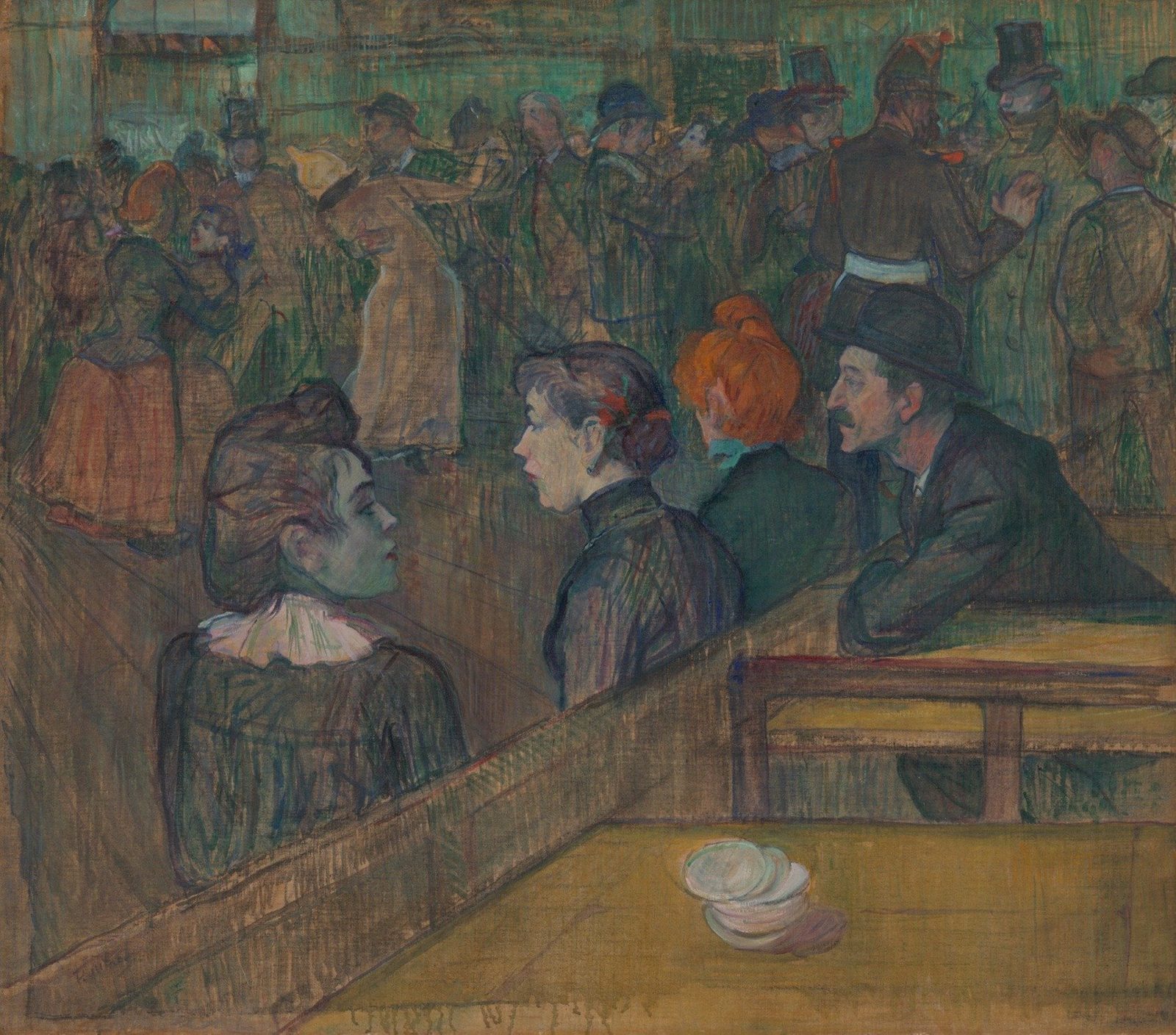
- Artist
- Henri de Toulouse-Lautrec
- Title
- Moulin de la Galette
- Date
- 1889
- Medium
- Oil on canvas
- Museum
- Art Institute of Chicago
- Image
- Public domain (CC0)
Open in Simple Art
Watch this story on iPhone and iPad, with offline downloads and a painting every day.
About 4 minutes of looking, in 10 parts.
A crowded room, a quiet eye
Painters, look at this. The room looks packed and noisy, but Toulouse-Lautrec has turned the chaos into something almost still — a quiet two-figure conversation sitting inside a swirl of green murk. Your eye finds the white collar first, and then it settles.
An 1889 oil sketch
This is an oil on canvas dated 1889, and it reads immediately as a study rather than a finish — the paint is thin, the ground shows through everywhere, and the edges stay soft. Toulouse-Lautrec was working alla prima, capturing the feel of the dance hall before the lamps cooled.
Two horizontal bands
Find the two long horizontals. The wooden railing sits a little below the eye line, and the foreground table sits near the bottom edge. Together they stack the picture into a quiet foreground, a populated midground, and a busy crowd above, with the two figure clusters flanking the center.
Dim and diffuse
The light is ambient and gas-lamp dim — no hard cast shadows, no clean modeling. Almost the entire value range sits in the darks and mid-tones; the only real brightness is held in two tiny accents, the seated woman's white collar at the left, and the small white bowl below.
Orange against teal
Drift with me up to the standing woman's hair at right. Saturated orange-red scumbled against a teal-green field — that complementary clash is the painting's whole color scheme compressed into one head. The cool background pushes her forward, the warm hair supplies the focal heat, and the irregular wet edge becomes the silhouette.
A face in three lines
Back down to the seated woman at left. Her face is built from a few thin dark contour strokes — eyelid, nose ridge, lips — laid over a cool pale wash. The shadows aren't mixed darker at all; they're simply the warm ground showing through, and her jawline just dissolves into the browns behind her.
The bowl as anchor
Now drop to the small white bowl on the table. It's not outlined — it's three or four broken concentric arcs in slightly different temperatures, with a soft grey-violet cast shadow that feathers out to the right. The temperature shifts alone are enough to tell your eye the curve.
Diagonal hatches
Push in on the standing man's dark jacket. The strokes all run diagonally from upper-left to lower-right, and the warm ochre ground is left deliberately exposed between them. The shadow side isn't painted with a darker mix — it's the underlayer doing the work, which keeps the paint thin and the gesture readable.
A rail in strokes
Follow the wooden railing across the middle. It's not a solid bar — it's a handful of loose parallel brown strokes, with one thin red-burgundy accent line riding the top edge. That single accent is enough to crisp the silhouette without redrawing it.
The crowd dissolves
Above the rail, the spectators recede. A scumbled wash of muted greens in mostly vertical drags, the occasional pale dab for a face, a dark comma for a hat. No contours drawn around the figures — they read as one mass because the ground tone unifies them and the foreground figures stay sharper by contrast.
Look closer
6 details, each checked against a close-up of the picture.
-
Foreground Figure
The seated woman's face is rendered with minimalist dark lines for eyes and mouth against a pale wash.
The crop isolates a seated woman in right-facing profile, framed against a murky brown-green background of vertical hatched strokes. Her face is built from a cool, pale grey-green wash with a faint pink-violet touch at the cheek, and the features—eyelid, brow, nose ridge, lips—are indicated by a few thin dark contour lines rather than modeled with shading. The white collar is a rapid fan of pale pink, blue, and green strokes, while her dark dress and hair are defined primarily by the negative space of the dark ground showing through, with loose vertical hatching reinforcing the silhouette. Edges throughout are soft and broken; the jawline, ear, and collar dissolve into the surrounding browns rather than terminating crisply.
-
Stack of White Saucers
The stacked saucers consist of simple concentric white curves with a soft grey shadow beneath it.
The crop centers on a small stack of white saucers resting on a warm ochre tabletop. The stack is constructed from loose, broken concentric arcs of cream and pale blue-white paint, with the rim and inner curve traced in soft pinkish-lavender tones suggesting interior contents. A diffuse grey-violet cast shadow stretches to the right of the stack's base, blending into the surrounding ground rather than terminating in a hard edge. The table is built from horizontal, slightly wobbly strokes of golden-raw-umber and burnt sienna, with darker grain lines drawn beneath and to the right of the saucers.
-
Auburn Hair
The woman's hair is a saturated orange-red that contrasts with the teal-green background.
The crop is dominated by a mass of loose, scumbled orange-red strokes building up a hair shape that occupies most of the frame. Brushwork is gestural and unblended, with individual strokes still readable: long vertical/diagonal drags define the sweep of the hair, while shorter dabs at the top suggest the bun or top-knot. The hair sits against a teal-green field laid in with broad horizontal and diagonal swipes, and the two color families meet at a soft, irregular edge with no hard outline separating them. A sliver of pale flesh tone (a cheek/jaw profile) appears at lower-left, and a muted blue-grey smudge below suggests a shoulder or garment.
-
Sketchy Clothing
The man's black jacket is composed of rapid, diagonal dark strokes leaving the ground visible.
The crop isolates a sweeping fold of dark green-black fabric, painted over a warm ochre ground that remains visible between and beneath the strokes. Diagonal marks run consistently from upper-left to lower-right, describing the drape of the sleeve or coat with long, loosely broken passages rather than a continuous silhouette. The lower edge dissolves into the warmer brown floor/table plane through short, agitated strokes of dark green, sienna and a thin red accent along the very bottom. Highlights are not modeled with lighter pigment but are produced by negative space where the underlying ground is left untouched.
-
Crowd Depth
Figures in the distance are rendered as blurred shapes in shades of green and grey.
The crop is dominated by a dense crowd of spectators rendered as loosely brushed vertical and slightly curved strokes in muted greens, grey-greens, and olive tones. Distant heads are reduced to oval smudges with only the slightest indications of facial features—a pale dab for a face, a dark comma for a hat. A dark green-grey wooden railing runs as a slightly darker horizontal band across the middle, with faint vertical post marks. In the lower foreground, more resolved figures (a woman with dark hair and white collar, a red-haired woman, and a man in a black bowler hat) sit against this unresolved background, their edges sharper and values higher in contrast. The background edges are soft, broken, and blend into one another with no clear contour lines.
-
Wooden Railing
The railing is defined by a series of loose, parallel brown lines rather than solid edges.
The crop centers on a horizontal wooden railing formed by loose, parallel brown and umber strokes rather than a single solid edge. A thin, broken red-burgundy line rides along the top of the rail, functioning as a chromatic accent that lifts the form from the muted ground. Below and behind the rail, dense vertical hatching in olive and dark green reads as the heads and shoulders of a packed crowd of spectators. To the upper left, broader blue and dark teal passages with reddish striations suggest drapery or shadowed interior architecture. The paint is thin enough that the warm tan ground and canvas weave remain visible through the strokes.
Moulin de la Galette in context
A mill that became a dance hall
The Moulin de la Galette began as a windmill near the top of Montmartre, built in 1622 [3]. In the nineteenth century the Debray family, who owned and worked the mill, made a brown bread galette that became popular enough to give its name to the mill and to the businesses around it, including an open-air dance hall and a restaurant [3]. Wikipedia describes the place as a diversion for Parisians in search of entertainment, a glass of wine and bread made from the mill's own flour [3].
Pierre-Auguste Renoir had painted the same dance hall in 1876, showing what Wikipedia calls a typical Sunday afternoon, when working-class Parisians dressed up to dance, drink and eat galettes into the evening [4]. Renoir's picture, now in the Musée d'Orsay, is known for its flickering, sun-dappled light [4]. The Art Institute lists a 2026 exhibition catalogue, Renoir and Love, that reproduces Toulouse-Lautrec's canvas as figure 12 [1].
How the museum has read it
An earlier Art Institute label, preserved in a 2017 web archive copy, called Toulouse-Lautrec the painter-chronicler of the entertainments of Montmartre. It read the barrier as a metaphorical divide [2]. The label described the foreground figures as bored and waiting women, accompanied by a proprietary male, and noted the dinginess of the subject [2]. Today's text keeps the divided composition but speaks of the tawdry atmosphere of the place instead [1].
That reading has a modern exhibition history. The painting appeared in Splendour and Misery, the 2015 to 2016 exhibition on images of prostitution in France from 1850 to 1910, organised by the Musée d'Orsay and the Van Gogh Museum [1]. But the museum's records do not identify the women, so who they were remains open [1].
First showings, shifting titles
Toulouse-Lautrec sent the picture to the Exposition des Indépendants in Paris in 1889, where it hung as catalogue number 257 [1]. It then travelled to the Salon des XX in Brussels in 1890, followed by the Salon des Arts Libéraux in 1891 and the Galerie Goupil in 1893 [1]. Wikipedia notes that he took part in the Indépendants regularly from 1889 to 1894 [7].
The title has not been fixed. A 1902 Durand-Ruel show listed it as Le Bal du Moulin de la Galette, the 1914 Manzi-Joyant retrospective as Au Moulin de la Galette, and Chicago catalogues of the early 1930s as A Dance at the Moulin de la Galette [1]. The Museum of Modern Art's 1956 catalogue dated it 1888, whereas the Art Institute dates it 1889 [1]. It is signed lower left HT Lautrec and is number P. 335 in M. G. Dortu's catalogue raisonné [1].
From Paris collections to Chicago
The museum's provenance begins with Joseph Albert, then a Mme Montandon in Paris by February 1890, then the collector Paul Gallimard [1]. Gallimard, who owned the Théâtre des Variétés and other Paris theatres, collected old masters alongside modern artists including Toulouse-Lautrec [6]. The dealer Paul Rosenberg had the painting by 1924, when it appeared in a Toulouse-Lautrec exhibition at the Arts Club in Chicago [1].
It then passed to Annie Swan Coburn. She began collecting after the death of her husband, Lewis Larned Coburn, in 1910 and kept her pictures in her apartment at the Blackstone Hotel [5]. She died in 1932, leaving the Art Institute more than one hundred works [5]. The museum exhibited her collection in 1932, and this canvas formally entered the Art Institute by bequest in 1933 [1].
- Henri de Toulouse-Lautrec, Moulin de la Galette (1933.458): object record, provenance, exhibition and publication history . Art Institute of Chicago (public API)
- Moulin de la Galette: earlier permanent collection label (archived 16 March 2017) . Art Institute of Chicago, via Internet Archive
- Moulin de la Galette . Wikipedia
- Bal du moulin de la Galette . Wikipedia
- Annie Swan Coburn . Wikipedia
- Paul Gallimard . Wikipedia
- Henri de Toulouse-Lautrec . Wikipedia