No te aha oe riri — Why Are You Angry?
A guided look at Paul Gauguin's 1896 Tahitian canvas
- Artist
- Paul Gauguin
- Title
- No te aha oe riri (Why Are You Angry?)
- Date
- 1896
- Medium
- Oil on jute canvas
- Museum
- Art Institute of Chicago
- Image
- Public domain (CC0)
Open in Simple Art
Watch this story on iPhone and iPad, with offline downloads and a painting every day.
About 6 minutes of looking, in 13 parts.
A silent question frozen on canvas
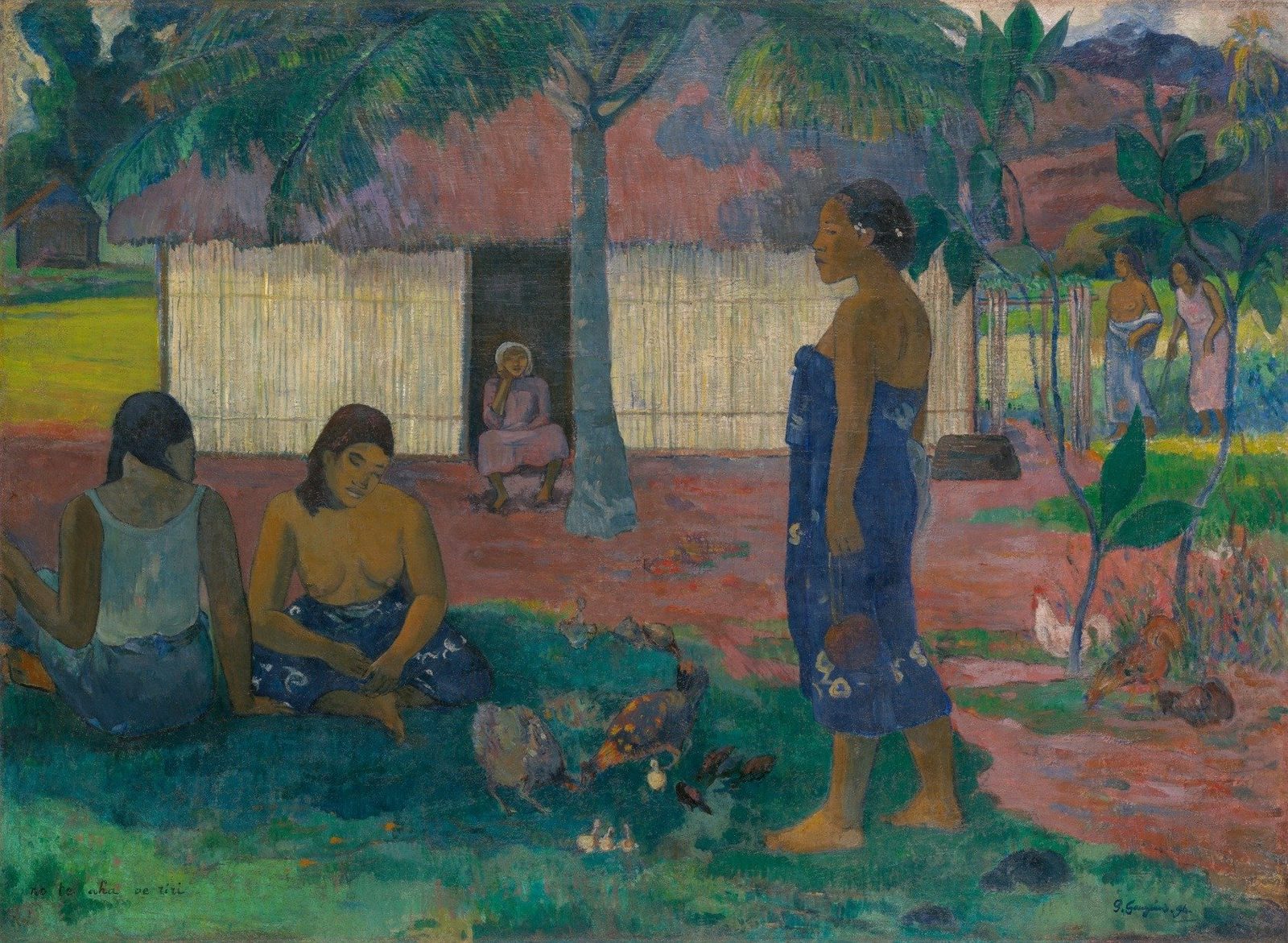
We're standing before Paul Gauguin's 1896 painting 'No te aha oe riri — Why Are You Angry?' Five Tahitian women cluster around a central palm tree in a tropical village, and the title itself is already being asked. A woman in deep blue stands in profile with a downturned mouth, addressing the seated group on the left — a confrontation staged entirely in color blocks.
Gauguin's 1896 Tahitian canvas
This is an oil on jute canvas from Gauguin's second Tahitian period, and the coarse weave even flickers through the thinner passages. The handling is Post-Impressionist with cloisonnist-influenced flat color areas — broad, visible brushwork where shape is blocked in as adjacent color fields and edges are set by juxtaposed values rather than smooth gradients.
A central palm anchors the scene
Zoom out to take in the whole structure. Gauguin builds the composition on a strong central vertical — that palm trunk — with a low horizontal mass of seated figures on the left balanced against the tall standing woman slightly right of center. A small seated witness punctuates the mid-upper register in the doorway, completing the frieze.
Diffuse tropical light from above
Now look at the light. Diffuse overhead tropical light favors the upper left, but there are no hard cast shadows anywhere — just a warm bounce off the red earth lifting the undersides of the figures. The value range is compressed: no deep blacks, only modest highlights, and a flat even daylight softened by the open-air canopy.
A warm/cool complementary split
And the color is the engine. The scheme is a complementary warm/cool split: rose-red ground against the saturated ultramarine of the standing woman's dress, with green foliage and ochre hut walls in between. Warm-dominant overall, with those cool blue passages acting as accents that pull the focal figure forward off the page.
Seated women at lower-left
Drift down into the seated group at lower-left. The woman on the far left is turned partly away from us in a sleeveless light-blue tank top — those loaded, opaque white dabs on her shoulder read as direct light hits and push the highlight forward against the cooler blue. The central seated woman is bare-chested, her lap covered by a deep blue cloth patterned with small white curvilinear marks.
The doorway witness in pink
Up to the doorway at center. A figure sits frontally in pink-mauve, framed by two thin blue-green jambs and cut against a near-black interior. Gauguin reserves his darkest dark for this single confined zone — and it's that surrounding low-value field that makes her pink dress read as luminous, not any added brightness in the pigment itself.
Red ground with pecking chickens
Down now to the ground at the figures' feet. The earth is not naturalistic brown — it's a warm rose-red band, scumbled with green and yellow-ochre horizontal streaks so the grass peeks through in broken patches. Chickens peck across the field; notice the cream egg shapes and the orange-ochre flecks on the central hen's body, those small bright notes leading your eye.
The blue dress as a flat block
And now the focal point — the standing woman in blue. It's one almost unbroken field of saturated ultramarine, broken only by pale-blue and white decorative motifs and that darker indigo pouch at her hip. Notice the modeling isn't done by internal shading on the cloth; it's done by the silhouette itself, locked in by the contour running from her crown down to her bodice.
The mouth that carries the question
Move up to her face. The profile shows a thin, downward-curving mouth — set just inside the silhouette beneath the nose as a small darker value shift, not drawn as an outline. That single stroke carries the entire narrative. Look also at the white blossom in her dark hair and the cooler shadow along her jaw separating face from neck.
Background figures against green
Across to the two background figures on the right, standing against dense tropical foliage. They wear pale blue and soft pink, and notice how their silhouettes are defined by color contrast alone — cool blue garment against warm green, pink form against cooler leaf tones. No drawn outline, just abrupt value steps. Compared to the foreground figures, they're rendered as simpler vertical color blocks.
The palm trunk's vertical streaks
Glide up that palm tree trunk. Gauguin laid a warm reddish-pink underlayer first, then dragged cool blue and grey strokes vertically down it with a flat or filbert brush. The warm base flickers through the cool surface, and that optical vibration does the cylindrical modeling for you — the light side catches paler strokes, the shadow side holds deeper blue-greys.
Feathered fronds overhead
Up into the palm fronds at upper-left. Each leaflet is built from parallel, slightly broken dashes of green that taper toward the tip — a two-pass feather: cool dark green first in the direction of the leaf, then shorter warmer yellow-green dashes over it, with the dark showing through in the recesses instead of being blended on the palette.
Look closer
10 details, each checked against a close-up of the picture.
-
Standing woman in blue
The deep blue dress is composed of flat color planes with minimal internal shading.
The crop isolates a woman in strict left-facing profile against a partly cropped background. Her silhouette is locked by a single dark contour that runs from the crown, down the nose, lips, chin, throat, and along the front of the bodice; the back edge of the figure is read as a softer meeting of flesh tones against the warmer wall behind. The deep ultramarine dress reads almost as one flat block, broken only by small pale-blue and white motif shapes and a round reddish-brown bag hanging on cords from her hand at the hip. Skin and ground are built from large, unblended planes of warm brown, salmon, green, and rose; brushstrokes are short, broad, and laid side-by-side rather than feathered, and a faint grid of craquelure crosses the entire surface.
-
Standing woman's profile
The mouth is rendered as a thin, downward-curving line in profile.
The crop isolates a standing woman's head, neck, and upper shoulder in left-facing profile against a muted greenish-blue and cream background. Her skin is built from warm umber and ochre masses, with a cooler shadow along the jaw and the underside of the chin separating face from neck. A single white blossom sits in the dark hair mass above the brow. The mouth reads as a small, narrow, slightly downward-tilting slash where the profile silhouette turns inward beneath the nose, with no interior red or lip modeling—only a tonal interruption along the contour. Edges are softened by adjacent brushstrokes rather than hard lines, and the cheek-to-background transition is handled by letting the dark hair mass and shoulder carry the silhouette while the forehead, nose bridge, and chin catch lighter cream values.
-
Seated women on left
The figure on the far left wears a light blue tank top with visible white highlights on the shoulder.
The far-left figure is shown from behind/side, wearing a sleeveless light-blue tank top; bright opaque white dabs sit on the upper shoulder, reading as direct light hits. The tank top's lower body is built from cooler, slightly greenish blues with a few pale-blue vertical streaks suggesting fabric folds. A hard contour separates her shoulder from the warm reddish background, while the inner arm edge against the central figure is softer. The central seated woman is bare-chested with a warm ochre body, her lap covered by a deep blue cloth patterned with small white curvilinear marks; her head is silhouetted against the lighter wall behind.
-
Doorway witness
The figure is seated in a pink garment, framed by the vertical edges of the doorway.
The figure sits frontally within a dark interior, framed by two vertical edge zones: a thin blue-green jamb on the right and a similarly toned vertical strip on the left. The pink-mauve dress is rendered with broad, flat-ish areas of color, broken by cooler violet and rose variations that suggest folds without hard contour. The white head wrap is a single near-white shape with a slight grey-violet undertone where it meets the hair, and it sits as a high-value accent against the near-black background. The reddish ground at the bottom is laid in with loose, scumbled strokes of orange, rose, and ochre, the lower edge of the dress melting into it with a soft, broken edge rather than a crisp hemline.
-
Palm tree trunk
The trunk is painted with vertical streaks of blue and grey over a warm base color.
The crop isolates a tall, slightly waisted palm tree trunk rendered with predominantly vertical brushwork. A warm reddish-pink ground tone reads through underneath, while cooler blue and blue-grey strokes are dragged lengthwise down the trunk to model its cylindrical volume. Lighter, paler strokes cluster along the centre-left, suggesting diffuse light raking across the curved surface, and deeper blue-greys sit in scattered vertical channels and along the right-hand edge. Edges against the pink wall on the left and the yellowish wall on the right are softly held, with some dry-brush feathering rather than crisp contour lines. Canvas weave shows through several thinner passages.
-
Red ground and chickens
The reddish-pink ground contains patches of green and yellow-brown brushstrokes.
The crop is dominated by a teal-green field (lower ~60% of frame) overlaid on a reddish-pink ground band visible across the upper third. Five to six chicken-like forms are scattered: a large dark bird with orange-ochre flecks at center-right, a paler gray-buff bird at center-left, smaller dark fowl at right, and a small bird at top center. Small cream/pale chicks sit low in the green zone. The red ground band shows long horizontal strokes interrupted by green and yellow-ochre streaks where grass/weeds are implied. Edges are soft and brushed, not crisp; bird bodies are blocked in with dark, broken outlines that bleed into the green ground. Left edge holds a deep blue-black mass (figure/clothing), right edge a cobalt vertical (door frame or figure).
-
Hut wall boundary
The cream-colored hut wall is separated from the red ground by a sharp, unblended horizontal edge.
The crop shows a roughly horizontal band where a pale cream-beige wall meets a deep red-brown ground at a clear, unblended step. Vertical brushstrokes in the cream area read as a thatched or woven wall surface, while the red ground below carries slightly scumbled, warmer-pink highlights. Two dark brown figural masses interrupt the band, and a rose-pink seated figure anchors the right side, sitting on the same red plane.
-
Background figures
Two figures are depicted in pale blue and pink garments against a green foliage background.
The crop isolates two standing figures against dense tropical foliage. The left figure wears a pale, slightly desaturated blue wrap gathered at the waist, rendered as a broad vertical block of cool color. The right figure wears a soft pink garment that reads warmer and slightly lighter in value, its hem falling against a vertical blue-green plant stem. The background is built from layered greens—olive, sap, and deeper forest tones—applied with visible directional strokes that suggest leaves without describing them. Foliage edges where they meet the figures are defined by abrupt color contrast rather than drawn contours, giving the silhouettes a cut-out quality typical of cloisonnisme.
-
Palm fronds upper left
The leaves are rendered as long, sweeping strokes of varying shades of green.
Long, curving strokes fan outward from a central stem that descends through the middle of the crop, forming the rib of the main frond. Each leaflet is built from parallel, slightly broken dashes of green that taper toward the tip, with darker blue-green passages suggesting depth between the leaf segments. The edges between adjacent fronds are not hard outlines but zones where one stroke family stops and another begins, with occasional short cross-strokes bridging them. A reddish-brown thatched plane sits behind and below the foliage, set off by cooler violet-pink transitional strokes rather than a clean contour. Vertical pale strokes at the bottom read as a slatted fence, while a sliver of pale sky in the upper left is left largely bare.
-
Artist signature
The signature 'P. Gauguin' is visible in the bottom right corner in dark paint.
The crop is dominated by vertical, streaky brushwork in a narrow band of greens ranging from warm yellow-green to cool teal. Two darker, more saturated green strokes sit slightly left of center and appear to form a short descending mark followed by a curved tail, consistent with a partial handwritten signature rather than a printed label. The vertical striations are the result of long, loaded drags of a bristle brush, with soft inter-color blending where adjacent strokes meet. No hard edges separate the signature marks from the surrounding field; they read as a value-and-saturation shift within a continuous green ground.
No te aha oe riri (Why Are You Angry?) in context
One of six for Monfreid
In February 1897 Gauguin wrote to his friend the painter Georges-Daniel de Monfreid that a shipment of paintings would soon arrive. He listed six by name, including 'Note aha oe riri. Pourquoi es-tu fâchée?' [2]. The Art Institute's catalogue groups it with six similarly sized figure compositions he finished between the summer of 1896 and March 1897 [2].
These were his largest canvases since 1881. The catalogue views them as experiments in an epic scale, close to painted wall decoration, that led to Where Do We Come From? What Are We? Where Are We Going? of 1897-98 [2]. One of them, Nave nave mahana (Delicious Day), has the same dimensions, and several scholars have suggested the two were a pair [2]. Warm reds and oranges dominate that picture, while cool colours run through this one [2].
A reworking of The Large Tree
The composition goes back to Gauguin's first stay in Tahiti. The catalogue calls it an enlargement and reworking of Te raau rahi (The Large Tree) of 1891, itself a reworking of Te fare Maorie of the same year [2]. The Cleveland Museum of Art, which owns The Large Tree, describes it as among the first paintings he finished on the island, on a canvas of about 74 by 93 centimetres [3].
It is not known whether Gauguin had the earlier picture with him during his second stay; the catalogue suggests he may have used a photograph or worked from memory [2]. He kept the hut with its central door, the striding woman and the two seated women, but dropped the mango and breadfruit trees for a single palm and added distant mountains [2]. A sketchbook drawing even notes the colour he planned for the roof, 'violet/purple' [2].
Seurat, Loti and a question
The catalogue reads the picture partly as a contest with Georges Seurat's A Sunday on La Grande Jatte. That painting had overshadowed Gauguin at the last Impressionist exhibition in 1886, and he found it cool and theoretical [2]. In its reading, Seurat's dogs become hens and a rooster, and the child in white who looks out at the viewer becomes the woman in the doorway [2].
For the title, the catalogue offers one possible source in Pierre Loti's novel Le mariage de Loti of 1878, where the Tahitian girl Rarahu is deserted and grows angry [2]. It notes that Gauguin too had left his Tahitian companion when he returned to France in 1893, while stressing that the scene allows many readings [2].
Jute, chalk-like ground and wax
Gauguin stretched the jute on a non-standard stretcher, sized it with glue and starch, and laid on a ground of zinc white and barium sulfate. He worked dried chips back into it for texture [2]. He drew first in what appears to be charcoal, then in dark blue paint [2]. An overturned basket by the hut was first painted with a broken rim and later mended [2].
The picture was probably left unvarnished at first. A natural-resin varnish was removed in 1966 and a later synthetic one in 1997 [2]. A coating of beeswax on the surface is probably original, as on other Gauguin paintings [2].
From Madame Chausson to Chicago
The first known owner was Mme Ernest Chausson of Paris, who had it by 1904. The name Chausson is written in blue crayon and pencil on the stretcher [1][2]. That year it was shown at La Libre Esthétique in Brussels [1]. How it passed from Gauguin's shipment to her isn't documented in the sources consulted here.
Durand-Ruel showed it in New York in February 1923 and sold it to Martin A. Ryerson of Chicago on 20 February 1925 [1]. Ryerson died in 1932, and the painting came to the Art Institute by his bequest in 1933 [1].
- Paul Gauguin, No te aha oe riri (Why Are You Angry?) (1933.1119): collection record with provenance and exhibition history (public API) . Art Institute of Chicago
- Richard R. Brettell and Genevieve Westerby, 'Cat. 90, No te aha oe riri (Why Are You Angry?), 1896', with technical report, in Gauguin Paintings, Sculpture, and Graphic Works at the Art Institute of Chicago (public API) . Art Institute of Chicago
- Paul Gauguin, The Large Tree (1975.263): collection record (open access API) . Cleveland Museum of Art