Seurat's Oil Sketch for La Grande Jatte
Reading the working proof behind the finished canvas
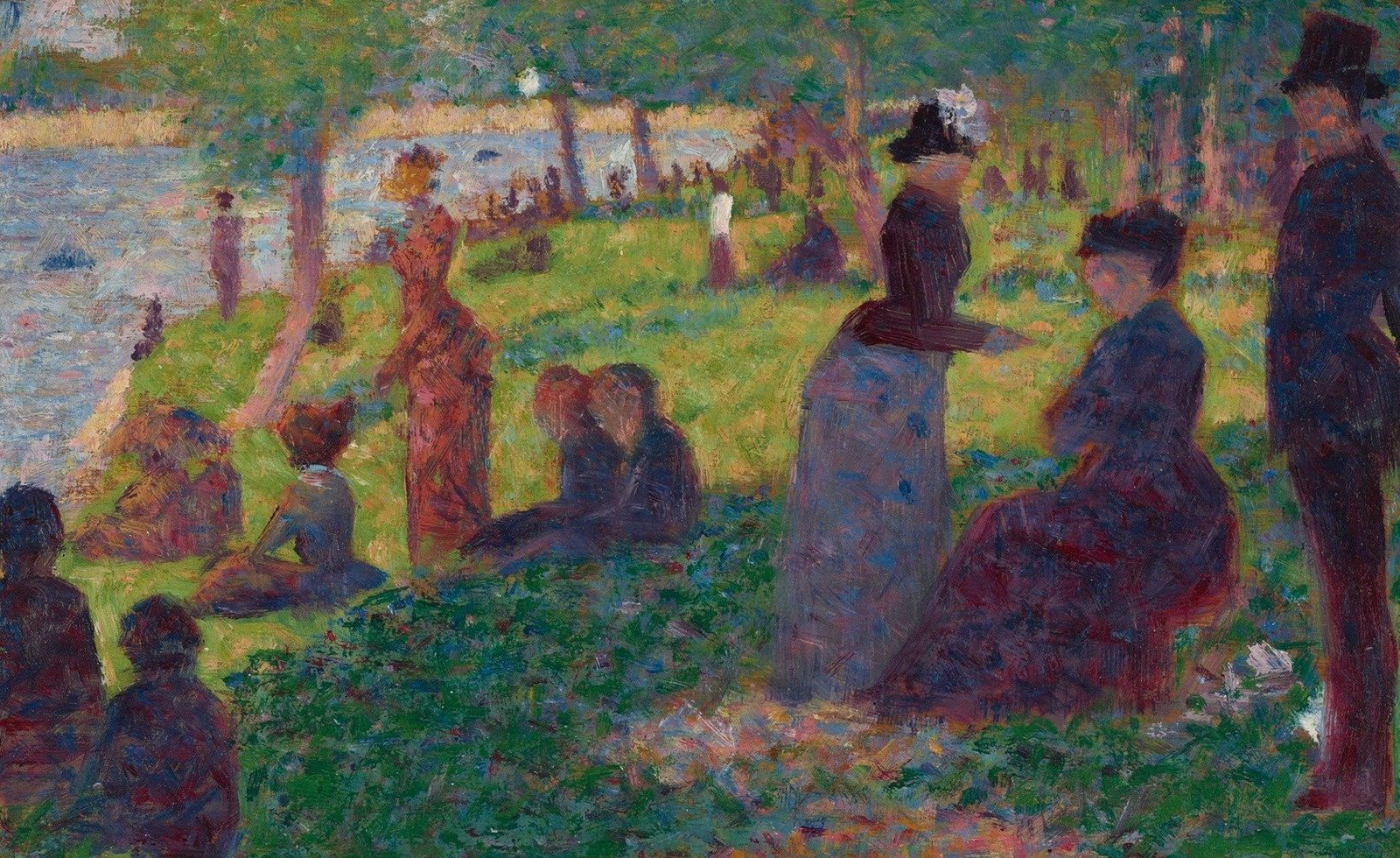
- Artist
- Georges Seurat
- Title
- Oil Sketch for "A Sunday on La Grande Jatte — 1884"
- Date
- 1884
- Medium
- Oil on panel
- Museum
- Art Institute of Chicago
- Image
- Public domain (CC0)
Open in Simple Art
Watch this story on iPhone and iPad, with offline downloads and a painting every day.
About 6 minutes of looking, in 11 parts.
An unfinished Sunday
Stop here. What you're looking at is not the famous finished Grande Jatte — it is Seurat's working oil sketch from 1884, oil on panel, where the final painting is still being invented in quick, broken-color strokes. The scene reads as a horizontal frieze of 1880s figures along a riverside, but the handling is loose, gestural, almost provisional. Notice how your eye is already being pulled to that rust-red standing woman near center-left — she is the warmest, most saturated mass in the field.
A sketch, not the canvas
This is preparatory — Seurat is working out figures, palette, and rhythm. The translation from study to masterwork means the brushwork is fast, with no tight divisionist dots yet, only scumbled patches of related hue. Long strokes, soft edges, no hard contours. He is essentially proofing a composition he will later freeze into pointillist stillness.
Frieze on a thirds grid
Camera, hold the frame and let the thirds grid fall. The horizon line of the river sits just above the lower third, exactly where survey.composition places it at v equals 0.22. The strong vertical accent on the far right — the standing man — punctuates the horizontal frieze. Focal point: the rust-red standing woman at roughly one-third across, halfway down.
Diffuse summer light
Now feel the light. survey.light describes it as diffuse outdoor daylight from above and slightly camera-left — paler highlights catch the upper-left faces and hat brims, with no hard cast shadows. It is overcast plein-air light, middle-key overall, deepest values concentrated in the parasols, hats, and that standing man's suit on the right, while the palest values live in the distant water and sky band.
The red focal mass
Drift into the rust-red figure. survey.composition marks her as the focal point, and the claim for r1 is that this dress is built from broad, vertical strokes of orange-red and burnt sienna. Look closely — cool blue-violet threads run through the folds as shadows, not as background peeking through. The silhouette is not drawn; it is implied by the abrupt juxtaposition of warm red against the surrounding green and ultramarine-touched grass.
Violet mosaic, soft edge
Sweep right to the seated figure in violet. The r3 read tells us her dress is a layered mosaic of deep violet, plum, and magenta, brushed in vertical and diagonal strokes that bleed into a green-yellow background. Edges are deliberately unfinished — saturated green strokes sit inside the silhouette and violet strokes extend beyond it. A small pale dusty pink scumble lifts the upper shoulder, and that single broken highlight does more work than a fully modeled form would.
Face as three marks
Hold on the hatted woman's profile. r4 describes the face as a simplified mass of pale ochre with a single dark smudge for the eye and a thinner stroke beneath for the lip. The hat is a heavy dark blue-black triangle that meets the pale face in a broken, stair-stepped edge — not a clean line. Below the face, broad rust-red brushwork tilts diagonally into the surrounding cool greens.
Soft suit edge
Push to the right margin — the standing man. r5 is about his soft, blurred edge against the green. His suit is a deep indigo-violet mass of broken vertical-to-diagonal strokes, and look at how cool green and teal hatch marks cross over the dark suit at the right edge, and the suit's own purple-blue strokes extend slightly into the foliage. There is no contour; the silhouette emerges by interlacing, not by outlining.
Water as broken color
Now look up and back — the distant water band. r6 says it is painted with horizontal streaks of light blue, white, and pale violet. The marks are unblended: each stroke keeps its own boundary, so the surface shimmers through broken color rather than a smooth blend. Toward the top edge the strokes lengthen into cream and straw verticals suggesting reeds or a far bank. That soft, layered handling is what gives the river its atmospheric distance.
Grass, two diagonals
Drop down into the foreground grass. r2 tells us it is built from short diagonal cross-hatched strokes of green, yellow, and blue — two crossing axes, not three. Cool blue notes are scattered through the mid-zone and a single small red-orange dab sits upper-center, the only warm note in the turf itself. Notice how the longer vertical strokes of the gown edge along the left contrast with the busy cross-hatch around it.
Loose left, resolved right
Now do a side-by-side read. On the left, the foreground figure in r10 is the coarsest, most sketch-like handling: a scumbled mass of navy and purple with soft broken edges. On the right, the standing man in r5 reads as more resolved, his long vertical strokes and interlaced edges still loose but more deliberately placed. survey.storyAngle calls this a working proof — the scratchy handling on the left loosens into more resolved silhouettes on the right, anticipating how Seurat will freeze these figures into the monumental frieze.
Look closer
9 details, each checked against a close-up of the picture.
-
Central Rust-Red Figure
The red dress is composed of broad, vertical strokes of orange-red and burnt sienna.
The crop centers on a standing figure rendered in rust-red drapery, painted with loose, visible, predominantly vertical brushstrokes that range from bright orange-red highlights to deeper burnt sienna mid-tones. Cool blue-violet notes are threaded through the dress folds, functioning as shadows rather than as background peeking through. The figure's edges are not drawn but implied by the abrupt juxtaposition of warm red strokes against the surrounding green, ochre, and ultramarine-touched grass; the silhouette reads as a mosaic of broken-color patches. Background trees register as dabs of ochre, orange, and dark green, with a pale sky band across the top, while a heavier maroon-brown shadow grounds the figure's lower right.
-
Foreground Grass Texture
The grass is rendered with short, diagonal, cross-hatched strokes of green, yellow, and blue.
The crop is dominated by a dense field of green paint in the lower two-thirds, built from short, overlapping strokes that run on multiple diagonals. Greens range from deep forest tones (~#1f3a26) in the recessed pockets to brighter yellow-greens (~#8fa83a) where thicker, lighter strokes sit on top. Cool blue notes (~#2c5070) are scattered through the mid-zone, and a single small red-orange dab (~#a83828) sits upper-center, the only warm note in the grass itself. A dark vertical mass (the rust-red gown from context) intrudes along the left edge, its strokes longer and more vertical, contrasting the busy cross-hatch of the turf. Strokes are laid wet-into-wet in places but show slight ridges, and edges between marks are softened by adjacent wet color rather than left crisp. The upper-left wedge of warm ochre and orange reads as out-of-focus foliage catching diffuse light, not as grass.
-
Seated Figure in Purple
The dress uses deep violet and magenta hues with light pink highlights on the shoulder.
The crop isolates a seated figure whose gown reads as a layered mosaic of deep violet, plum, and magenta, brushed in vertical and diagonal strokes that bleed into a green-yellow background. Edges between dress and ground are deliberately unfinished — saturated green strokes sit inside the silhouette and violet strokes extend beyond the contour, so the figure emerges through color contrast rather than a drawn outline. A small zone on the upper shoulder (roughly crop-local 0.55, 0.20) is lifted with a pale dusty pink scumble, but the highlight is muted and broken rather than crisp. Values across the dress stay in a narrow mid-to-dark range; there is no strong shadow line, just warmer magenta passages modeling the skirt's volume.
-
The Standing Man's Silhouette
The right edge of the man's suit is a soft, blurred boundary against the green background.
A tall male figure in dark dress dominates the crop, his silhouette extending nearly the full vertical span. The suit reads as a deep indigo-violet mass composed of broken, vertical-to-diagonal strokes that carry warm reddish and cool blue notes within a single garment shape. Against the surrounding greens, the right edge is not a contour but a series of overlapping, unblended strokes: cool green and teal hatch marks cross over the dark suit, and the suit's own purple-blue strokes extend slightly into the foliage zone. At the lower right, the trouser leg is defined by thin verticals of crimson, indigo and olive laid side by side, with bare canvas and mixed greens breaking through. The top hat is a small, dense black-purple block with no internal modeling.
-
Hatted Woman's Profile
The face is a simplified mass of pale ochre with a dark smudge for the eye and lip.
The crop is dominated by a heavy, roughly triangular mass of very dark blue-black at the top, which sits directly on a wedge of pale, scumbled ochre that reads as a face in profile. Within the ochre, a single small horizontal smudge of darker tone marks the eye area, and a thinner dark stroke beneath suggests the mouth. The edge where the dark hat mass meets the pale face is not a clean line but a broken, stair-stepped transition where dark and light strokes interlock. Below the face, a broad area of rust-red and brownish-red brushwork tilts diagonally, edged on the right by cooler greens and blues of the surrounding foliage.
-
Seated Figures Left
The figures on the far left are loosely sketched with minimal definition of limbs.
The crop reveals two roughly indicated seated forms on the left, built from broad, overlapping patches of rust, violet, and deep blue-green rather than drawn contours; limbs are absent as separate shapes and emerge only as broken color zones where the figure meets the surrounding grass. A third seated figure occupies the right half, with a dark crimson hat/mass and a navy torso suggested by a few wide strokes, the chair or bench implied by a horizontal smear of ochre and pink. Edges between figure and ground are deliberately left wet and unblended, with mid-value violets serving as transitional halos. Highlights on the upper-left are kept thin and pinkish, while shadow pockets are loaded with cool blue-purple, giving the forms a faceted rather than modeled look.
-
Foreground Figure Bottom Left
The figure's clothing is rendered as a dark, scumbled mass of navy and purple.
The crop is dominated by a dark, scumbled mass of pigment occupying the central and lower portions, where navy blue, deep purple, and touches of rust-red are dragged and layered over one another in loose, gestural strokes. The edges where this dark form meets the green background are soft and broken, with no hard contour — the green is dragged into the dark mass and vice versa. Value contrast is low across the figure itself, with small flecks of lighter blue and pink acting as scumbled highlights rather than modeled form. The green surrounding the figure shows horizontal and diagonal strokes in a brighter yellow-green, laid on top of darker olive underlayers.
-
Distant Water Band
The water is painted with horizontal streaks of light blue, white, and pale violet.
The upper two-thirds of this crop is a watery band built from short, mostly horizontal strokes of light cerulean blue, off-white, pale lavender-violet and occasional salmon-pink, layered wet-into-wet so that warmer underlayers (pink, ochre) peek through the cooler top passes. Toward the top edge the marks lengthen into cream and straw verticals, suggesting reeds or a far bank. Lower down the horizontal energy is interrupted by a dark plum vertical dab (a figure's reflected silhouette) and a cluster of purple-mauve flecks at the very bottom (shadow or foliage). Edges are soft and unblended: every stroke keeps its own boundary, so the water reads as broken color rather than smooth surface.
-
Green/Blue Transition
The transition between grass and river includes streaks of turquoise and pale green.
The crop captures the middle-left zone where two lavender-purple vertical strokes (tree trunks) rise from a dense field of green grass into a turquoise wash at the upper-left. The grass is built from short, varied greens — pale mint, yellow-green, and deeper olive — applied as distinct dashes and commas rather than blended. To the left, the turquoise river area shows horizontal, broken strokes of pale cyan and white-blue, with a soft, undefined edge where water meets grass. Lower right, a diagonal band of rust-red and terracotta (suggesting either ground or a draped fabric) edges into the green with a crisp but gestural boundary.
Oil Sketch for "A Sunday on La Grande Jatte, 1884" in context
Two years on the island
According to Wikipedia, Seurat worked on La Grande Jatte from May 1884 to March 1885 and again from October 1885 to May 1886 [2]. Wikipedia's biography counts about 60 studies for the painting, while the Art Institute counts more than 20 painted ones [1][3]. The largest painted study, measuring about 70 by 104 cm, is now in the Metropolitan Museum of Art [2].
This panel measures only 15.5 by 24.3 cm [1]. Scholars have titled it in different ways. Dorra and Rewald listed it in 1959 as a general view with groups of figures, dated 1884-85. De Hauke called it simply a small sketch in 1961. And the 2004 Chicago exhibition named it a sketch with many figures [1].
From strokes to dots
Seurat drew on colour writers like Michel Eugène Chevreul and Ogden Rood. They described how colours placed side by side mix in the eye [3]. He preferred to call his method divisionism. Wikipedia reports that dots of almost uniform size appeared only in the second year of work on the big canvas, 1885-86 [2].
In the first stage, begun in 1884, he still mixed his paints and used earth pigments like ochre and burnt sienna [2]. Dated 1884, this sketch with its loose strokes probably belongs to that early phase, before the dots [1][2]. He summed up his ideas in an 1890 letter to Maurice Beaubourg: 'Art is Harmony' [3].
Showing the painting in 1886
Wikipedia's article on the painting says it was first shown at the eighth and last Impressionist exhibition in May 1886, and again that August at the Salon des Indépendants [2]. Its article on Neo-Impressionism instead names the Indépendants as the first showing, so the two accounts differ [2][4]. The critic Félix Fénéon coined the term Neo-Impressionism in 1886. Early reactions to the painting included strong hostility [4].
A short career
In 1889 the model Madeleine Knobloch moved in with Seurat. He kept the relationship hidden, and their son Pierre-Georges was born on 16 February 1890 [3]. That summer Seurat painted at Gravelines on the Channel coast [3].
He died at his parents' home in Paris on 29 March 1891, aged 31 [3]. The cause is uncertain, with meningitis, pneumonia, infectious angina and diphtheria all proposed, and his son died two weeks later [3]. His last large painting, The Circus, was left unfinished [3].
Through Luce's hands
The sketch was still in Seurat's studio when he died. Listed as panel no. 87 in the posthumous inventory of 3 May 1891, it may then have passed to his mother [1]. It later belonged to the painter Maximilien Luce. According to Wikipedia, Luce was introduced to Seurat's divisionist technique around 1884 [1][5]. In 1938 the work was shown in Paris in an exhibition titled Quelques oeuvres échangées jadis entre eux (some works once exchanged among them). The museum's record does not say how Luce obtained it [1].
Luce's son Frédéric sold the sketch to Wildenstein in 1955. Leigh and Mary Block of Chicago bought it that November [1]. It came to the Art Institute in 1981 as a gift of Mary and Leigh Block [1].
- Georges Seurat, Oil Sketch for "A Sunday on La Grande Jatte, 1884", 1981.15: object record, label text, provenance and publication history . Art Institute of Chicago (public API)
- A Sunday Afternoon on the Island of La Grande Jatte . Wikipedia
- Georges Seurat . Wikipedia
- Neo-impressionism . Wikipedia
- Maximilien Luce . Wikipedia