On a Balcony — A Walkthrough for Painters
Mary Cassatt, 1878–79: cool whites, warm blossoms, and the geometry of quiet attention
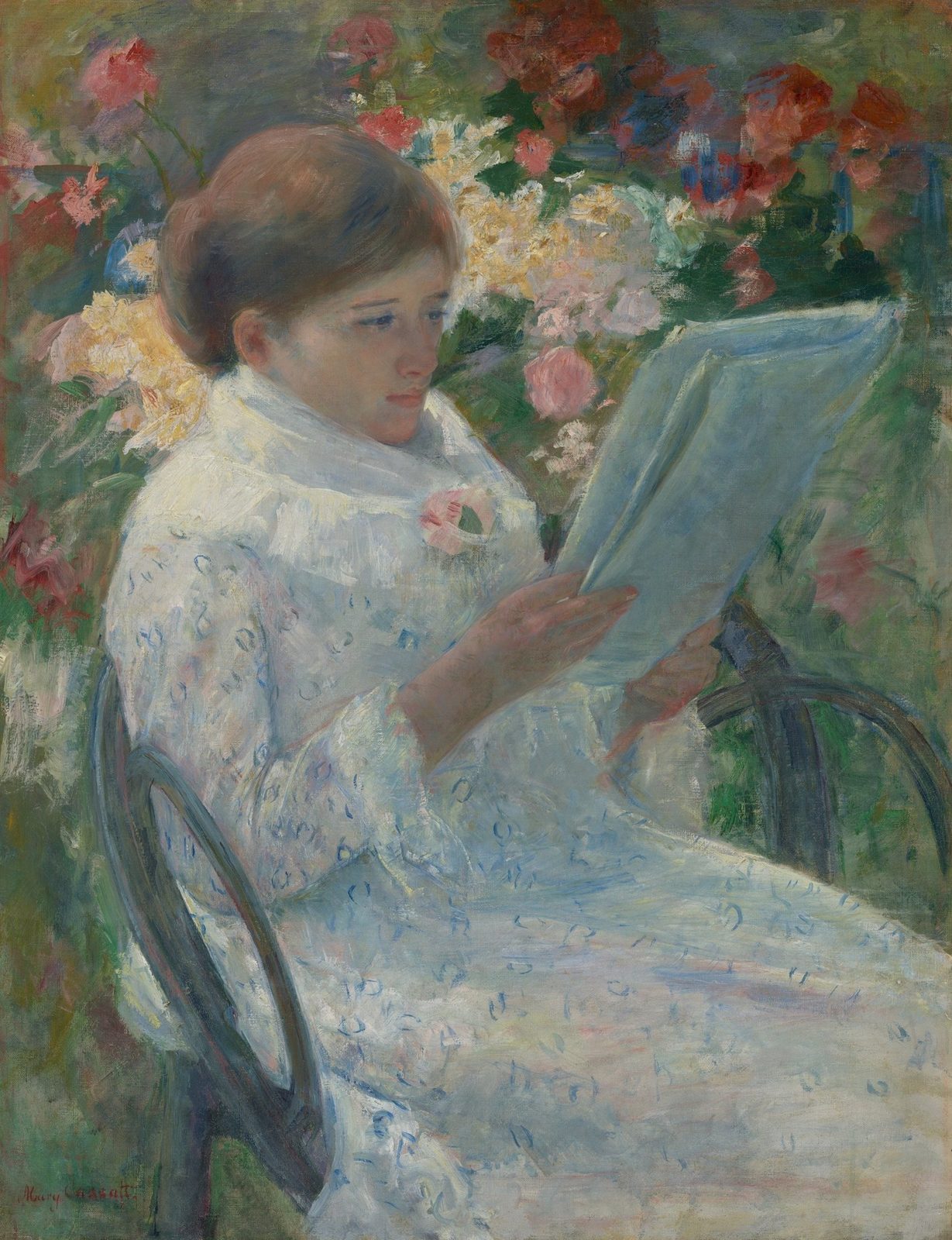
- Artist
- Mary Cassatt
- Title
- On a Balcony
- Date
- 1878–79
- Medium
- Oil on canvas
- Museum
- Art Institute of Chicago
- Image
- Public domain (CC0)
Open in Simple Art
Watch this story on iPhone and iPad, with offline downloads and a painting every day.
About 6 minutes of looking, in 12 parts.
A quiet moment, wrapped in roses
Picture a young woman in white, absorbed in something she's reading, framed by an explosion of roses. This is Mary Cassatt's On a Balcony, painted in 1878–79. The whole composition pulls you in with one simple contrast — a still, cool figure wrapped in a riot of warm color.
An American in Parisian Impressionism
Cassatt was an American working in Paris during the rise of Impressionism, and she absorbed two influences you'll see right here: the loose, broken brushwork of her French peers, and the flattened, decorative patterning of Japanese woodblock prints. She turned a private act of reading into a study of opposites — quiet attention against floral exuberance.
A triangle in a sea of petals
Look at the underlying geometry. The woman forms a broad triangle from her head down to her lap, and your eye races along the diagonal from her downcast face to the bright page she holds. Watch the diagonal guide overlay — that line is the spine of the whole picture. The floral halo above her head acts as a frame, locking her into the canvas.
Cool figure, warm garden
Notice the palette. Cool whites, blue-grays, and greens dominate, while the pinks and reds of the blossoms punch through as warm accents. That temperature contrast is what makes the white figure glow against the garden without any hard outline. Light falls softly from the front-left — the brightest passages will cluster there.
The anchor: a face tilted down
Drift to the face — the emotional and compositional anchor. Cassatt blended the flesh wet-into-wet so transitions are soft, then scumbled a warm pink flush on the cheek over a cooler base. Look at the swatches: a translucent rose sitting on a creamy peach. That is how you make a face feel alive without painting it sharply.
Where the light lands hardest
Follow the gaze down to the page, then back up along the curving white sleeve. The shoulder crest here is the brightest white in the entire composition — thick, loaded impasto catching the front-left light. Around it, cooler lavenders and dusty blues fall just a step darker. Even a white needs contrast to read as light.
Shadows made of color, not gray
Now look closely at the dress. The shadow areas aren't mixed gray — they are built from short, comma-shaped strokes of lavender, pale blue, and flecks of yellow, placed side by side without blending. The eye does the mixing for you. Lay in the lightest local tone first, then drop in cool accents wet-into-wet. The whites stay luminous.
A single bloom, embedded
A small pink flower is pinned to the bodice, and it does the same trick Cassatt used in the background. One saturated accent against a deliberately desaturated, scumbled blue-gray field. No outline. The petal edges dissolve into the fabric, so the bloom feels embedded rather than stuck on. Chroma and warmth rising together — that is where the eye lands.
Edges that breathe
Look where her auburn hair meets the green foliage — there is no hard contour. The two zones share three or four interpenetrating strokes of each other's color. Hair strokes run one way, leaf strokes another, and a fringe of mid-value green-blue sits where they meet, blurring the boundary. That is how you lose a hard edge without ever touching a blending brush.
Petals without outlines
Now pull back and study the floral backdrop. Each bloom is just clustered dabs of saturated color — crimson, rose, salmon — with no dark contour line wrapping the petals. The Japanese print influence is right here: forms defined by color contrast alone, and the whole field flattened into a tapestry-like pattern. Tapestry, not depth.
One decisive sweep
Hidden beneath the figure is a wicker chair, and its curves are defined by one confident, sweeping arc of dark blue and warm umber. Watch the stroke overlay — that long gesture is the structural skeleton. Smaller ribs branch off it. Compare it with the loose floral dabs around it: one structured line, one broken pattern, both working together.
A small surprise, and a signature
Finally, peek at the upper left, where a small dog peeks out from the foliage. Cassatt implies it with three or four dabs — a cream head, two dark eyes, a soft muzzle — and lets the leaf strokes nibble into the silhouette so it almost disappears. Drift down to the bottom-left corner, where her red signature anchors the work. A quiet everyday moment, deliberately constructed.
Look closer
9 details, each checked against a close-up of the picture.
-
Woman's Face
The facial features are rendered with soft, blended edges and a warm pink flush on the cheek.
The crop shows a three-quarter view of a young woman's face angled downward, painted with softly blended passages rather than crisp lines. Her cheek carries a distinct warm pink-red flush that sits over a cooler underlying flesh tone, reading clearly against the surrounding peach and cream half-tones. The hair is built from broad, broken strokes of auburn, dark brown, and ochre that remain visible as separate marks, while the face itself is more smoothly worked so individual strokes are absorbed into the form. The white collar at the bottom is rendered with loose cream and pale grey strokes that abut a dense green foliage mass on the right, where dabs of yellow and orange read as distant flowers.
-
Dress Shadows
The white dress contains distinct flecks of lavender, light blue, and pale yellow paint.
The crop shows a close-up of a white garment rendered in broken, scumbled brushwork. Short comma-shaped strokes of cool blue and pale lavender sit against a warm off-white ground, with scattered flecks of pale yellow and cream breaking up the shadow zones. Edges between strokes remain soft and unblended, so each mark reads as a separate touch of pigment. A darker diagonal band in the lower left suggests a shadow plane or chair rail beneath the fabric.
-
Floral Backdrop
The red and pink flowers are composed of dabs of saturated color without outlines.
The crop reveals a dense, decorative field where red and pink blooms read as soft, rounded masses rather than discrete objects. No dark contour lines wrap the petals; instead, each flower is constructed from clustered dabs of saturated color — deep crimson, rose, salmon, and cooler blue-violet — set against a matrix of varied greens. Where a bloom edges into foliage, the transition is achieved by adjacent contrasting dabs and softened wet-into-wet blending rather than a drawn line. In the lower band, cream, ochre, and white dabs suggest a lighter cluster of flowers, while the upper area shows cooler blue-green passages peeking through, creating a tapestry-like, flattened space.
-
Hair and Background Merge
The boundary between the woman's hair and the green foliage is soft and blurred.
The crop captures the crown of the head and the upper-left to upper-right edge where auburn hair meets green foliage. Hair is built from broad, curved sweeps of warm reddish-brown (cobalt and ochre underpainting visible in places), with a cool blue-gray shadow mass dominating the right-center that suggests the roundness of the skull. Green leaf strokes in the upper-left corner (vertical stems, dashed foliage) and the upper-right corner (a smear of pinkish-red flower) overlap the hair's silhouette with no hard contour. The transition is resolved by interpenetrating strokes: hair strokes run one direction, leaf strokes another, and a small fringe of mid-value green-blue sits where they meet, blurring the boundary.
-
Sleeve Highlight
The top of the sleeve is the brightest white in the composition, receiving direct light.
The crop shows a tight detail of a white sleeve rendered in thick, loaded impasto across the upper portion, where creamy off-white and pale yellow strokes sit highest in relief and read as the brightest passage in the visible field. Below this highlight zone the surface cools noticeably, with broken strokes of lavender, dusty blue, and muted pink laid beside one another in short, sketchy marks. Small curling motifs—visible as dark blue-grey loops, S-shapes, and short hooks—are dotted over the lower half, reading as embroidered or printed decoration rather than solid contour. Edges between color notes are soft and wet-into-wet in places, while the embroidery marks are drier and more graphic, suggesting they were added as a later pass over a damp-to-dry base.
-
Bodice Flower
A small pink flower is pinned to the dress, echoing the larger floral background.
The crop centers on a small floral form rendered with loose, broken strokes against a dominant field of blue-gray. The bloom is built from a cluster of pink and coral dabs, with three or four deeper crimson-magenta marks suggesting petal folds or shadow creases at roughly the flower's center. A diamond-shaped green leaf sits to the lower right of the bloom, formed by two or three angled strokes in olive and sap green. The surrounding 'fabric' is a scumbled, vertical weave of pale blue, lavender-gray, and muted slate, with frequent streaks of raw canvas or warm undertone showing through. Edges are deliberately soft; no contour line separates flower from dress, and the petals dissolve into the grayed blue field.
-
Wicker Chair
The chair's curves are defined by thick, sweeping strokes of dark blue and brown paint.
The crop isolates a section of a wicker chair against a decorative background of pink, white, and pale blue floral touches. The chair's structure is defined by a dominant sweeping arc that descends from the upper left toward the lower right, built up in dark blue-grey and warm umber strokes. Smaller secondary curves branch off this main gesture, suggesting the woven ribs of the wicker. The background consists of short, broken C-shaped and circular dabs in pale blues, pinks, and whites, layered loosely with visible canvas weave showing through in places. Edges between chair and background are soft and interpenetrating rather than crisp, with green foliage notes pressing in from the lower left.
-
Pale Yellow Blossoms
A small cluster of cream and pale-yellow dabs reads as blossoms among the foliage.
The crop is dominated by loose, broken brushstrokes of cool blue-grey, sage green, and warm ochre against a darker indigo background. A roughly rounded form sits in the lower-center, built from a couple of cream and pale-ochre dabs, with two small dark brown flecks and a softer dark passage below. Edges everywhere are soft and unresolved; the form is implied more than drawn, with the surrounding foliage strokes overlapping and partially masking the contour.
-
Artist Signature
The signature 'Mary Cassatt' is visible in the bottom left corner in red paint.
The crop shows a painted surface dominated by mottled green brushwork with scattered darker passages and faint hints of warmer tones bleeding in from the right edge. Across the lower-left quadrant, the cursive signature 'Mary Cassatt' is legible, executed in a dark red-brown pigment that sits on top of the green ground. The signature letters have uneven thickness and slightly broken interiors, suggesting a brush with limited paint or a lightly loaded applicator. Edges of the green background are soft and scrubbed rather than crisp, with visible weave/texture of the support peeking through thin passages.
On a Balcony in context
A second showing in 1880
Edgar Degas invited Cassatt to show with the Impressionists after both of her Salon entries were rejected in 1877, and her first appearance with the group came at the exhibition that opened on 10 April 1879 [2]. The Art Institute records that On a Balcony was included in the fifth Impressionist exhibition of 1880, her second showing with the group [1]. Wikipedia notes that she went on to take part in four of the eight group exhibitions held between 1874 and 1886 [3].
The group was divided at the time. According to Wikipedia, Degas also insisted on bringing in realist painters such as Jean-François Raffaëlli, and in 1880 Monet complained that the Impressionists were opening their doors to all comers [3].
Family life as subject
In 1877 Cassatt's parents and her sister Lydia joined her in Paris, and the family shared a large apartment on the Avenue Trudaine [2]. Wikipedia says that by the summer of 1880 her work had turned towards scenes of home life, with Lydia as a frequent model until her death in 1882 [4].
A close comparison is Lydia Crocheting in the Garden at Marly of 1880, now in the Metropolitan Museum. It also sets a woman absorbed in a task against a garden, and it was shown at the sixth Impressionist exhibition in 1881 [4]. The same article notes that Cassatt usually avoided painting out of doors, although the sunlight in that picture suggests it was made in the garden [4].
A painting with many titles
The present title is relatively recent. When Durand-Ruel showed the canvas in New York in 1903 it was called Femme Lisant dans un Jardin, and between 1914 and 1917 it travelled to Washington, San Francisco and Worcester as Woman Reading in a Garden [1]. The Philadelphia memorial exhibition of 1927 listed it as a portrait of the artist's sister, Miss Lydia Cassatt, in a garden, dated 1881, and a year later in Pittsburgh it appeared as Girl Reading in a Garden [1].
The museum's own description doesn't name the sitter, so the identification with Lydia made in 1927 should probably be treated as one proposal among several rather than an established fact [1]. Frederick Sweet still used the title Woman Reading in a Garden in his 1967 survey of the Art Institute's Cassatts [1].
From a dealer's stock to Chicago
The painting was with Durand-Ruel in New York by 1903, and an inscription on the stretcher, D.R. N.Y 2707, records its place in the firm's stock [1]. It stayed with the dealer through several exhibitions until 1922, when it was sold to Delia Spencer Field of Washington, DC, also known as Mrs. Marshall Field [1].
After her death it passed to her niece, Catherine Eddy Beveridge, who gave it to the Art Institute in 1938 in her aunt's memory [1]. The museum put it on the cover of its Bulletin that spring, and it has since been lent to the 1998 exhibition Mary Cassatt: Modern Woman and to Mary Cassatt at Work in Philadelphia and San Francisco in 2024 to 2025 [1].
- Mary Cassatt, On a Balcony, 1878-79 (1938.18): object record, description, provenance, exhibition history and bibliography . Art Institute of Chicago (public API)
- Mary Cassatt . Wikipedia
- Impressionism . Wikipedia
- Lydia Crocheting in the Garden at Marly . Wikipedia