On the Bank of the Seine, Bennecourt: A Walkthrough
Claude Monet, 1868 — Painted en plein air on the Seine
- Artist
- Claude Monet
- Title
- On the Bank of the Seine, Bennecourt
- Date
- 1868
- Medium
- Oil on canvas
- Museum
- Art Institute of Chicago
- Image
- Public domain (CC0)
Open in Simple Art
Watch this story on iPhone and iPad, with offline downloads and a painting every day.
About 6 minutes of looking, in 10 parts.
A quiet moment by the Seine
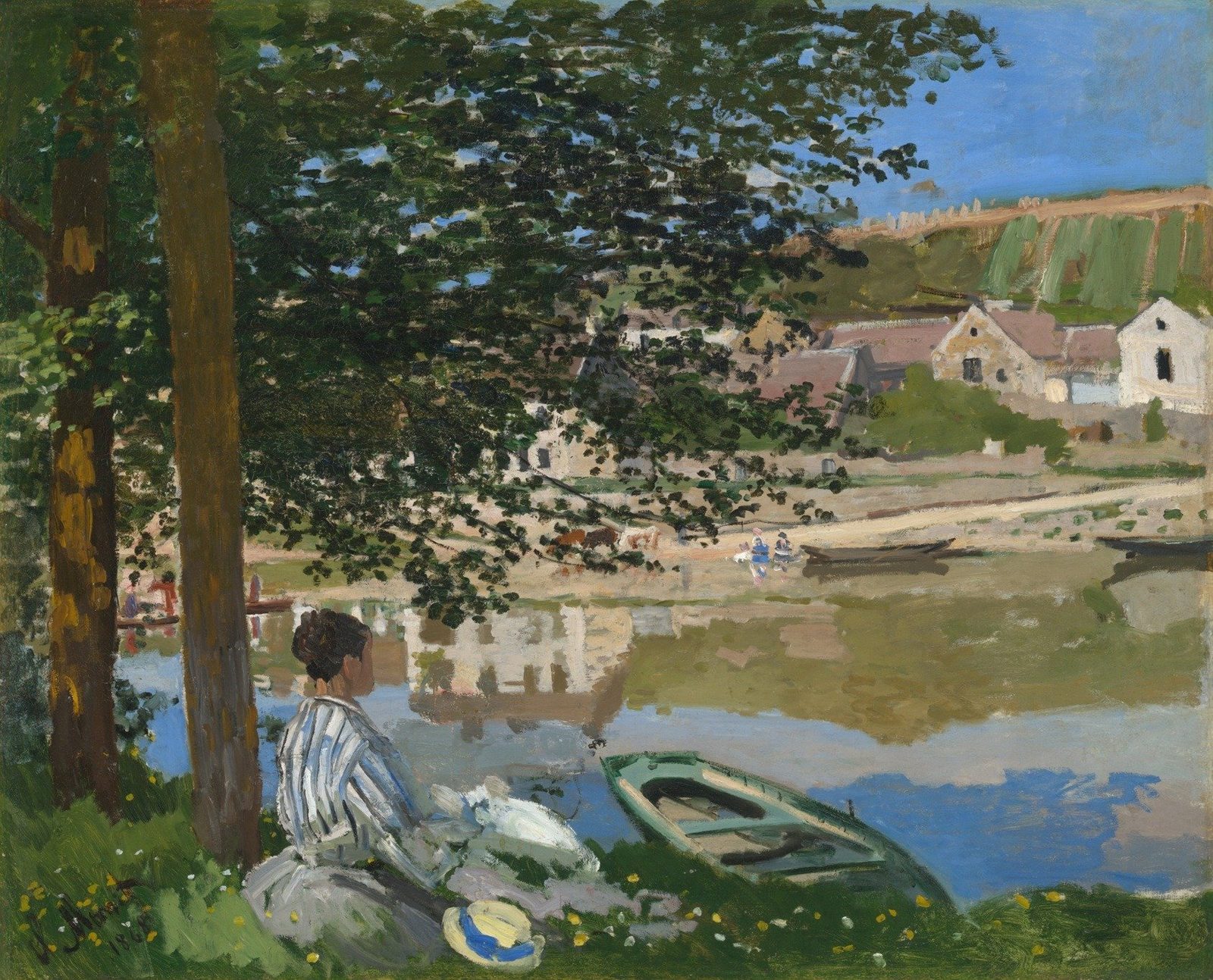
Before you is Claude Monet's 1868 oil on canvas, 'On the Bank of the Seine, Bennecourt' — a quiet, almost theatrical moment where a young woman in a white dress pauses on a flower-strewn riverbank, gazing across the water. Notice how the dark canopy of trees frames her like a proscenium arch, turning an ordinary riverside stop into an intimate pocket of stillness. This is plein air painting at its most personal.
Plein air, summer 1868
Monet painted this outdoors during the summer of 1868, when he was living near Bennecourt on the Seine with his companion Camille Doncieux, who is most likely the woman on the bank. It is a pivotal proto-Impressionist work — the brushwork is loose and broken, the light is observed directly, and the scene was rendered with the immediacy of someone working quickly in front of his subject.
An asymmetric, tree-framed view
Pull back and read the structure. Two tall tree trunks on the left and a heavy canopy act as a dark arch, opening onto a horizontal band of river and a distant village. The seated woman sits at roughly the lower-left third intersection — the bright focal point set against the dark trunk. The horizon sits low, around the upper third, giving the canopy weight and the river room to breathe.
Light from the upper right
Notice the direction of the light. It comes from the upper right, falling on the right-facing walls of the village, the right side of the woman's dress, and the lit faces of the leaves. The left tree trunks sit in deep shade, and that high contrast — near-black foliage on one side, luminous white dress and white walls on the other — drives the entire key-value structure. The canopy itself is built from broken dabs of green, yellow, and blue placed side by side rather than blended.
The seated focal figure
Move into the central figure. Seen from behind, the woman wears a dress with vertical blue stripes over a white base, the blue strokes laid in as discrete vertical passes with visible bristle marks. Her right sleeve catches warm, yellowish-white light, while folds along her spine read as cool blue-gray shadow. The painter resisted blending across the band boundaries. Notice how the silhouette is sharpened only against the dark tree trunk at her shoulder — that abrupt value jump gives both shapes their punch.
Yellow dabs in the grass
Drop down to the bank around her. The grass is laid in with overlapping directional flicks of several greens — warm yellow-green, sap green, deep forest — and across this matrix sit small, thicker dabs of pure yellow functioning as wildflowers. The yellow touches are a separate, slightly impasto pass, and the painter resisted blending them into the grass so each dab keeps its edge and reads as a discrete point of color.
The rowboat at her side
Follow her gaze outward to the small rowboat moored beside her. The interior is rendered as a single dark, cool green-black mass, with one bright pale cyan-green stroke running along the upper rim. The rim highlight does all the work of defining the form — the rest is just shadow. This is a quick plein air trick: block the dark interior first, then add the lit edge as one confident contrasting pass.
Vertical streaks across the water
Now cross the river with her. The reflection of the white buildings reads as softened, vertically dragged streaks of cream and pale grey-ivory over a cool blue-grey wash. The dark window openings bleed downward as short, smudged verticals — crisp at the top, blurred at the bottom. That blur comes from one confident downward pull, not from softening afterwards, which would muddy the crisp darks you placed wet-into-wet.
Figures as cool dabs
On the far bank, just left of the moored boat, two tiny standing figures exist only as compact dabs. The left figure is a vertical stack of cobalt and ultramarine with one small white patch; the right figure is a paler arrangement of off-white and warm grey. No contour is drawn — they emerge only where the cool strokes meet the warm ochre bank. This is lost-and-found silhouette painting at its most economical.
Warm roofs, cool water
Sweep across the far bank into the village. The roofs are a muted pinkish-red, almost terra-cotta, laid in broad, slightly broken strokes. To keep that red from reading as candy-colored, the artist mixed in a touch of complementary green and raw umber, knocking it back to a dusty tone. The warm roofs push forward against the cool blue water — those warm accents are doing the work of aerial perspective here.
Look closer
8 details, each checked against a close-up of the picture.
-
Seated Woman
The woman's dress features vertical blue stripes over a white base with visible broad brushstrokes.
The crop centers on a woman seen from behind, her hair pulled up into a dark bun with warm brown and black dabs. Her dress reads as a white ground carrying roughly vertical stripes of cool blue, applied as discrete strokes rather than filled shapes. The right edge of the sleeve and skirt catches a warm, yellowish-white light, while the left side and the folds along her spine sit in cool blue-gray shadow, giving the figure clear volumetric modeling. Edges between the figure and the surrounding foliage and water are broken and soft, with paint from the background often touching and sharing the boundary with the dress. Dabs of yellow-green and small white flecks along the bottom suggest grass and flowers against the seated form.
-
Canopy Foliage
The green foliage is composed of small, distinct dabs of paint rather than blended washes.
The crop is a dense mat of foliage built from short, comma-like dabs and small flecks of paint that remain visually separate rather than blended into a smooth mass. Greens range from near-black shadowed passages to brighter yellow-greens placed against the darks, with cool sky-blue and pale cream-white dabs interspersed as gaps and highlights. Edges between leaves are implied by the contrast of adjacent dabs; there is almost no continuous contour, and the sky reads as irregular pin-pricks of blue scattered across the surface. Layering is visible where lighter, warmer strokes sit over cooler dark underlayers, giving a vibrating, broken texture.
-
Water Reflections
The reflection of the white buildings in the river consists of vertical, blurred streaks of light paint.
The crop reads as two horizontal bands: the upper third holds the source — cream and warm-white building masses punctuated by dark window openings, with green foliage flanking the left and right edges. The lower two-thirds is water, where the buildings are echoed as softened, vertically dragged strokes of cream and pale grey-ivory sitting on top of a cool blue-grey wash. A mid-band of warm ochre-tan (around y≈0.45) acts as a tonal seam, mixing the warm wall light into the cool water. Edges between reflection and water are deliberately fuzzy: there is no hard contour separating the reflected windows from the surrounding river — the dark openings simply bleed downward as short, smudged verticals. The right-edge foliage pushes into the water as cool blue-greens, telling you the painter wet-into-wet or at least softened those passages after.
-
Village Architecture
The roofs of the buildings are painted in a muted pinkish-red tone contrasting with white walls.
The crop is dominated by a diagonal sweep of muted pinkish-red roof planes at left and center, applied in broad, slightly broken strokes that read as terra-cotta or faded brick. The central gable shows a warm cream-yellow wall with a triangular peak catching the upper-right light, while a brighter white building at the right edge reads cooler and more opaque. Roof edges meet wall edges with crisp but paint-torn contours where thin lighter strokes lift the silhouette. A heavy band of dark olive-green and sap-green foliage sits in the foreground, laid in short dashes and scumbled patches that interleave with brighter yellow-greens where sun filters through.
-
Tree Trunk Contrast
The dark brown tree trunk has a sharp, unblended edge against the strip of blue water that separates it from the white dress.
The crop is dominated by a thick vertical tree trunk rendered in dark umber and warmer chocolate browns, with sparse olive-yellow accents running through its middle. On the right, past a strip of blue water, sits a pale dress fabric marked by vertical white-cream strokes and cooler blue-grey shadow notes that read as folds. Trunk and dress do not touch here: a vertical strip of cobalt water with a small green tuft separates them, and the trunk's right edge against that water is a relatively crisp contour. Above, slivers of sky/water in cobalt and cerulean peek through, and at the base a patch of grassy green anchors the trunk.
-
Riverbank Flowers
Small yellow and white dabs of paint represent wildflowers in the foreground grass.
The crop shows a sloping patch of riverbank grass built up from many short, slanted strokes in several distinct greens: a warm yellow-green, a cooler sap green, a deep forest tone, and dark olive shadows near the lower right. Scattered across this green matrix are small, roughly circular dabs of bright yellow and a few pale-white touches sitting on top of the grass, functioning as flower accents rather than as dabs with stems. The upper right corner breaks away into long, horizontal pale grey-blue strokes with a curving white highlight, reading as the edge of the river. Edges between hues are left soft and broken; no single stroke has a hard outline, so the yellow flowers read as warm specks against the cooler greens.
-
Moored Boat
The interior of the boat shows pale tan and green-grey planking crossed by dark green-black strokes, inside a pale green rim.
The crop isolates a small rowboat resting on a grassy bank, its hull tilted toward the viewer so the interior cavity is fully exposed. The boat's inside is rendered in pale tan and green-grey, crossed by two curved dark green-black strokes, all inside a pale cyan-green rim. Surrounding the hull, loose vertical and diagonal strokes of deep green suggest grass, punctuated by small, thick dabs of yellow and white that read as wildflowers. Beyond the boat, the water is painted in choppy horizontal strokes of mid and light blue with greenish tints, and the sky/waterline at the top breaks into pale greys and blues with broken, scumbled edges.
-
Distant Figures
Small, simplified figures are rendered as minimal dabs of blue and white on the far bank.
The crop centers on two small standing figures rendered as compact, broken dabs against a warm ochre bank. The left figure is built from a vertical stack of deep cobalt and ultramarine blue strokes with a small white/cream patch (head/shoulder) catching the upper-right light, while the right figure is a paler arrangement of off-white, warm grey, and faint rose tints with no saturated blue. A soft, blurred lower edge of pinkish-grey and a darker horizontal mass to the right (the dark hull of a moored boat) frame them. No contours are drawn; the silhouettes emerge only where the cool dabs meet the warm tan ground. A thin band of cool green-grey at the very bottom reads as the nearer water surface.
On the Bank of the Seine, Bennecourt in context
Daubigny's stretch of river
Scholars have usually credited Émile Zola, who had recently stayed at Gloton with Paul Cézanne, with sending Monet there in the spring of 1868 [2]. The Art Institute's catalogue points out that the area was also a favourite of Charles-François Daubigny, an early supporter who had helped Monet get a harbour scene into that year's Salon [2]. Daubigny painted rivers from a small boat fitted out as a floating studio, and several of his canvases show Gloton's riverfront houses seen from the Seine [2].
The catalogue suggests Monet may have chosen the very view Daubigny had recently painted, and reads the cows drinking on the far bank as a possible nod to him [2]. It also treats the picture as Monet's first experiment with upside-down reflections and the shadows of overhanging leaves. These motifs return in the Mornings on the Seine and the Water Lilies [2].
Getting to Gloton
Gloton lay roughly halfway between Rouen and Paris. Getting there meant taking a train from the Gare Saint-Lazare to Bonnières-sur-Seine, then a chain ferry to the Grande Île, one of the islets in this bend of the river [2]. Camille sits on that island, looking towards the ferry landing and the inn of Mme Dumont, where the family lodged [2]. The catalogue identifies a small ochre shape at the far left as the ferry itself, carrying a fashionably dressed woman [2]. The trip was Camille's first time away from Paris since Jean's birth in August 1867 [2].
Thrown out of the inn
The stay ended on 26 June, when Monet wrote to Frédéric Bazille that he had been thrown out of the inn. He left Camille and Jean with Mme Dumont and went to his family in Le Havre [2]. Wikipedia adds that he threw himself into the river the following night, with no serious after-effects. The museum's catalogue does not discuss this episode [3].
The canvas has old damage, including a tear at the upper left and a puncture to the right of Camille. These were mended rather crudely with lead white paint or adhesive [2]. The catalogue suggests the damage may date from the hurried end of the stay, wondering whether Monet made the repairs himself [2].
A child, or a second adult?
The museum's short label says the painted-out traces show that Camille once held a bonneted child, presumably Jean [1]. The fuller catalogue entry is more cautious [2]. It reports Mary Mathews Gedo's view that Jean, and perhaps a small dog, once sat on Camille's lap, but says recent findings suggest the head beside her in the X-ray is too large for a ten-month-old and may belong to a second adult in a bonnet-like hat, who might in turn have held a baby or a doll [2]. It concludes that technical imaging does not settle which figures were there [2].
From Clapisson to Palmer
The painting is thought not to have been exhibited until 1889. That year, it appeared in the Monet and Rodin exhibition at the Galerie Georges Petit as Au bord de l'eau; Bennecourt, lent by Léon Clapisson [1][2]. Clapisson had bought it for 500 francs. He sold it to Durand-Ruel on 21 April 1892 for 1,500 francs, and on 18 May Durand-Ruel sold it to Potter Palmer of Chicago for 7,500 francs [1][3]. The dealer's stock book recorded it as Argenteuil, and it was lent to an exhibition in Boston in 1905 under that title [1]. The Palmer family gave it to the Art Institute in 1922 [1][3].
- Claude Monet, On the Bank of the Seine, Bennecourt (1922.427): collection record with description, provenance and exhibition history (public API) . Art Institute of Chicago
- Gloria Groom, 'Cat. 14, On the Bank of the Seine, Bennecourt, 1868', with technical report, in Monet Paintings and Drawings at the Art Institute of Chicago (public API) . Art Institute of Chicago
- On the Bank of the Seine, Bennecourt . Wikipedia