Manet's Oysters, 1862 — A Still Life Built from Value Patches
How a humble plate of shells becomes monumental
- Artist
- Edouard Manet
- Title
- Oysters
- Date
- 1862
- Medium
- oil on canvas
- Image
- Public domain (CC0)
Open in Simple Art
Watch this story on iPhone and iPad, with offline downloads and a painting every day.
About 5 minutes of looking, in 11 parts.
A plate of oysters — and a monument.
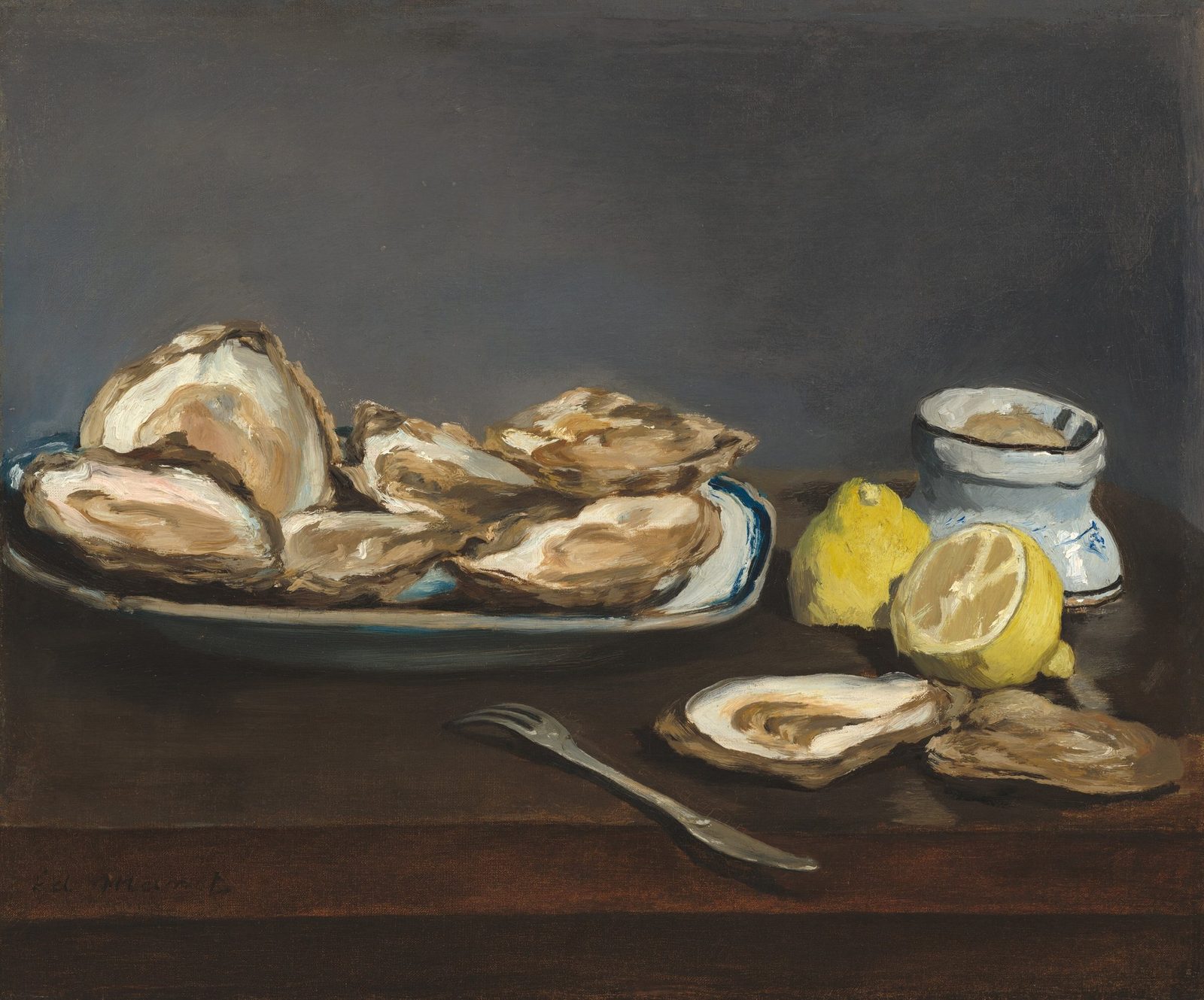
A plate of oysters from 1862, and yet they look like a monument. Watch how a single lifted shell gives this kitchen scene the gravity of a portrait, and how the bright curves of shell and lemon rhyme across a dark, quiet table.
Manet, 1862, oil on canvas.
This is Edouard Manet's Oysters, painted in 1862, oil on canvas. A still life in the French Realist tradition, but handled loosely enough to feel like the start of something modern — closer to a kitchen still life than a formal display piece.
Low horizon, long horizontal plate.
Step back and look at the structure. The horizon line sits low, right around the upper third, and the long oval of the plate runs as a strong horizontal, carrying the eye from that bright lifted shell on the left, all the way across to the lemons and cup on the right.
Cool gray pushes the warm subjects forward.
Light comes softly from the upper left, and the value structure is bold: deep gray-brown background and tabletop against luminous cream oysters and yellow lemons. The cool, neutralized slate pushes the warm subjects forward, and the lemons are the chromatic accent that focuses the whole painting.
The focal oyster — impasto you can see.
Now drop in on the focal point — that upright oyster shell at upper left. The paint here is physically thick. Cream and white strokes build the upper rim, warm brown and pinkish-ochre mark the recessed interior, and you can see real relief in the surface where ridges of pigment catch the light. The edge is built entirely by adjacent value patches; there is no drawn outline at all.
Wet-looking flesh, hard cut edge.
Move down to the foreground oyster. Inside the shell, broad sweeping strokes of cream, bone-white, and warm ochre curve from the rim down into a swirled hollow, where a small pool of dark umber suggests the oyster's liquor. The hard lower-right edge is almost knife-cut against the blackened table, while the upper rim dissolves into broken drags that let the dark ground show through.
Edges by adjacency, not by line.
In the central cluster, watch how the edges between shells are formed entirely by adjacent value — cream strokes sitting directly beside dark brown and near-black, each one defining the other's boundary. There is no continuous contour line. The shells' silhouettes are read purely through color and value meeting.
The halved lemon — broken color.
Slide right to the halved lemon. The rind is a patchwork of yellow, ochre, and warm gray strokes laid side by side, unblended, so you can follow each mark along the curve of the fruit. Resist the urge to blend every transition; lay two or three hues down in distinct parallel strokes and let the viewer's eye mix them at reading distance.
A white cup that turns on temperature.
Look at the white cup behind the lemons. The lit left side reads as warm beige-white, while the shadowed right side shifts noticeably to cool blue-gray. That warm-to-cool transition is what makes a white object turn in soft light — temperature does more work than value alone, even when the value range is modest.
A warm earth cast shadow.
Notice the cast shadow sweeping down from the halved lemon. It is a warm earth brown — not gray, not black — and you can see directional brushwork within it following the fall of light from upper left. Mixing a cast shadow with burnt sienna and umber keeps it optically related to the lit local color while staying darker in value.
The lemon–table edge: no outline.
And here at the whole lemon's edge, the bright yellow paint simply stops against the dark brown table — no drawn contour, no halo, just the value jump itself. Lay the dark passage first, let it set, then drive your light strokes firmly up to it and stop. The contrast alone reads as a clean edge.
Look closer
9 details, each checked against a close-up of the picture.
-
Upright oyster shell (focal)
Heavy impasto strokes of white, brown, and pink build the upright oyster, casting tiny real shadows that make the shell project from the canvas.
The crop centers on an upright oyster shell rendered with very thick impasto. Cream and white strokes form the upper rim and highlighted ridges, while warm brown and pinkish-ochre marks define the recessed interior and the shadowed cavity. Edges are soft and broken: the shell's outline dissolves into adjacent strokes rather than being drawn as a hard contour, and the gray background (a muted blue-gray) shows visible horizontal brush sweeps behind the form. A small sliver of pink flesh-toned paint sits just left of center, and the right flank of the shell drops into a deep brown mass that reads as cast shadow falling onto the plate below. You can see physical relief in the paint surface — ridges of pigment catch light along the upper dome, confirming genuine impasto rather than implied texture.
-
Halved lemon peel
The lemon rind is made of separate, unblended strokes of yellow, ochre, and warm gray that leave visible ridges of paint.
The crop centers on a halved lemon with the cut face angled toward the viewer. The rind reads as a patchwork of yellow, ochre, and warm gray strokes that sit side by side rather than being smoothed together, so the eye can follow each individual mark along the curve of the fruit. The pith and flesh area is built from cooler brownish-ochre tones streaked with pale cream highlights that suggest wet, glistening pulp. Background and foreground are handled with similarly loose, directional strokes in blue-grays and dark browns, keeping the focus on the yellow mass.
-
Foreground oyster interior
Pale, wet-looking strokes inside the foreground oyster contrast sharply with the dark shell and surrounding table.
The crop isolates the concave interior of a single opened oyster against a deep umber-black ground. Inside the shell, broad sweeping strokes of cream, bone-white, and warm ochre curve from the upper rim down into a swirled central hollow, where a small pool of dark umber and golden-ochre suggests the oyster's liquor. The edge of the shell reads as a hard, almost knife-cut boundary on the lower right where pale putty-grey meets the blackened table, while the upper rim dissolves through a few dragged, broken strokes. A thin, broken highlight of cool white runs along the inner upper lip, and the surrounding negative space is laid in with flat, scumbled darks that push the luminous interior forward.
-
Central oyster cluster
Adjacent strokes of brown, gray, and cream form the central oyster edges without any continuous contour line.
The crop is dominated by sweeping, diagonally oriented brushstrokes in cream, warm umber, and cool gray, which together model what reads as a central mass of oyster shells. Edges between the lighter shell forms and the dark recesses are built from neighboring strokes of contrasting value rather than from a single drawn line; cream strokes sit directly beside dark brown and near-black strokes, letting each define the other's boundary. A small saturated blue passage near the lower center (roughly at 0.35, 0.78) breaks the otherwise earth-toned palette and appears to sit on top of the surrounding browns. The surface shows fine craquelure and visible impasto, with the highest ridges of cream paint catching the most light. Dark horizontal strokes at the very bottom anchor the composition, separating the central cluster from the surface below.
-
White cup and blue accent
The cup's body shifts from warm beige-white in the light to cool blue-gray in shadow, with a small blue mark on its side.
The crop shows a bulbous white cup with a dark rim, flanked by two lemons in the foreground, all set against a dark gray ground. The cup's lit left side reads as warm beige-white, while the shadowed right side shifts noticeably to cool blue-gray, with a small blue decorative mark (a quick star-like dab) on its lower-right flank. The cup's interior shows a warm tan that contrasts with the cooler exterior, and the dark rim line is broken and irregular rather than continuous. The lemons are rendered in thick yellow paint, with the halved one showing a brownish-olive center where the rind transitions to flesh. Brushstrokes are visible throughout, with directional drags especially apparent on the cup's curved body and the lemon rinds.
-
Fork tines
Three pale tines separated by thin dark gaps suggest the fork, fading into the brown tabletop rather than forming crisp outlines.
Three thin, curving pale-grey strokes separated by dark gaps arc across the upper half of the crop, read as the tines of a fork lying on a dark wooden surface. Each tine is rendered with a darker line of pigment flanked by a paler, slightly cooler highlight, giving the impression of cylindrical metal without committing to crisp contours. To the right, the tines thicken and lighten into a single elongated form suggesting the fork's neck or handle, where the strokes spread and become more blended. The brown ground around the tines is unevenly brushed with horizontal and diagonal weave-like streaks, and the dark strokes of the tines simply dissolve into that ground where the handle begins. No hard outline encloses the metal; separation from the table is achieved purely through value contrast.
-
Whole lemon edge
The whole lemon's bright yellow paint stops against the dark brown table with no dark contour line between them.
The crop centers on a whole lemon built from thick, opaque yellow strokes laid in a generally vertical, slightly curving direction. Subtle greenish-yellow and ochre tones gather along the upper-left and lower-left flanks, modelling the form's shadow side, while a small creamy nub at the top marks the stem pit. The bright yellow body ends abruptly against the dark brown table along the lower and left perimeter—no drawn contour line, no halo, just the yellow strokes stopping where the brown begins. At the far left a blue-and-white dish rim intrudes, and at the lower right a fragment of a halved lemon shows pale cream flesh.
-
Plate rim cobalt band
A narrow stripe of saturated blue runs along the porcelain plate rim visible between the oyster shells.
A curving band of saturated cobalt blue sweeps from upper right to lower center, following the rounded contour of a plate rim. The blue is uneven: dense and almost black where the stroke is thickest at upper right, then thinning and breaking into streaks where lighter porcelain white shows through beneath. To the left of the band, warm ochre and raw umber passages sit alongside pale cream whites, with visible ridges where a loaded brush has dragged pigment. Edges between the blue and the white are soft and feathered, while the transition from blue into the dark background at right is sharper.
-
Lemon shadow and oyster
A narrow near-black shadow under the halved lemon separates it from the warm brown shell of a second oyster below.
The crop is dominated by the lower curve of a halved yellow lemon occupying the upper half, with a narrow near-black cast shadow directly beneath it; below that, the broad warm brown mass is the rough outer shell of a second oyster lying on the table, a mid-value umber clearly distinct from the near-black tabletop at the upper right. The shadow's upper edge against the lemon is soft and broken, while its lower edge dissolves into the lighter beige table surface through streaky, loaded strokes. Visible directional brushwork within the shadow follows the diagonal of the light, reinforcing the fall of light from upper left.
Oysters in context
From Couture's studio to the Salon
The Metropolitan Museum's essay on Manet says that he was the eldest son of an official in the French Ministry of Justice, hoped at first to become a naval officer, and turned to art after twice failing the training school's entrance exam [2]. In Paris he studied with Thomas Couture and copied works in the Louvre [2]. Wikipedia dates his time with Couture to 1850 to 1856, and says that brief trips to Germany, Italy and the Netherlands in those years brought him into contact with Frans Hals, Velázquez and Goya [3].
French Wikipedia records that Manet soon lost confidence in his teacher, quoting him saying that arriving at the studio felt like entering a tomb [5]. His public career began at the Salon of 1861, where, the Met says, The Spanish Singer earned an honourable mention [2].
A small picture from 1862
The museum dates Oysters to 1862 and gives its size as 39.2 by 46.8 centimetres [1]. Wikipedia places that year between two larger events. In 1862 Manet painted Music in the Tuileries, which drew mostly hostile attention when it was shown in 1863. After his father's death that year, he married Suzanne Leenhoff in 1863 [3]. The museum's provenance begins with the painting as a gift from the artist to Suzanne Leenhoff Manet [1].
Dutch tables and Spanish lemons
French Wikipedia says that still lifes make up about a fifth of Manet's work and that he called still life the touchstone of the painter [4]. It describes a group of 1860s still lifes of meals in which lemons appear, names Oysters as one of them, and says comparable arrangements are found above all in Haarlem painting of the seventeenth century, for example in Willem Claesz Heda [4]. The same article notes that, unlike the Dutch painters, Manet is not known to have meant his still lifes as reminders of transience, and it links his lemons more generally to Spanish still life, citing Francisco de Zurbarán [4].
Another French Wikipedia article sees Manet's fish, oysters and other dishes as a kind of homage to Chardin [5]. The museum's bibliography for the picture includes Petra ten-Doesschate Chu's 1974 study of the influence of Dutch seventeenth-century painting on French painting between 1830 and 1870 [1].
From Suzanne to Washington
After Manet's death the painting was number 18 in the Manet exhibition at the École des Beaux-Arts in 1884. It was also number 90 in the Manet sale at the Hôtel Drouot on 4 February 1884 [1]. The museum lists Paul Michel Michel-Lévy as the next owner, followed by his own sale at the Hôtel Drouot on 16 October 1889, and then Paul Gallimard in Paris by 1908 [1].
Gallimard sold it in 1920 to Charles Montag, and by 1923 it belonged to Emile Staub-Terlinden of Männedorf, Switzerland [1]. According to the museum, it stayed in Switzerland until 1938, when it was sent to an exhibition in Paris and then shipped to New York, where it remained with Wildenstein until it was sold in 1943 [1]. Dr David M. Levy and Adele Rosenwald Levy owned it by 1946, and it came to the National Gallery in 1962 as a gift of the Adele R. Levy Fund [1]. In 2000 and 2001 it was shown in Manet: The Still-Life Paintings at the Musée d'Orsay and the Walters Art Gallery [1].
- Edouard Manet, Oysters (1962.3.1): object record, visual description, inscription, provenance, exhibition history and bibliography (Internet Archive copy, 11 August 2025) . National Gallery of Art, Washington
- Rebecca Rabinow, 'Édouard Manet (1832-1883)', Heilbrunn Timeline of Art History, October 2004 (Internet Archive copy, 16 June 2026) . The Metropolitan Museum of Art, New York
- Édouard Manet . Wikipedia
- Le Citron (Manet) . Wikipedia (French)
- Édouard Manet . Wikipedia (French)