Rain without raindrops
Caillebotte builds a wet Paris crossroads from umbrellas, reflections and one green lamppost
- Artist
- Gustave Caillebotte
- Title
- Paris Street; Rainy Day
- Date
- 1877
- Medium
- Oil on canvas
- Museum
- Art Institute of Chicago
- Image
- Public domain (CC0)
Open in Simple Art
Watch this story on iPhone and iPad, with offline downloads and a painting every day.
About 4 minutes of looking, in 10 parts.
Paris Street; Rainy Day
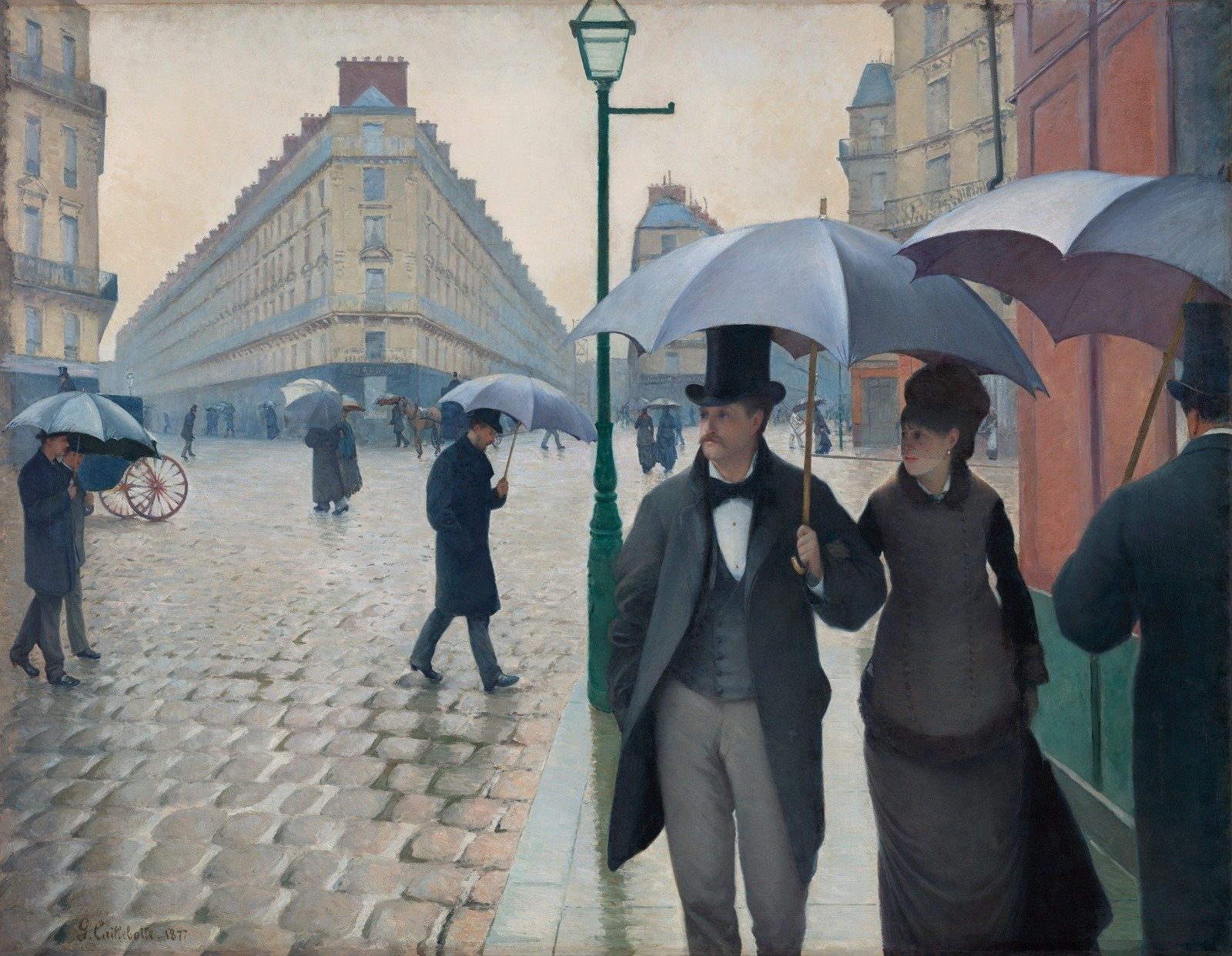
A wet afternoon at a Paris crossroads. A couple under one umbrella walks almost straight at us, while others cross the cobbles behind them. No raindrops are painted anywhere, yet you know at once that it's raining.
Caillebotte, 1877, oil on canvas
Gustave Caillebotte painted this in oil on canvas in 1877. The Art Institute of Chicago calls it his largest and most ambitious work, a busy intersection a short walk from his home. The rain, the museum notes, comes from umbrellas and reflections on the wet stones.
Split by a lamppost
Look at how the picture is built. A tall green lamppost stands near the middle and splits it in two. On the left, the streets open wide and run deep into the distance. On the right, the couple fills the frame, cropped as sharply as a photograph might be.
The couple
Now the couple. His top hat, coat and bow tie have crisp, controlled edges. Her dark dress shifts gently between warm and cool, with a little violet in the shadows and a fine veil over her cheek. Both seem to glance at something outside the picture.
One green upright
The lamppost is the strongest colour in the picture, a cool green in a world of greys and creams. It runs almost the full height of the canvas, lighter near the lantern and darker at the base. Its crisp edge holds firm against the soft, pale sky.
Stones, stroke by stroke
Drop down to the paving. Each stone seems built from a few short strokes: a warm pinkish base, a cooler grey shadow on one side and a creamy highlight on the other. The joints between them are thin and broken. In the corner is the inscription, G. Caillebotte, 1877.
Water on stone
Across the middle of the street, the stones begin to blur. Pale vertical streaks of grey and near-white are dragged over the warmer ground. They don't mirror anything exactly, but your eye reads them as water lying on stone.
The sharp corner
Further back, a wedge-shaped building points straight at us, its sides running away in perspective. The corner is a crisp, dark edge against the pale sky, and the windows repeat in regular columns. That one sharp corner gives the street its depth.
Caught mid-step
Here a man hurries across, his heel lifted, caught in mid-step. The museum points out that painters of the time rarely tried to show people in motion. Further left, a carriage waits, its wheel drawn with a thin dark rim and reddish spokes.
Near and far
Now compare the couple with the walkers in the distance. Up close, everything is crisp and fully modelled. Far off, people become soft blue-grey shapes with no faces at all. That change in sharpness pushes the street back as much as the perspective lines do.
Look closer
10 details, each checked against a close-up of the picture.
-
Bourgeois Couple
The man wears a black top hat and the woman a dark dress with a high collar.
The crop centers on a couple rendered with crisp, photographic contours against a softer, hazier background of pedestrians and architecture. The man's top hat, overcoat, and trousers are painted in deep neutrals with small, controlled strokes that define the bow tie, fur collar, and buttoned vest; his face shows blended flesh tones with a sharp moustache edge. The woman's dark dress is modeled with subtle warm-cool shifts (a touch of violet in the bodice shadows, a hint of rust at the cuff) and her veil is a translucent gray film over a pale cheek. The pale blue umbrella above them is laid in with broad, slightly visible directional strokes that feather at its scalloped edge, while the green cast-iron lamppost to the left is painted with long vertical strokes showing tonal banding.
-
Green Lamppost
The lamppost is a saturated green color contrasting with the surrounding gray tones.
The vertical lamppost spans nearly the full height of the crop in a saturated cool green that reads at first as a single local hue but actually darkens slightly toward the fluted base and lightens around the collar and lantern junction. Its edges are crisp and linear against the desaturated warm gray sky and the muted blue-gray umbrella behind it, making the post the highest-chroma element in the field. A thin horizontal arm projects right at roughly the upper third, painted in the same green. The lantern glass at the top is rendered in cool near-whites and pale grays, framed by the dark green housing, while the lower base shows a darker, almost black-green passage where the post meets the wet pavement.
-
Cobblestone Textures
Individual stones are rendered with small, distinct strokes of varied gray and brown.
The crop is dominated by a regular grid of roughly octagonal paving stones receding into the upper third, where one pedestrian's dark shoe enters the frame at the top right. Each stone is built from a few short, distinct brushstrokes: a warm pinkish-beige base is overlaid with cooler gray shadows along the lower-right edge and a creamy off-white highlight along the upper-left edge, giving each block a beveled, lit-from-above volume. The interstitial joints are dark, thin, and slightly broken rather than continuous lines, with greenish-brown tints pooling where stones meet. Across the central band the paint softens into wet, blended passages where cream and pale lavender strokes smear across two or three stones at once, reading as rainwater reflection. A signature 'G. Caillebotte 1877' sits in the lower-left corner in reddish-brown.
-
Wet Pavement Reflections
Vertical white and light-gray streaks represent reflections of the sky and figures on wet stone.
The crop is dominated by a cobblestone sidewalk rendered in warm beige and ochre tones, with cooler gray-white streaks and patches where the stones are saturated with rainwater. One pedestrian's dark trousered legs and black leather shoes advance from the upper edge; the trailing shoe catches a small specular highlight, while the leading shoe reads as flat dark. A vertical green post (likely a lamp standard or umbrella shaft) sits at upper right, and a swathe of black fabric edges in from the far right. A pale blue-gray strip — the curb or gutter — runs diagonally from lower center toward the right margin, wet and lighter than the surrounding stones. The pavement brushwork is loose and directional, with vertical white/gray strokes layered over the warmer ground to suggest reflective sheen without defining any specific mirrored figure.
-
Architectural Recession
The building edges create a sharp diagonal line leading toward the upper left.
The crop is dominated by the sharp vertical edge of a Haussmannian building corner that bisects the frame, with the left-hand facade receding toward the upper left via a series of diminishing cornice and window lines. The building's silhouette is rendered as a crisp, dark blue-gray contour against a warm cream-tan overcast sky, giving the edge high contrast. Window bays are stacked in regular vertical columns, each opening a darker navy rectangle that reads as a repeated rhythmic motif rather than individually lit shapes. The cornice line is articulated with small, closely spaced vertical ticks of darker pigment, while the wall plane softens into cool blue-grays and ochres with subtle wet-into-wet blending.
-
Walking Pedestrians
The man at u=0.35 is captured mid-stride with one foot lifted.
The crop centers on a single pedestrian in a long dark overcoat and bowler hat, holding a grey-blue umbrella at shoulder height. His right leg is planted flat while the left foot is lifted at the heel, toe still grazing the wet cobblestones, confirming the mid-stride read. The figure is silhouetted as a near-solid dark mass against a paler, broken ground of tan and grey pavement, with crisp contours on the leading shoulder and a slightly softened edge along the trailing coat hem. Background pedestrians and a horse cart are reduced to small dark shapes that read as accents, not detail. Short, hatched strokes describe the wet reflections on the paving stones, while the coat itself is built from broader, loaded strokes that read almost flat at this scale.
-
Carriage Wheel
The carriage wheel is drawn with a thin, dark rim and reddish spokes, tilted in steep perspective.
The crop shows a spoked carriage wheel tilted in steep perspective, with a thin dark rim curving around its circumference and a dark central hub. The spokes are clearly warm reddish-orange (rust/burnt sienna tones), not white — the verified claim is inaccurate on that point. The surrounding pavement is rendered in cool grays and pale blues with broken, scumbled brushwork suggesting wet reflections. A pedestrian's lower leg in dark trousers and shoe enters the upper right, while dark drapery (umbrella/cloak) occupies the upper left, anchoring the wheel between figure and ground.
-
Umbrella Canopy
The underside of the umbrella shows a network of ribs and a pale blue-gray fabric.
The crop isolates the underside of a large dome-shaped umbrella, revealing a pale blue-gray fabric stretched across radial ribs that converge near the upper center. Subtle value shifts distinguish the individual fabric panels: a slightly cooler, lighter tone along the upper curve and a faintly warmer, deeper blue-gray toward the lower edge. The ribs read as soft linear shadows rather than crisp lines, with the panel seams visible as gentle tonal breaks. To the right, a second umbrella in deep plum-mauve overlaps, its underside catching less light and reading nearly black in its recesses.
-
Artist Signature
The signature and date, recorded by the museum as 'G. Caillebotte. 1877', sit in the lower left corner; the letters are hard to resolve at this scale.
The crop is dominated by long, soft-edged vertical streaks running top to bottom, suggesting wet-into-wet vertical drag or motion-blurred strokes. Values cluster in a narrow mid-range of muted green-grays (v≈0.35–0.55), with a slightly lighter, cooler band across the upper third and warmer reddish-brown notes along the very bottom edge. No legible letterforms or numeric characters are resolvable at this resolution; the darker shapes read as low-contrast vertical passages rather than formed glyphs. Edges throughout are soft, with no crisp contours anywhere in the frame.
-
Distant Figures
Figures in the distance are rendered as simplified, blurry shapes with less detail.
The background figures appear as flat, simplified silhouettes rendered in muted blue-grays with a small touch of dusty pink at roughly (0.32, 0.55). No facial features, fingers, or clothing folds are readable; only a head, a torso, and a bundled shape (likely a child or package) can be parsed. Edges between figure and pavement are soft, with pigment feathered outward rather than crisply outlined. The wet cobblestones around them are suggested with horizontal streaks in cool grays, and the overall value range is compressed into a narrow mid-tone band compared to the sharp, fully-modeled man on the right.
Paris Street; Rainy Day in context
A crossing near home
The Art Institute of Chicago calls Paris Street; Rainy Day Gustave Caillebotte's largest and most ambitious work; it measures 212.2 by 276.2 centimetres and is inscribed 'G. Caillebotte. 1877' at lower left [1]. The museum says the intersection was a short walk from his home, and that his paintings of Paris rarely go beyond his familiar neighbourhoods [1]. Wikipedia identifies the place as the meeting of the rue de Turin, rue de Moscou, rue Clapeyron and rue de Saint-Pétersbourg, today's Place de Dublin, near the Gare Saint-Lazare [2].
This was newly rebuilt Paris. Wikipedia describes the decades-long remaking of the city under Napoleon III's prefect Georges-Eugène Haussmann, noting that the Caillebotte family moved into a large house in the eighth arrondissement while it was under way [2]. It counts 24 figures, most of them well off, with a maid, two cab drivers and a house painter carrying a ladder among them [2]. And the Art Institute adds that the umbrellas were a newly available retractable type [1].
Planning the scene
Wikipedia reports 23 surviving studies in graphite and oil, most of them working out where to place the pedestrians [2]. The museum suggests that the dramatic cropping may have been inspired by photography [1]. How Caillebotte actually built his perspective is debated: Wikipedia records that many scholars have assumed he worked from photographs, but that a 2015 Art Institute investigation concluded he probably used a camera lucida [2].
The museum stresses that although his subject was modern city life, his technique was closer to Realism than to the loose handling of his Impressionist colleagues [1]. According to Wikipedia, the painting was treated in 1964 and again after the 2012 to 2013 exhibition Impressionism, Fashion, and Modernity, when a deteriorated early twentieth-century varnish was addressed [2].
Shown once, then kept in the family
The painting first appeared in April 1877 at the third Impressionist exhibition, at 6 rue Le Peletier. It was number 1 in the catalogue under the title Rue de Paris; Temps de pluie [1]. Caillebotte was an unusual member of the group. Born into a well-off family, he used his money to finance and organise several of its exhibitions and to buy his colleagues' work [3]. Wikipedia says critics praised the painting's precision, though some objected to the lack of visible rain and to the treatment of perspective [2].
It wasn't exhibited again until a retrospective at Durand-Ruel in June 1894, the year of the artist's death [1]. His death also brought the bequest of his collection of Impressionist paintings to the French state [3]. But this canvas stayed with the family. The museum's provenance follows it from his brother Martial and Martial's wife Marie Minoret, to Georges Minoret at the Château de Montglat near Provins in 1900, back to Albert and Geneviève Chardeau, Martial's daughter, in 1950, to Walter P. Chrysler Jr. in 1954, and through Wildenstein and Company to the Art Institute in 1964 [1].
Rediscovery
The museum says the painting has been a visitor favourite since it arrived in 1964, well before Caillebotte's contribution to Impressionism was widely recognised [1]. Wikipedia credits the purchase with helping to revive his reputation. That reputation had faded after he withdrew from exhibiting in the early 1880s to concentrate on gardening, sailing and stamp collecting [2].
In 2024 the painting returned to Paris as one of the centrepieces of Gustave Caillebotte: Painting Men at the Musée d'Orsay. The exhibition went on to the J. Paul Getty Museum and closed in Chicago in 2025 as Gustave Caillebotte: Painting His World [3]. A reviewer of the Paris showing notes that Caillebotte focused almost entirely on male figures, and that his street scenes set top-hatted gentlemen alongside working men [3].
- Gustave Caillebotte, Paris Street; Rainy Day (1964.336): object record, provenance and exhibition history . The Art Institute of Chicago
- Paris Street; Rainy Day . Wikipedia
- Amit Kestenbaum, review of Gustave Caillebotte: Peindre les hommes (Painting Men), Nineteenth-Century Art Worldwide 24, no. 1 (Spring 2025) . Nineteenth-Century Art Worldwide