The book, not the face
How Beatrix Godwin Whistler makes an open book the brightest point in a quick sketch of a reader
- Artist
- Beatrix Godwin Whistler
- Title
- Peach Blossom
- Date
- c. 1890-1894
- Medium
- oil on wood
- Image
- Public domain (CC0)
Open in Simple Art
Watch this story on iPhone and iPad, with offline downloads and a painting every day.
About 3 minutes of looking, in 9 parts.
A reader in pink
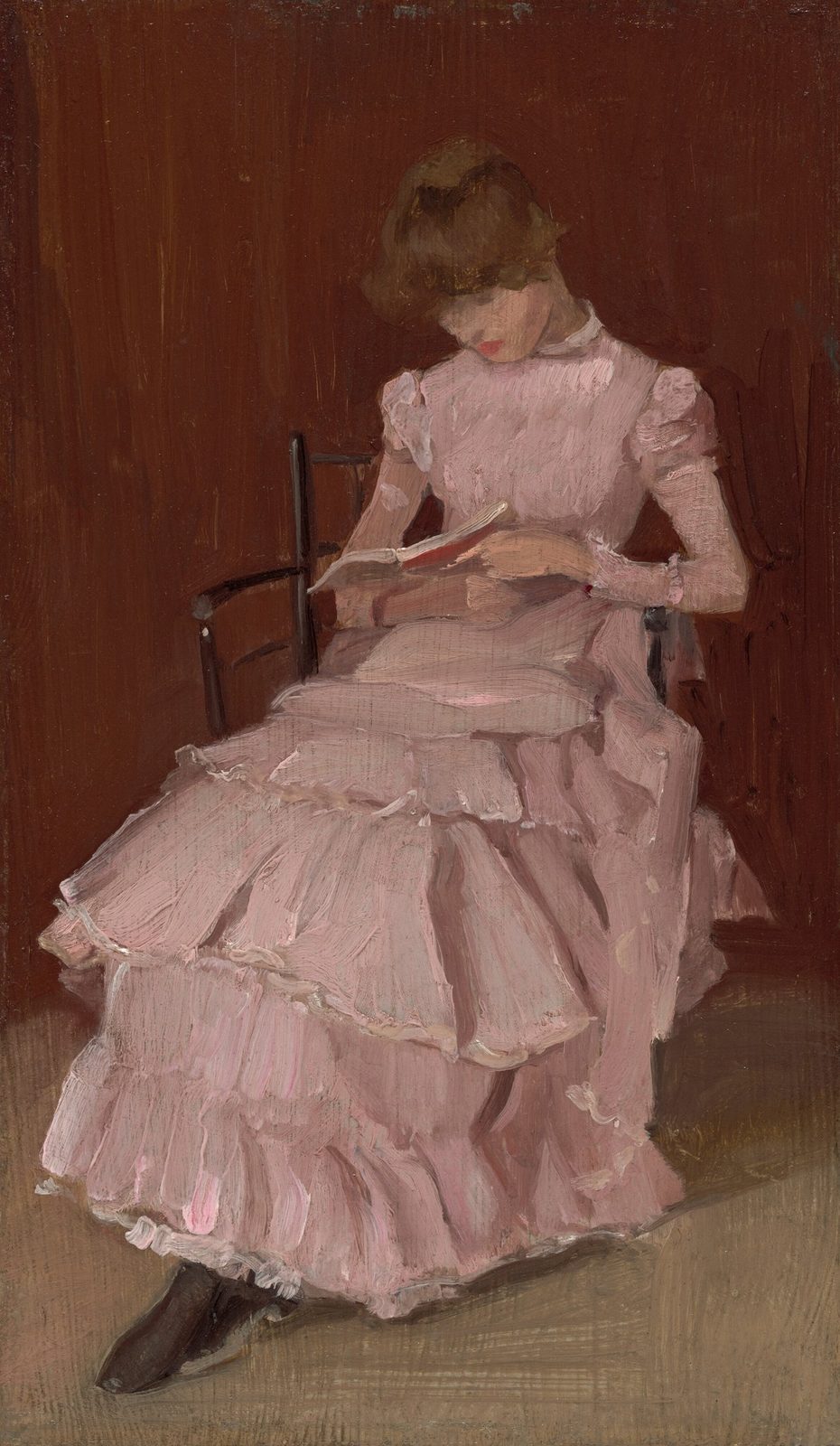
A young woman in a pink dress sits reading, her head bent so low that we hardly see her face. The brightest thing in the picture isn't her face at all. It's the open book in her lap.
Beatrix Godwin Whistler, c. 1890 to 1894
This is Peach Blossom by Beatrix Godwin Whistler, painted around 1890 to 1894 in oil on a wooden panel. It's tiny, only about twenty-four centimetres tall. The brushwork is loose and quick, and the setting is little more than a dark wall, a chair and a floor.
A pink pyramid
The figure makes a broad pyramid. Her head is the peak, and the shape widens through the bodice to a skirt that spreads almost the full width of the panel. The open book sits near the middle, where the eye keeps coming back.
The palest pink
The light is soft, with no hard shadows anywhere. Look at the shoulder on the right. Its strokes are paler and look thicker than the pink beside them, so they seem to catch the light. Down the sleeve, warm pink turns grey-violet where the arm faces away, and there's no outline at all.
Warm pink, cool pink
What separates her from the wall is temperature more than colour. On the bodice the lit pink is a warm rose with a hint of orange. Where shadow falls between the bust and the arm, the same pink turns cooler and greyer, as if a little blue had been mixed in.
A face that's hardly there
Now the head. The face is one warm mid-tone with almost no modelling. The eyes are lost in a soft shadow under the hair, and the mouth is a single small red stroke. Hair and wall are so close in tone that the head barely separates from the background.
The open book
Here is the heart of the picture, the hands and the open book. It's the lightest cluster in the painting, laid in with thick strokes of cream and pale pink. A crisp white stroke runs along the top page, and a strip of red, probably the cover, shows just beneath it.
A skirt in tiers
Follow the skirt down. Each tier is a band of broad horizontal strokes in dusty rose and grey-violet. Along the lower edge of every ruffle, a pale dragged stroke marks the turn of the cloth and overlaps the tier below, so the edge stays soft and broken.
A hem with no outline
At the hem the strokes get shorter and break into small dabs of pale pink and white. They simply stop above the floor, with no contour line. Just below, the shoe is barely two dark strokes, with one small warm touch on the toe.
Look closer
10 details, each checked against a close-up of the picture.
-
Hands and open book
The open book and the hands holding it form the single lightest-value cluster in the painting, rendered with thick strokes of warm cream and pink.
The crop centers on an open book held in two hands, with a tiered pale-pink skirt filling the lower half and a small cream-colored shoe visible at bottom-left. The book's page block is built from thick, loaded strokes of cream and pale pink, with a bright white impasto edge along the topmost page. The hands are modeled in warm pinks and dusty roses, with a small saturated red accent at the right wrist (likely a ribbon or bracelet) and a cooler grey-pink along the left thumb. Horizontal sweeping strokes define the lap and the curved front of the skirt, and a faint diagonal weave/cross-hatch pattern is visible beneath the paint in the lower lap area, suggesting the canvas texture or an underdrawing. The dark warm brown of the background frames the upper right, where the figure's arm meets the wall in a soft, broken edge.
-
Bowed head and summary face
The face is a single warm mid-tone with almost no modelling; the eyes are lost in soft shadow under the hair and the mouth is a small red stroke, with no pupils or nostrils painted.
The crop isolates a downward-tilted head, where the facial mass is blocked in as a single warm mid-tone (peach-ochre) with almost no modulation across the cheeks, jaw, or forehead. A heavy dark horizontal smear at roughly mid-face height reads as closed or downcast eyes, bisected only by a short vertical greenish-olive slash for the nose. The mouth is a single short red stroke sitting low on the head, off-center, with no nostril or pupil marks anywhere. Hair and background read as a continuous dark mass because their values are nearly identical, and the face's lower edge dissolves into a pale pink shoulder that itself is only loosely defined by directional, unblended strokes.
-
Mid-skirt tier strokes
The skirt tiers are built from broad, separate horizontal strokes of dusty rose and grey-violet, with dragged white scumbles forming the lower edge of each ruffle.
The crop shows the mid-section of a tiered skirt rendered in broad, sweeping horizontal strokes of dusty rose and grey-mauve paint against a flat dark brown ground. Each tier is defined by a continuous, dragged white-cream scumble that runs along the lower edge where the ruffle turns, lifting the value at the break between forms. The strokes are loaded and directional, with the brush pulling the pigment down and across, leaving combed ridges and small transverse toolmarks where the hairs caught heavier paint. Where two tiers meet, the white scumble overlaps the rose body of the tier below, creating a soft, broken edge rather than a hard line.
-
Illuminated shoulder and sleeve
The shoulder and upper sleeve on the right side of the figure contain strokes of pale pink-white that are clearly several tones lighter than the center of the bodice.
The crop isolates a fabric passage where thick, ridged strokes of pale pink-white sit along the upper-right shoulder and sleeve, physically raised above the surrounding surface. These highlight strokes are laid in long, slightly diagonal sweeps that read as distinctly cooler and lighter than the flatter, more saturated rose-beige strokes filling the bodice center just to their left. Toward the right edge the marks become shorter and more broken where the light catches the curve of the shoulder, while a deep chocolate-brown shape (background) and a small triangular dark recess (under-arm shadow) frame the lit area. Edges between highlight and mid-tone are achieved by stroke direction and paint thickness rather than a smooth gradation.
-
Bodice color temperature
The bodice contains strokes of warm rose on the light plane and cooler blue-pink in the shadow between the bust and arm, modulating form through temperature shifts.
The crop isolates the upper torso, the lower face (chin and red mouth) at top, and the open book resting across the lap. The bodice is built from broad, loaded diagonal strokes running roughly upper-left to lower-right; these strokes vary in temperature rather than just value. On the right shoulder and the broad front plane, the paint reads as a warm dusty rose with a faintly orange-pink undertone. Toward the left, where the arm meets the body and a cast shadow drops from the bust, the same pink desaturates into a cooler, slightly violet-grey-pink, noticeably lower in chroma and temperature. The edge between warm and cool zones is soft and irregular, defined by a few broken grey-pink strokes rather than a hard line. A horizontal band of cream and a saturated red ribbon from the book slice across the lower third, while deep brown background frames the left.
-
Lower skirt hem and edge
The bottom hem of the skirt dissolves into individual loose strokes of white and pale pink that end abruptly above the floor, creating a soft edge without an outline.
The crop captures a wide swath of vertical, dragged brushwork in muted rose and dusty pink that defines the lower body of a skirt. Along the lower third the strokes shorten into broken, staccato marks where pale pink and near-white pigment hang over the tonal change to the warm tan floor below; these strokes simply stop rather than turning into a contour line. At lower left a roughly triangular form in dark umber–black sits against the floor, its edges softened by scumbled mid-tone. The floor itself is laid in horizontally brushed tan/olive, and the boundary between hem and floor is established by value and color shift alone, not by a drawn edge.
-
Right sleeve and forearm
The sleeve and forearm are built from strokes of warm pink where lit and grey-violet in shadow, turning the form by color direction without any contour line.
The crop isolates the figure's right sleeve and forearm against a flat dark brown wall. The lit planes are built from thick, directional strokes of warm pink and peach, while the underside of the arm and the folds shift into cooler grey-violet and muted mauve. Edges between light and shadow are formed by abrupt temperature and value shifts rather than by drawn contours; small wet-into-wet blends soften only where the strokes overlap. The brushwork clearly tracks the cylinder of the arm, with strokes curving over the upper sleeve and running more longitudinally down the forearm. At the lower edge, a sliver of grey near the lap suggests the book and a tiny red accent breaks the otherwise pink-brown harmony.
-
Dark shoe and floor
The shoe is painted with only two dark brown strokes and a small pale highlight on the toe, lacking any laces, eyelets, or sole line.
The crop centers on a dark, pointed shoe rendered as a simple lozenge shape against a tan floor, with the ruffled pink and white hem of a skirt above. The shoe body is built from essentially two broad dark brown strokes — one angled stroke forms the instep, the other defines the pointed toe — that meet in a soft, blurred seam rather than a hard edge. A small pale grey dab sits at the tip of the toe, the only value lift on the form, and a thin lighter strip traces the underside where the shoe meets the floor. There are no painted laces, eyelets, stitching, welt, or heel block; the entire object is a silhouette with one pale accent.
-
Floor dry-brush texture
The floor is scratched in with vertical dry-brush streaks of tan and grey that leave the darker underlayer visible in the gaps between strokes.
The crop shows the lower hem of a pale pink/rose dress meeting a brown floor plane. The floor is built from short, vertical dry-brush strokes in tan and cool grey, with the darker brown underlayer clearly visible in the negative spaces between marks. The pink fabric above shows softer, broader wet-into-wet strokes that contrast with the scratchy, broken texture of the floor below. A transitional ridge of darker brown and a few white scumbled touches mark where the hem rests on the ground.
-
Suggested chair back
The chair behind the figure is indicated by only a few thin dark strokes and two small grey highlights, with no filled seat or back panel.
The crop shows the central-left portion of the painting where a chair is implied rather than depicted. A single thin vertical dark stroke runs from upper-center downward, intersecting with a short horizontal stroke near the top right that bends back into the wall, and a curved descending stroke on the left forms what reads as an arm or leg. Two small pale grey dabs — one ovoid at the curve junction on the left, one tiny round dot below it — sit on these dark linear marks. The chair's mass is entirely the underlying brown wall color, never blocked in; only the structural edges are drawn. To the right, soft pink fabric strokes enter the frame, contrasting the linear chair marks with broader, warmer brushwork.
Peach Blossom in context
A designer in Chelsea
Beatrix Whistler was born Beatrice Philip in London on 12 May 1857, a daughter of the sculptor John Birnie Philip and Frances Black [2]. She studied in her father's Chelsea studio and with the architect Edward William Godwin, a leading figure of the Aesthetic Movement, whom she married [2]. Her designs for tiles, panels and wallpaper survive, and many were sold to manufacturers, including Minton's [2].
Godwin died in 1886, and on 11 August 1888 she married James McNeill Whistler [2]. She joined his pupils, who included Walter Sickert, and exhibited as Rix Birnie to avoid being classed as a woman or an amateur [2]. In 1892, the couple moved to Paris [3].
A small, quick oil
Peach Blossom measures 23.7 by 13.8 centimetres and is painted on a single piece of light softwood over a white ground laid on with sweeping strokes [1]. The National Gallery of Art's conservators describe it as executed very spontaneously, blending thick paint wet into wet on the figure while using thin browns and greys that let the ground show through in the background [1]. Losses around the edges seem to have happened when the still-wet paint stuck to the frame [1].
According to the Glasgow edition of Whistler's correspondence, her subjects were mainly flowers and women, and her curving strokes differ from her husband's narrower, smoother ones [2]. Family members and professional models posed for both Whistlers [2].
Sold as her husband's
Whistler labelled the panel "Mrs J McN Whistler". With the s of Mrs rubbed out, it was bought as a work by him [2]. The gallery thinks the artist probably gave or left it to William Webb, of Whistler's lawyers, and Webb certainly owned it by 1904, when he lent it to the Whistler memorial exhibition at Copley Hall in Boston [1].
In 1930 the Philadelphia collector Lessing J. Rosenwald bought it through the dealer Charles Sessler, with a certificate from Sickert, and he gave it to the National Gallery of Art in 1943 [1]. The gallery's 1970 catalogue still listed it as by James McNeill Whistler, and the 1980 catalogue gave it to Beatrix [1].
Separating her hand
Beatrix developed cancer in 1894 and died on 10 May 1896 [2]. Her youngest sister, Rosalind Birnie Philip, inherited Whistler's estate and gave the Hunterian Art Gallery in Glasgow the finest collection of her work [2]. Little of what she exhibited survives, her small oils are sometimes mistaken for his, and telling her work apart from that of her partners remains a central problem [2]. Wikipedia lists Peach Blossom among the small number of her works that remain [3]. The gallery listed it as not on view when this was written [1].
- Peach Blossom (1943.11.8): object record, provenance, exhibition history, technical summary and bibliography (Internet Archive copy, 23 September 2025) . National Gallery of Art, Washington
- Beatrix Whistler, 1857-1896: biography, The Correspondence of James McNeill Whistler . University of Glasgow
- Beatrice Whistler . Wikipedia