Gauguin's Quiet Triangle: A Walk Through Polynesian Woman with Children
Reading the late master on color, contour, and Cloisonnist family portraiture
- Artist
- Paul Gauguin
- Title
- Polynesian Woman with Children
- Date
- 1901
- Medium
- Oil on linen canvas
- Museum
- Art Institute of Chicago
- Image
- Public domain (CC0)
Open in Simple Art
Watch this story on iPhone and iPad, with offline downloads and a painting every day.
About 5 minutes of looking, in 11 parts.
Three faces, one quiet triangle
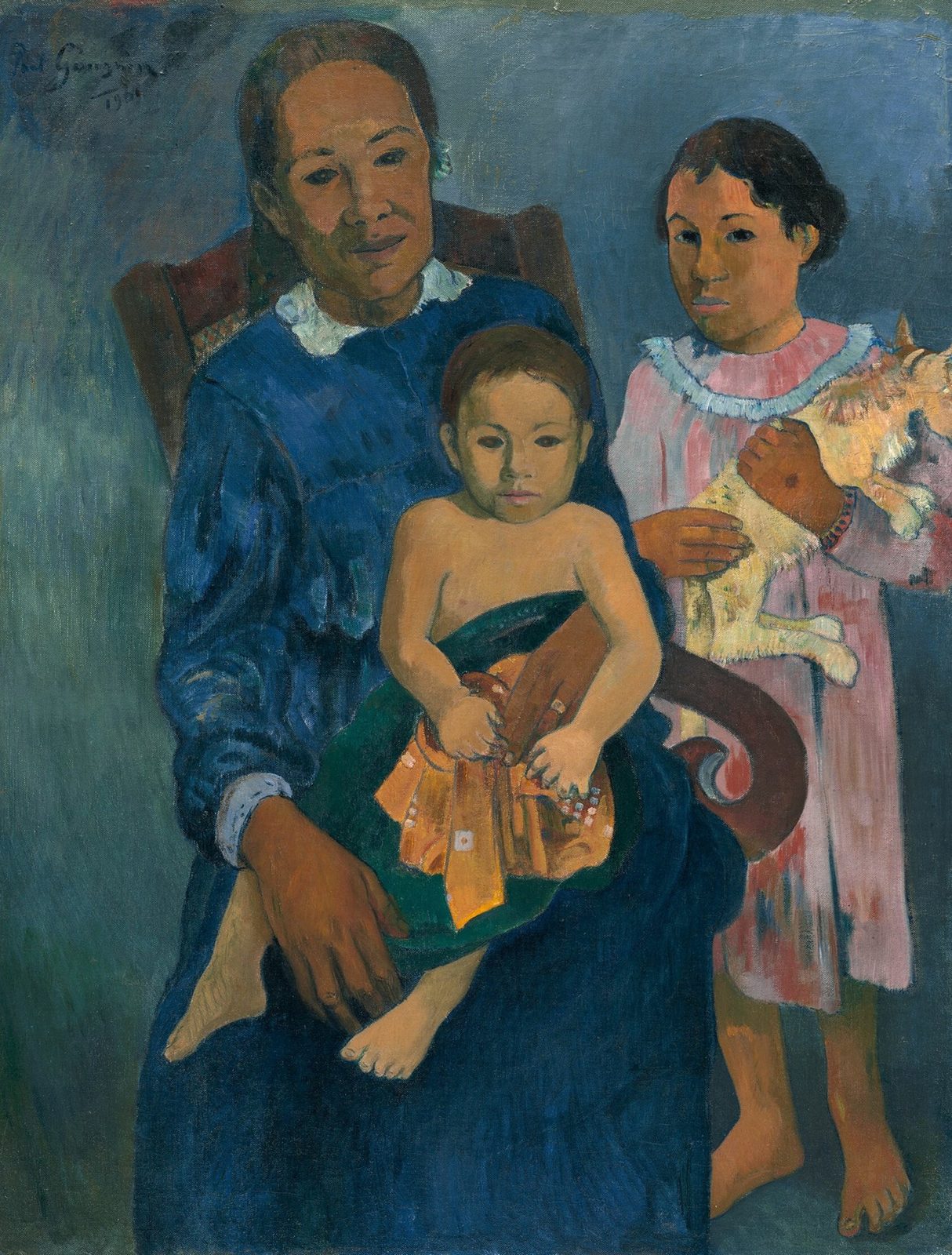
Three faces, three gazes, one quiet triangle of devotion. Step into Paul Gauguin's 1901 canvas, where a seated mother anchors a pyramidal family group, a wide-eyed toddler grips a glowing orange cloth at the center, and a pink-clad girl clutches a white kitten on the right. The whole image reads instantly as intimate, yet deliberately composed, like an icon rather than a casual snapshot.
Late Gauguin, oil on linen
This is Polynesian Woman with Children, oil on linen, painted in 1901, late in Gauguin's career. His Post-Impressionist hand is unmistakable in the flat planes of saturated color, the simplified contours around each figure, and the dark outlines that separate skin from cloth, the very Cloisonnist edge we will trace in a moment.
A pyramid with a diagonal spine
Notice the triangular scaffolding. The mother's head at upper left, the toddler at center, the standing girl at upper right form a stable pyramid, while a strong diagonal sweeps down through the orange cloth and the maternal hand. Two diagonal guides underscore the construction: one falling from the mother's face to the child's lap, the other rising from the kitten back up to the standing girl's chin.
Soft, upper-left, no hard shadows
Light arrives softly from the upper left, with no hard cast shadows anywhere, an interior, overcast luminosity. You can see it in the brighter cheek on the right side of the toddler's face and the gentle shadow falling to the figures' right. Watch how that diffuse light rakes across the whole composition as we drift toward the painted center.
The anchor: toddler and orange cloth
Here at the painted center, the toddler's face and the orange cloth become the visual anchor. The skin is built from warm ochre planes with a cooler shadow along the left jaw, and a brighter highlight rides the right cheek, confirming that upper-left source. Below, both small hands grip a bundled orange cloth patterned with little white-square motifs, set hard against the deep teal-blue of the mother's dress.
Orange against blue, no soft seam
Now look at the complementary collision. The saturated orange of the cloth ranges from a chrome-yellow highlight at the top fold through cadmium mid-tones to burnt-sienna shadows, sitting flush against an ultramarine blue field with almost no blended transition. A hard dark seam at the orange-blue border makes the warm shape leap forward, while the hands act as a chromatic bridge, their pinkish-orange flesh touching both zones.
One dark stroke, then flat planes
Follow the toddler's shoulder up against the cobalt background, and you find the stroke Gauguin favors: a single dark contour tracing the silhouette where flesh meets blue. Rather than softening that edge, he commits to a bold outline and then fills the interior with broad, flat planes of warm and cool skin, cool tan-green turning under the arm, warm ochre riding the shoulder. The Cloisonnist line does the work of anatomy.
Modeling with temperature, not value
Inside the figure, the technique softens. Across the toddler's chest you can read short, slightly directional brushwork sweeping the sternum, with warm peach and golden-yellow advancing while cool olive-green recedes along the shadow side. Gauguin models volume with color temperature rather than value, and then reasserts that one dark stroke only where the silhouette turns against the blue.
Fur as multi-directional marks
Drift right to the kitten cradled against the pink dress, and the handling shifts again. The fur is built from short, thick, multi-directional strokes in cream, warm grey, and a cool greenish shadow underneath, with pink reflections bouncing into the upper edges from the dress. The texture stays alive because the edges are never blended, just broken by overlapping marks of the adjacent pink.
A hand in three tones and a contour
Back to the mother's hand wrapping the child's leg, and you feel the gesture. The fingers are simplified into trapezoidal shapes, each bounded by a dark line, with one well-placed tonal shift suggesting knuckles rather than careful modeling. A scalloped white cuff at the wrist provides the only cool highlight on the form. One stroke and a clean contour carry the entire protective gesture.
Frill as a rhythm of white commas
Finally, the standing girl's collar, a rhythmic row of small comma-shaped white dabs over a pale blue shadow, reading instantly as lace. Between each white stroke, that cool blue peeks through, while a crisp dark contour runs along the lower edge of the frill. Gauguin paints decorative pattern as discrete marks, never as a single blended white shape.
Look closer
8 details, each checked against a close-up of the picture.
-
Central Figure Group
The toddler's face and orange cloth are centrally positioned between the two older figures.
The crop centers on a toddler's face rendered in warm ochre skin tones, with a darker shadow plane along the left jaw and a brighter highlight on the right cheek, confirming upper-left lighting. Below the chest, both small hands clasp a bundled orange cloth patterned with small white-square motifs and pale floral accents. The orange sits against a deep teal-blue dress field to the upper left and a darker green-blue mass at the lower edge, while a sliver of pink and white frilled fabric intrudes at the right margin and a brown-orange form occupies the lower-left corner. Dark outline strokes visibly separate the child's silhouette from the blue background, and the cloth folds are suggested with quick curved strokes rather than modeled gradations.
-
Artist Signature
The upper left corner contains the text 'P Gauguin' and the date '1901'.
The crop reveals a section of woven canvas where the blue ground is thinly painted, allowing the regular grid of warp and weft to read through the surface. Dark, slightly desaturated navy-to-black pigment forms cursive script reading approximately 'P Gauguin' with trailing strokes consistent with a '1901' date, set against the mottled cerulean/Prussian-blue background. The letter edges are soft and broken, with pigment sitting partly on top of the weave rather than filling it, so highlight threads remain visible within the strokes. Lighter flecks in the field are the raw canvas catching diffuse light rather than added paint, giving the signature area an atmospheric, slightly worn tonality.
-
Complementary Contrast
The bright orange cloth sits directly against the deep blue of the woman's dress.
The crop centers on two hands gripping a draped orange-gold cloth that descends into a broad V-shape against a deep ultramarine blue field on the right and a dark teal-green field on the left. The orange reads as a warm scale running from a pale chrome-yellow highlight near the top fold, through cadmium-orange mid-tones, into a burnt-sienna shadow along the cloth's left edge. A hard, near-vertical contour line in dark brown separates the orange cloth from the blue, and small circular white dabs punctuate the orange at two spots. The hands are modeled with pinkish-orange flesh tones that act as a chromatic bridge between the two complementary zones, while the smaller hand shows a cool violet cast on its shadow side.
-
Cloisonnist Outline
A dark, distinct line separates the toddler's shoulder from the blue background.
The crop isolates the upper torso and bent arm of a young child rendered in warm ochre-peach flesh against a deep cobalt background. A dark, near-black contour line traces the top of the shoulder and outer arm where flesh meets blue, confirming the Cloisonnist edge. The skin is modeled with broad, flat planes rather than smooth blending—shadow under the arm shifts to a cooler tan-green while the upper shoulder reads warm and light. A small reddish fleck sits on the chest, and the lower right corner introduces a darker green-teal passage suggesting layered clothing.
-
The Kitten's Fur
The white fur of the kitten is rendered with short, thick white and grey brushstrokes.
The crop centers on the kitten cradled against the pink-and-white striped dress. Short, thick brushstrokes in cream, white, and warm grey build the fur in layered, multi-directional marks — many run diagonally while others follow the curve of the body. Shadows on the underside read as cool grey with a slight greenish tint, while pinkish reflections bounce into the upper edges from the surrounding dress. Edges are mostly soft and broken, though a firmer contour appears where the kitten's back meets the hand and dress. The body extends into two distinct paw/limb shapes pointing right, painted with paler, smoother strokes than the textured torso.
-
Skin Tones
The toddler's torso is painted with blended peach and yellow tones without hard outlines.
The crop isolates a toddler's face and bare upper torso against a saturated blue. Skin is built from warm peach, golden-yellow, and ochre passes, with cooler olive-green tones turning the form on the child's right side (viewer's left) and beneath the chin. Edges along the shoulder and arm, where the body meets the blue drape and the dark green cloth, read as firm dark contours, while the interior transitions between cheek, neck, and chest are softly modulated rather than sharply drawn. Individual brushstrokes are visible as short, slightly directional sweeps across the sternum and a couple of small scumbled dabs on the left shoulder.
-
Maternal Hand
The woman's large hand wraps around the toddler's leg with a simplified, broad shape.
The crop centers on a large, broad hand painted in flat planes of warm brown and ochre, with a clear dark outline wrapping each finger. The hand rests diagonally across a teal-green background on the upper left and a deep blue field (the dress) on the lower left. A white cuff with a scalloped lower edge sits at the top-left, providing the only cool highlight. The fingers are simplified into trapezoidal shapes with knuckles suggested by slight tonal shifts rather than detailed modeling. The fingertips fade into a lighter peach-cream passage on the lower right, indicating contact with another body (the toddler's limb).
-
Collar Detail
The white frills of the pink dress collar are painted as a series of small, repetitive white arcs.
The crop centers on a scalloped white frill encircling the high collar of a pink dress, with a hand resting in the lower right and a sliver of cream-orange fur or fabric at the right edge. The frill is built from repeated, comma-shaped white strokes set against pale blue shadow bands, creating a rhythmic, lace-like edge. Dark blue contour lines (notably along the lower border of the frill) separate it from the pink bodice, consistent with the Cloisonnist handling described. The pink dress itself is laid in with broad, slightly streaky brushwork where warmer rose tones sit beside cooler lilac pinks, and a turquoise-blue vertical accent runs down the left side.
Polynesian Woman with Children in context
Tahiti or the Marquesas
The painting is inscribed 'Paul Gauguin 1901' at the upper left [1]. Gauguin left Tahiti for the Marquesas Islands in September 1901, and the catalogue says it isn't clear where he completed this canvas [2]. Most scholars place the bulk of his 1901 paintings in Tahiti, but the authors think it equally possible he finished this one in the Marquesas [2].
Gauguin didn't inscribe a title, and no reference to the work is known in his letters [2]. It was shown at Ambroise Vollard's gallery in Paris in 1906 as Famille de tahitienne, and the catalogue notes it may have been the 'mother and child' in Vollard's 1903 memorial exhibition [2].
A photograph of Holbein
The authors suggest the composition may have been prompted by a photograph Gauguin owned of Hans Holbein the Younger's portrait of his wife and two eldest children, now in the Kunstmuseum Basel [2]. A 1901 photograph by Louis Grélet of Gauguin's studio shows the reproduction behind the model [2]. Britt Salvesen, cited in the catalogue, also sees in this kind of grouping an echo of the Madonna with the infant Christ and the young Baptist [2]. In Avant et après (1903) Gauguin complained that the wife's hands were too tiny to be human, and the catalogue proposes that the very large hand here may be a reply [2].
Technical study found other second thoughts. A floral motif in a bowl or squat vase once sat at the upper left and was painted out just before signing, and 'Paul' was added in front of the surname later [2]. The authors read both of these details, along with the woman's first hand position, as possible nods to Cezanne [2].
Biographical readings, and their limits
The catalogue cautiously explores whether the children stood for Gauguin's own [2]. In the autumn of 1892 he wrote that Tehamana, his first Tahitian partner, was pregnant, but no birth is recorded [2]. His daughter Aline had died in 1897 [2]. Pahura, who the catalogue notes was only fourteen when she became Gauguin's vahine, or mistress, in January 1896, bore him a daughter in 1897 who died shortly after birth, and a son, Émile, on 19 April 1899 [2].
The authors then point out that the seated woman looks at least in her forties, so she isn't likely to be Pahura, and conclude that a firm identification may not be possible [2]. They also consider whether the differing skin tones were an 'anthropological observation about race', judging aesthetic needs the more likely reason [2].
From Vollard to Chicago
Vollard lent the painting to exhibitions in Dresden and Munich in 1910 [1]. By 1927 it belonged to Heinrich Thannhauser's gallery, and Frederic C. Bartlett bought it from the Thannhauser exhibition in Berlin that February, giving it to the Art Institute the same year for the Helen Birch Bartlett Memorial Collection [1].
The conservators report that the canvas has never been varnished but carries a wax coating [2].
- Paul Gauguin, Polynesian Woman with Children, 1927.460: object record, provenance, exhibition and publication history . Art Institute of Chicago (public API)
- Cat. 122, Polynesian Woman with Children: catalogue entry by Richard R. Brettell and Genevieve Westerby, with technical study, in Gauguin Paintings, Sculpture, and Graphic Works at the Art Institute of Chicago (2016) . Art Institute of Chicago (public API)