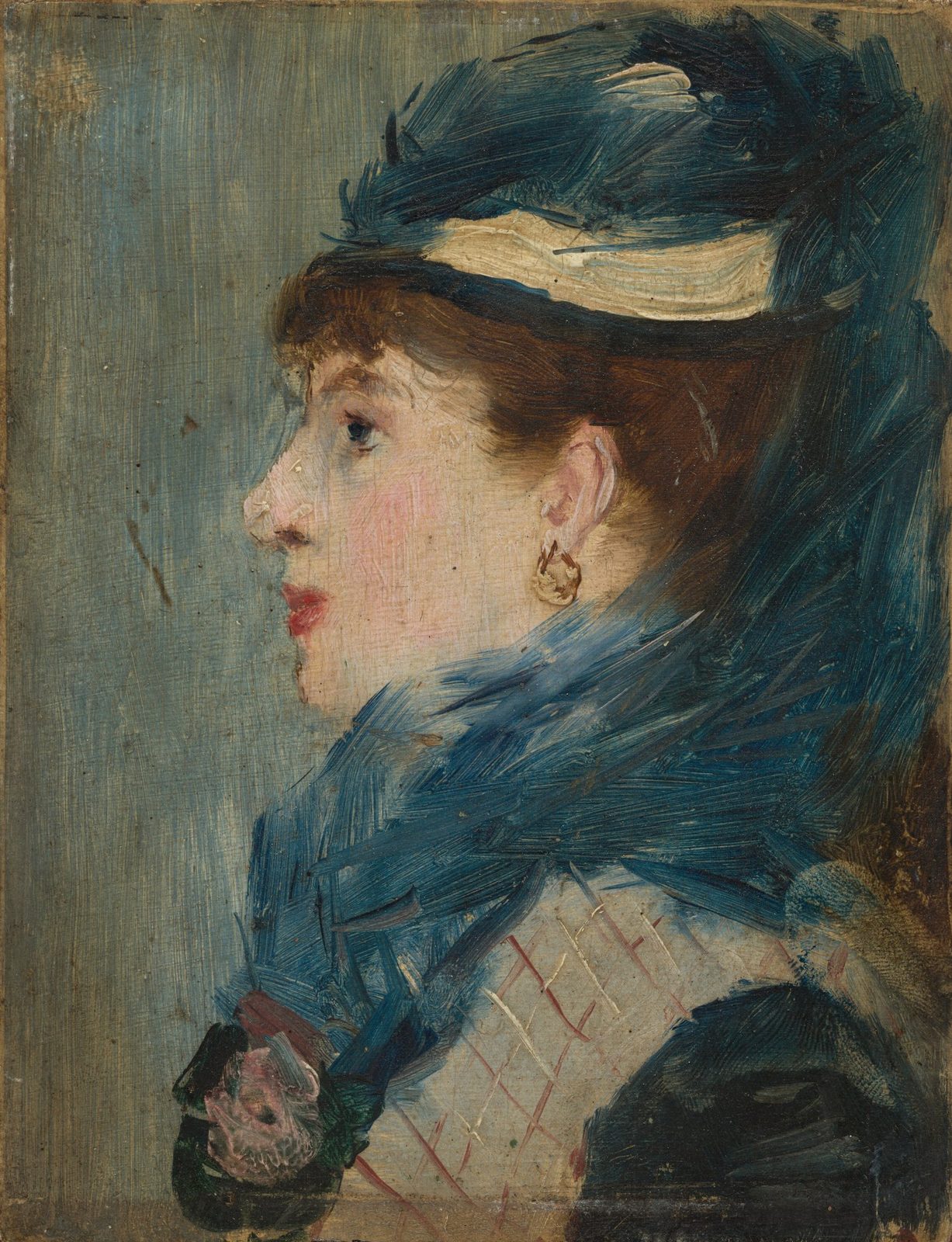
Edouard Manet, Portrait of a Lady (c. 1879)
Reading a profile in oil on wood — composition, light, and a few decisive strokes
- Artist
- Edouard Manet
- Title
- Portrait of a Lady
- Date
- c. 1879
- Medium
- oil on wood
- Image
- Public domain (CC0)
Open in Simple Art
Watch this story on iPhone and iPad, with offline downloads and a painting every day.
About 5 minutes of looking, in 12 parts.
A woman in profile, eyes turned away
A young woman turns away from us, her face in strict profile, an enormous plumed hat crowning her head. Notice how the painting refuses her gaze — she is locked in her own world, and we are left to study her silhouette. This is Manet's late style, a few strokes doing the work of a finished portrait.
Manet, c. 1879, oil on wood
Manet painted this around 1879, in oil on a small wood panel — you can already sense the intimate scale. The handling is loose, Impressionist-influenced, but the structure is deliberate, the profile as crisp as a coin.
A diagonal architecture
Set your eye on the strong diagonal that runs from the upper right, where the hat plume fans outward, down through the cream ribbon to the blue wrap at the lower left. The face itself sits on a near-vertical axis on the left side. It is a composition built on two intersecting lines, very deliberate, very stable.
Soft light from the left
Light comes from the left and slightly front, striking the bridge of the nose, the cheekbone, the hat brim, and the ear. The back of the head and the folds of the wrap recede into shadow, so the lit profile and the dark mass of hair and feathers form the painting's key contrast.
Cool blues, warm flesh
The palette is built on cool blues — the hat, the wrap — set against warm pinks, ivories, and auburn in the face and hair. A muted olive-brown ground sits between them, absorbing the temperature contrast so the figure never feels harsh.
The blue plumed hat
Drift up to the hat. The plumes are not blended at all — long, fanning strokes of dark navy and lighter teal sit beside one another, each ridge of paint still visible. A pale cream wedge, dragged over a damp dark layer, acts as the highlight. The entire hat is built in a single quick pass.
The cream ribbon
Now follow the cream ribbon down. Watch how Manet treats it as a single lit band sandwiched between the dark hair above and the black hat band below. The strokes are long and horizontal, the upper edge wetter and brighter, the lower edge stopping hard without softening. One gesture, one form.
The downcast eye
Settle on the eye — the painting's quiet center. A single dark dab for the pupil, a thin angled brown stroke for the upper lid, and a soft smudge below. That is all Manet gives us, and the downcast gaze is unmistakable. Resist the urge to outline the almond — three marks do the work.
Two touches of red
Drop to the mouth. The upper lip is a loaded red stroke, the lower lip a more diluted, broken pink that lets the wood grain show through. A narrow dark line between them describes the opening without ever drawing the lips' shape. Two temperature-keyed touches and a single dark note.
Sharp nose, soft chin
Pull back to the profile contour itself. Notice how the edge from the nose tip to the upper lip is a sharp, almost knife-edge meeting of pink flesh and olive background — but the chin and jawline deliberately break and soften, dry strokes drifting into the ground. That contrast is what makes the sharp edge feel sharper.
The blue wrap's diagonals
Follow the diagonal down into the blue wrap. Long ribbon-like strokes run from upper left to lower right, with a second, more vertical pass crossing them on the left edge. The strokes overlap like feathers, and the raised ridges of paint do the modeling for him. No blending, no reworking — just direction.
A small gold hoop
And one last tiny detail before we pull back — the gold hoop earring, drawn in a single curved ochre stroke with a small cream highlight on the inner curve. A few decisive marks anchor the jewelry against the ear and the cool blue below.
Look closer
10 details, each checked against a close-up of the picture.
-
Profile face: eye, nose, and lip focal
The face in profile contains a dark pupil in a pink eye socket, a continuous light ridge from forehead to nose tip, and two small red touches for the lips that are sharply separated from the background.
The crop isolates the left-facing profile: a small dark dot of pupil sits in a pinkish eye socket rimmed with deeper rose, while a continuous near-white highlight runs unbroken from the brow ridge down the bridge to the nose tip. The lips read as two quick saturated red strokes that float on the face with no soft blending into surrounding skin. The ear is built in pale pinks with a small curled earring, and the hair falls back from the temple in brown strokes that darken behind the ear. The blue garment at lower right is laid in long parallel brushstrokes crossing from upper-left to lower-right, and the muted olive background on the left is painted in thin vertical drags. Wood-grain striations and a fine craquelure network run across the entire face.
-
Eye detail with pupil and lid strokes
The eye is rendered with a single dark dot for the pupil, a thin brown stroke for the upper eyelid, and a soft shadow beneath the lower lash line.
The crop isolates a single eye rendered with very few, very deliberate marks. The pupil reads as a small dark mass — not a perfectly round dot — with a tiny cooler touch at its upper edge suggesting a catchlight or a lifted stroke. A thin brown stroke angles down toward the outer corner to indicate the upper lid, but it does not fully close the eye shape at the inner corner. Below, a soft pinkish-brown smudge hints at a shadow rather than a hard lash line. The surrounding flesh is built from warm cream and pink vertical strokes that follow the contour of the cheek, and a network of craquelure runs across the entire surface, confirming oil paint on an aged support.
-
Sharp profile edge from nose to chin
The silhouette from nose tip to chin forms a sharp edge where pink flesh paint meets the olive background without any transitional blending.
The crop shows a left-facing profile from eye level down to the chin against a muted olive background, executed on a wood panel with visible vertical grain and an all-over craquelure network. The nose-tip-to-upper-lip contour reads as a crisp, almost knife-edge meeting of warm flesh paint and the cooler olive ground, with little or no transitional mid-value scumbling. However, the edge softens noticeably from below the red mouth down through the chin and jaw: loose, broken flesh-toned strokes drift into the background area, and a faint shadow tone sits between chin and ground, contradicting a uniformly 'sharp' silhouette. The lip is a single loaded red stroke, and a small triangular scumble of darker flesh under the nostril adds form.
-
Blue collar diagonal brushwork
The blue collar is formed by separate horizontal and diagonal strokes of dark and light blue that overlap like feathers and leave raised ridges of paint.
The crop shows long, ribbon-like brushstrokes running diagonally from upper-left to lower-right, with a secondary set of more vertical strokes along the left edge. Strokes vary in tone from dark navy through mid teal-blue to pale grey-blue, and they overlap so that each stroke's raised edge casts a tiny shadow on the one beneath, producing a quilted, feather-like relief. In the upper-left and lower-right corners the cream-beige ground or underlayer shows between strokes, and a few thin ochre and dark red marks sit on top of the blue field. The paint appears to sit in low relief along the stroke centres, while the gaps between strokes read darker.
-
Hat plume brushwork and texture
The blue hat is built from thick, unblended strokes of dark and light blue that overlap and leave visible ridges of paint.
The crop shows the upper region of a hat with sweeping, fan-like brushstrokes radiating roughly from a point near the upper center. Dark navy and near-black strokes alternate with lighter teal-blue strokes, many of which retain the bristle marks of a loaded brush. A pale cream-toned wedge of paint sits in the upper-left of the crop, sitting on top of the dark strokes rather than being blended in. The lower band of the crop shows a pale beige ground broken by thin vertical/horizontal drag-throughs of blue-grey. On the right side, the strokes bend in long arcs that suggest a curving feather edge, while the left side reads as more compressed, hatched marks. No two strokes are fully merged; edges remain crisp where wet paint met wet paint and where the lighter strokes ride over the darker ones.
-
Cream ribbon light and color
The cream ribbon is modeled with pale yellow and gray strokes, and its top edge catches light while its underside dissolves into dark hair with unblended marks.
The crop isolates a cream-colored ribbon band running horizontally across the middle, flanked by a deep navy-blue mass of hair above and a near-black hat band below, with a warm brown background peeking at the bottom. The ribbon is built from parallel horizontal strokes in pale yellow, ochre, and cool gray, with the upper edge receiving brighter, lighter values and the lower edge sliding into shadow. Where the ribbon meets the dark hair above, the paint remains relatively dry and the brush marks are legible; where it descends into the dark hat band, the strokes stop abruptly without softening, leaving unblended terminations. Fine craquelure runs across the cream surface, and a few stray dark flecks sit on the ribbon. The overall structure is read as a single lit band separating two deep darks.
-
Mouth detail with red lip touches
The lips are painted with two distinct touches of red-pink, separated by a narrow dark gap that indicates the mouth opening.
The crop isolates the mouth and surrounding cheek of a left-facing profile on a wood panel. A concentrated patch of warm red sits at the upper lip, applied in a few thick, slightly curved strokes that catch the panel's grain. Below it, a narrower, more diluted pinkish wash indicates the lower lip, and a thin dark sliver between them reads as the mouth opening. The skin is built from warm cream and peach tones that blend into a cooler blue-grey area on the left, while a sliver of a blue feathered element intrudes at the lower right. Vertical and diagonal wood grain ridges are visible beneath the paint, especially in the half-tone passages.
-
Bodice lattice pattern
The bodice shows a lattice of thin red diagonal lines crossing an ivory ground, with the lines slightly paler at their intersections.
The crop is dominated by a pale ivory-cream ground traversed by a loose lattice of thin red diagonal strokes that cross to form open diamond shapes. The red lines are not crisp: their edges are soft, they vary in opacity, and at the crossing points the colour appears slightly paler and muddier, as if the second stroke was dragged through a tacky first layer. Surrounding the bodice on the upper and right edges are dense, gestural strokes of deep blue-black and grey-blue that read as fur or feathers; these strokes are wider, drier, and laid with visible bristle marks, and their boundary against the lattice is left unresolved, the lattice simply stopping where the dark wrap begins. A scattering of tiny green and dark specks sits on the surface, and a fine craquelure plus vertical wood-grain shows through the lighter passages, confirming a thin oil film over a small panel.
-
Gold hoop earring
The gold hoop earring is drawn with a continuous ochre stroke and contains a small bright highlight on its upper inner curve.
The crop centers on a small gold hoop earring rendered as a crescent-shaped form with ochre and burnt-umber tones against a warm peach-beige skin passage above and a blue garment below. The earring's contour is built from a single continuous curved stroke that thickens and thins, with a pale cream highlight placed on its upper inner curve where light would catch. Above the earring, a soft pinkish flesh tone (chin/jaw area) is laid in thin, scumbled passes over a ground that shows network craquelure. Below, the blue wrap is constructed with diagonal, directional brushstrokes that read as folded fabric, transitioning from mid cerulean to deeper navy where the strokes overlap and darken.
-
Pink rose corsage
The corsage at the lower left is a pink rose built from thick strokes of gray and pink paint, set in dark green leaves and a dark ribbon.
The crop reveals a pink rose corsage rendered with thick, broken strokes of gray and dusty pink paint that read as ruffled petals. The corsage's mass is built from a coral-pink upper patch (petals), a saturated green lower cluster (leaves), and a few lighter dabs that suggest highlights on individual blooms. A dark teal-green shape anchors the lower left, fanning outward as the wrap or sleeve, while the upper background shows diagonal, scratchy blue-green hatching that recedes against a warmer olive-brown field to the right. The painted surface shows vertical cracks and wood grain on the far left edge, confirming a panel support, and edges between the hand and bouquet are blurred by overlapping wet strokes rather than drawn contours.
Portrait of a Lady in context
A sitter without a name
The National Gallery gives the panel only the general title Portrait of a Lady, dates it about 1879 and names no sitter [1]. Its visual description adds details the eye can easily miss: small gold hoop earrings, rosy cheeks, and a light-coloured, patterned garment with dark sleeves beneath the blue wrap [1]. It describes her eyes as looking forward rather than down [1].
The museum's bibliography shows that Paul Jamot and Georges Wildenstein catalogued the panel in 1932, followed by Denis Rouart and Daniel Wildenstein in 1975, both times as number 307 [1]. But the museum page doesn't mention whether either catalogue proposed a name for her, so her identity remains open here.
Parisian women around 1879
The panel belongs to a period when Manet often portrayed fashionable women of Paris. The Metropolitan Museum's pastel of the courtesan Valtesse de la Bigne is dated 1879 and was shown at the Salon of 1880 [2]. The same museum says that between 1879 and 1882 he made several portraits of Isabelle Lemonnier, a jeweller's daughter of whom he seems to have been fond, and in the summer of 1880 sent her letters decorated with watercolour sketches [3].
Wikipedia notes that in the early 1880s the demi-mondaine Méry Laurent sat for seven portraits in pastel [4]. The Art Institute of Chicago says its Woman Reading, from 1880 to 1882, shows a fashionably dressed young woman in what looks like a café. But it is actually a setting recreated in his studio, painted with the quick, free strokes and light colours of his late work [5].
A borrowed studio on the rue d'Amsterdam
Wikipedia says that for nine months in 1878 and 1879 Manet used as a studio a conservatory at 70 rue d'Amsterdam, owned by the painter Georg von Rosen [6]. There he painted In the Conservatory, a double portrait of his friends the Guillemets, which hung at the Salon of 1879 [6]. The critic Castagnary found its faces and hands more carefully drawn than usual and asked whether Manet was making concessions to the public [6].
The National Gallery doesn't say where this small panel was painted, so any link to that studio rests only on its approximate date of about 1879 [1].
Through the Knoedler circle
According to the museum, the panel was with M. Knoedler and Co. in Paris by 1932 and until at least 1947 [1]. But it also notes that a 2016 article by Margaret Iacono cites Knoedler records showing that Charles Stewart Carstairs, a member of the firm, bought it in 1914 [1]. His widow, Elizabeth Carstairs, left it to the National Gallery, and it entered the collection in 1952 [1]. It is listed as not on view [1].
- Edouard Manet, Portrait of a Lady, c. 1879 (1952.9.1): object record, provenance and bibliography (read via an Internet Archive copy) . National Gallery of Art, Washington
- Edouard Manet, Emilie-Louise Delabigne, Called Valtesse de la Bigne, 1879 (object 436959) (read via an Internet Archive copy) . The Metropolitan Museum of Art, New York
- Edouard Manet, Mademoiselle Isabelle Lemonnier, 1879-82 (object 436958) (read via an Internet Archive copy) . The Metropolitan Museum of Art, New York
- Édouard Manet . Wikipedia
- Edouard Manet, Woman Reading, 1880-82 (object 14591): collection record . Art Institute of Chicago
- In the Conservatory . Wikipedia