Portrait of a Man — A Walkthrough
Follower of Jean Siméon Chardin, 18th century — how one slash of red organizes a quiet portrait
- Artist
- Follower of Jean Siméon Chardin
- Title
- Portrait of a Man
- Date
- 18th century
- Medium
- oil on canvas
- Image
- Public domain (CC0)
Open in Simple Art
Watch this story on iPhone and iPad, with offline downloads and a painting every day.
About 5 minutes of looking, in 12 parts.
First encounter
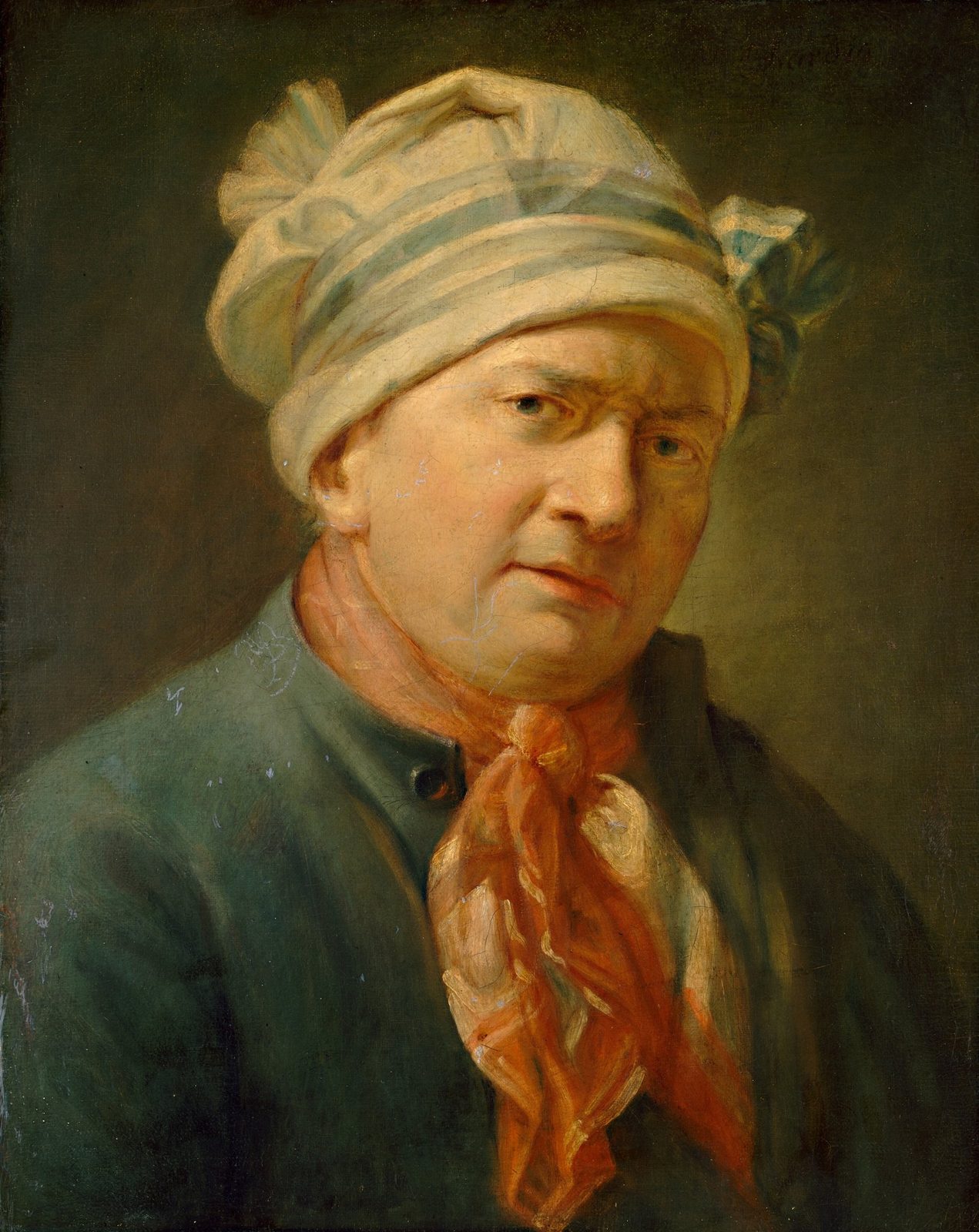
A half-length portrait of an older man, set against a deep olive ground, fixes our attention the moment we look at it. A cream-and-blue striped turban frames a weathered face, and just below, a slash of vivid orange-red fabric cuts through the muted palette.
Eighteenth-century origin
This is an 18th-century oil on canvas, attributed to a follower of Jean Siméon Chardin. The turban motif and the loose, alla-prima handling also recall the tête de caractère tradition of French character heads — a deliberate study of a face rather than a commissioned likeness.
Pyramid and thirds
Notice the pyramidal structure: the head sits at the apex, the shoulders widen downward, and a single vertical column of red anchors the lower center. The sitter's eyes and the cravat knot align along lines the thirds grid quietly confirms.
Light from the upper left
Light pours in from the upper left, catching the cream folds of the turban, the left cheek, and the bridge of the nose. The right side of the face falls into a soft, cool-tinged shadow — a quiet chiaroscuro rather than a hard spotlight.
Turban folds
Our eye begins at the top, in the turban. The stripes are made of broad, sweeping strokes of cream and blue-gray laid side by side, their edges feathered until no contour line remains. Volume is described by color temperature alone — warm yellow-ochre passages advance, cooler teal bands recede.
The eyes
Drop down to the eyes. The sitter's right eye carries a small, sharp white catchlight at about ten o'clock, while the left eye sits in dimmer flesh and reads as a darker point without that spark. That single asymmetry tells you exactly where the key light lives.
Cheek to shadow
Follow the cheekbone down. Warm peach and coral highlights model the lit plane, while a cooler olive-brown scumble shapes the shadow side. The terminator running along the nose is soft and unsharpened — the painter let two temperature zones turn the form rather than a hard value gradient.
The red scarf
Now the eye lands on the scarf, and the whole portrait finds its loudest note. The painter dropped separate strokes of vermilion, orange, and cream directly against the cool teal of the coat, each stroke kept distinct with a visible tip. No blending — the eye does the mixing, and that hard warm-cool edge is the temperature opposition that organizes everything else.
Coat and button
Travel back up along the coat collar. A small dark button sits there, ringed with umber and capped with a single warm highlight. Notice how the teal field is laid in loosely enough that the canvas weave shows through — economy of handling in the non-focal passages.
Dissolving jawline
And down at the jaw, there is no drawn line. The flesh tone simply cools and darkens through broken mid-tone strokes until the jaw melts into a deep umber shadow, and a thin warm glaze keeps the neck glowing rather than going gray.
Craquelure, not brush
Look closer at the cheek and you will see a fine web of hairline cracks running across the flesh at angles that ignore the brushwork entirely. That indifference is the proof that craquelure is the paint film's own aging history, not a mark the painter made — read it as a map of the surface, not a stroke.
Warm against cool
Now compare the warm scarf and the cool coat side by side. In both, a single hue pushed to its highest chroma organizes the temperature field around it: the orange advances, the teal recedes, and the whole portrait resolves into one chromatic decision.
Look closer
7 details, each checked against a close-up of the picture.
-
Face and eyes
The sitter's right eye has a small white catchlight, while the left eye is set in softer shadow with a less distinct highlight, creating asymmetrical lighting.
The crop shows the sitter's full face framed by a cream and pale green turban and the collar of a teal-green coat. The skin is built from warm, broken layers of ochre, raw sienna, and pinkish flesh tones, with the right side of the face (sitter's left, viewer's right) falling into a soft, cool-tinged shadow while the left cheek and brow ridge receive the strongest light. The sitter's right eye carries a small, sharp white catchlight at roughly the 10–11 o'clock position of the iris, whereas the left eye sits in dimmer flesh tones and reads as a darker, less reflective point without a comparable spark. A fine network of craquelure and a few chalky white scuff lines cross the cheek and jaw, and the brows are rendered as thin, broken strokes rather than solid shapes.
-
Orange scarf against teal coat
The scarf is made of separate strokes of vermilion, orange, and cream placed directly against the teal coat, producing the painting's strongest warm-cool contrast.
The crop isolates the scarf draped at the throat against the teal coat. The scarf is built from distinct, individual strokes of vermilion, mid-orange, and pale cream laid side by side rather than blended wet-into-wet; each stroke keeps a visible tip and a separate identity. Where the scarf meets the coat on the left, the warm reds and creams sit directly against the cool dark teal with a hard, unsoftened edge. The teal itself is a thin, broken scumble rather than a solid block, so the cool field reads as recessive while the orange strokes advance.
-
Turban folds
The turban stripes are formed by broad strokes of pale cream and blue-gray that intermingle with soft edges and no hard contour lines.
The crop reveals broad, sweeping brushstrokes that curve in parallel arcs, describing the rounded volume of the turban. Pale cream and yellow-ochre passages alternate with cooler blue-gray and teal-green bands, and these zones interpenetrate with soft, feathered edges rather than crisp lines. A network of fine craquelure covers the surface, and faint warm underpainting (a soft salmon-pink near the lower right) shows through where the upper paint layer is thinner. The strokes clearly follow the underlying form, tightening along ridges of fold and relaxing across the broader planes of cloth.
-
Lit cheek and shadow transition
The left cheek carries warm peach highlights while the right side of the face falls into cooler olive shadows, showing a clear light-dark transition at the nose bridge.
The crop centers on the lower face, capturing the left cheek, the full nose, the mouth, and the inner corner of the right eye. Warm peach and coral highlights sit on the high points of the cheekbone and the bridge of the nose, while the right side of the nose and the right cheek hollow drop into cooler olive-brown shadow. A soft terminator runs diagonally down the nose, with a clear but unsharpened edge between lit and shadowed planes. The eye shows a green-olive iris with a dark pupil, rimmed by a thin warm upper lid. Network craquelure is visible across the entire surface, and several small losses appear as pale bluish-white flecks where underlying ground shows through.
-
Soft jaw-to-neck transition
The jawline dissolves into the neck through soft, feathered strokes rather than a sharp contour, letting warm flesh tone melt into shadow.
The crop captures the lower jaw dissolving downward into the neck and the adjacent folds of teal-green coat and vivid orange scarf. Warm peach and ochre flesh tones along the upper edge feather through broken, mid-value strokes that carry no continuous outline; the lower jaw simply loses value and merges into a deep umber shadow. The teal fabric on the left is laid in with broader, slightly drier strokes that abut the flesh without a hard seam, while the orange scarf below is dragged in long, translucent glazes that warm the shadow side of the neck. A network of fine craquelure and a brighter whitish retouch crack cross the surface, but the painted edge logic remains soft throughout.
-
Coat collar and button
A dark button sits at the coat collar, painted with a ring of umber and a small highlight, surrounded by loose teal strokes where canvas texture is visible.
The crop isolates the meeting point of a teal-green coat collar, a dark button, and the warm orange-red fabric of the draped scarf. The button reads as a small, near-black disc, ringed with a thin umber halo and carrying a single warm brown highlight on its upper-right curve, where a faint rim of light orange peeks through. Surrounding the button, the coat is built from loose, broken teal strokes that vary in chroma and value, with mid-tone greens running into darker blue-greens in the shadowed recess along the collar's inner edge. The painted surface clearly shows the weave of the canvas through thinner passages of green, and a network of fine craquelure covers the entire field. White, slightly raised squiggles in the upper-left appear to be either pentimenti or later retouch marks sitting on top of the green.
-
Craquelure on cheek
Fine craquelure lines run across the cheek, intersecting the flesh tones at angles independent of the brushwork direction.
The crop isolates the left cheek, the side of the nose, and the corner of the mouth, rendered in warm cream-to-ochre flesh tones that warm into terracotta in the creases beside the nose. A web of hairline craquelure covers the entire surface, with a denser cluster of brighter hairline cracks crossing the lower cheek diagonally from upper left to lower right, independent of the soft horizontal/diagonal flesh transitions. A few thicker whitish fissures—likely where a former varnish or retouch has abraded—cut more boldly across the same cheek, and the flesh transitions themselves are very soft, with the warmest pinkspearles reserved for the cheekbone ridge, the nostril wing, and the upper lip.