Black, with two notes of colour
How Bronzino builds a cool, polished portrait from one light and an almost black costume
- Artist
- Bronzino (Agnolo di Cosimo di Mariano)
- Title
- Portrait of a Young Man
- Date
- 1530s
- Medium
- Oil on wood
- Image
- Public domain (CC0)
Open in Simple Art
Watch this story on iPhone and iPad, with offline downloads and a painting every day.
About 3 minutes of looking, in 9 parts.
Portrait of a Young Man
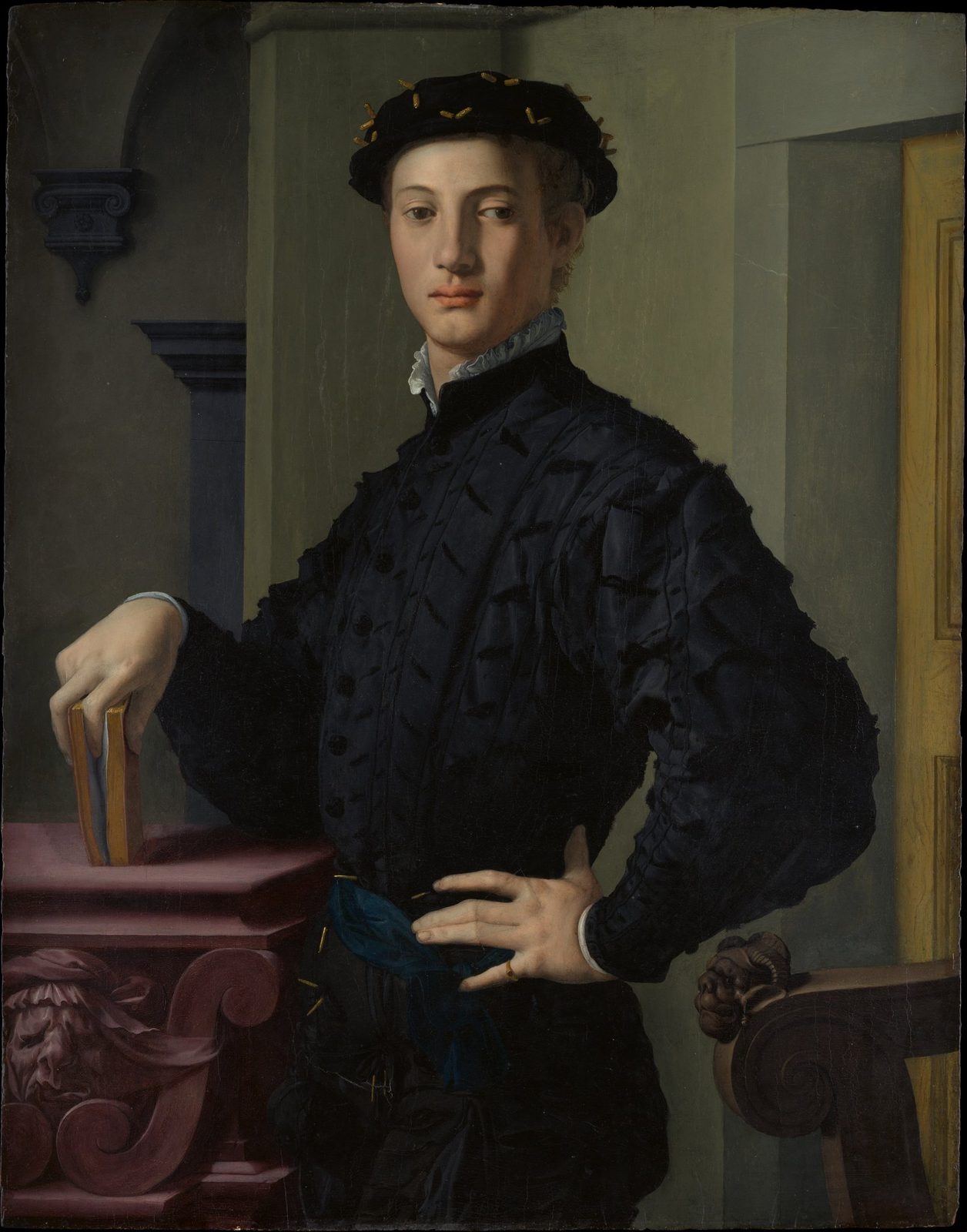
A young man in black turns his head and looks at us from the corner of his eye. One hand rests on a small book. Almost everything here is black, olive green or pale skin, and that restraint is the first thing to notice.
Florence, 1530s, oil on wood
This is Bronzino's Portrait of a Young Man, painted in Florence in the 1530s, in oil on wood. Nothing in the picture tells us who he was. What we can see is a surface so smooth it hardly looks painted.
A pyramid with the face at the apex
The figure makes a tall triangle. His head is the peak, and the base runs from the carved stone at the lower left to the hand at his waist. Your eye lands on his face, and the design keeps sending it back there.
One light, from the upper left
The light comes from the upper left, and his right hand on the book shows it best. The knuckles, the ridge of the thumb and what looks like a gilded edge to the pages all catch it, while the book throws a dark shadow onto the pink stone. Whatever faces away drops into cool shadow.
A face without brushmarks
Up close, the face shows no brushmarks at all. Warm pink on the lit forehead turns cool, then grey-brown along the shadowed jaw, with no edge you could point to. In each eye sits a tiny white catchlight at the upper left, from the same light that falls on his cap.
Gold pins on the cap
The cap is scattered with little gold pins, and they aren't identical. Those facing the light are bright yellow; those turned away sink into amber, then brown. That small change is what makes them sit on a soft, curved cap.
The teal-blue sash
At his waist is the sash, one of only two real colours in the picture. Bright teal runs along the top fold and sinks into deep navy where the cloth bunches. There's no outline against the black. The blue looks thin, as if laid over something darker.
Black that isn't flat
Now look hard at the black doublet. It isn't flat. Each raised seam between the puffed panes catches a thin band of cool grey, and inside each pane the dark shifts so gently that you sense the arm before you see it.
Pink stone, carved scrolls
The other colour is the dusty pink of the stone. At its corner a small carved mask sits among scrolls, all one family of warm reds, maroon in the hollows and soft mauve where the light catches the top. Up at the top left, a dark bracket curls in a similar spiral against the green wall.
Look closer
7 details, each checked against a close-up of the picture.
-
Face and cap
The sitter's face is rendered with an enamel-like surface showing no visible brushstrokes, and the eyes contain small white catchlights at their upper left.
The crop frames the head and shoulders of a young man turned slightly to the viewer's right against a flat olive-green ground. The flesh is blended to a near-porcelain smoothness: warm pinks on the lit left forehead, cheekbone, and nose ridge shift through a cool half-tone into grey-brown shadows along the right jaw and the right side of the nose, with the softest transitions running along the cheek plane. The cap is a dense, low-chroma black with the left edge catching a soft sheen, studded with small gold ornaments whose lit left tips and shadowed right sides register the raked light. The eyes are dark brown almonds; a tiny opaque white dot sits in the upper-left quadrant of each iris, mirrored by a smaller fleck in the pupil, while the lower rim of the iris darkens into the lash line. The white frill at the throat reads as small scalloped strokes of impasto against the dark doublet.
-
Right hand on book
A raked light from the upper left produces bright highlights on the knuckles and the top edge of the book held in the right hand.
The crop isolates a right hand draped over the top edge of a slender, upright book, with the fingertips curling down the front cover and the thumb running along the spine. Light clearly rakes in from the upper left: the upper ridge of each knuckle, the ridge of the thumb, and the gilded top edge of the book catch the brightest flesh and metallic highlights, while the lower right side of the hand and the right face of the book fall into cool shadow. A dense cast shadow projects from the book down onto the pink-red surface at the right, anchoring the volume. Edges between the fingertips and the book are crisp but slightly softened, and the flesh transitions from warm pinkish-tan in the lit zones to a greyed olive in the shadow, never abruptly.
-
Blue sash at waist
The sash at the waist is painted as a saturated teal-blue cloth that stands out against the near-black doublet.
The crop centers on a pale hand wearing a thin gold ring with a dark stone on the little finger, resting on a swag of teal-blue sash against a near-black doublet. The blue cloth reads as the highest-chroma passage in the field: bright teal highlights follow the upper fold ridge running from upper-left to center, dropping into deep navy where the fabric bunches and disappears into the black garment. The edge between sash and doublet is not a hard contour but a soft modulation of value, with the painter letting the dark ground come through to shape the silhouette. Gold pin-heads or cord ends appear as small bright dabs at the upper-left edge of the sash (around x≈0.15) and lower-left (around x≈0.20, y≈0.62). Surface craquelure is visible across the entire crop as a fine web.
-
Doublet fabric texture
The black doublet shows crisp, raised seams between the puffed panes and smooth tonal transitions within each pane.
The crop shows a section of a black doublet with vertically running puffed panes separated by raised, slightly lighter seams. Light from the upper left catches the left-facing edge of each seam with a thin band of cool charcoal grey, while the right side of each pane falls into a deeper near-black. Within each pane the transitions are smooth and almost imperceptible, with subtle diagonal folds suggesting the underlying arm and body form. A few small raised dots—likely decorative trim or button loops—appear in the left third, picking up faint highlights. The paint surface shows a network of fine craquelure throughout, and a thin strip of olive-green background is visible at the top left edge.
-
Cap with gold pins
The black berretto is decorated with small gold pins that read as bright yellow points catching the light.
The crop shows the upper portion of a man's head wearing a soft, gathered black berretto studded with small gold pins or short rods that pierce the fabric. The pins are distributed irregularly across the cap's visible surface, each rendered as a small bright-yellow highlight flanked by warm orange-ochre body and a dark brown shadow on its underside. Light rakes from the upper left, so pins on the left side and top crest read as the brightest accents while those on the right and lower-right fall into deeper amber tones. The black fabric itself is nearly flat in value but carries just enough cool grey-green modulation to suggest the soft, bunched folds of the velvet-like material. Below, the flesh of the forehead is rendered with smooth pale-cream to warmer rose transitions, its upper edge meeting the cap in a soft but continuous line. A pale olive-green background frames the figure and is intersected by the fine craquelure pattern visible across the whole crop.
-
Carved console mask
The lower left corner of the console displays carved scrollwork and a small sculpted mask in warm pinkish stone.
The crop isolates the corner of a carved stone console rendered in warm pinkish-red tones. A large scrolling volute dominates the right and lower portion, with smaller secondary curls visible in the lower left. Above the lower-left curl, a small carved mask is partially visible, set within a recessed pocket of darker shadow. A loose, lighter-toned drapery (or carved drapery swag) drapes across the upper-left area, its folds catching more light than the stone around it. Values step from a deep maroon-brown in the deepest recesses (under the main curl, behind the mask) through mid pinkish-reds on the curving flanks, up to soft mauve-pink highlights along the upper ridges where the raked light from the viewer's left falls. A fine network of craquelure covers the entire surface, the cracks slightly lighter than the surrounding paint.
-
Architectural bracket
The upper left background contains a dark stone bracket with spiral volutes against an olive-green wall.
The crop isolates the upper register of a carved stone console bracket against an olive-brown wall. Two prominent spiral volutes curl inward from either side, framing a shallow central recess; their upper arcs catch a thin, cool-gray highlight while their undersides and the inner channels fall into near-black shadow. The top shelf edge reads as a horizontal band with a crisp upper lip and a softly beveled lower return. Fine craquelure runs diagonally and irregularly across the entire surface, more visible in the mid-tones than in the deepest darks. The background wall is a flat, low-chroma olive-brown that sits only slightly warmer and lighter than the stone itself.
Bronzino's young man in context
A painter who wrote poems
The Met gives Bronzino's dates as 1503 to 1572, born at Monticelli and died in Florence [1]. According to Vasari, whom Wikipedia cites, the butcher's son trained first with Raffaellino del Garbo and was then apprenticed to Pontormo at fourteen [3]. He was also a poet, and the Met suggests he took as much pleasure in language as in the witty details of his pictures [1].
Most scholars date this panel to the 1530s, a decade when Bronzino often painted members of a close circle of friends who shared his literary interests [1]. His Medici patronage began only in 1539, with decorations for the wedding of Cosimo I [3]. By 1540 he had become court painter to Cosimo [2]. So if the usual dating holds, the portrait comes from before his years at court.
Who was he?
Nobody knows. Vasari names several of these friends early in his life of the artist. It has recently been suggested that the sitter is Bonaccorso di Pietro Pinadori, born in 1502, whom Vasari mentions alongside Ugolino Martelli and Lorenzo Lenzi [1]. An older idea that the picture is a self-portrait hasn't been taken up [1].
Wikipedia's article on the painting describes Pinadori as a wealthy spice merchant who also sold artists' materials, and records two other proposals: the banker Benedetto Busini, born in 1513, and Antonio Lupi, born in 1527, though if he were the sitter the picture could not date from the 1530s [4].
Changes under the paint
X-radiographs were already recording Bronzino's changes of mind in 1930, and new X-rays and infrared images made in 2009 showed far more [1]. At first a straight moulding ran diagonally behind the sitter. The book had its spine towards us with the covers splayed. And something tucked into the codpiece, almost certainly a pair of gloves, was later painted out [1].
The head began much narrower, but the features stayed in the same place, which rules out a second sitter [1]. Because the alterations are so extensive, some have speculated that the panel was begun at one time and finished later, perhaps years later [1].
Grotesque masks decorate the table and the chair. In 1994 the scholar Elizabeth Pilliod noticed a third face hidden in the folds of the costume [1]. What they mean is debated. They plainly set off the young man's refined features. And the Met wonders whether they also hint that his polished appearance is a kind of mask [1].
The Florentine maniera
The style is usually called Mannerism, after Vasari's word maniera. In Italy it lasted from roughly 1520 to 1600 and valued complexity and virtuosity over naturalism [2]. Ross Finocchio of the Met calls this picture typical of Bronzino in its refined execution and graceful silhouette, with the book, the clothes and the affected pose there to show the sitter's learning and rank [2].
From Rome to Fifth Avenue
By 1808 the panel belonged to Lucien Bonaparte, Prince of Canino, in Rome. At his London sale in 1816 it was catalogued as "A Florentine Gentleman" by Sebastiano del Piombo [1]. It kept that attribution in the Paris collection of the comte de Pourtalès-Gorgier, whose estate sold it in 1865 [1]. It then passed through the Seillière family to a Paris owner, M. Bourdariat, who sold it to Durand-Ruel in 1898 for 140,000 francs. The dealer sold it the same year to Mr and Mrs H. O. Havemeyer of New York for $40,000 [1].
In 1915 Louisine Havemeyer held a second exhibition of her collection at Knoedler's to raise money for women's suffrage [5]. The Met's record lists this panel in a Knoedler loan show that April, lent anonymously as "Portrait of the Duke of Urbino" [1]. It came to the museum with her bequest in 1929 [1].
Later reputation
His figures have often been found cold and artificial, and his reputation suffered along with Mannerism's in the nineteenth and early twentieth centuries, though recent decades have been kinder [3]. The portrait went to Florence for the Palazzo Strozzi's Bronzino exhibition in 2010 to 2011 and was shown again in the Met's The Medici: Portraits and Politics, 1512–1570 in 2021 [1]. When this was written it hung in Gallery 612, and the museum states that it may not be lent [1].
- Portrait of a Young Man (29.100.16): object record, catalogue entry (Andrea Bayer, 2010), technical notes (Charlotte Hale, 2010), provenance and exhibition history . The Metropolitan Museum of Art
- Mannerism: Bronzino (1503–1572) and his Contemporaries, Heilbrunn Timeline of Art History (Ross Finocchio, 2003) . The Metropolitan Museum of Art
- Bronzino . Wikipedia
- Portrait of a Young Man with a Book (Bronzino) . Wikipedia
- Louisine Havemeyer . Wikipedia