A picture built like a building
An illustrated medical manual from 1224, where every figure stands in its own compartment
- Artist
- 'Abdullah ibn al-Fadl
- Title
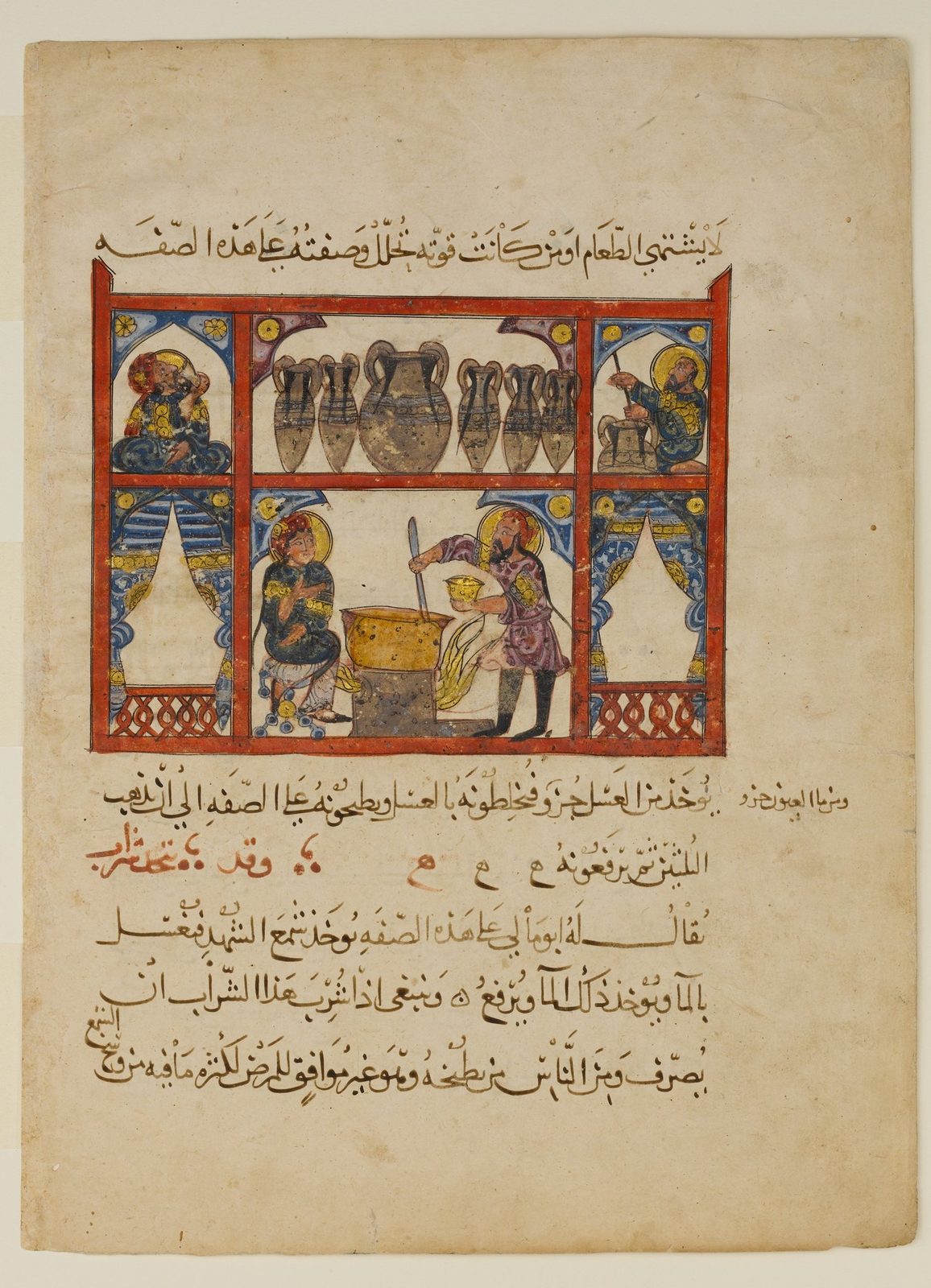
- "Preparing Medicine from Honey", from a Dispersed Manuscript of an Arabic Translation of De Materia Medica of Dioscorides
- Date
- dated 621 AH/1224 CE
- Medium
- Ink, opaque watercolor, and gold on paper
- Image
- Public domain (CC0)
Open in Simple Art
Watch this story on iPhone and iPad, with offline downloads and a painting every day. This one is free in the app.
About 3 minutes of looking, in 10 parts.
Preparing Medicine from Honey
This is a page from a working medical textbook, and the picture is set into the text like a diagram. Look at its structure. It is built like a building, with no window onto a scene.
Baghdad, 1224
An Arabic translation of Dioscorides, copied and painted in twelve twenty-four. Ink, opaque watercolour and gold on paper. The subject is a recipe: how to prepare a medicine from honey.
Bays, not depth
A red architectural facade cuts the image into two storeys and a row of bays, and every figure and object sits inside one of them. Nothing overlaps into distance or recedes. The design is near-symmetrical, with matching curtained bays left and right.
Look at the frame
Up close the frame is plainly a drawn building: ruled red members, a corner bracket turning the angle, and inside the bay a pointed arch with blue spandrels and gold rosettes. The figure sits within it. His face has been rubbed away by eight hundred years of handling.
Where modelling is allowed
The cauldron is one flat shape with no shading at all, but darker magenta runs through the robe describing folds. I had assumed nothing here was modelled, and I was wrong. Cloth gets folds and a metal pot does not, the reverse of what a Western eye expects.
Fire as a thing
The flames are pointed gold tongues with dark outlines, sitting beside the stove like any other object. They do nothing to their surroundings: the cauldron above is not brightened and the legs beside are not warmed. In this picture, fire is one more object.
Gold is a material
Behind the head there is a plain gold disc with a drawn ring around it, and no gradient or glow. The gold is burnished, so on the actual page it reflects and shifts as you move. It is bright because of what it is made of.
Stages, stacked
Upstairs, a second man grinds with a mortar and pestle. He is above the others, in his own bay. The stages of the process are stacked into compartments, which is what a manual needs, so the picture reads as a sequence of steps.
Repeated by hand
The storage jars along the top look identical until you compare them. Each varies slightly in width, in the tilt of its handles, in how its speckled glaze falls. They were repeated by hand, not traced, which is why they read as real objects.
One line in red
The text is in a fluid brown-gold hand with full vowel pointing. One line running through it is written entirely in red, punctuation dots included. It marks a whole section, the way a heading would.
Look closer
8 details, each checked against a close-up of the picture.
-
the cauldron and the stirrer
The cauldron is a large flat gold-ochre mass with a standing figure stirring it with a long rod, and neither the vessel nor the figure carries any shading.
The cauldron is one flat ochre-gold shape with a dark rim, sitting on a grey stove, with gold flame-tongues beside it. The figure stirring it wears a magenta robe with gold panels and black boots, and carries a gold bowl in his free hand. And here my first reading was too sweeping: the robe IS modelled. Darker magenta passages run through it describing folds. So this system does not refuse modelling everywhere - it refuses it on objects and permits it on cloth.
-
the red architectural frame
The frame is drawn as a red architectural structure with ruled straight members and a corner bracket, not as a plain border around a picture.
This is a drawn building, not a border. Ruled red members frame the bay, a corner bracket turns the angle, and inside sits a pointed arch with blue spandrels carrying gold rosettes. A figure occupies the bay on a blue cloud-like cushion, his face noticeably abraded by handling. Everything in the picture is placed INSIDE one of these compartments; nothing stands in open space.
-
seated figure with a gold disc
A seated figure in blue and gold has a plain gold disc behind the head, painted flat with a firm contour and no attempt at radiance.
Behind the head sits a plain gold disc with a drawn contour ring around it. There is no gradient, no glow and no attempt to make it look like emitted light. But the gold is burnished, so on the actual page it genuinely reflects and shifts as you move - the halo is bright because of what it is made of, not because of how it was painted.
-
the rack of storage jars
A row of near-identical handled jars stands along the upper storey, drawn in grey-brown with dark contour and no modelling, repeated with slight variation.
Seven or so handled jars stand in a row along the upper storey, near-identical but not traced - each varies slightly in width, in the tilt of its handles, in how its speckled glaze falls. There is no shading on any of them and no shelf drawn beneath, so they float on the bay's ground.
-
the Arabic text with red words
Lines of Arabic run below the picture in a fluid brown-black hand, with some words picked out in red.
Arabic in a fluid brown-gold hand with full vowel pointing, and running through it one line written entirely in red, including a run of red punctuation dots. The red is not decoration or emphasis on a single word - it marks a whole section, so it is doing structural work in the text the way a heading would.
-
the ornamented bay
The flanking bay is filled with blue and gold ornament built from small repeated motifs, ending in a red lattice band at its foot.
The bay is filled with blue and gold ornament assembled from small repeated units - rosettes in the spandrels, banded pattern down the sides - and closed at the foot by a red lattice band. It is dense, flat and symmetrical, and it occupies exactly the space that a background would occupy in a picture that depicted space.
-
the flames
The fire beneath the cauldron is drawn as a cluster of pointed flat yellow-gold tongues with dark outlines, not as glow or light.
The fire is a cluster of pointed flat gold tongues with dark outlines, sitting beside the stove like any other object. Nothing around them responds to them: the cauldron above is not brightened, the figure's legs are not warmed, no glow spills onto the bay. This is the clearest evidence in the whole page that the system does not depict light at all - it depicts things, and fire is a thing.
-
the figure with mortar and pestle
In the upper right bay a figure works a tall mortar with a pestle, shown mid-action gripping the long pestle.
A seated figure in a blue robe with gold panels grips a long pestle with both hands in a tall mortar whose base is drawn with a lattice pattern. Correcting my claim: he is seated with hands at chest height, not arms raised. His robe carries the same darker-value fold lines as the stirrer's, confirming that drapery modelling is a consistent convention here rather than a one-off. Above him the bay's pointed arch repeats the one on the far side of the page.
A medical page from Baghdad, 1224
A Greek handbook in Arabic
De Materia Medica, written by the physician Pedanius Dioscorides of Anazarba in Cilicia, was one of the most influential medical treatises that passed from antiquity to the Muslim world. [1] Sources differ on his date: the Met's catalogue texts place him in the first century B.C., while the Cleveland Museum of Art and Wikipedia put him in the first century A.D. [1][4][6]
In ninth-century Baghdad, Istifan ibn Basil translated the Greek text into Arabic, and Hunayn ibn Ishaq (d. 873) then corrected it. [1] That corrected version was regarded as definitive and circulated widely, though the text on this page belongs to a somewhat abbreviated variant. [1] The treatise explains how to prepare medicines from up to five hundred plants. [1]
Baghdad in the 1220s
By the thirteenth century the Abbasid caliphs had long since lost real political power, first to the Buyids and then to the Seljuqs, keeping mainly moral and spiritual authority. [2] They enjoyed a brief revival under the caliphs al-Nasir (r. 1180-1225) and al-Mustansir (r. 1226-42), when Baghdad again became the greatest centre for the arts of the book in the Islamic world. [2] The Met's timeline notes that paper made books available to a broader audience, including the urban bourgeoisie, and that illustrated texts were popular. [3]
The manuscript is dated Rajab 621, which corresponds to June or July 1224, in the last years of al-Nasir's reign. [1][2] The Met attributes the manuscript to Baghdad, one of its texts adding "probably". [1] Related manuscripts have been placed variously in Baghdad and the northern Jazira, but a 2008 study cited by the Met firmly assigns this one to Baghdad. [1] That flourishing was cut short in 1258, when the Mongols sacked Baghdad and killed the last Abbasid caliph to rule from the city. [3]
Who made the page
The text is written in naskhi script by the calligrapher 'Abdullah ibn al-Fadl, and the Met's record lists him as the artist. [1] Another museum text calls him a well-known calligrapher who was for a long time believed to be the painter of the miniatures, which leaves the question open. [5]
Illustrated herbals developed in two directions, with pictures of plants alone or with small scenes including people, as here. [1] The Met's entry lists features typical of the Baghdad School: flat, two-dimensional painting, bright colours, lively figures in local dress with haloes, and bilateral symmetry. [1] It compares the pictures with a Maqamat of al-Hariri made in Baghdad and dated 1237, now in Paris. [1]
The page comes from book 5, on wines and minerals, and concerns a medicine of honey and water prescribed for weakness and loss of appetite. [1] The Met cautions that such pictures don't necessarily record real medical practice, but suggests this one may well show a pharmacy within a hospital, where doctors also saw outpatients. [1]
A manuscript taken apart
The bulk of the manuscript is still in Istanbul, though the Met's two catalogue texts name different libraries: the Topkapı Palace Museum in one and the Süleymaniye Library in the other, both citing the old Ayasofya number 3703. [1] According to the Met, thirty-one folios were removed before 1910, while the Cleveland Museum of Art counts thirty-three illustrated pages dispersed from the Topkapı library. [1][4]
Leaves are now spread across several collections, including the Sackler Gallery in Washington, the David Collection in Copenhagen, the British Museum and the Walters Art Museum in Baltimore. [1] The Met's page belonged to the Swedish collector F. R. Martin by 1910, then to V. Everit Macy in New York, and finally to Cora Timken Burnett, who bequeathed it to the Met on her death in 1956. [1] A folio from the same manuscript, now in the Khanenko Museum in Kyiv, was also bought from Martin's collection in Paris in 1914. [5]
The page was shown in Munich in 1910 at the exhibition of masterpieces of Islamic art, and at the Met in 2016 in Court and Cosmos: The Great Age of the Seljuqs. [1]
- "Preparing Medicine from Honey" (57.51.21): object record with catalogue entries by Sheila R. Canby (2016) and Maryam Ekhtiar (2011), provenance and exhibition history . The Metropolitan Museum of Art
- The Art of the Abbasid Period (750–1258), Heilbrunn Timeline of Art History (Suzan Yalman, after Linda Komaroff) . The Metropolitan Museum of Art
- Iraq, 1000–1400 A.D., Heilbrunn Timeline of Art History . The Metropolitan Museum of Art
- Folio from an Arabic translation of the Materia Medica of Dioscorides (1977.91) . Cleveland Museum of Art
- Preparation of Medicine. Folio from Manuscript of an Arabic Translation of 'De Materia Medica' of Dioscorides (Khanenko Museum) . Discover Islamic Art, Museum With No Frontiers
- Pedanius Dioscorides . Wikipedia