Sunlight laid on thick
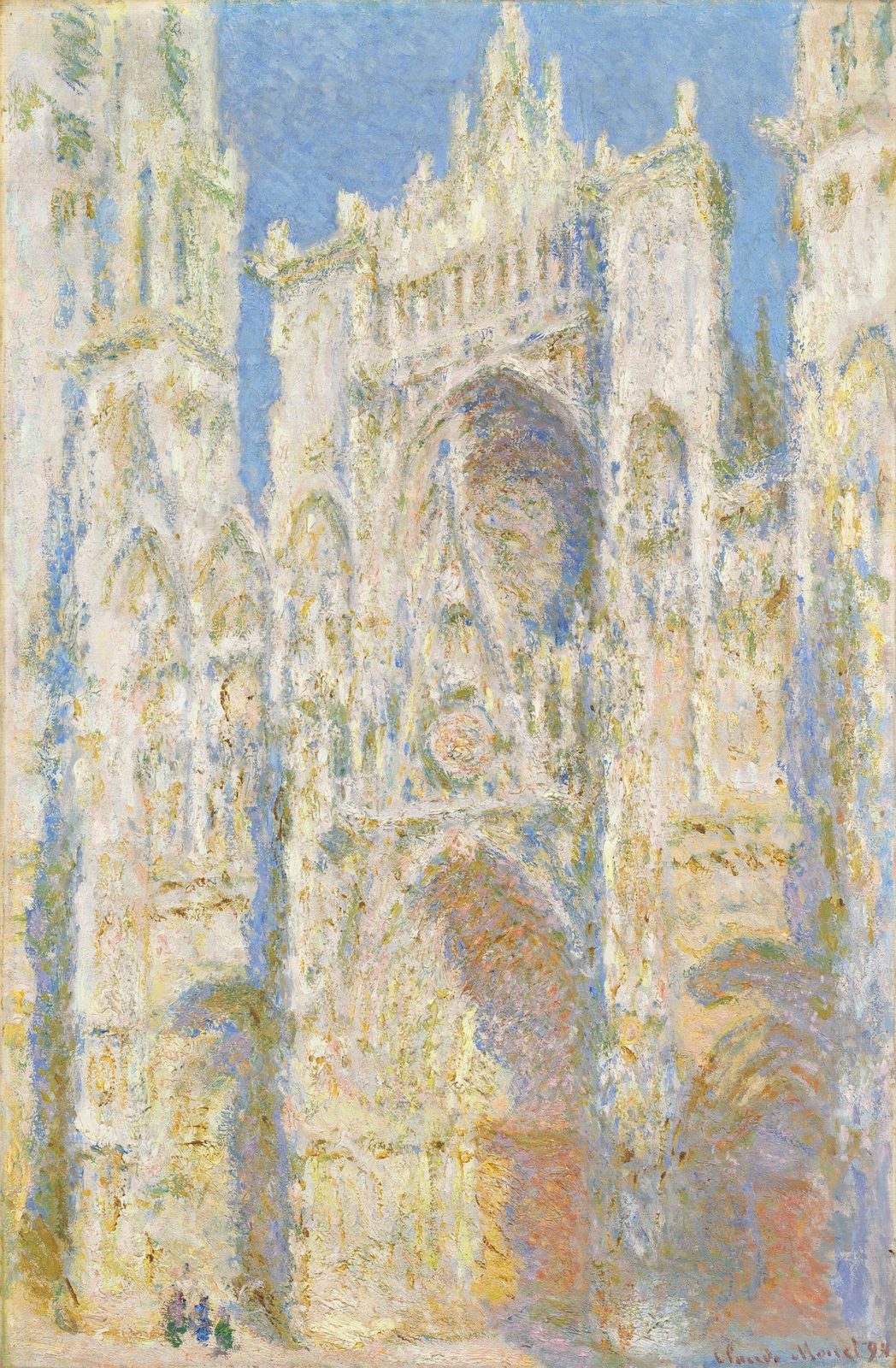
In full sun, Monet piles warm, ridged paint over cool blue until the stone seems to catch real light
- Artist
- Claude Monet
- Title
- Rouen Cathedral, West Façade, Sunlight
- Date
- 1894
- Medium
- oil on canvas
- Image
- Public domain (CC0)
Open in Simple Art
Watch this story on iPhone and iPad, with offline downloads and a painting every day.
About 3 minutes of looking, in 8 parts.
Rouen Cathedral, West Façade, Sunlight
This is Claude Monet's Rouen Cathedral, West Façade, Sunlight, painted in oil on canvas and signed with the year 94 at the lower right. A Gothic front glows against a strip of blue sky. The stone is cream, butter yellow and pale orange, and the paint is so thick that it seems to catch light of its own.
Towers and a central portal
Two tall towers frame a central block that seems to push slightly forward. The palest paint gathers in the upper part and down the left tower, while the right tower stays cooler. Your eye tends to settle on the centre, where the carving is densest.
Ridges of sunlit paint
Look at the sunlit face of the left tower. Thick ridges of yellow and cream appear to have been dragged downwards over blue, and the blue still shows in the channels between them. These ridges are the lightest marks on the stone, and they cast tiny shadows of their own.
A tower built from dabs
A little higher, the tower is a stack of short, near-vertical strokes in cream, pale yellow and light blue. There is no mortar line and no clean edge. Cooler blues gather on one side and warmer creams on the other, and that change of temperature is what makes the tower look solid.
The portal in warm and cool
Now the central portal. The great arch is suggested by warm pinks and ochres around it, turning to cooler violet-blue inside. The carved figures become clusters of ochre, coral and pink dabs. Nothing has an outline, yet you still find an arch.
A rose made of commas
Inside it, a round motif, perhaps a carved rose, is made of little comma-shaped strokes in pink, sage green, ochre and ivory. They curl around an off-centre core. Up close it is simply paint. From a distance it reads as carving.
A corner made of colour
Cross to the right tower. Cool blue and violet strokes run down one side, warm cream down the other, with a few olive and rust flecks between them. The corner of the building is simply where one family of colour stops and the next begins.
Orange at the foot
Drop to the lower right. Thick strokes of orange, coral and mauve lie over a cooler blue layer, slanting up from left to right. Against all the blue higher up, this warm ground balances the picture. The dark signature sits on top of it, right at the bottom edge.
Look closer
7 details, each checked against a close-up of the picture.
-
Central portal and rose
The central zone contains disconnected dabs of ochre, violet, and blue with no continuous contour outlining the arch, round motif, or sculpted figures.
The crop shows the central portal of a Gothic cathedral facade, dominated by a large rounded arch in the upper third that reads as a rose/tympanum area and a smaller sculpted tympanum zone below. The arch is not drawn: it is implied by a band of warmer pinks and ochres giving way to cooler violet-blues inside the void, with the curve traced only by the shift in dab orientation. Sculpted figures appear as denser clusters of opaque ochre, coral, and pink dabs sitting against a haze of pale blue, white, and yellow vertical strokes; no single figure has a closed contour. Across the central zone, strokes read as discrete, slightly curved dabs and short verticals that abut but do not fuse into a continuous line.
-
Tympanum rose motif
A cluster of comma-shaped strokes in brown, green, and pink sits at the center of the round motif without outlining any recognizable figure.
The crop isolates a roughly circular motif in the lower-center—apparently the rose carving from a Gothic tympanum—built from dense, comma-shaped strokes of pink, sage green, ochre and ivory that curl around an off-center core. These marks sit on top of a cooler blue-and-cream ground in which vertical streaks above hint at the flanking towers. Thick impasto ridges cast tiny cast-shadows, and the most saturated pinks, yellows and creams read as the freshest, topmost layer, while duller greens and blue-greys settle beneath. No figure, leaf, or carved edge is drawn; the 'rose' is conjured purely by the directional curl of the strokes and by warm/cool color juxtaposition.
-
Left tower impasto
Short vertical strokes of cream, yellow, and pale blue pile up with heavy impasto, never forming a straight mortar line or continuous edge.
The crop shows the left tower of a cathedral rendered as a dense field of short, near-vertical dabs rather than a defined column. Cream, pale butter-yellow, and cool light-blue strokes sit side by side, with the warmest, thickest paint riding the central vertical band where the implied edge of the tower catches light. A cooler blue column of strokes runs along the left third, reading as shadowed stone; warmer cream and ochre dabs cluster on the right of the tower mass. There is no continuous contour line anywhere: edges of the tower, the vertical moulding, and the stonework are all implied by juxtaposed color temperatures and varying stroke length. The paint sits in heavy ridges, casting tiny shadows of its own that add to the broken, vibrating surface.
-
Right tower shadow edge
Cool blue and violet vertical strokes on the right tower stop abruptly against warmer cream strokes, dissolving the corner into adjacent color patches.
The crop shows a vertical band of stacked, broken brushstrokes in cool blues, lavenders, and violets on the right half, meeting a zone of warmer cream, pale ochre, and faint pink strokes on the left. Edges between the cool and warm zones are not hard lines; instead, short vertical strokes interlace and stand alongside one another, so the boundary reads as an irregular, broken meeting of color rather than a crisp corner. Thick impasto ridges are visible throughout, with paint dragged downward in roughly parallel vertical gestures. Scattered olive-green and rust flecks sit between the dominant blue and cream areas, acting as transitional notes rather than as a unified middle tone.
-
Warm ground lower right
The lower right ground is covered in thick strokes of orange, coral, and mauve lying directly over a cooler blue underlayer.
The lower right of the crop is built up from dense, short, loaded strokes of warm pigment — oranges, corals, pinks, and mauves — that sit on top of a clearly visible cool blue and blue-violet underlayer. The warm strokes are mostly diagonal, slanting from lower-left to upper-right, and they are thick enough to leave ridges and cast tiny shadows of their own. Edges are not blended; instead, warm marks butt against cool ones, and the canvas weave is partly exposed where the brush lifted. Values swing between the bright orange-ochre highlights and the recessed blue-mauve gaps, giving the surface a vibrating, granular read rather than a smooth stone plane.
-
Sunlit left tower face
Bright yellow-cream impasto ridges are dragged vertically across a blue underlayer, creating the highest physical texture and value on the stone.
The crop shows a heavily worked surface where thick, ridge-forming strokes of yellow, cream, ochre, and pale salmon have been dragged in a generally vertical direction. A cool blue underlayer shows clearly between the lighter ridges, especially along the left edge and in recessed pockets, establishing the base temperature against which the warm sunlit strokes sit. Edges of the paint strokes are crisp and unbroken in places where the butter has held its shape, but soften into adjacent blues elsewhere, producing a broken, shimmering read rather than a unified stone surface. The highest values are the unblended cream-white peaks; the deepest passages are the small blue channels between ridges. A few scattered olive-green and rusty-brown dabs break the otherwise pale, sun-struck palette, suggesting weathered stone or shadowed detail.
-
Artist signature
Dark umber strokes forming the signature sit on top of the thick orange and blue ground paint in the lower right corner.
The crop isolates the lower right portion of the canvas where the ground paint is built up in heavy, broken strokes of warm orange, peach, and pale blue with passages of creamy white. Across the lower band of the image, a series of dark reddish-brown marks reads as a signature; the strokes are short, tapered, and gestural rather than carefully lettered. The signature strokes sit on top of the textured ground, with their crisp edges clearly distinct from the softer, blended impasto beneath. The contrast in value between the dark umber marks and the lighter ground makes the signature legible despite the rough surface.
Rouen Cathedral, West Façade, Sunlight in context
Twenty façades in one room
Durand-Ruel's Paris gallery held a Monet exhibition from 10 to 31 May 1895 that included twenty versions of the Rouen Cathedral alongside other canvases [4]. The Metropolitan Museum of Art notes that the pictures were given titles there, its own showing as Le Portail (Soleil), The Portal (Sunlight) [3]. The National Gallery of Art says the paintings in the series were named after the viewpoint and the weather, and were told apart chiefly by colour [2].
The Gallery also stresses that visitors described an effect that went beyond any single canvas, and that the series as a whole seemed to deny the solidity of the building in favour of light, colour and mood [2]. Rouen's tourist office adds that Degas, Cézanne, Pissarro and Renoir admired the pictures [6].
Clemenceau's review
Georges Clemenceau saw the show and published his first piece of writing on art, 'Révolution de cathédrales', in the newspaper La Justice on 20 May 1895 [4]. He ended it by addressing the President of the Republic, suggesting that France acquire the twenty canvases. Together, they represented a moment of art and 'une révolution sans coup de fusil', a revolution without a shot fired [4]. The article later became a chapter in his book on the Water Lilies, published after Monet's death [4].
That phrase stuck. The Musée de l'Orangerie quoted it in 2026 for its exhibition marking the centenary of Monet's death [5].
A series that was not kept together
France didn't buy the twenty as a group. In October 1907 the State acquired a single version, The Portal Seen from the Front (Brown Harmony) of 1892, for the Musée du Luxembourg. They bought it through Clemenceau, who regretted seeing the series dispersed [4]. That painting is now in the Musée d'Orsay [4]. The National Gallery of Art observes that Monet never insisted on a series being sold as a group [2].
Rouen's tourist office counts seven cathedrals in French collections today, including one given to the Musée des Beaux-Arts in Rouen by a local patron in 1909 [6]. Washington, by contrast, holds two, both from the collection of Chester Dale [1][2].
Sunlight, or a symphony in grey?
This canvas is signed 'Claude Monet '94' at the lower right [1]. The Gallery's text says Monet painted the series between 1892 and 1893, moving from canvas to canvas to follow the light, and finished it at Giverny in 1894 [1]. It also notes that from a distance the building looks sturdy, while up close it breaks into fragments of colour [1].
The picture's recorded exhibition history only begins in 1917, when Durand-Ruel showed it in New York as 'Rouen Cathedral - Symphony in Gray' [1]. It was lent to the Brooklyn Museum in 1922 and 1923 under a French version of the same title [1]. The record doesn't list it in the 1895 exhibition, so it isn't clear from the Gallery's page whether it was one of the original twenty [1].
From dealers' stock to Chester Dale
According to the Gallery, the painting went from the artist to Durand-Ruel in Paris, held on joint account with Bernheim-Jeune, and sold to Chester Dale on 10 November 1926 [1]. This date comes from Dale's own papers in the Gallery's files [1]. The canvas appeared in Durand-Ruel's New York exhibitions of 1926, 1927 and 1933, and it was reproduced in Maud Dale's 1929 book on the collection [1].
The painting came to the Gallery with the Dale bequest in 1963 [1]. Its twin in Washington, Rouen Cathedral, West Façade, followed a separate route through the New York dealer James F. Sutton [2]. An archived record from March 2026 places this painting in Gallery 80 of the West Building [1].
- Claude Monet, Rouen Cathedral, West Façade, Sunlight (1963.10.179): object record, commentary, provenance, exhibition history and bibliography (Internet Archive copy, 9 March 2026) . National Gallery of Art, Washington
- Claude Monet, Rouen Cathedral, West Façade (1963.10.49): object record, overview and audio commentary (Internet Archive copy, 27 November 2025) . National Gallery of Art, Washington
- Claude Monet, Rouen Cathedral: The Portal (Sunlight) (30.95.250): object record (Internet Archive copy, 13 June 2026) . The Metropolitan Museum of Art, New York
- Monet Clemenceau: focus sur la collection (press kit, 14 November 2018 to 11 March 2019), including chronology . Musée de l'Orangerie / Établissement public des musées d'Orsay et de l'Orangerie
- Monet, painting time (exhibition, 2026) . Musée de l'Orangerie, Paris
- Monet and his cathedrals . Rouen Normandie Tourisme & Congrès