Saint Francis Kneeling in Meditation
A camera walkthrough of El Greco's c. 1595–1600 devotional canvas
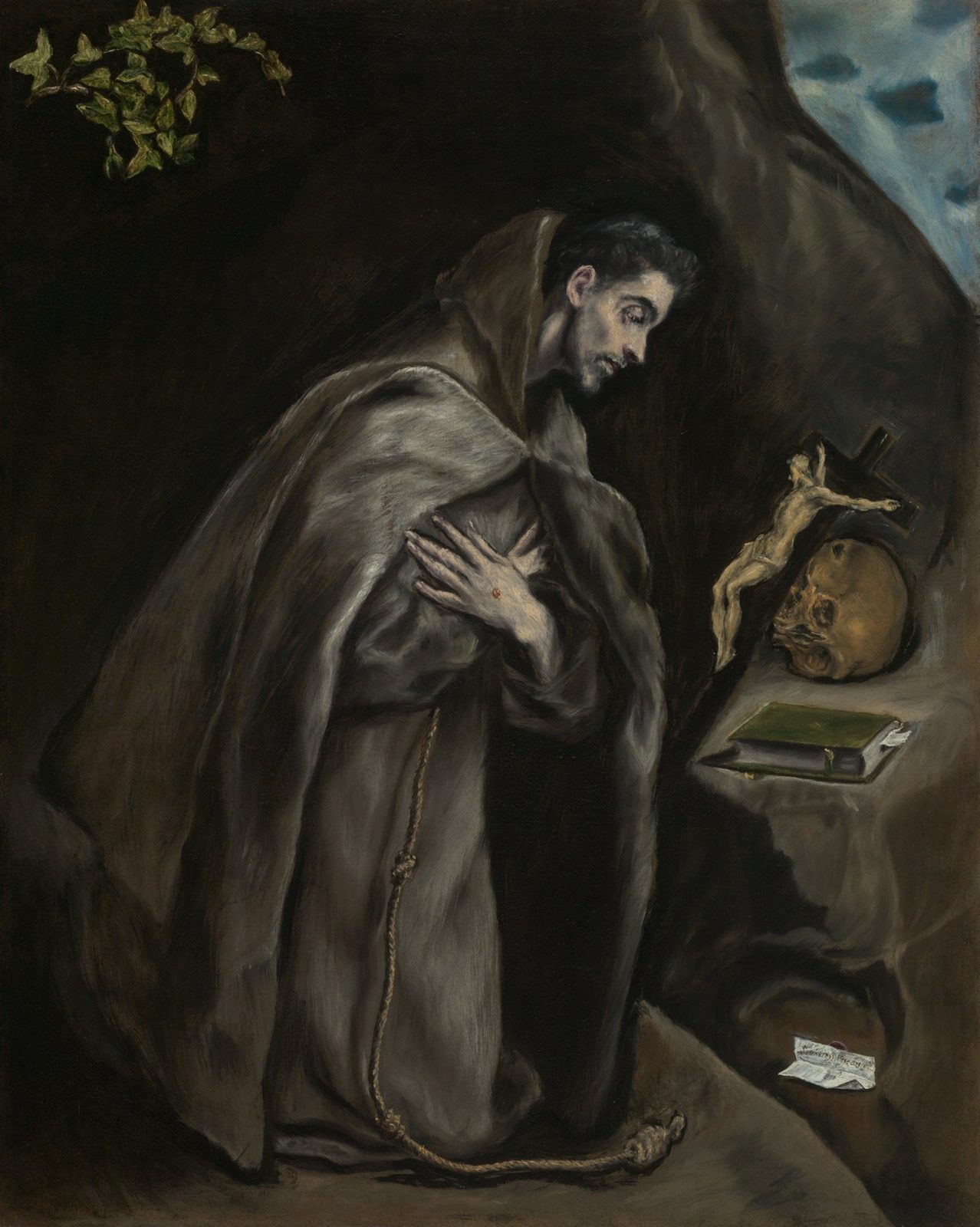
- Artist
- Domenico Theotokópoulos, called El Greco
- Title
- Saint Francis Kneeling in Meditation
- Date
- c. 1595–c. 1600
- Medium
- Oil on canvas
- Museum
- Art Institute of Chicago
- Image
- Public domain (CC0)
Open in Simple Art
Watch this story on iPhone and iPad, with offline downloads and a painting every day.
About 6 minutes of looking, in 12 parts.
A window onto a saint
The camera opens on a dark field where a single illuminated face bows in prayer. This is El Greco's Saint Francis Kneeling in Meditation, painted around 1595 to 1600, oil on canvas. Notice how the kneeling figure emerges from a near-black ground as though carved out of shadow, his body forming a long, slender vertical against the dark wilderness behind him.
Late Mannerism, Spanish period
El Greco worked in Spain during the late sixteenth century, and this canvas belongs to his mature style: elongated forms, dramatic chiaroscuro, and visibly loose, painterly brushwork. The saint's habit is the gray-brown of the Franciscan order, and the small props beside him—skull, crucifix, book, paper note—form a quiet still life of mortality and devotion.
Strong vertical, offset still life
Step back and look at the structure. The friar anchors a powerful vertical along the left-center, with the head tilting on a diagonal toward the lower right, while a secondary cluster of objects sits to the right. The thirds grid helps: the bowed face falls along the upper third, the clasped hands and skull land near the middle, and the small paper scrap rests in the lower right corner.
Light pours from the upper right
Now follow the light. It comes from the upper right, where a patch of pale blue and white sky opens through the wilderness. This is the window of grace El Greco engineers, raking across the face, the knuckles, the cheekbone, and the cheek of the skull, while the left side of the figure dissolves into deep shadow.
The bowed face
Close in on the face. The light hits the forehead and the bridge of the nose, while the eye recedes into a warm dark socket. The hood behind the head is a flat tan-brown field, and the beard is built from short overlapping strokes of lighter gray laid over a darker underlayer. Notice the hard-edged cast shadow under the brow ridge: a single loaded stroke that does most of the modeling work.
The stigmata
Drop down to the clasped hands. Cool grays and warm whites model the fingers against the dark robe, and at the center of the hand sits a single concentrated dab of red-brown pigment: the stigmata. This tiny warm accent is the only saturated color on the figure, and it is what your eye finds first after the face.
Memento mori
Move to the right, to the still life. The skull is rendered with broad, loaded strokes of warm ochre, its sockets punched in with near-black, and its cheekbone and brow ridge catch a hard, raking light. Beside it, a small elongated crucifix figure is sketched in cool blue-grays with loose, broken strokes—form built by contrast rather than outline.
Long fluid strokes
Now look at the robe. Long vertical brushstrokes drag the highlight color down each fold, tapering to shadow without lifting, so the brush's own pressure falloff does the gradation. The transitions are entirely soft, with no crisp outlines—the form turns on value alone.
Ivy in the dark
Glance to the upper left, where ivy leaves cluster against the near-black ground. Each leaf is just a few confident dabs: a yellow-green highlight, a mid-value green body, and a darker edge where it turns into shadow. The light is consistent with everything else—coming from the upper right—so only the upper and right-facing surfaces catch the dabs.
Cincture of poverty
Lower down, a coarse braided rope circles the waist and pools into a knot on the ground. The painter set the silhouette and the cast shadow first, then dragged a broken pale highlight along the upper edge of the rope, leaving the underside nearly the same value as the robe behind it. That single contrast does most of the work.
A green-covered volume
Beside the skull, a small volume sits on the ledge: a muted olive-green cover, a few off-white page edges, and a slim ribbon dropping from the gutter. The corner facing the upper right catches the brightest highlight, and the near edge falls into a deep brown-green shadow—volume built through value contrast, not line.
The smallest accent
Finally, settle on the lower right corner, where a small irregular scrap of paper lies on the umber ground. Faint thin dark strokes suggest handwriting without describing letters, and a soft cast shadow anchors it to the surface. It is the last resting place for the eye.
Look closer
10 details, each checked against a close-up of the picture.
-
Face and Hood
The light hits the forehead and bridge of the nose, while the eye is cast in shadow.
The crop shows a tightly cropped head study: dark hair mass at top, a pale illuminated forehead, a deeply shadowed eye socket, a lit bridge of the nose, and a loosely brushed beard descending into the dark ground. The hood behind the head is rendered as a flat tan-brown field with a soft diagonal fold edge, while the background dissolves into near-black on the right. Highlights on the forehead and nose bridge sit as the brightest passages; the eye is recessed into a dark, warm-brown cavity with a single pinpoint of light on the lower lid. Edges are wet and blended along the brow ridge but become scratchy and broken where beard hairs meet shadow.
-
Wound on Hand
A small, concentrated dot of red pigment marks the center of the hand.
The crop isolates a pale hand modeled in cool grays and warm whites, set against a dark, loosely brushed gray-brown habit that fills the lower and left portions of the frame. A small, concentrated dab of reddish-brown pigment marks the back of the hand near the center of the crop, registering clearly as a wound against the desaturated flesh tones. The fingers taper into soft, broken edges where they cross the wrist, and visible directional brushstrokes follow the long axis of each digit. Modeling is achieved through thin, scumbled layers of light over a darker underpainting rather than smooth blending, leaving the surface lively and textured.
-
Skull and Crucifix
The skull is rendered with broad, pale highlights and deep sockets, placed beside a small figure.
The crop isolates a small elongated crucifix figure at upper left and a large skull at lower right, set against a deep umber-to-black ground. The skull is built from broad, loaded strokes of warm ochre on the cranium that read as one continuous mass, while the eye sockets and nasal cavity are punched in with near-black, leaving the brightest highlights to float above. Edges between skull and background are softened and partially absorbed into the dark, whereas the cheekbone and brow ridge catch a hard, raking light. The Christ figure is rendered in pale warm creams, its body sketched with loose, broken strokes that read as form through contrast rather than outline. A thin olive-green sliver of the book edge appears at the bottom, and the whole group sits on a subtly cool gray ledge.
-
Robe Folds
Long, fluid, vertical brushstrokes of light gray define the ripples of the cloth.
The crop isolates the draped habit of a kneeling friar, dominated by long vertical folds descending from hood to lower frame. Warm gray-brown highlights run down the left-center where raking light grazes the fabric, while deep umber-black settles into the recessed valleys between folds. On the right third, a knotted cincture cord descends, painted with finer, more deliberate strokes that contrast the looser handling of the cloth. Edges are soft and blended throughout, with no crisp outlines defining the contours; the transitions rely entirely on value shifts within each stroke. A subtle woven-canvas texture shows through the thinner paint passages, especially in the mid-tones.
-
Upper Right Opening
A patch of pale blue and white paint suggests a glimpse of the sky.
A diagonal edge separates a dark brown and black mass on the lower left from a lighter blue, gray, and white area on the upper right. The dark section contains long, sweeping brushstrokes that angle downwards towards the bottom right. The lighter upper area features soft, diffuse brushwork with three darker, horizontal, blurred shapes layered on top. The boundary between the two main areas is irregular, showing visible feathering and overlapping paint marks.
-
Green Leaves
The foliage in the upper left consists of dabs of yellow-green and dark green paint.
The crop shows a cluster of ivy-like leaves against an almost black ground. Each leaf is built from a few confident dabs: a yellow-green highlight, a mid-value green body, and a darker green or near-black edge where the form turns into shadow. Edges alternate between crisp—where a single loaded stroke defines a leaf silhouette—and soft, where the leaf melts into the dark background. The lighter dabs cluster on the upper and right-facing surfaces of the leaves, while the lower-left sides disappear into the dark. A thin, broken stem-line runs through the cluster, indicating a gesture of how the branch was laid in before the foliage was added.
-
Knotted Rope Belt
A coarse, braided rope circles the waist and ends in a knot on the floor.
The crop shows the lower torso of a kneeling figure wrapped in deeply shadowed, gray-brown drapery that folds into soft vertical channels. A thin, twisted rope of warm ochre tone curves down the left side, across the lower belly, and pools on the ground where it terminates in a bulky, roughly painted knot at the lower right. The rope's lit upper edge reads as a continuous broken highlight of pale yellow-white, while its underside falls into a thin core shadow that nearly merges with the dark robe. Canvas weave is clearly visible through the thin, lean paint in the deepest darks, contrasting with the slightly more loaded strokes that describe the knot. Edges between rope and robe are crisp where the highlight strikes, but dissolve into a soft rubbed transition where the rope crosses into shadow.
-
Closed Book
The book is shown as a green-covered volume with white pages and a thin bookmark.
A rectangular, closed (or barely cracked) volume sits on a gray-brown ledge, its top and front board painted in a muted olive green. The right edge reveals a small stack of off-white leaves with a slim ribbon or clasp dropping from the gutter. The cover's far corner catches the brightest highlight; the near edge and underside fall into a deep brown-green shadow, and the form rests against a scumbled, atmospheric rock surface. Brushwork is loose and visible — board edges are described with broken, slightly dragged strokes rather than crisp contours, and the page edges are a few quick, dry highlights over a darker base.
-
Shoulder Transition
The edge of the shoulder blends softly into the dark brown background.
The crop is dominated by a near-black field on the upper left that yields, along a soft diagonal running from upper-right to lower-left, to a mid-warm brown shoulder mass. The transition is not a hard contour: the dark ground and the brown of the habit are knit together by blurred, low-contrast passages where individual bristles never resolve into a line. Within the brown area the marks are long, slightly diagonal streaks oriented roughly parallel to the incoming light, with a faint highlight clinging to the upper-right edge. A few short, lighter flecks appear at the very top where the illuminated shoulder crest meets the shadowed background.
-
Paper Note
A small scrap of white paper with faint scribbled lines lies on the ground.
A small, irregularly shaped scrap of paper rests on a dark umber ground. The paper is rendered in cool off-white with subtle warm grey shadows along its folded and creased edges, and a small reddish-brown smudge marks its upper edge. Thin, dark parallel strokes suggest handwritten script across the upper portion of the scrap, loosely indicating rather than describing text. The dark ground surrounding the paper shows visible directional brushwork in deep browns and near-blacks, with a soft cast shadow anchoring the lower right of the paper to the surface.
Saint Francis Kneeling in Meditation in context
A saint in coarse sackcloth
The painter and theorist Francisco Pacheco visited El Greco in Toledo in 1611 and judged him the painter who had portrayed Saint Francis best, faithful to the story even if he dressed the saint roughly in coarse sackcloth [2][4]. The Art Institute links the many repetitions of this composition to Francis's great popularity in Toledo [1].
The Bilbao Fine Arts Museum owns another version and identifies the setting as the small cell dug at the foot of a beech on Mount Alverna, described in The Little Flowers of Saint Francis [2]. Its catalogue text by José Álvarez Lopera reads the closed book beside the skull as a breviary, treating the hanging ivy on the cave wall as a familiar sign of penance [2].
Seventeen pictures, few by one hand
The Art Institute says at least a dozen other versions exist [1]. According to the Bilbao museum, the scholar Harold Wethey catalogued seventeen, including originals, workshop pictures and seventeenth-century copies, and he thought only three were probably by El Greco himself: Bilbao's, one in the de Young Museum in San Francisco and Chicago's, which he considered painted with the workshop [2]. The Bilbao version of about 1585 may be the first of the series, and the San Francisco one, where the saint looks younger, the latest [2].
Versions differ in size. Chicago's measures 92 by 74 centimetres, Bilbao's 105.5 by 86.5, and the version at the Meadows Museum in Dallas, dated about 1605 to 1610, 75.9 by 63.5 [1][2][3]. The Art Institute's bibliography includes a 2011 technical study comparing four of El Greco's images of Saint Francis, a sign that questions of authorship and sequence are still being examined [1].
A workshop built for repetition
Wikipedia notes that El Greco seems to have hired an assistant in 1585 and set up a workshop able to produce altar frames and statues as well as paintings [4]. From 1585 he rented rooms in a large complex in Toledo that also served as his studio [4]. His son Jorge Manuel, born in 1578, assisted him and went on repeating his compositions for many years after inheriting the studio [4]. Workshop practice of this kind may help explain why one design, such as this kneeling Francis, could survive in so many hands and qualities [2][4].
A name on a scrap of paper
The Chicago canvas has the painter's Greek name, Domenikos Theotocopulos, inscribed at the lower right, followed by letters the museum doesn't transcribe [1]. The Bilbao version carries a similar signature in tiny Greek letters on a piece of paper on the floor [2].
From Toledo to Chicago
The museum suggests the painting may have been among the works in El Greco's possession when he died in 1614, recorded in the inventory of his estate, but the link isn't certain [1]. By 1902 it belonged to Don Clemente de Velasco in Madrid, who lent it that year to an El Greco exhibition at the Prado [1]. The New York dealers Durlacher Brothers had it by 1935 and sold it to the Art Institute that year through the Robert A. Waller Memorial Fund [1]. It was shown in the museum's exhibition El Greco: Ambition and Defiance in 2020 [1].
- El Greco, Saint Francis Kneeling in Meditation, 1935.372: object record, label text, provenance, exhibition and publication history . Art Institute of Chicago (public API)
- El Greco, Saint Francis in Prayer Before the Crucifix, c. 1585 (text by José Álvarez Lopera) . Bilbao Fine Arts Museum
- El Greco, Saint Francis Kneeling in Meditation, c. 1605-10, MM.99.01 . Meadows Museum, SMU, Dallas
- El Greco . Wikipedia