Painting the Gaze: Goya's Señora Sabasa Garcia
A close study of how value, temperature, and unfinished edges carry a portrait
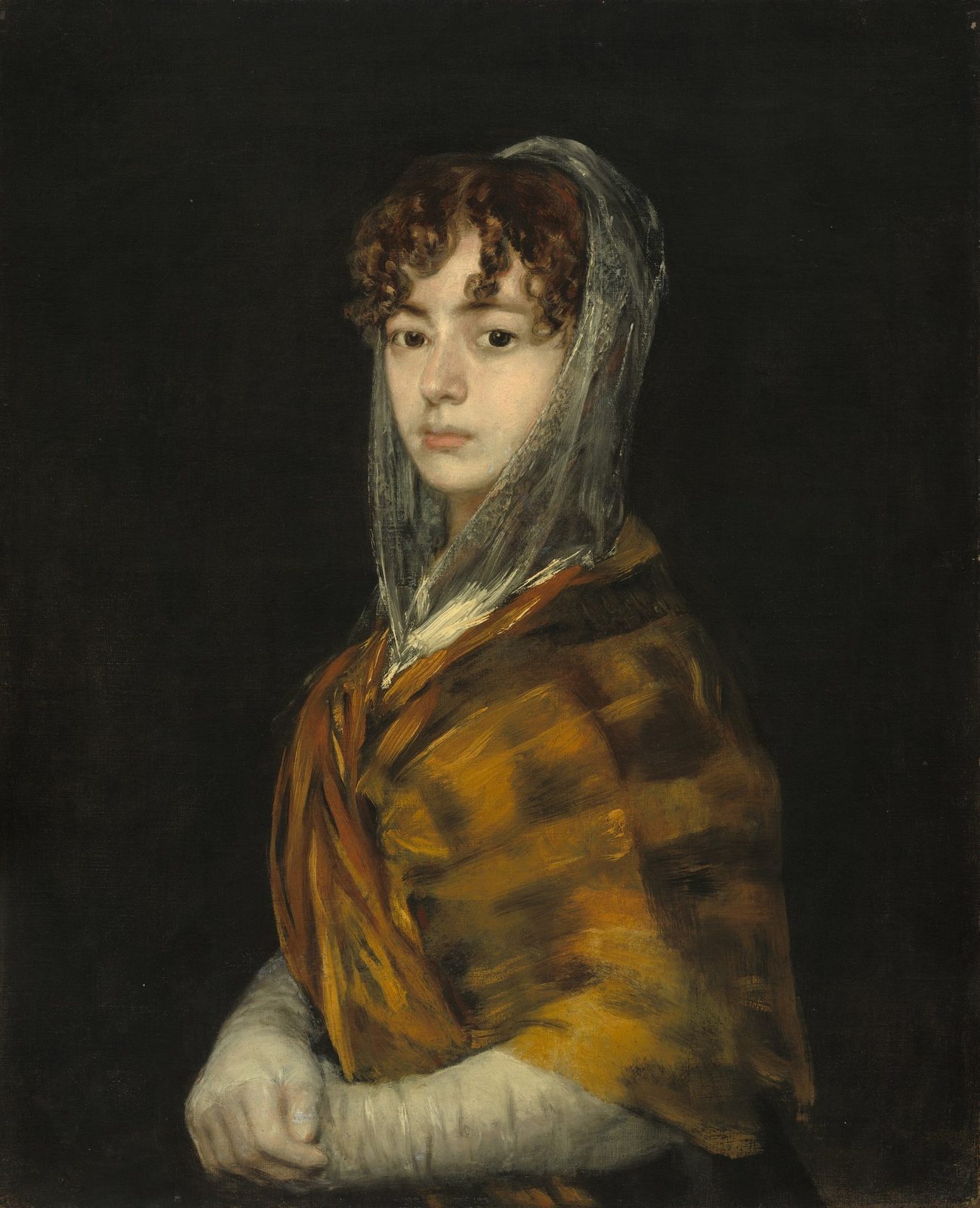
- Artist
- Francisco Goya
- Title
- Señora Sabasa Garcia
- Date
- c. 1806/1811
- Medium
- oil on canvas
- Image
- Public domain (CC0)
Open in Simple Art
Watch this story on iPhone and iPad, with offline downloads and a painting every day.
About 6 minutes of looking, in 12 parts.
A woman emerges from a near-black void
A woman emerges from a near-black void, her eyes meeting yours with a quiet, unblinking steadiness. There is no jewelry, no elaborate setting, no decorative flourish—just a face, a translucent veil, and the suggestion of a warm brown-gold wrap. Watch how the entire figure organizes itself around that single point of contact.
Goya, Spain, c. 1806 to 1811
Francisco Goya painted this portrait, titled Señora Sabasa Garcia, somewhere between about 1806 and 1811, in the last years of his court career. He treats the face with a refined, blended finish, but everything below the chin dissolves into loose, summary brushwork—a deliberate split that tells you exactly where he wants your attention to live.
A pyramid widening downward
Step back and read the structure. The head sits high on the canvas, and from there the figure widens through the shoulders and drapery down to the folded hands at the base—a classical pyramid opening downward. Her eyes land almost exactly on the upper third line, and the broad base of the triangle sits at the lower margin.
Three values, one light source
The light comes from the upper left, slightly in front of her, and it produces a soft but firm chiaroscuro. Notice the three-tier key: the deep near-black surround, the mid-value brown-ochre of the wrap, and the narrow band of highest value reserved for the face, the lit edge of the veil, and a sliver of white sleeve. Nothing else in the picture is allowed to be bright.
Eyes that refuse to be white
Now look closely at the eyes, where the camera is settling. The pupils are crisp dark ovals, the upper lids carry soft grey-brown cast shadows, and there is a tiny warm pink touch at each inner corner. Crucially, the whites of her eyes are not white—they are a warm cream scumble that sits inside the painting's mid-value range. Resist the urge to leave the brightest value in the portrait sitting in the eyeball.
Temperature does the rounding
On the left cheek, the form is turned not by blending but by a jump in temperature. A creamy, peachy highlight sits directly above a cool grey-green shadow beside the nose. Goya lays them as two adjacent strokes of similar value but opposite temperature and leaves the boundary as a soft painterly edge—the temperature contrast alone makes the cheek feel rounded and lit.
Hair as a stack of comma-shaped dabs
Up at the hairline, the curls are not drawn. They are built from discrete, comma-shaped touches of warm umber, each one carrying its own little highlight along the upper edge. There is no continuous outline around the mass of hair—only the optical edge made by the curving impasto dabs against the pale skin below. Try painting hair this way and let the pattern of touches build the shape for you.
Transparency by letting the ground breathe
The veil is the great lesson here. Goya dragged thin, semi-dry strokes of grey and off-white vertically and diagonally across a near-black ground, and he did not fill the gaps. Narrow channels of dark canvas show through, and that is what reads as sheer fabric. Resist the temptation to cover every square inch; let the ground breathe through the scumble and the weave does the rest.
Drapery in two values, no blending
Now sweep down to the brown-gold wrap. Broad diagonal ochre strokes sweep from upper left to lower right, then shorter curving strokes follow the fall of the fabric. The strokes are unblended—where one passes over another, the lower stroke shows at its edge, and tiny slivers of dark ground remain visible. The form emerges from stroke direction and overlap, not from smooth tonal gradation.
A lost edge, then one hard accent
Down at the neck, the veil's right-hand contour is deliberately dissolved—Goya pulled the stroke thinner and let the ground swallow it. Then, just beneath the chin, he places a single loaded, slightly broken horizontal stroke of warm white-cream. That one hard highlight re-anchors the entire lost edge in your eye. Don't draw a clean contour where a form turns into shadow; thin the stroke to zero, then drop one bright loaded stroke to rescue it.
Two temperatures, no-man's-land between
At the meeting of sleeve and wrap, watch what is missing. There is no mixed mid-tone bridging the cool grey-white of the sleeve and the saturated yellow-ochre of the wrap—just a narrow dark crease. The temperature jump is so sharp that the figure feels genuinely advanced from the ground. A blended middle tone would have flattened the whole thing.
Two values is enough at the base
At the very bottom, the folded hands are barely described. The fingers are built from broad rounded strokes of pale cream and warm pinkish flesh, the cuff is a series of parallel vertical white strokes, and the lower edge of the hand simply dissolves into the dark background. The figure is grounded at the base with the least possible finish, and the tenebrist ground does the work of the shadow for free.
Look closer
9 details, each checked against a close-up of the picture.
-
Face and veil — the pyramidal center of the portrait
The face is centered in the canvas, the left cheek is brightly lit, and the right side of the face falls into shadow against the dark background.
The crop shows a female head emerging from a near-black ground, framed by loose russet curls and a gauzy, semi-transparent veil. The face itself is rendered with relatively blended, controlled strokes—soft transitions around the eye sockets, a softly modelled nose, and a small warm pink-red note at the lips—while the veil is laid in with long, dragged, partly dry brush marks that show the grey-white pigment skipping over the dark underlayer. The lit left cheek (viewer's left) sits in high value against a deep umber-black background; the right side of the face turns down into a cool, broken shadow that loses its edge into the veil and ground. Edges between the veil and the face are intentionally lost, whereas the contour of the lit cheek against the background is kept crisp.
-
Eyes — crisp pupils and veiled sclerae
Both eyes contain dark, distinct pupils, soft gray shadows on the upper lids, and small warm highlights at the inner corners, while the whites are toned down rather than pure white.
The crop centers on both eyes, the bridge and tip of the nose, the inner brow mass, and a sliver of the upper lip framed by the translucent veil. The pupils read as crisp dark ovals set into sclerae that are warm cream-pink rather than white, with soft grey-brown shadows pooled under the upper lids and small reddish-pink accents at the inner canthi; a single sharp catchlight sits on the right pupil. Brow hair is laid in confident curling dark strokes, while the veil is dragged in slightly broken grey-white verticals that skim past the cheeks. The bridge of the nose carries a soft vertical light strip that feathers into a warmer half-tone on the right plane, and the upper lip just visible at the lower edge reads as a muted pinkish-red.
-
Left cheek — warm highlight against cool shadow
A warm, creamy highlight on the left cheek sits directly against a cool gray shadow beneath the eye, showing the light source from the upper left.
The crop isolates the left cheek, half of the nose, the left eye, and a strip of translucent veil against a near-black ground. A creamy, peachy highlight sits broadly across the cheekbone, while directly above it a cool gray-green shadow defines the lower eyelid and the soft triangle beside the nose. The boundary between warm and cool is not blended but left as a soft, painterly edge where one temperature meets the other. The veil on the left is dragged in long, broken vertical strokes of cool gray over white, allowing the dark ground to read through the gaps. A bright catchlight rides the right edge of the nostril, and small scumbled white dabs along the lower border suggest reflected light on the veil near the jaw.
-
Veil texture — dragged broken strokes over ground
The veil is painted with thin, dragged strokes of gray and white that leave narrow channels of the black ground exposed, creating literal transparency.
The crop isolates the right side of the sitter's head, where a translucent veil drapes from the crown down past the cheek. The veil is constructed from thin, dragged strokes of cool gray and off-white laid vertically and diagonally, with the dark, near-black ground left bare between them in narrow channels. Beneath this scumbled veil the warm brown curls of the hair read through, edged in places with a fleck of red-brown where the artist dragged a saturated stroke across a lighter one. The veil's lower edge resolves into a softer, bluer-gray fold that bleeds into the white sleeve and shawl at the bottom left, while the upper edge against the hair is left soft and unresolved.
-
Drapery — broad summary ochre brushwork
Broad, unblended ochre and brown strokes overlap and leave small areas of dark ground exposed, creating the surface texture of the wrap.
The crop is dominated by sweeping, diagonal ochre and umber brushstrokes that read unambiguously as a single broad gesture from upper-left toward lower-right, then layered with shorter, curving strokes that follow the wrap's fall. Strokes are unblended: where one passes over another, the lower stroke shows through at its edges, and tiny slivers of very dark brown ground remain visible between strokes, especially in the upper-middle band near x≈0.55, y≈0.15. Values run from near-black (#2a1f14 region in shadow pockets at right and lower-left) through a saturated mid-ochre to a near-cadmium highlight; edges are kept soft and streaky rather than feathered. The bristle track is legible throughout—hairs split and rejoin within each stroke—indicating a relatively stiff, well-loaded brush pulled with the lay of the fabric rather than scrubbed.
-
Neck veil edge — lost edge and chemise highlight
The veil has a completely soft, lost edge across the neck, while a single bright horizontal stroke beneath it provides the only hard accent in this area.
The crop captures the lower jaw and chin descending into a dark veil whose right-hand contour dissolves into the near-black ground without a drawn outline. A single loaded, slightly broken horizontal stroke of warm white-cream sits just under the chin, reading as a chemise edge catching the upper-left light. Below that highlight the brown-gold wrap is laid in with broad, slanted, wet-into-wet strokes whose values step from mid umber into deep chocolate. The veil is built with thin, dry, parallel drags that sit over a darker scumbled layer, so its surface reads textured rather than wet. The contrast between the soft, scumbled veil edge and the crisp, opaque horizontal highlight is the principal edge event in this region.
-
Forehead curls — discrete impasto touches
The curls are made of discrete, warm umber touches that overlap the forehead and veil with no continuous outline.
The crop shows tightly grouped curls modelled with short, comma-shaped dabs of paint stacked along the hairline and across the brow. Each curl is a separate touch of warm umber with a slightly lighter, sometimes reddish, mid-tone catching the upper edge — there is no drawn outline around the mass of hair, just the optical edge made by the curving impasto dabs against the pale skin below. The forehead itself is built with broad, blended strokes of warm pinkish flesh, brightest on the left under the described light and cooled toward the right where the veil passes over it. On the right side, a translucent veil is laid in with thin, vertical brushstrokes of cool grey-white, partially covering both the curls and the skin, softening the underlying edges without obscuring them.
-
Sleeve and wrap — warm/cool temperature contrast
A sharp value step separates the cool gray-white sleeve from the warm ochre drapery, with no intermediate mixed color between them.
The crop isolates the meeting point between the figure's cool gray-white sleeve on the left and the warm ochre-brown wrap cascading from the upper right. Broad, loaded brushstrokes describe the sleeve with horizontal-then-vertical directional sweeps, the white paint slightly broken to reveal a cooler lavender-pink in the lower fold near the cuff. The wrap is built with diagonal, gravity-pulled strokes of saturated yellow-ochre and darker burnt sienna, its lower edge set against a near-black ground. The boundary between sleeve and wrap is a direct temperature jump — warm ochre sits against cool white with only a narrow dark crease between them, not a softened blend.
-
Folded arms — minimal value anchoring the base
The single visible hand, gripping the other arm's white sleeve, and the cuffs are modeled with only two or three values and dissolve into the near-black background at the lower left.
The crop isolates a folded hand and forearm emerging from a white sleeve against an almost-black ground, with a mass of warm brown-gold drapery descending from the upper right. The hand is built from broad, rounded strokes of pale cream and warm pinkish flesh tones that read more as shapes than as anatomy. Edges along the lower-left dissolve abruptly into the dark background, while the cuff above is described with a series of parallel vertical brushstrokes in a near-white value, with only a couple of mid-tone shadows to separate the pleats. The brown wrap shows loose, directional strokes that follow its diagonal fall, with the darkest passages left as bare ground rather than painted.
Señora Sabasa García in context
A name found later
When the painting appeared in Berlin in 1908 to 1909, it was catalogued simply as a young girl [1]. Juan Allende Salazar first identified the sitter as Sabasa García while the picture hung at Duveen's galleries in New York [2]. Most later scholars have accepted this. But Enriqueta Harris and José Camón Aznar pointed out that no document confirms it, and the Gallery's catalogue calls the identification reasonable based on the provenance [2].
María García and her uncle
Close friends used the name Sabasa for María García Pérez de Castro, born in Madrid in 1790 [2]. She married Juan Peñuelas, a landowner living in Madrid, in 1820, and her last known document is a will from 14 May 1850 [2]. Her uncle Evaristo Pérez de Castro, whom Goya painted before 1806, was close to her and acted as executor for her earlier wills [2]. Spanish Wikipedia describes him as one of Goya's main protectors [3].
The Gallery calls him Spain's minister of foreign affairs [1]. But Spanish Wikipedia places his term as Secretary of State in 1820 to 1821 and his premiership in 1838 to 1840, so he probably held neither office when Goya painted him [3].
Dating the portrait
No document dates the picture [2]. Judging by the sitter's apparent age, the catalogue places it between 1806 and 1811, the same range scholars had proposed based on style before her birth year was known [2]. José Valverde Madrid suggested that the lack of jewellery means Goya painted it before her marriage [2]. The catalogue groups it with other portraits from these years set against neutral backgrounds without signs of rank, when Goya increasingly treated portraits as psychological studies [2].
Goya after 1806
The Gallery describes the years before the French invasion of 1808 as busy and financially secure for Goya [1]. On 23 December 1808 he swore loyalty to Joseph Bonaparte, and scholars still debate what that meant [2]. He painted French residents of Madrid and later the Duke of Wellington, and from 1810 worked on the Disasters of War etchings, which were first published in 1863 [2]. His wife Josefa died in 1812 [4].
After 1814 Ferdinand VII restored his salary but gave him no commissions [2]. In 1824 Goya moved to Bordeaux, where he died on 16 April 1828 [2].
From Madrid to Berlin to Washington
The portrait stayed with the sitter until she died, then passed to her goddaughter, Mariana García Soler, whose husband sold it in Madrid [1]. By 1908 it belonged to the Berlin collector James Simon, and later to Count Paalen and Heinrich Sklarz [1]. Duveen Brothers sold the painting to Andrew W. Mellon on 21 February 1930, and it came to the Gallery with his gift in 1937 [1].
The Gallery's technical notes describe a greyish white ground and record areas of old repaint in the face and hands that have turned white [1].
- Francisco Goya, Señora Sabasa García (1937.1.88): overview, provenance, exhibition history, technical summary and bibliography (Internet Archive copy, 21 April 2025) . National Gallery of Art, Washington
- Jonathan Brown and Richard G. Mann, Spanish Paintings of the Fifteenth through Nineteenth Centuries (Systematic Catalogue, 1990): Goya biography and entry 1937.1.88 (Internet Archive copy of the PDF) . National Gallery of Art, Washington
- Evaristo Pérez de Castro . Wikipedia (Spanish)
- Francisco Goya . Wikipedia