Eyes before cathedrals
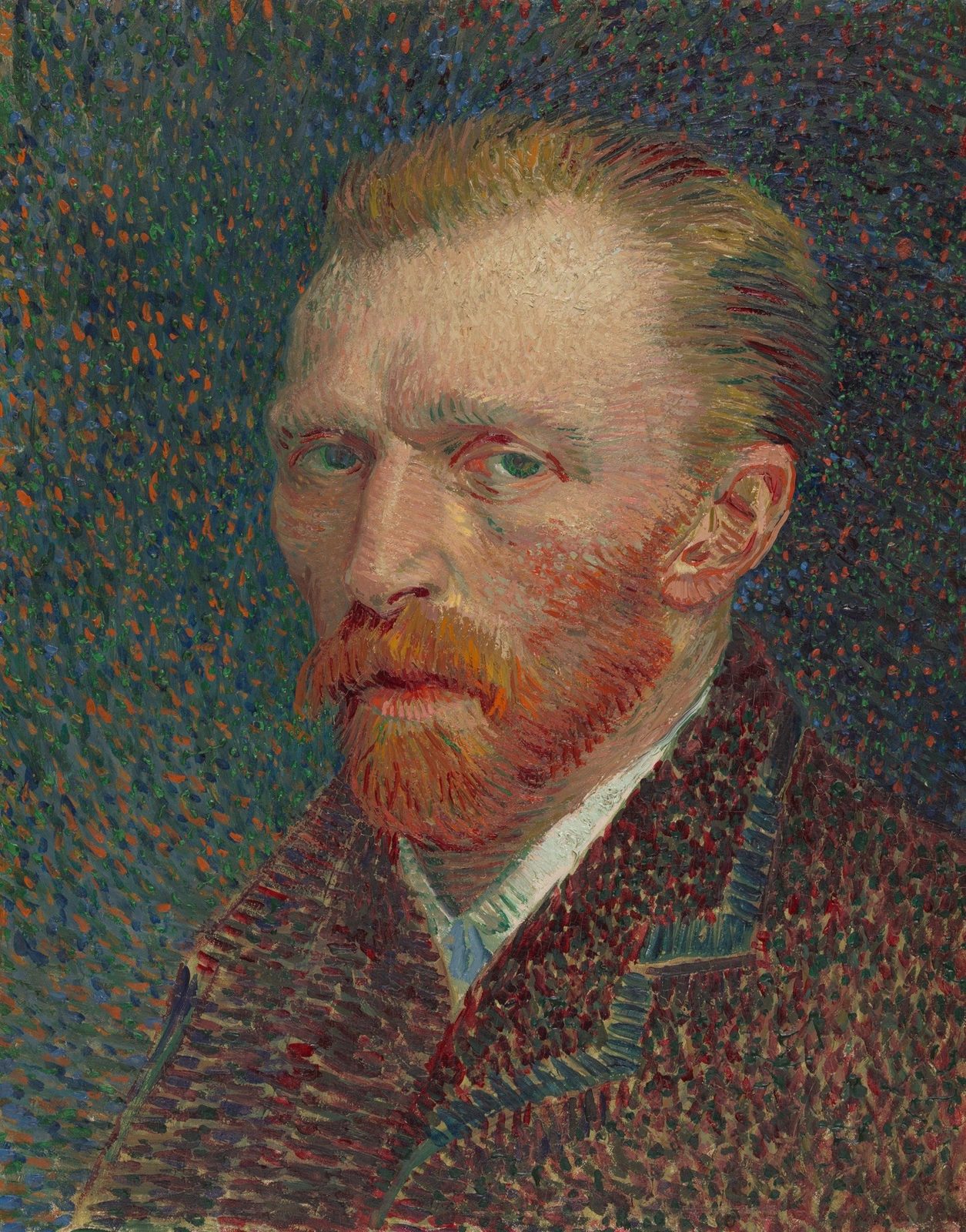
In Paris in 1887, Van Gogh fills the air around his head with Seurat-like dots and keeps his own thick, directional strokes for the face
- Artist
- Vincent van Gogh
- Title
- Self-Portrait
- Date
- 1887
- Medium
- Oil on artist's board, mounted on cradled panel
- Museum
- Art Institute of Chicago
- Image
- Public domain (CC0)
Open in Simple Art
Watch this story on iPhone and iPad, with offline downloads and a painting every day.
About 4 minutes of looking, in 10 parts.
Self-Portrait
A red-bearded man looks straight out at us from a field of tiny coloured marks. The background almost hums. Yet your eye keeps returning to the same place: two pale green eyes set in a warm orange face.
Paris, 1887, oil on board
This is Vincent van Gogh, painting himself in 1887. The Art Institute of Chicago notes that he made at least twenty-four self-portraits during his two years in Paris. This early one is small, and painted on prepared artist's board rather than canvas.
A head on a broad base
The design is simple. The head is a slightly tilted oval, and the jacket spreads below it into a broad triangle. The ear and shoulder on the right nudge the whole figure a little off centre, so it doesn't feel stiff.
The eyes
Now the eyes. The irises are patches of green-teal with tiny off-white catchlights, inside rims of reddish brown rather than a single dark outline. The museum quotes a letter to his brother Theo: he preferred painting people's eyes to cathedrals.
A beard of ridges
Drop down to the beard and the paint thickens. Orange, red and deep crimson are laid in short parallel strokes that seem to follow the way the hair grows. Each stroke looks as if it kept its own ridge of paint.
Colour does the modelling
Beside the nose, the cheek turns from pale cream-yellow into orange and red. It isn't blended. Small strokes sit side by side and curve around the cheek, so the colours seem to mix as you look rather than on the board.
Seurat's dots, loosened
Now the background. Short dashes of blue, green and orange sit next to each other on a dark teal ground, each keeping its own colour. The museum links this dabbed brushwork to Seurat's pointillism. Here, though, the marks are commas rather than neat dots, and the orange ones look thicker.
The brightest note
The collar is the lightest thing in the picture, a V of off-white and pale blue-green. Where it meets the jacket, the white appears to sit on top of the dark red strokes, as if it went on near the end.
Stripes made of strokes
Down in the jacket, slanting strokes of red, dark blue and brown run mostly one way, crossed here and there by shorter marks. Up close it is all separate touches, but from a step back it reads as striped, woven cloth.
Two ways of painting
Put the beard beside the background. One is thick, directional and shaped to the form. The other is a scatter of separate coloured marks. As the museum describes it, Seurat's cool, scientific method becomes in Van Gogh's hands something intensely emotional.
Look closer
8 details, each checked against a close-up of the picture.
-
The Eyes
The eyes are rendered with pale teal and white highlights against darker outlines.
The crop isolates the eyes and the bridge of the nose of a bearded sitter. The irises carry distinct green-teal patches with small off-white dabs acting as catchlights, sitting inside reddish-brown rims that read as upper-lid shadow. Surrounding skin is built from short, directional impasto strokes in warm pinks, ochres, and salmon, laid roughly perpendicular to the eye sockets so the brushwork describes the orbital form. Edges along the lids and tear ducts are softened wet-into-wet, while the whites of the eyes are tinted with faint green and pink reflections rather than left neutral. The right eye (viewer's) shows a more saturated orange-red crescent in the iris that is not present in the left, suggesting asymmetrical observation rather than mirrored copying.
-
Beard Texture
The beard consists of thick, directional impasto strokes of orange, red, and yellow.
The crop isolates the lower half of a face, dominated by a moustache and full beard rendered in dense, parallel impasto strokes. The strokes run diagonally from upper-left to lower-right across the cheek and jaw, and curve downward beneath the moustache, following the growth direction of the hair. Palette is built from cadmium-orange, vermilion, and deep crimson with short yellow and pale-pink highlights catching light on the upper moustache and the lit cheek ridge. Deeper maroon and brownish-green strokes sit in the recesses under the moustache and along the jaw shadow, while a sliver of pale cream-white at lower right reads as a collar edge.
-
Background Pointillism
The background is composed of discrete, unblended dashes of blue, green, and orange.
The crop is a densely worked field of small, discrete paint marks set against a dark teal ground. The marks read as short comma-shaped dashes rather than pure round dots, most roughly 5-12 pixels wide and slightly longer than they are tall. Orange touches are visibly thicker and more impastoed than the surrounding blue-green notes, sitting up off the surface. Colors are placed side-by-side without on-canvas blending - each dab keeps its own hue, with a few lighter blue-violet accents scattered among the dominant dark teal, warm orange, and mid-green palette.
-
Hair Striations
The hair is painted with long, curving strokes radiating from the crown.
The crop is dominated by long, arcing brushstrokes that sweep from the upper-center downward and outward to the left, right, and bottom edges. Upper-area strokes are thin, loaded with impasto, and multi-hued, mixing deep blues, greens, vermilion, ochre, and near-black in adjacent dashes; lower strokes broaden and shift to creamy pinks, pale ochres, and muted greens that read as the lighter beard area. Edges are crisp where a single stroke sits over the next, with small gaps of underlying canvas or cooler color visible between hairs, especially along the dark band near the top.
-
Collar and Shirt
The collar consists of bright white and pale blue strokes overlapping the jacket.
The crop centers on a V-shaped collar opening where thick, short strokes of off-white and pale blue-green sit on top of the underlying red-brown jacket. The collar strokes run roughly horizontally, while the jacket on either side is built from short, slanted dashes of deep red, maroon, and dark green that read as a woven or striped fabric. At the lower V-tip, a patch of mid blue-grey appears beneath the white, suggesting a shirt or shadowed recess. The impasto is heavy enough that individual ridges catch light, especially along the right side of the collar where the white is highest in value. Edges between collar and jacket are softened by overlapping rather than crisp lines, and the background red at the top reads as longer, more sweeping strokes compared to the dabs on the jacket.
-
Jacket Weave
The jacket uses cross-hatched strokes of blue, brown, and red to suggest fabric texture.
The crop shows a dense field of impasto brushstrokes forming the jacket surface, with strokes predominantly angled from lower-left to upper-right in a diagonal weave. Layered reds, dark blues, and earth browns interweave, and cross-hatched applications—shorter perpendicular strokes crossing the dominant direction—are visible especially in the lower-left and center. A cream and ochre underlayer peeks through gaps in the paint, particularly along the right-side edge where a folded lapel boundary emerges as a softer transition from dense weave to sparser marks. Stroke tops show slight ridge highlights, suggesting the paint was loaded thickly and not fully blended. Edges between color zones are softened by impasto overlaps rather than hard-drawn lines.
-
Ear Detail
The outer edge of the ear is defined by a thin line of dark reddish-brown paint.
The crop isolates the right ear of a bearded self-portrait, rendered in short, directional impasto strokes of coral, salmon, and warm pink. The outer helix is traced by a thin, broken line of dark reddish-brown paint that sits on top of the flesh tones, and where that line breaks you can see the lighter pink beneath. Inside the concha, cooler lavender-pinks recede while small dabs of pale ochre catch the light on the tragus and upper ridge. To the right, the densely stippled background of green, blue, and orange dashes butts directly against the ear without a halo of blending.
-
Cheek Transition
The cheek moves from pale cream-yellow into orange and red through small, unblended adjacent strokes.
The crop shows a painted surface transitioning from pale cream-yellow tones in the upper portion into saturated oranges, terracotta reds, and deeper red-browns below. Marks are short, comma-shaped and slightly tapered, applied in a directional sweep that curves diagonally from upper-left toward lower-right, following what reads as the rounded volume of a cheek. Edges between colors are not blended but left as distinct juxtaposed dabs of impasto, with small flecks of greenish-grey and salmon sitting between the warm zones. The paint sits thickly; ridges of pigment catch light along individual strokes, and tiny untouched weave/texture of the support shows through where scumbles are thin.
Self-Portrait (1887) in context
Eyes rather than cathedrals
The line the Art Institute quotes beside this picture was written before Van Gogh reached Paris. It comes from a letter to Theo from Antwerp, dated Saturday 19 December 1885, in which he mentions drawing studies of the cathedral as souvenirs for foreign visitors [1][4]. He then says he would rather paint people's eyes than cathedrals, because the soul of a person interests him more [4]. The editors of the letters note that the date follows the one Jo van Gogh-Bonger gave in her 1914 edition [4].
A sitter who cost nothing
In Paris he made at least twenty-four self-portraits in two years [1]. The Van Gogh Museum explains that models were expensive, so he bought a good mirror and used himself as his subject, and that for one summer self-portrait of 1887 he could not afford new canvas and painted on the back of an earlier still life [2][3]. Writing to his sister Willemien in late October 1887, he said that since Nuenen he had not had the chance to find models, but had been able to study colour instead [5].
This early example is small, 41 by 32.5 centimetres, and painted on prepared artist's board that is now mounted on a cradled panel [1]. It carries no signature or inscription [1]. The painting is number 345 in J.-B. de la Faille's catalogue raisonné and number 1249 in Jan Hulsker's [1].
Sold by Jo van Gogh-Bonger
The first owner named by the museum is Van Gogh's sister-in-law, Johanna van Gogh-Bonger, in Amsterdam [1]. Her account book records 2,942.50 guilders received in February 1912 from the Frankfurter Kunstverein for a portrait, which the museum identifies as the sale of this painting to Leonhard Tietz of Cologne [1]. German Wikipedia describes Tietz as a department-store entrepreneur of Jewish origin whose descendants were persecuted by the National Socialists [7].
Tietz died in 1914 and the painting passed to his son Alfred [1]. According to the museum, Alfred Tietz sold it to E. J. van Wisselingh and Co. in Amsterdam on 12 December 1933, and the firm then sold it to Étienne Bignou in Paris on 31 December [1]. By 1935 it belonged to Joseph Winterbotham of Burlington, Vermont, who died in 1953, and it was given to the Art Institute in 1954 [1].
Cologne in 1912
In the year of its sale, the portrait was shown in Cologne at the international exhibition of the Sonderbund, as catalogue number 11 [1]. Wikipedia describes that 1912 show as a landmark that introduced French Impressionist, Post-Impressionist and modern art to western Germany, featuring works by Van Gogh, Cézanne, Gauguin and Picasso among many others [6]. When the Wallraf-Richartz Museum reconstructed the exhibition in 2012, this painting returned to Cologne as number 3 [1][6]. And it was also in Paul Cassirer's gallery in Berlin in 1914 [1].
A Winterbotham picture
The painting belongs to the museum's Winterbotham Collection, established in 1921 by Joseph Winterbotham to assemble thirty-five modern European paintings [1][8]. Its terms allow the museum to sell or exchange works in the group to acquire better ones, and the museum lists this self-portrait among the collection's best-known works [8]. Since arriving in Chicago, it has travelled to exhibitions including Van Gogh and Gauguin: The Studio of the South in 2001-02 and the Courtauld's Van Gogh: Self-Portraits in London in 2022 [1].
- Vincent van Gogh, Self-Portrait (1954.326): collection record with description, provenance, exhibition and publication history (public API) . Art Institute of Chicago
- Vincent van Gogh, Self-Portrait with Pipe and Straw Hat (s0163V1962) . Van Gogh Museum
- Vincent van Gogh, Self-Portrait with Straw Hat (s0060V1962v) . Van Gogh Museum
- Letter 549, Vincent van Gogh to Theo van Gogh, Antwerp, Saturday 19 December 1885 . Van Gogh Museum and Huygens ING, Vincent van Gogh: The Letters
- Letter 574, Vincent van Gogh to Willemien van Gogh, Paris, late October 1887 . Van Gogh Museum and Huygens ING, Vincent van Gogh: The Letters
- Sonderbund westdeutscher Kunstfreunde und Künstler . Wikipedia
- Leonhard Tietz . Wikipedia (German)
- The Winterbotham Collection . Art Institute of Chicago