Stacks of Wheat (End of Day, Autumn)
A walkthrough of Claude Monet's 1890–91 stack landscape for painting students
- Artist
- Claude Monet
- Title
- Stacks of Wheat (End of Day, Autumn)
- Date
- 1890–91
- Medium
- Oil on canvas
- Museum
- Art Institute of Chicago
- Image
- Public domain (CC0)
Open in Simple Art
Watch this story on iPhone and iPad, with offline downloads and a painting every day.
About 5 minutes of looking, in 11 parts.
Sunlit stacks at the close of day
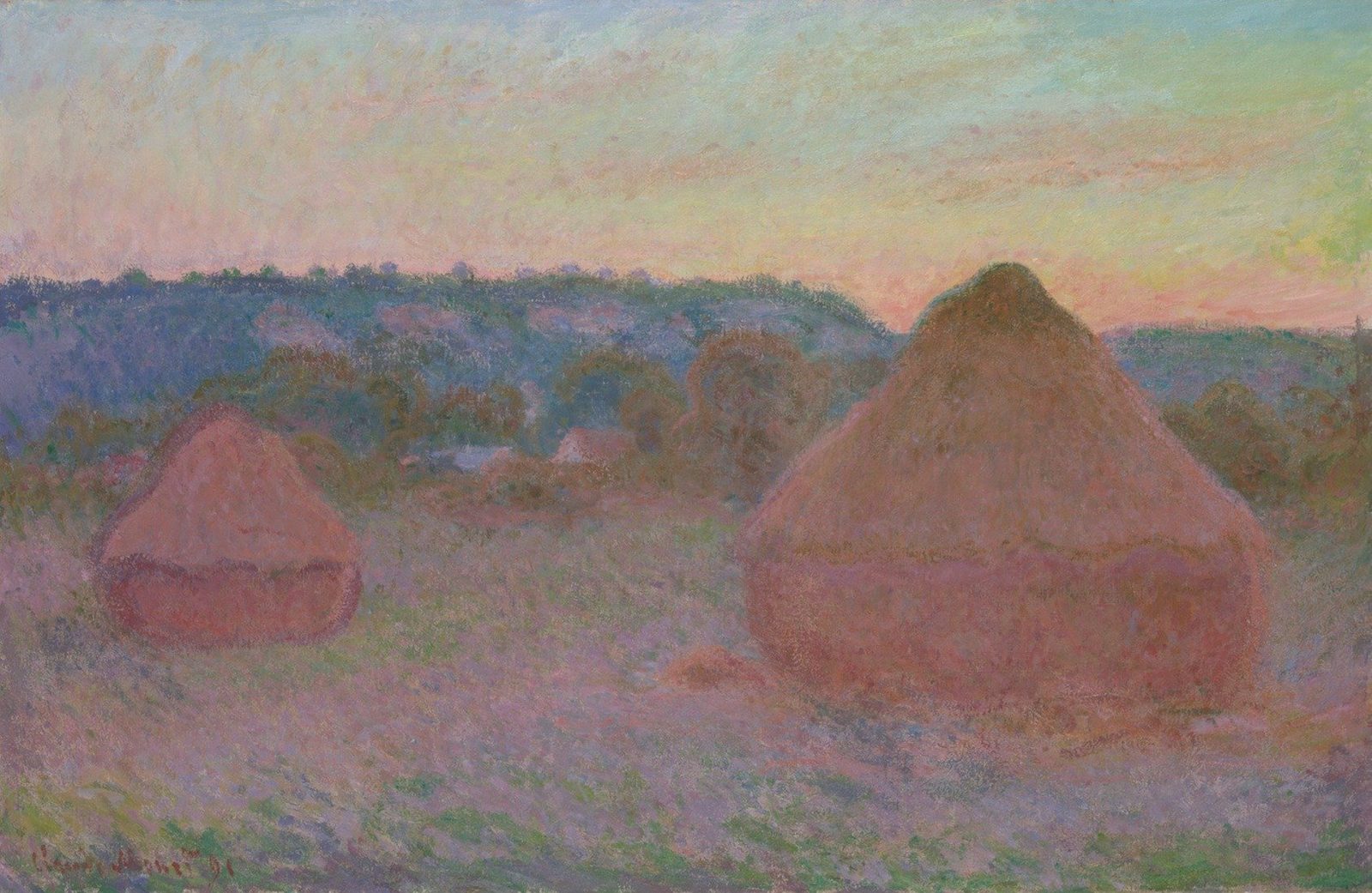
Look at this field at the very end of day: a glowing conical stack dominates the right, smaller cones step back toward the left, and a soft pink sky hangs over a low treeline. One motif, repeated, but every stack sits in its own temperature of light.
Monet, autumn 1890–91
This is Claude Monet's Stacks of Wheat, painted in oil on canvas between 1890 and 1891, the same autumn campaign that produced his celebrated Haystacks series. The point of these paintings was never the wheat itself, but the falling light turning ordinary forms into a study of color.
Triangular mass, stepped diagonal
Notice the geometry: a strong triangular mass on the right, its apex high in the frame, is balanced by a stepped diagonal of smaller cones receding to the left, all set against a horizontal treeline about a third of the way down. The eye naturally slides down the lit flank of the big stack, across the cones, and back along the pink ground.
Raking low-right sunlight
The light comes from the right, raking across the scene as late sun. It is soft and high-key, felt more as colored atmosphere than as sharp modeling. The warmest, lightest pinks sit on the right stack's sunlit face; the deepest values cluster in the shadowed left cones and the distant treeline.
Warmest cream and peach dabs
Move into the upper-right shoulder of the big stack. Here the brightest cream, peach, and warm rose dabs are clustered where the raking sun actually grazes. They sit on top of deeper salmon and mauve, and to the right the cool blue-violet passages define the receding background, so the boundary between lit stack and cool air is a vibrating alternation, never a hard line.
Form without a drawn outline
Pull back to the whole right stack. It is built from short, dab-like strokes of pink, salmon, magenta, orange, and violet, with cooler olive dabs at the apex and along the left rim. There is no drawn contour; the silhouette is created entirely by juxtaposing warmer strokes against the cool trees and pale sky behind. A saturated magenta band runs across the lower third as the cylinder's lit belly.
Shadows built from violet, not black
Now slide to the shadow side of the same stack. Cutting through the warm pinks and corals are passages of deep violet, plum, and a cooler blue-violet concentrated along the left flank. The shadows are not mixed with black or brown; they are complementary-cool violets placed next to warm light strokes, so the eye reads both warmth and chill simultaneously.
Leftmost cone: the same motif, cooler
Drift left to the smallest stack. It shares the same pear-shaped silhouette and the same warm pink-orange family, but the whole cone is markedly cooler and more muted than the right stack. The lit upper-right corner still glows rose-magenta, but the surrounding field and the stack's lower belly shift toward dusty plum and cool sage, because distance and the angle of the raking sun have wrapped it in complementary light.
Dabbing strokes, no blending
Drop down to the foreground ground. It is not painted as a smooth field; it is built from short, dabbing strokes laid side by side, pinks and magentas in the upper zone, olives and sages in the lower, with small cobalt and periwinkle dabs scattered through both. Edges are crisp at the stroke scale and soften only at viewing distance. Notice the warm pink and a greenish dab sitting next to each other without being blended, vibrating as complements.
Sky: cool blue-violet to warm peach
Rise into the sky. The upper portion carries a cool, slightly desaturated blue-green with mauve flecks, the middle band warms to a dusty rose-lavender, and it resolves into a saturated peach-yellow just above the dark silhouettes below. No hard horizon line is drawn; the warm band simply butts against the dark mass, and the transition happens in the eye.
Horizon edge: warm into cool, no line
Finally, settle on the seam where the wooded ridge meets the sky. Vertical feathery strokes of warm peach, apricot, and cream intermix directly with cool blue-greens, dusty violets, and slate blues across a transition band of about a third of the crop. The edge is implied by a color-temperature shift and by overlapping vertical strokes running perpendicular to the horizon, not by a drawn line.
Look closer
7 details, each checked against a close-up of the picture.
-
Dominant Right Haystack
The right haystack is composed of layered pink, orange, and purple brushstrokes without a black outline.
The crop is filled almost edge-to-edge by a single conical haystack built from short, dab-like strokes that read as pink, salmon, magenta, orange, and violet, with cooler greenish-olive dabs at the apex and along the left rim. There is no drawn contour line; the silhouette is created entirely by juxtaposing warmer strokes against the cool blue-green trees and pale sky behind it. A dense, more saturated magenta band runs across the lower third, functioning as a value/temperature accent that suggests the cylinder's belly in raking light, while the upper flanks lift toward yellow-pink where the late sun catches them.
-
Right Stack Highlight
The brightest highlights on the stack are warm pinks and creams concentrated on the upper right flank.
The crop shows the upper-right flank of a conical haystack catching raking late-afternoon light. Short, broken dabs of cream, peach, and warm rose sit on top of deeper salmon and mauve strokes, with the brightest cream notes clustered along the upper right ridge. To the right, cooler blue-violet passages define receding shadowed forms and a distant horizon, while a soft band of pink-cream sky carries the warm palette upward. Edges between the lit stack and the cool background are soft and flickering, built from alternating warm and cool dabs rather than a single contour line. The texture is uniformly granular, indicating consistent small-touch application across light and shadow zones.
-
Shadow Side of Right Stack
The left side of the large stack contains deep purples and cool blues in its shadows.
The crop reveals a densely worked passage of broken, scumbled brushstrokes dominated by warm pinks, corals, and brick-oranges, indicating the sunlit face of the large stack. Cutting through these warm notes are distinct passages of deep violet, plum, and a cooler bluish-purple concentrated in the upper-left quadrant and along a curving band descending through the middle. The transitions between warm and cool are achieved through adjacent, lightly overlapping strokes rather than blended edges, with the cool notes functioning as reflected and ambient shadow. The paint is applied in short, dabbed, multi-directional marks that do not align with any single contour, producing an overall granular, vibrating surface.
-
Foreground Texture
The ground consists of distinct, dabbing strokes of green, pink, and blue.
The surface is built from short, dabbing strokes laid side by side without blending into a smooth field. The upper two-thirds are dominated by pinks, magentas and lavenders in roughly oval/tick-shaped marks; the lower third introduces greens (olive, moss, and a bluer sage) sitting alongside the rose tones rather than beneath them. Small blue accents—cobalt and a softer periwinkle—appear as isolated dabs scattered through both zones, never forming a continuous line. Edges between colors are crisp at stroke scale but visually soften at viewing distance, and there is no drawn contour around any shape; the texture reads as mass only through accumulated juxtaposition. A warmer red-orange patch in the upper right reads as the highest-chroma note and sits adjacent to its complement (a greenish stroke) for vibration.
-
Leftmost Haystack
The smaller left stack is rendered in cooler, more muted tones than the dominant right stack.
A single pear-shaped conical stack fills the centre, with the brightest warm pink-magenta mass concentrated on the upper right (lit side) and a deeper rose-violet tone on the lower left shadow belly. The form is built from short, broken dabs of pink, salmon, rose, and plum laid side by side, with no hard contour; the edge dissolves into a field of cool teal, sage, lavender, and muted blue-green strokes. A few small orange-pink flecks sit on the crown, and the base reads as a darker plum-pink rather than a true shadow, indicating the form is shaped almost entirely by warm/cool contrast rather than value contrast. The surrounding field is markedly cooler and more desaturated than the stack itself.
-
Sky Gradient
The sky transitions from a pale blue-violet at the top to a warm yellow-pink near the horizon.
The crop shows a band of sky executed in small, broken, dry-looking strokes that sit side by side rather than blending smoothly. The upper portion carries a cool, slightly desaturated blue-green (with faint mauve flecks scattered through it), while the middle band warms into a dusty rose-lavender, then resolves into a saturated peach-yellow just above the silhouettes at the bottom edge. Edges between hues are kept soft and irregular—adjacent strokes of contrasting chroma (cool green against warm pink) sit next to each other, so the eye mixes the transition. A hint of greenish-grey treetops and the dark dome of a haystack intrude only as a thin strip at the lower margin, reading as the deepest value in the field.
-
Horizon Blend
The edge between the distant treeline and the sky is soft and blurred, with colors bleeding into each other.
The crop isolates the upper boundary where a low wooded ridge meets the sky. No hard contour exists between them; instead, vertical feathery strokes of warm peach, pale apricot, and cream (top third) are intermixed directly with cool blue-greens, dusty violets, and slate blues (middle band). The transition zone is roughly the upper-middle third of the crop, where you can see pink and orange flecks riding over green, and thin blue-green strokes nudging up into the warm zone. Short, broken, mostly upright dashes — each only a few millimetres tall — give the edge a vibrating, soft quality rather than a silhouette.
Stacks of Wheat (End of Day, Autumn) in context
A title settled in 1995
The Art Institute's title for this canvas is a modern one. Its catalogue explains that the name came out of research for the museum's 1995 Monet exhibition and from consulting several Monet scholars [3]. But in Monet's lifetime the picture went by another name. Durand-Ruel's New York stock books list it in September 1891 and again in April and November 1892 as 'Meules, fin de l'été', stacks at the end of summer [3]. The dealer's Paris records use the same words for its first sale [1].
That was also an early title of the canvas now called Stacks of Wheat (End of Summer), which hangs in the same museum [3]. The museum dates it 1890-91, a range that includes the inscribed date of 1891 and allows for a start in 1890 [3].
Tops above the hills
The museum points out that in this view, as in nearly all the autumn pictures in the series, the conical tops of the stacks break the horizon and push into the sky [1]. But in most of the winter views, which it calls the core of the series, the stacks instead seem wrapped by bands of hill and field, as if bedded down for the season [1].
The catalogue also sorts the Stacks into four canvas sizes [3]. This one is on a standard no. 40 marine canvas of about 65 by 100 centimetres [2]. Seven Stacks use that format. Six of them show two stacks, though their placement varies from picture to picture [3].
More than one sitting
The linen came ready primed with a single off-white ground of lead white and chalk, and infrared examination found no underdrawing [2]. Beneath the final sky lie quick, undulating zigzag strokes. The catalogue also finds this kind of brushwork in two other Chicago Stacks and in Sandvika, Norway of 1895 [3]. Here Monet later quietened them with flatter horizontal bands of colour [2]. Where the horizon and the top of the big stack were extended over the sky, the sky paint was already dry. This suggests that some time passed between the first campaign and the changes [2].
The red signature picked up wet pale pink and bluish-purple paint. So those strokes may have been among the last touches before Monet signed [2]. The catalogue contrasts this densely built surface, where the ground is mostly hidden, with the more open handling of Stacks of Wheat (End of Summer) [3].
Palmer, Van Horne, Palmer again
Monet sold the painting to Durand-Ruel in Paris on 2 July 1891 for 3,200 francs [1][2]. According to the dealer's books, its New York branch sold it the same day to the Chicago collector Potter Palmer for $1,200, although the Durand-Ruel Archives told the museum there is a discrepancy in their records of this sale that they cannot explain [1]. By 7 March 1892 it was back in New York stock and was sold to Palmer again, for $1,500 [1]. Palmer returned it by 19 April 1892, when Durand-Ruel sold it to Sir William Van Horne of Montreal for $1,250 [1]. By 22 November 1892 the dealer had it once more and sold it to Palmer for $1,200 [1].
The record is then silent until about 1932, when the New York dealer Howard Young had it [1]. It passed to Annie Swan Coburn of Chicago. She began collecting after her husband's death in 1910 and hung her pictures in an apartment at the Blackstone Hotel [1][4]. The canvas was shown in the Art Institute's exhibition of her collection, which opened in April 1932. She died that May, and the painting came to the museum by her bequest in 1933 [1][4].
Frame and surface
The museum says the gilt Louis XVI Revival frame, French and of the late nineteenth or early twentieth century, appears to be original to the painting [2]. The canvas was wax-resin lined in 1974. In 1993 that lining and the varnish layers added with it were removed, and the picture was left unvarnished, with a soft matte surface [2].
- Claude Monet, Stacks of Wheat (End of Day, Autumn) (1933.444): collection record with description, provenance and exhibition history (public API) . Art Institute of Chicago
- 'Cat. 28, Stacks of Wheat (End of Day, Autumn), 1890/91': technical report, frame and provenance, in Monet Paintings and Drawings at the Art Institute of Chicago (public API) . Art Institute of Chicago
- 'Cats. 27 to 33, Stacks of Wheat, 1890/91': catalogue essay and notes, in Monet Paintings and Drawings at the Art Institute of Chicago (public API) . Art Institute of Chicago
- 'Mrs. Lewis Larned (Annie Swan) Coburn', collector entry in Monet Paintings and Drawings at the Art Institute of Chicago (public API) . Art Institute of Chicago