Stacks that break the horizon
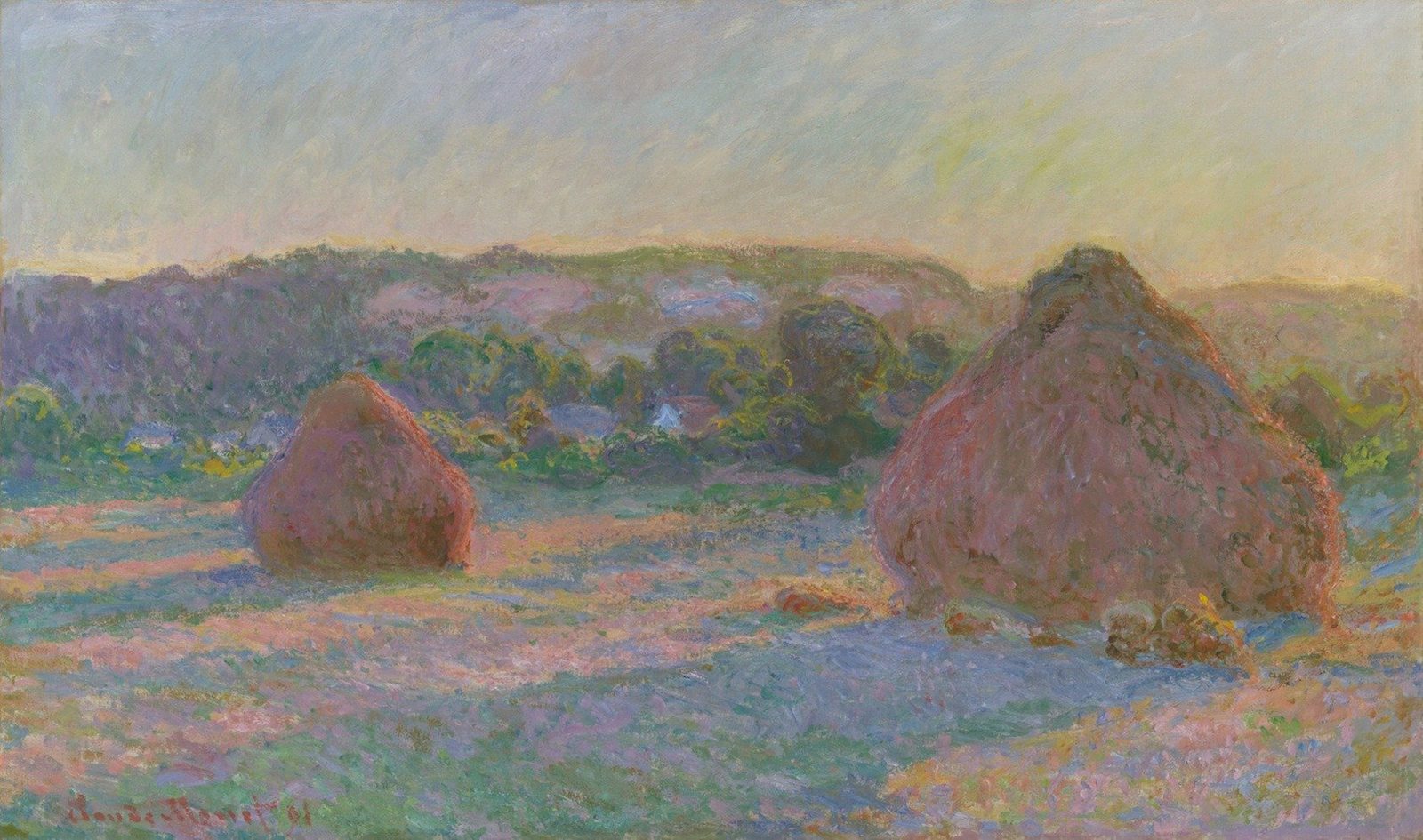
Monet paints two wheat stacks in late summer light, from the series he made outside his house at Giverny
- Artist
- Claude Monet
- Title
- Stacks of Wheat (End of Summer)
- Date
- 1890–91
- Medium
- Oil on canvas
- Museum
- Art Institute of Chicago
- Image
- Public domain (CC0)
Open in Simple Art
Watch this story on iPhone and iPad, with offline downloads and a painting every day.
About 4 minutes of looking, in 9 parts.
Stacks of Wheat (End of Summer)
Two great stacks of wheat stand in a stubble field, one near, one further off. Behind them lies a band of trees and hills, and above that a pale, hazy sky. Look at the tops of the stacks. The larger one pushes up past the hills and into the sky.
Claude Monet, 1890 to 1891, oil on canvas
This is Claude Monet's Stacks of Wheat, End of Summer, painted in oil on canvas in 1890 to 1891. The stacks stood just outside his farmhouse at Giverny. He worked on the series in the field, at several easels at once, and in the studio. In May 1891 he hung fifteen of these canvases side by side in one small room in Paris.
Two unequal masses
The hills sit about a third of the way down. The two stacks are unequal, the big one on the right and a smaller one left of centre, with open field between. The museum notes that in the autumn views, as here, the stacks break the horizon; in winter they seem wrapped in bands of hill and field.
A shadow made of colour
Come close to the big stack's right shoulder. The light seems low, catching it in coral and salmon. As the form turns away, those strokes give way to lavender, mulberry and slate blue. The shadow here is made of colour, not of black.
A cone of curving strokes
Now the stack as a whole. It looks built from short, curving strokes that sweep down and around the cone, following its shape. Orange and brick red sit beside violet and blue, with little flecks of red, olive and pink scattered across it. Even its edge against the sky is simply one colour meeting another.
Sky, stacks and field
Step back and follow the colour from top to bottom. The sky is palest at the top and warms towards yellow above the hills on the right. The field below is cooler, full of blues and violets with pink running through. The stacks sit in between, the densest, ruddiest shapes in the picture.
A field of short strokes
Look down into the field. It's a weave of short, mostly horizontal strokes, blue, violet, pink, peach and green, set close together and not blended. In the small gaps between them, a lighter ground seems to show through. From a distance, they merge into stubble catching the light.
Hills melting into haze
Lift your eyes to the hills and trees behind. Muted purples, lavenders and sage greens melt into the hazy sky with no firm line between them, and a few ochre flecks catch the tops. Because the contrast is so low, this band seems to sit far back, behind the stacks.
Signed in the field's colours
In the lower left corner, the canvas is signed and dated Claude Monet 91. The reddish strokes almost blend into the pinks and greens of the field around them.
Look closer
5 details, each checked against a close-up of the picture.
-
Right Haystack Mass
The form of the haystack is composed of overlapping curves of orange, red, and violet without a dark outline.
The crop isolates the right conical haystack, a mass built entirely from short, curving, overlapping brushstrokes that sweep downward along the form. No dark contour line separates the stack from the sky or field; instead, the upper edge is read by juxtaposing warm peach/coral dabs against the pale cream sky, and the right edge by the cool violet-blue strokes meeting the greener field tones. Within the mass, orange and brick-red strokes cluster on the upper-left shoulder where the context indicates low raking light falls, while violet, mauve, and slate-blue strokes dominate the right flank and lower belly, describing shadow through temperature rather than darkness. Small punctuating flecks of saturated red, olive-green, and pink sit scattered across the surface, animating it without resolving into local detail.
-
Foreground Field Texture
The ground is made of short, horizontal, broken strokes of blue, pink, and green.
The crop is a dense field of short, broken brushstrokes layered across the surface with no resolved local shapes. Most strokes run roughly horizontally, though many tilt slightly diagonal, tracing a gentle undulation rather than a flat line. Cool blues and violets sit directly beside warm pinks and pale peach, with greens concentrated in the lower band, and the strokes' edges remain soft rather than crisp. Where strokes do not cover, the slightly lighter ground shows through as small interstices, so the reading is entirely a mosaic of color, not of form.
-
Atmospheric Horizon Line
The distant trees are rendered in muted purples and greens that blend into the hazy sky.
The crop captures a band where warm peach and pale yellow sky tones in the top edge meet a dense, broken zone of muted violet, dusty lavender, and sage hues representing the distant tree line. Edges between sky and foliage are not drawn but rather implied through juxtaposed dabs of pinkish-cream and cool purple that optically soften against one another. Short, comma-shaped and diagonal strokes cluster densely in the mid-band, creating texture without resolving individual leaves; warmer ochre flecks scatter across the top third, suggesting raking light catching the upper canopy. Values stay compressed overall, with the darkest passages concentrated in the lower-left and lower-right corners, while the highest chroma (warm peach and pale pink) sits in a soft cloud-like patch near the upper center.
-
Right Stack Shadow Edge
The right edge of the large stack is defined by a transition to deep violet and blue rather than a black line.
The crop isolates the right shoulder of a large haystack, where a dense field of coral and salmon strokes (left half) rolls into a shadowed mass built from lavender, mulberry, and slate blue dabs. Rather than a hard contour, the right boundary dissolves through successive strokes of violet and ultramarine that interleave with cooler greens, ochres, and a few bright yellow-orange flecks. Patches of bare or thinly scumbled ground peek between strokes, especially in the upper right, allowing warm underpainting to vibrate against the cool darks. The edge is defined purely by temperature shift (warm peach into cool violet-blue) rather than by an outline, and the strokes follow the curving, down-sloping mass of the stack.
-
Artist Signature
The inscription 'Claude Monet 91' is written in reddish strokes in the lower left corner.
The crop is dominated by vertical, smeared streaks of pigment that read almost like a motion-blurred exposure. Soft greens, coral pinks, dusty mauves, pale blues and creamy whites alternate in irregular vertical bands, with no crisp edges anywhere. In the lower-left quadrant the marks gather slightly darker, warmer reddish-maroon dashes over a faintly cooler ground, but no letterforms are legible to me. The whole field reads as a single sweeping, dragged passage rather than discrete strokes.
Stacks of Wheat (End of Summer) in context
A field next to the house
In November 1890 Monet bought the house at Giverny that he had rented since 1883, and in the same year he began the Stacks of Wheat [2]. The catalogue counts about twenty-five canvases in the series proper, six of them now in Chicago, probably painted between late August or early September 1890 and February 1891 [2]. The stacks stood in a field next to his property and rose fifteen to twenty feet [1][2].
On 7 October 1890 he wrote to Gustave Geffroy that the sun set so fast he could not keep up, and that he wanted to render 'instantaneity' and above all the enveloppe, the same light spread over everything [2]. He had called groups of pictures 'series' before, for example the Gare Saint-Lazare views of 1877, but the catalogue sees these as the start of a new working method: one motif, painted again and again under changing conditions, partly outdoors and partly in the studio [2].
Wheat, not hay
Robert Herbert argued that these are not haystacks but grain stacks, built carefully from tied sheaves and thatched against rain, so that what Monet painted was the stored wealth of the farm's owners [2]. Paul Tucker linked the motif to the patriotism and nostalgia attached to images of fertile French countryside in the later nineteenth century [2]. The Art Institute describes the stack as a symbol of sustenance and survival for Monet [1].
Fifteen in one small room
In May 1891 Monet showed fifteen Stacks side by side in one small room at the Galerie Durand-Ruel in Paris [1][2]. This canvas was number 1 in the catalogue, as 'Meules. (Fin de l'été.)', already listed as belonging to Durand-Ruel [1]. In his preface Geffroy called the grouping of fifteen canvases of one subject a victorious artistic demonstration, and the Dutch critic Willem Byvanck wrote that each picture gained its full value by comparison with the others [2].
No photographs of the room survive, so it is not known whether the canvases were hung by season, by size or in some other order [2]. Two of Monet's 1886 figure paintings of a woman with a parasol were reportedly hung above the row, with four field pictures from 1890 and one Creuse landscape elsewhere in the room [2]. The museum calls the show an unprecedented critical and financial success [1].
Not a clock
Geffroy's preface and Monet's precise titles encouraged the idea that the series charts the sun's passage hour by hour, but the catalogue argues against reading it as a chronometer [2]. Technical study of the six Chicago Stacks shows changes over several sessions [2]. In this canvas Monet adjusted the shapes and sizes of the stacks and the horizon, and enlarged the big stack at right by extending its top and sides over the landscape [2][3].
The catalogue does find patterns in canvas size [2]. Five Stacks are on a non-standard format of about 60 by 100 centimetres, and four of those, this one among them, show two separate stacks of different sizes [1][2]. The thread pattern of this canvas matches seven other Monets in Chicago, which suggests they were cut from the same bolt of linen [3]. The orange-red signature at lower left was added when the paint below was dry, and some of the taller letters have been smudged to the left [3]. The museum dates the picture 1890/91 to allow for a start in 1890, although it is inscribed 91 [2].
Boston, then Chicago
Durand-Ruel bought the painting from Monet on 9 May 1891 for 3,000 francs [1]. On 26 June it was sold for 5,000 francs to Charles Fairchild of Boston, who on 4 August returned it in exchange for another Monet, On the Cliff at Pourville of 1882, now in the Nationalmuseum, Stockholm [1]. The same day Durand-Ruel sold it to Potter Palmer of Chicago for 6,000 francs [1].
Mrs Potter Palmer lent it to a Monet exhibition at the Copley Society in Boston in 1905 [1]. It passed by descent to Pauline Palmer Wood and her husband Arthur M. Wood, who gave it to the Art Institute in fractional shares from 1985, with the last share received in 2007 [1]. The museum holds the largest group of Monet's Stacks of Wheat anywhere [1].
- Claude Monet, Stacks of Wheat (End of Summer) (1985.1103): collection record with description, provenance and exhibition history (public API) . Art Institute of Chicago
- Jill Shaw, 'Cats. 27 to 33, Stacks of Wheat, 1890/91', in Monet Paintings and Drawings at the Art Institute of Chicago (public API) . Art Institute of Chicago
- 'Cat. 27, Stacks of Wheat (End of Summer), 1890/91': technical report, in Monet Paintings and Drawings at the Art Institute of Chicago (public API) . Art Institute of Chicago