Cézanne's Standing Bather — A Walkthrough
How Cézanne builds volume without a single drawn line
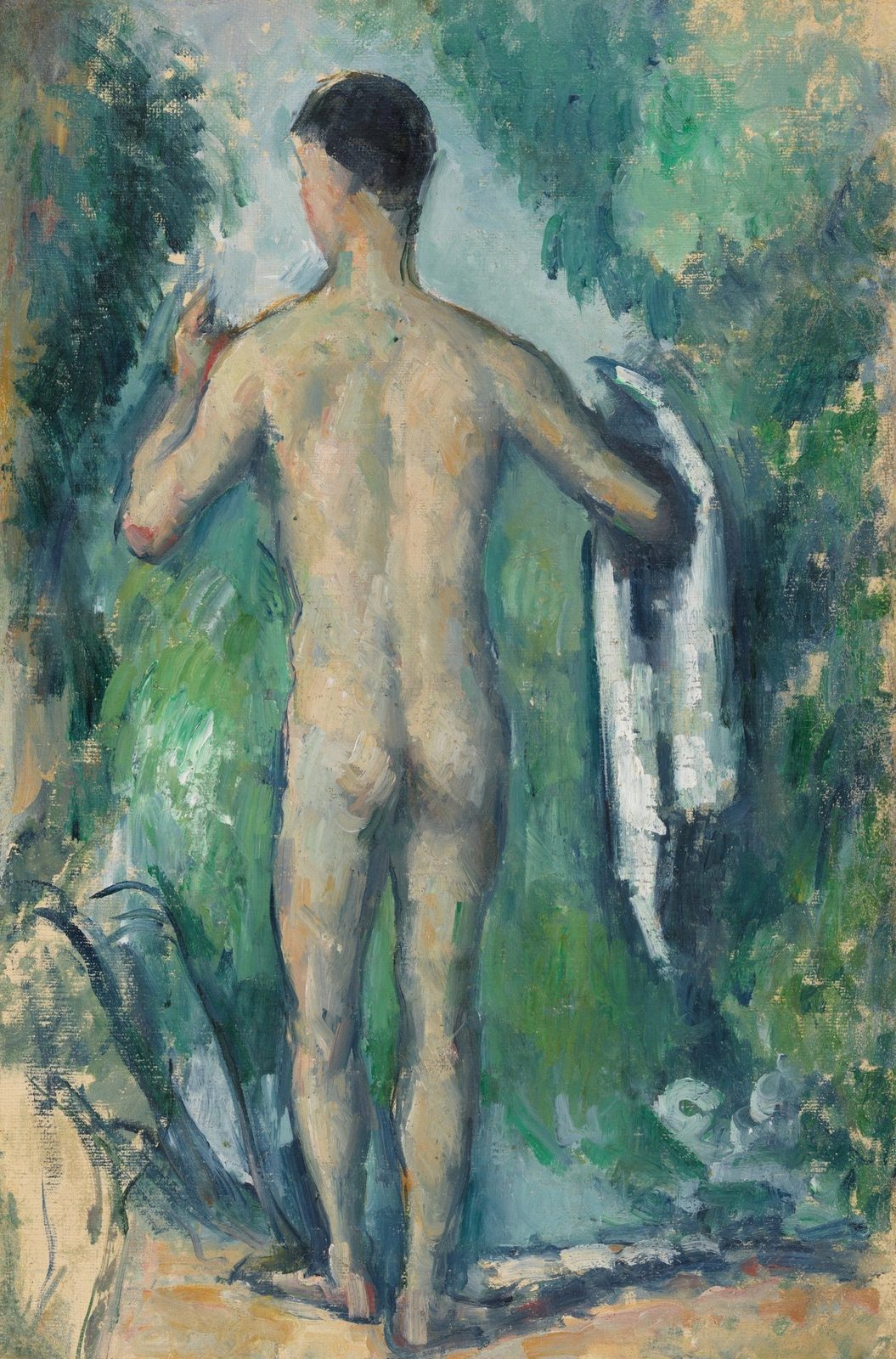
- Artist
- Paul Cezanne
- Title
- Standing Bather, Seen from the Back
- Date
- 1879-82
- Medium
- Oil on canvas
- Museum
- Art Institute of Chicago
- Image
- Public domain (CC0)
Open in Simple Art
Watch this story on iPhone and iPad, with offline downloads and a painting every day.
About 5 minutes of looking, in 11 parts.
A figure turned from us
A nude figure stands with her back to us, anchored at the center of a green wood, while a pale cascade of water breaks the right side of the canvas. The composition is almost devotional in its stillness. We are looking at Cézanne's Standing Bather, Seen from the Back.
Cézanne's bather, 1879-82
This is an oil on canvas by Paul Cézanne, painted between 1879 and 1882, and it belongs to the long series of bathers that occupied him for decades. Although the file tags this figure as male, the proportions of the waist, hips, and gluteal curve read clearly as female. Trust the canvas — the bather is a woman.
A triptych of verticals
Step back and read the structure. A single plumb line runs down the figure's spine, with a dark tree trunk at the far left and a pale waterfall at the right acting as bookends. Together they form a quiet triptych of three vertical accents, and the eye drops from the dark head down the bright back, pauses at the curve of the hips, then drifts right to the cascade before returning to the feet.
Light from the upper left
Light comes in from the upper left, warming the full expanse of the back while casting the right side of the body into cooler shadow. It is diffuse and ambient, the kind of soft daylight that would filter through a forest canopy, and it is enough to set up a quiet dialogue between warm cream and cool blue-grey across every plane of the figure.
The head, no outline
Start at the head. The hair is the darkest note in the painting, dense with navy and near-black, yet there is no drawn line where the hair meets the nape. Dark strokes simply buttress warm peach strokes, and the edge is read entirely by value contrast. The lit left side of the neck is warm pink; the right side cools into lavender.
Three patches, one shoulder
Drop to the upper back. This is the heart of Cézanne's constructive stroke. The shoulder is not modeled — it is built, out of distinct patches of ochre, pale pink, and a cool blue-grey, laid side by side and unblended. Three temperatures, three values, and the volume emerges entirely in the eye. Watch how the warmest patch sits on the upper left, exactly where the light lands.
The turning of a back
Continue down the spine to the lower back. Here the turn of the body becomes a quiet battle between two temperature families. Cream and ochre strokes on the left, blue-grey and slate on the right, interlocking without any blending at all. It is the optical mixture of these neighbors that makes the plane turn away from us.
Cool wedge, warm swell
Pause at the gluteal curve. Cézanne does not draw a line around it. He places pale cream highlights on the outer flanks and, between them, leaves a channel of cool blue-green that deepens into teal. That cool wedge reads as recession; the warm patches around it read as outward swell. Curvature emerges from temperature alone.
Edge of two languages
Drift right to the right arm, where it meets the cascade. Again, no contour line. The arm is dense and cool, the cascade broken and warm-vertical. Where the two stroke languages collide, you read both an arm and falling water in a single glance — the edge exists only as the meeting of two color directions.
A looser ground
Drop to the feet and the ground. Here the handling loosens. The shins are two pale vertical forms, but the earth is a horizontal scumble — broken ochre dragged over cool blue-green, with a thin arc of dark grey curving beneath the right foot. Even the ground is built, not described, and a small touch of brick red at the lower left ankle quietly echoes the warm side of the body above.
One structural logic
Pull back to take in the whole canvas. Notice that the foliage and the body are made of the same parallel, patchy strokes, the same temperature contrasts. For Cézanne, the figure does not stand in front of the forest — the figure is the forest, constructed by the same hand and the same logic. Cool greens frame warm flesh exactly the way cool shadow frames warm highlight on the body.
Look closer
6 details, each checked against a close-up of the picture.
-
Upper Back and Shoulders
The form of the shoulder is built from distinct patches of ochre, pale pink, and blue-gray.
The crop frames the broad upper back of a nude figure seen from behind, with both shoulders sloping outward and the base of the neck visible at the top center. The form is constructed from adjacent, unblended patches of color: warm ochre and pale pink concentrate on the left shoulder and upper back where light strikes, while the right shoulder and right-side back recede into blue-gray and cool green-gray shadow. Edges of the figure are defined by color juxtaposition against surrounding foliage greens rather than by drawn contours, and a small streak of reddish-orange at the upper left edge marks a transition into background. Brushwork is visibly parallel and faceted, with short strokes laid side by side so the surface reads as a mosaic of small planes.
-
Right Arm and Hanging Cloth
The edge of the arm is defined by the juxtaposition of skin tones against the white of the draped cloth.
The crop isolates the boundary between the figure's right arm and the pale cloth draped over it. The arm is built from a dense core of deep blue-black and cool grey strokes, with a thin warm ochre highlight running along its upper crest. At the right of the arm, a roughly vertical edge is formed where the dark cool strokes butt directly against broken white and cream verticals of the hanging cloth. Below the arm, the cloth descends in long, vertical, parallel dabs of white, pale grey and faint blue, with small gaps of canvas-dark letting the cloth feel fragmentary rather than solid.
-
Head and Hair
The dark hair is rendered with dense, dark blue and black strokes that lack sharp outlines.
The crop isolates the back of a dark-haired head tilted slightly to the viewer's right, set against a mottled green-blue background. The hair is built from layered, overlapping strokes of deep navy, near-black, and a little olive where it catches light; no contour line separates the hair mass from the nape—instead, the boundary is implied by the meeting of dark hair strokes against warm peach and cream skin strokes. The lit left side of the neck and shoulder reads as warm pinks and ochres, while the right side cools into blue-greys and lavenders. Across both figure and ground, the marks are short, parallel, and slightly diagonal, and the canvas weave shows through the thinner passages of paint.
-
Gluteal Highlight
Pale cream highlights are placed adjacent to cool blue-green shadows to create curvature.
The crop isolates the lower torso and gluteal region of a figure painted with short, parallel, patchy strokes. Pale cream and warm ivory patches occupy the upper left and right flanks, where the most direct light falls. A cool blue-green band runs vertically down the center between the two rounded forms, deepening into teal and grey-green in the deepest pocket. Warm ochre and muted yellow strokes bridge the transition between the lit outer edges and the cooler recessed channel. The edges between highlight and shadow are not hard outlines but are made by adjacent color patches of contrasting temperature, with no continuous contour drawn.
-
Lower Back Shadow
The right side of the lower back contains cooler, blue-tinted grey tones compared to the left.
The crop captures the lower back/hip region where the figure's torso turns into the buttocks. Left of center reads as warm cream, ochre and pale peach in short, slightly diagonal strokes. Right of center the same mass is built from cooler blue-grey, slate and muted lavender-grey strokes laid in vertical and slightly curving patches. The transition between warm and cool is a broken, irregular zone where the two temperature families interlock stroke-against-stroke rather than blending. A band of teal/turquoise on the far right reads as background foliage, set against a darker vertical shadow at the lower edge.
-
Lower Legs and Feet
The feet and ground are rendered with loose, horizontal scumbled strokes of ochre and blue.
The crop shows the lower legs descending into roughly modeled feet, with two pale ochre-cream vertical forms (the ankles/shins) flanked and underpinned by a horizontal band of ground. Cool teal and blue-green shadow passages sit between the legs and pool beneath the right foot, while a thin arc of dark blue-grey curves around the right foot's base. Touches of dull red/brick appear at the lower left ankle and between the feet. Ground strokes are clearly horizontal and scumbled, layering cream-ochre over cooler blues, with broken, soft edges where leg meets earth.
Standing Bather, Seen from the Back in context
Swimming in the Arc
Paul Smith's entry in the Art Institute's 2026 catalogue explains Cezanne's long attachment to this figure partly through autobiography, since for him swimming carried personal meaning [2]. If Émile Zola's novel L'œuvre of 1886 can be trusted, Cezanne, Zola and their friend Jean-Baptiste Baille could all swim by about the age of twelve, in the river Arc near Aix [2]. Letters between the two friends in 1858 recall a swimming hole at Palette and a pine leaning over the river, and a letter of June 1859 ends with Cezanne's sketch of the three of them bathing [2]. Later in life, in a light-hearted questionnaire, Cezanne named swimming as his favourite recreation [2].
A pose with a long ancestry
Smith proposes that the figure was modelled on a demon carrying a dead soul in a drawing by Luca Signorelli, a study for the Last Judgement in Orvieto, which Cezanne copied in the Louvre [2]. The raised left arm and the cloth hanging from it, he suggests, come from a Roman statue in the Louvre then known as Germanicus, copied in reverse [2]. Germanicus was remembered both for his victories and for his early death at thirty-three, and Smith reads the bather as a quiet memento mori, though he presents this as a suggestion rather than a documented intention [2].
Smith also traces a mock-heroic strand. Zola recalled their swimming parties and a lost play about a character called Pitot, whose deeds Cezanne meant to model on those of Hercules [2]. Smith suggests these tales, along with Provençal legends of Hercules fighting giants near Aix, may lie behind the monumental figures of Bathers at Rest [2].
A study for a group
The catalogue identifies the same man, second from the left, in three paintings of five male bathers made between the mid-1870s and the early 1880s [2]. His pose is closest to the one in Five Bathers of 1880 to 1882, now in a private collection, which shares the blue zigzag at the hip and the red at the elbow [2]. In the earlier Five Bathers of 1876 to 1877 the figure wears bathing trunks, as do the men in Bathers at Rest, probably the bather picture Cezanne showed at the Third Impressionist Exhibition in 1877 [2]. Reviewing that show, the critic Georges Rivière compared Cezanne to a Greek of the Golden Age [2].
Vollard, Guillaume and the McCormicks
The dealer Ambroise Vollard owned the painting by 1931, and it later belonged to the Paris dealer Paul Guillaume and then to his widow, Domenica [1][2]. In January 1936 she sold it to Chauncey and Marion Deering McCormick of Chicago, and it passed to their son, Brooks McCormick, who bequeathed it to the Art Institute in 2007 [1][2]. Its first recorded exhibition was a Cezanne centenary show at the Marie Harriman Gallery in New York in 1939, where it was called Baigneur debout [1]. It was later shown in Becoming Edvard Munch at the Art Institute in 2009 and in Cezanne Drawing at the Museum of Modern Art in 2021 [1].
In 2021 and 2022 the conservator Kim Muir removed a synthetic varnish and a later campaign of retouching, and the painting is now shown unvarnished [2]. The catalogue cannot say whether the canvas was cut down after it was painted or was a scrap Cezanne reused [2].
- Paul Cezanne, Standing Bather, Seen from the Back, 2007.289: object record, provenance and exhibition history . Art Institute of Chicago (public API)
- Cat. 3, Standing Bather, Seen from the Back, 1879-82: entry by Paul Smith, technical report by Kim Muir with Giovanni Verri, in Cezanne Paintings and Watercolors at the Art Institute of Chicago (2026) . Art Institute of Chicago